
Views: 252 Author: GB FREIGHT Publish Time: 2026-09-03 Origin: Site


Content Menu
>> Seller Responsibilities Under DDP Shipping
>> Seller Responsibilities Under DAP Shipping
>> Buyer Responsibilities Under DAP Shipping
● DDP Shipping vs DAP Shipping: Main Differences
● Who Pays Import Duty, VAT, and Customs Charges?
>> DDP Shipping Cost Structure
>> DAP Shipping Cost Structure
>> How to Compare Total Landed Cost
● When Should B2B Buyers Choose DDP Shipping?
>> DDP May Be a Good Option When
>> DDP May Require Extra Review When
● When Should B2B Buyers Choose DAP Shipping?
>> DAP May Be a Good Option When
>> DAP Requires Operational Preparation
● The Importer of Record: Why It Matters
>> Questions to Ask Before Booking DDP Shipping
● Practical Example: DDP vs DAP for a Warehouse Delivery
● How to Prevent DDP and DAP Shipping Delays
>> 1. State the Exact Delivery Term and Address
>> 2. Provide Accurate Product Information
>> 3. Confirm Cargo Restrictions Early
>> 4. Confirm Warehouse Delivery Conditions
● DDP and DAP Decision Checklist
● Summary
>> What is the main difference between DDP and DAP shipping?
>> Does DAP shipping include delivery to a warehouse?
>> Does DDP shipping include duty and tax?
>> Which shipping method is better for first-time importers?
>> Can DDP shipping be used for sea freight from China?
When importing goods from China, choosing between DDP shipping and DAP shipping can significantly affect your total cost, customs responsibilities, delivery timeline, and supply-chain control.
Both options can provide door-to-door delivery from a Chinese supplier to your warehouse, factory, office, fulfillment center, or project site. However, they are not the same service. The core difference is simple: DDP shipping places import clearance, duties, and taxes on the seller, while DAP shipping places these destination import responsibilities on the buyer.
For B2B buyers, this decision should never be based on freight price alone. The better option depends on your company's import experience, customs registration, product category, tax arrangement, internal compliance capability, and desired level of cost certainty.
GB FREIGHT AGENCY CO., LTD. provides transportation solutions for businesses shipping goods from China to Europe, North America, South America, Southeast Asia, the Middle East, Africa, and Oceania. With 15 years of international logistics experience, we coordinate supplier bookings, export customs clearance, international transportation, and final delivery based on each customer's cargo requirements and destination market.
This guide compares DDP and DAP shipping in detail and helps B2B buyers select a more suitable delivery term for their imports from China.
> Important note: Delivery terms define the allocation of transportation costs, risk, and customs responsibilities between the seller and buyer. They do not replace a detailed purchase agreement, product compliance review, insurance arrangement, or local legal advice.
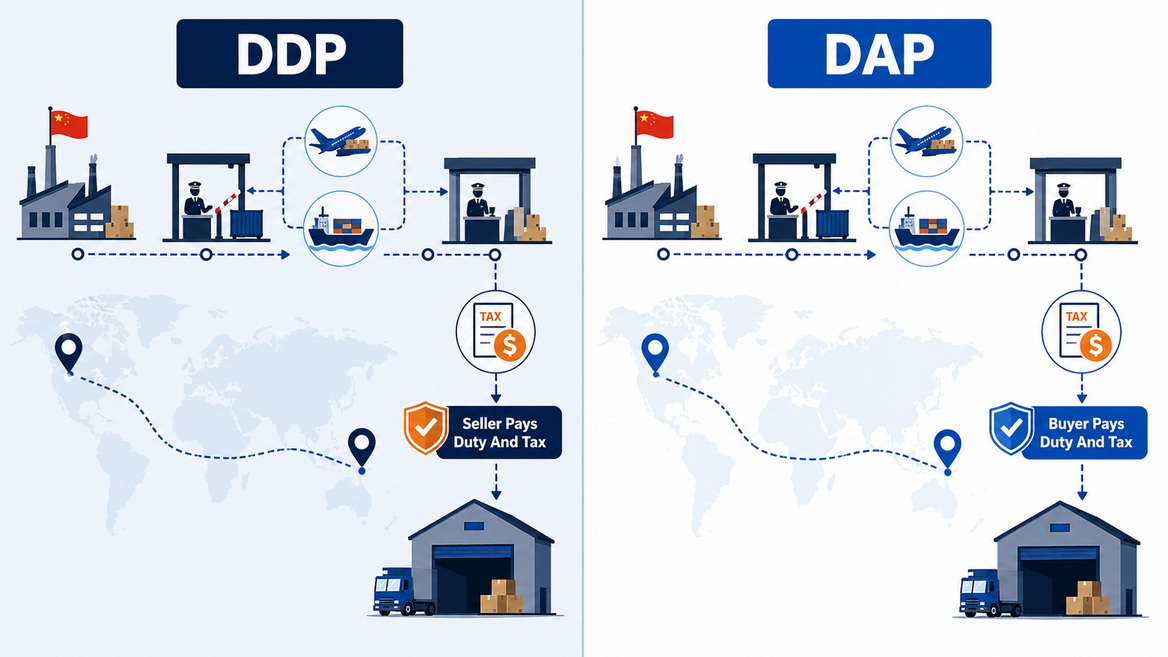
DDP shipping means Delivered Duty Paid. Under this arrangement, the seller is responsible for delivering goods to the named destination after completing export procedures, arranging transportation, managing destination customs clearance, and paying applicable import duties and taxes.
In simple terms, DDP provides a more complete delivered solution for the buyer.
The seller or its appointed logistics provider manages the shipment from China through the destination-country customs process and delivers the cargo to the agreed address. The buyer normally receives the goods without needing to arrange routine customs clearance or make a separate duty and tax payment before delivery.

Under a typical DDP arrangement, the seller is responsible for:
- Coordinating cargo pickup or booking with the Chinese supplier
- Preparing export shipping documents
- Completing export customs clearance in China
- Arranging international air, sea, rail, truck, courier, or multimodal freight
- Managing destination customs clearance
- Paying import duty and applicable import taxes
- Coordinating final-mile delivery
- Bearing transportation risk until the goods reach the named destination, ready for unloading
The buyer is generally responsible for:
- Providing accurate company and delivery information
- Confirming product details and destination requirements
- Receiving the goods at the agreed location
- Unloading the shipment unless unloading is specifically included in the agreement
Many buyers choose DDP because it creates a more straightforward import experience. Instead of coordinating several parties—supplier, freight forwarder, customs broker, port agent, tax authority, and local carrier—the buyer works with one logistics provider for the full shipment journey.
DDP is particularly useful when the buyer wants greater visibility over total delivered cost before confirming an order.
For example, a U.S. distributor sourcing customized packaging equipment from China may prefer DDP delivery to its warehouse. The distributor can receive a single delivered quotation that includes transportation, customs handling, duty, tax arrangements, and final delivery.
This reduces the number of operational tasks for the buyer's purchasing team.
DAP shipping means Delivered at Place. Under DAP, the seller arranges transportation and bears the transportation risk until the goods arrive at the named destination, ready for unloading.
However, the buyer is responsible for import customs clearance, import duty, VAT, GST, customs brokerage charges, and other destination-side import costs.
DAP can still be a door-to-door shipping method. For example, goods can be transported from a supplier in Shenzhen, Ningbo, Shanghai, Guangzhou, Qingdao, or another Chinese city directly to a buyer's warehouse overseas.
The important distinction is that the buyer handles the import stage.
Under a standard DAP arrangement, the seller is usually responsible for:
- Supplier booking coordination in China
- Cargo pickup or delivery to the export terminal
- Export documentation
- Export customs declaration
- International transportation
- Destination inland transport
- Delivery to the agreed warehouse, factory, office, or project site
- Transportation risk until the cargo arrives at the named delivery location
Under DAP, the buyer is typically responsible for:
- Acting as the importer of record, where required
- Appointing a customs broker or clearing agent
- Submitting customs clearance information
- Paying import duty
- Paying import VAT, GST, or other relevant taxes
- Providing permits, registrations, licenses, or certificates if required
- Managing customs inspections or additional document requests
- Unloading goods at the delivery point unless otherwise agreed
For experienced importers, DAP can provide more direct control over customs declarations, tariff classification, duty payment, product valuation, and import documentation.
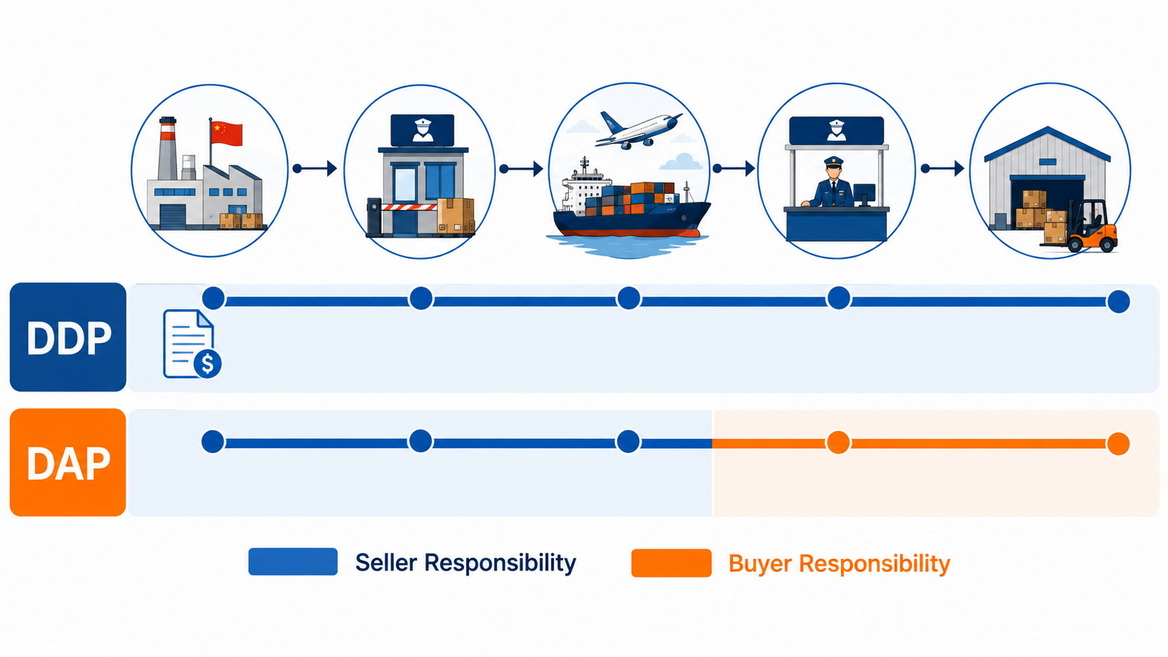
The following comparison shows how the two shipping methods differ for B2B buyers importing from China.
| Shipping Factor | DDP Shipping | DAP Shipping |
|---|---|---|
| Full delivery term | Delivered Duty Paid | Delivered at Place |
| Export customs clearance | Seller | Seller |
| International freight | Seller | Seller |
| Delivery to named destination | Seller | Seller |
| Import customs clearance | Seller | Buyer |
| Import duty | Seller | Buyer |
| Import VAT or GST | Seller | Buyer |
| Customs broker coordination | Seller or logistics provider | Buyer or buyer’s broker |
| Importer-of-record responsibility | Depends on the legal import arrangement | Usually buyer |
| Risk before delivery | Seller | Seller |
| Unloading at final destination | Usually buyer | Usually buyer |
| Cost certainty for buyer | Generally higher | Depends on actual duty, tax, and customs charges |
| Customs process control | Lower for buyer | Higher for buyer |
| Best suited to | New or occasional importers | Experienced and established importers |
The primary difference is not whether cargo can be delivered to the buyer's door. Both DDP and DAP can support door-to-door delivery.
The key question is: Who takes responsibility for import customs clearance and destination charges?
Under DDP shipping, the seller pays import duty, import tax, and the cost of import customs clearance.
Under DAP shipping, the buyer pays import duty, import tax, customs brokerage fees, and other destination-side clearance charges.
This may appear simple, but B2B buyers should always compare the complete landed cost rather than only comparing freight quotations.
A DDP quotation may include:
- Supplier pickup or origin delivery
- Export documentation and customs clearance
- Air freight, sea freight, rail freight, road freight, or courier transportation
- Origin terminal charges
- Destination handling fees
- Customs clearance service
- Import duty
- Import VAT, GST, or similar taxes
- Final-mile delivery
- Logistics coordination fees
The strongest advantage is cost predictability. If the shipment details are accurate and the terms are clearly defined, the buyer can estimate the delivered cost before goods leave China.
However, buyers should always confirm exactly what is included. A professional DDP quotation should identify the destination address, cargo description, shipment size, service scope, and any exclusions.
A DAP quotation often covers transportation from China to the named delivery place but excludes import-related charges.
The buyer may need to budget separately for:
- Customs broker service fees
- Import duty
- Import VAT or GST
- Customs declaration processing charges
- Terminal handling fees
- Customs inspection costs
- Storage charges if clearance is delayed
- Demurrage or detention charges for sea freight
- Product testing, licensing, or certification costs
- Additional inland delivery fees if the agreed delivery location changes
DAP may offer a lower freight quotation at the beginning. However, the actual final cost can be higher if the buyer does not accurately calculate the destination-side expenses.
A practical way to compare DDP and DAP is to calculate the complete landed cost:
Total Landed Cost=Product Cost+Freight+Insurance+Import Duty+Import Tax+Customs Fees+Destination Charges+Final Delivery
For DDP shipments, many of these costs are included in the delivered quotation.
For DAP shipments, the buyer should estimate and add each destination-side cost before making a purchasing decision.
DDP shipping is often suitable for buyers that want a simplified import process and a clearer delivered-cost model.
- You are importing from China for the first time
- You do not have an internal import compliance department
- You do not have a local customs broker
- You want transportation and destination delivery managed by one provider
- You are importing samples, replacement parts, promotional goods, consumer products, or moderate-volume commercial cargo
- You want to reduce the administrative workload on your purchasing team
- You need a delivered cost estimate before you approve the purchase order
- Your shipment is urgent and you want to reduce customs coordination delays
A business importing furniture accessories, machine spare parts, retail displays, textile products, packaging materials, or general merchandise may benefit from a professionally arranged DDP service.
DDP is not automatically the best solution for every import.
Buyers should conduct a more detailed review when:
- The cargo has a high declared value
- The goods are regulated or require special permits
- The product involves food, medical, chemical, electrical, battery, or safety requirements
- The buyer must use its own tax registration or customs account
- The buyer has strong internal customs and compliance capabilities
- The buyer needs direct visibility over import entry documents
- The buyer is importing full containers regularly
- The destination market has strict importer-of-record rules
DDP can simplify logistics, but it does not remove the need for accurate product information, lawful customs declarations, correct tariff classification, compliant documentation, and destination-market product compliance.
DAP shipping is usually more suitable for companies with established importing experience and local customs resources.
- You have a registered importing entity in the destination country
- You already work with a trusted customs broker
- You want to use your own importer-of-record account
- You want to control duty and tax payments directly
- You need access to customs entry records
- You have import VAT or GST management procedures
- You import from China regularly
- Your products require detailed compliance management
- You need to manage HS codes, customs value, product origin, and broker instructions internally
For example, a European machinery distributor importing industrial components from China every month may choose DAP because it already has an established customs broker, tax registration, EORI arrangement, and internal compliance process.
The company may prefer to control all customs declarations rather than rely on a seller-managed import arrangement.
Before using DAP shipping, the buyer should make sure the following information is ready:
- Full legal company name
- Tax registration number
- Importer-of-record details
- Customs broker contact information
- Product descriptions
- Commercial invoice
- Packing list
- HS codes, if available
- Country-of-origin details
- Import licenses or permits, if needed
- Product certificates and test reports
- Warehouse delivery appointment requirements
- Contact person for customs clearance questions
Delays often occur when customs paperwork is incomplete, the buyer cannot be contacted, product values are unclear, or required certifications are missing.
The importer of record is generally the party responsible for ensuring that imported goods are properly declared and comply with destination-country customs regulations.
This responsibility may include:
- Accurate product descriptions
- Correct tariff classification
- Correct customs value declaration
- Country-of-origin reporting
- Duty and tax payment
- Record keeping
- Product compliance documentation
- Permit and licensing requirements
- Response to customs inquiries or inspections
For B2B buyers, the importer-of-record position should be clarified before cargo is shipped.
A freight forwarder can coordinate transportation, book shipping space, prepare documents, arrange delivery, and work with customs brokers. However, the freight forwarder is not automatically the legal importer of record.
Before accepting a DDP quotation, buyers should request clear written answers to the following questions:
1. Who will be responsible for import customs clearance?
2. Who will be listed as the importer of record?
3. Which destination charges are included in the quotation?
4. Are import duty and import tax included?
5. What product information is required before booking?
6. Which HS code or tariff classification is being used?
7. How will the customs value be declared?
8. Are customs inspections, storage charges, or additional duties included or excluded?
9. Does the cargo require product certificates, labels, test reports, or permits?
10. Is final delivery included to the exact warehouse address?
Clear communication before shipment is far less expensive than solving a customs issue after cargo has arrived.
Imagine that a U.S. wholesaler buys 300 cartons of customized home organization products from a supplier in China.
The supplier is located in Ningbo, and the buyer wants delivery to a warehouse in Los Angeles.
The freight forwarder coordinates supplier pickup, export customs clearance, ocean freight, destination customs clearance, duty and tax handling, port release, and truck delivery to the buyer's warehouse.
The buyer receives a delivered quotation and does not need to coordinate routine customs clearance for the shipment.
This can be an efficient solution if the buyer is new to importing or wants to minimize administrative work.
The freight forwarder handles transportation from Ningbo to the buyer's Los Angeles warehouse. However, the buyer must arrange customs clearance, pay duty and taxes, provide importer details, work with a customs broker, and ensure the cargo is released before delivery.
This can be a better option if the buyer already has an import structure and wants direct control over customs documents and local tax payments.
The freight journey may appear similar under both options. The business process behind the shipment is very different.
Most shipping delays are caused by unclear responsibilities, incomplete documents, inaccurate cargo data, or late customs communication.
B2B buyers can reduce risk by following a structured preparation process.
Do not use vague descriptions such as "DDP USA" or "DAP Europe."
Use a complete delivery instruction that includes the delivery term, precise address, and current rules version.
Examples:
- DDP Buyer Warehouse, 850 Example Avenue, Chicago, Illinois, USA, Incoterms® 2020
- DAP Buyer Distribution Center, Rotterdam, Netherlands, Incoterms® 2020
A clear named place helps define the delivery point and reduce misunderstandings about final-mile transport.
The commercial invoice and packing list should accurately state:
- Product name
- Quantity
- Unit value
- Total value
- Net weight
- Gross weight
- Carton dimensions
- Material or product composition
- Country of origin
- Intended use where relevant
Avoid using descriptions that are too broad, such as "parts," "accessories," "samples," or "gift." Specific product descriptions support more accurate customs processing.
Some products require additional planning, including:
- Lithium batteries
- Cosmetics
- Food-contact materials
- Medical products
- Chemicals
- Wireless devices
- Children's products
- Electrical goods
- Machinery
- Branded goods
- Wooden packaging materials
Early review can help identify potential permits, testing, labeling, packaging, safety, or declaration requirements.
A shipment can clear customs successfully but still face final-mile delivery problems.
Before booking, confirm:
- Warehouse opening hours
- Delivery appointment requirements
- Liftgate requirements
- Forklift availability
- Pallet restrictions
- Truck access limitations
- Residential or commercial delivery status
- Contact person and phone number
- Storage capacity at the destination
These details are especially important for LCL sea freight, oversized cargo, palletized shipments, and time-sensitive commercial deliveries.

Choose DDP shipping when your business values:
- A clearer all-in delivery cost
- Simplified import coordination
- Fewer customs-related tasks
- Door-to-door transportation managed by one provider
- Support for occasional, first-time, or less-complex imports
- A lower administrative burden for internal purchasing teams
Choose DAP shipping when your business values:
- Direct control over import customs clearance
- Use of your own importer-of-record structure
- Control over duty, VAT, GST, and broker payments
- Access to local customs documents
- Stronger oversight of tariff classification and import valuation
- Scalability for frequent or highly regulated imports
The correct choice depends on the shipment—not only the destination country.
A company may use DDP for samples, urgent spare parts, or first-time imports, while using DAP for regular container shipments and strategic long-term purchasing programs.
DDP and DAP are both useful delivery methods for B2B buyers sourcing goods from China.
DDP shipping provides a more complete delivery arrangement. The seller manages export procedures, transportation, import customs clearance, duties, taxes, and delivery to the named destination. It is often attractive for buyers that want a simpler process and more predictable delivered cost.
DAP shipping gives buyers more control over the import process. The seller transports goods to the agreed destination, while the buyer manages import customs clearance, duty, tax, and destination-side compliance responsibilities. It is often more suitable for experienced importers with an established customs and tax structure.
The most reliable decision comes from comparing total landed cost, import readiness, product compliance requirements, customs responsibilities, and delivery expectations before the goods leave China.
GB FREIGHT AGENCY CO., LTD. supports businesses with customized freight solutions from China, including supplier booking coordination, export customs clearance, international transport, customs-related coordination, and final-mile delivery planning across major global markets.
For a smoother import experience, provide complete cargo information early and confirm whether DDP or DAP better matches your company's operating model, customs capability, and delivery requirements.
The main difference is import responsibility. Under DDP, the seller handles import customs clearance and pays import duty and taxes. Under DAP, the buyer handles import customs clearance and pays import duty, VAT, GST, and related destination charges.
Yes. DAP can include delivery to a warehouse, factory, office, distribution center, or project site. However, the buyer is normally responsible for customs clearance, import duty, taxes, and unloading unless the agreement states otherwise.
Yes. Under a properly arranged DDP shipment, the seller is responsible for paying applicable import duties, taxes, and customs clearance costs before delivery to the buyer.
DDP is often easier for first-time importers because the seller or logistics provider manages more of the transportation and customs process. Buyers should still verify the shipping scope, product compliance requirements, importer arrangement, and included charges before booking.
Yes. DDP shipping can be used for sea freight, air freight, rail freight, truck freight, courier shipments, and multimodal transportation. The available service structure depends on cargo type, route, destination market, shipment value, and import requirements.
1. [Kuehne+Nagel — Incoterms® 2020 International Trade Regulations]
2. [Gebrüder Weiss — Incoterms® 2020 Guide]
3. [U.S. Customs and Border Protection — Tips for New Importers and Exporters]
4. [Business.gov.nl — Using Incoterms® Transport Conditions]
5. [Export Development Canada — Incoterms® 2020 Group D Rules Explained]
6. [Dimerco — What Are U.S. Importer of Record Responsibilities?]


