
Views: 251 Author: GB FREIGHT Publish Time: 2026-09-04 Origin: Site


Content Menu
● What Is Door-to-Door Delivery From China?
● Why End-to-End Freight Coordination Matters
>> Common Challenges in International Shipping
● The Door-to-Door Shipping Process From China
>> 1. Supplier Booking and Cargo Readiness Confirmation
>> 2. Cargo Pickup and Consolidation
>> 3. Export Documentation and Customs Procedures
>> 4. International Freight Transportation
>> 5. Shipment Tracking and Status Updates
● Understanding Destination Handling and Final Delivery
● How to Compare Door-to-Door Freight Quotes
>> Quote Scope
>> Transit Time
● Lower Freight Cost Does Not Always Mean Lower Landed Cost
● A Practical Checklist Before Shipping From China
>> Shipment Information Checklist
>> Questions to Ask Before Booking
● Why Businesses Choose GB FREIGHT
● Summary
● Discuss Your Shipment With GB FREIGHT
>> What is door-to-door shipping from China?
>> Is door-to-door delivery the same as DDP shipping?
>> Which is better: air freight or sea freight from China?
>> Can cargo from different Chinese suppliers be combined into one shipment?
>> What information is needed for a freight quote from China?
Moving cargo from China to overseas markets involves far more than booking space on a vessel or aircraft. A successful shipment depends on supplier coordination, accurate documentation, export procedures, route planning, international transport, destination handling, customs coordination, and final delivery.
For importers, distributors, retailers, e-commerce sellers, and project-based businesses, door-to-door deliveryfrom China provides a more coordinated way to manage these stages. Instead of arranging separate providers for pickup, export customs, international freight, destination clearance, and local trucking, businesses can work with one freight-forwarding partner to manage the shipment flow from origin to final destination.
GB FREIGHT AGENCY CO., LTD. has 15 years of international logistics experience and provides door-to-door freight solutions for businesses shipping from China to Europe, North America, South America, Southeast Asia, the Middle East, Africa, and Oceania. From booking coordination with suppliers to export customs clearance, international transportation, destination handling, and final delivery, we help customers move cargo efficiently, transparently, and cost-effectively.

Door-to-door delivery from China is an international freight service that manages cargo movement from a supplier, factory, warehouse, or consolidation point in China to the consignee's designated address in another country.
The final destination may be:
- A company warehouse
- A distribution center
- A retail store
- A fulfillment center
- A project site
- A business office
- A residential address, subject to service availability
- A third-party logistics warehouse
The scope of door-to-door shipping varies by route, cargo type, commercial terms, and destination requirements. In most cases, it can include cargo pickup, supplier coordination, consolidation, export declaration, international transportation, customs support, inland delivery, and proof of delivery.
The main benefit is not simply convenience. It is coordination. International freight includes many operational handovers, and every handover can create delays, information gaps, extra charges, or misunderstandings. A door-to-door freight solution brings these activities into a more structured transport workflow.
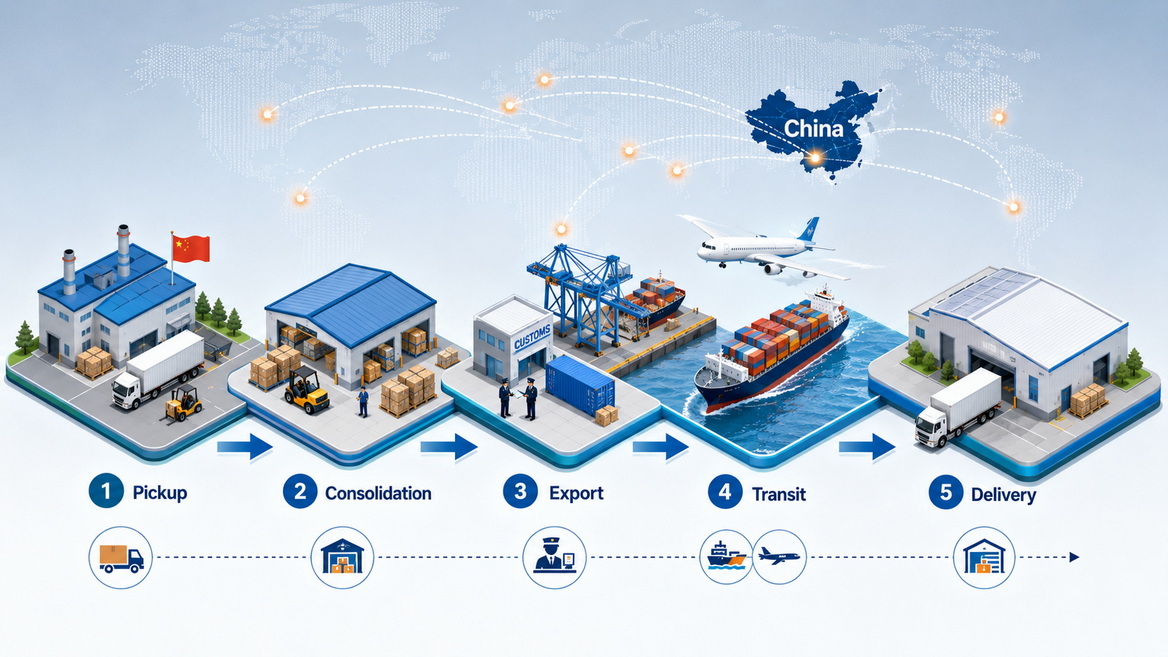
Global shipping is affected by many moving parts. Cargo may pass through factories, warehouses, ports, airports, customs offices, transshipment hubs, destination terminals, and local delivery networks before it reaches the final consignee.
When each stage is handled by a different company without clear coordination, the shipment becomes harder to control. The buyer may not know whether the cargo is ready, whether export documents are complete, whether the vessel departed as planned, or whether final delivery has been booked.
A coordinated freight-forwarding process helps reduce these information gaps.
Businesses shipping goods from China often face the following issues:
- Suppliers miss cargo-ready dates
- Carton counts or package dimensions change after booking
- Incorrect invoices or packing lists delay customs procedures
- Cargo arrives too late for a vessel or flight cut-off
- Freight rates change because of capacity shortages or routing changes
- Port congestion extends transit time
- Destination charges are not clearly explained before shipment
- Import customs requirements are discovered too late
- Final delivery appointments are not arranged in time
- Buyers receive limited or unclear shipment updates
A strong door-to-door delivery solution addresses these risks early. The freight forwarder should not only arrange transport but also help organize information before cargo starts moving.
A well-planned shipment follows a clear sequence. While the exact process varies by destination and shipping method, the core stages are similar for most international freight movements.
The first stage begins with supplier coordination. Before cargo can be picked up or delivered to a warehouse, the freight team needs accurate shipment details.
Important information includes:
- Supplier address and contact person
- Cargo-ready date
- Product description
- Number of cartons, pallets, crates, or packages
- Package dimensions
- Gross weight
- Cargo value
- Packaging condition
- Battery, liquid, magnetic, oversized, fragile, or dangerous-goods status
- Required shipping documents
- Delivery deadline at the destination
Supplier coordination is especially important when a buyer purchases goods from several factories. Each supplier may have a different production schedule, packaging standard, delivery location, and export document process.
Early communication helps avoid missed collection dates, incomplete paperwork, and unexpected changes in shipment volume.
After cargo readiness is confirmed, the shipment may be collected from the supplier's factory or warehouse. Depending on the shipment plan, cargo can be moved directly to a port or airport, delivered to a consolidation warehouse, or transported to a rail terminal.
Consolidation is useful for buyers sourcing from multiple Chinese suppliers. Instead of shipping several small consignments separately, compatible goods can be gathered into one combined shipment.
This approach may help businesses:
- Reduce repeated origin handling charges
- Simplify document coordination
- Improve shipment visibility
- Avoid sending multiple low-volume shipments separately
- Create a more efficient container-loading plan
- Coordinate one international delivery process for several suppliers
However, consolidation should be planned carefully. If one supplier is delayed, the entire combined shipment may need to wait. The best solution depends on cargo urgency, supplier reliability, inventory requirements, and the buyer's preferred balance between cost and speed.
Documentation is one of the most important parts of international logistics. Even when cargo is physically ready, incorrect or inconsistent paperwork can delay export customs clearance or create problems at the destination.
Common shipping documents may include:
- Commercial invoice
- Packing list
- Bill of lading
- Air waybill
- Export declaration information
- Certificate of origin
- Insurance certificate
- Product testing reports or certifications
- Licenses or permits for regulated products
- Dangerous-goods declarations, where applicable
Every document should match the actual shipment. Product descriptions, quantity, weight, value, consignee information, and packaging details need to be accurate and consistent.
Importers should also understand that destination customs rules vary by country and product category. Product labeling, tariff classification, declared value, safety standards, licensing requirements, and tax obligations may differ from one market to another.
Preparing documents early reduces the risk of storage charges, inspections, delays, or delivery disruptions.
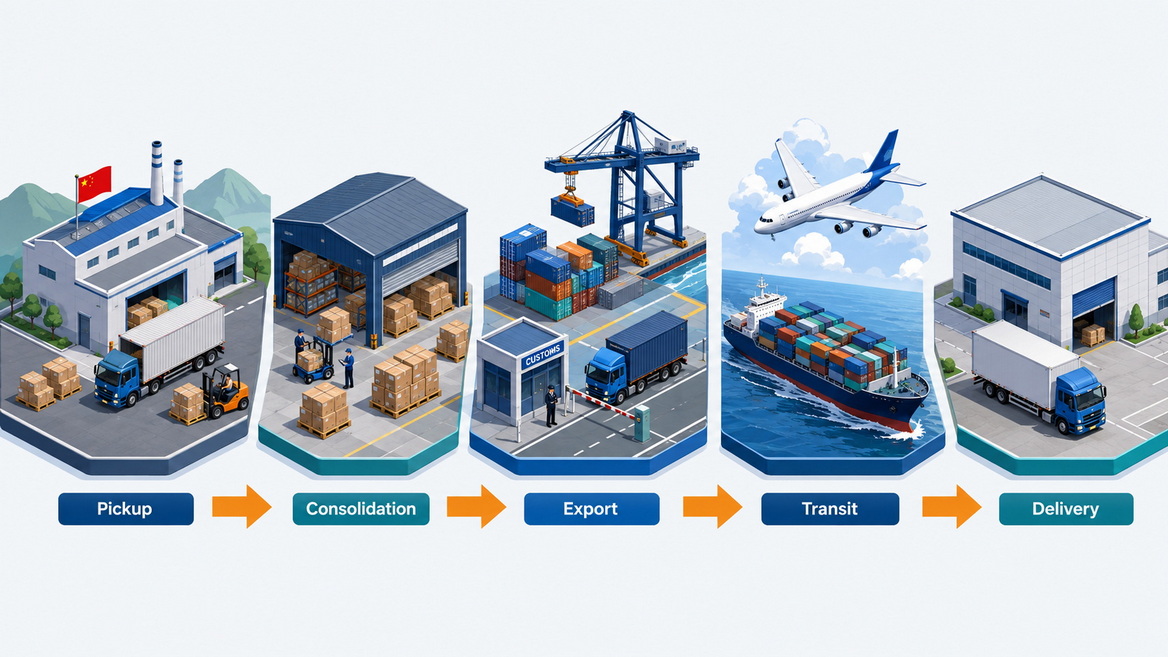
The right shipping method depends on the cargo, destination, budget, and delivery timeline. There is no single best option for every business.
| Transport Method | Best For | Main Benefit | Main Consideration |
|---|---|---|---|
| Ocean FCL | Large shipments that fill most or all of a container | Cost-effective for high-volume cargo | Longer transit time |
| Ocean LCL | Smaller shipments that do not fill a container | Shared-container pricing | More handling and possible consolidation time |
| Air Freight | Urgent, high-value, lightweight, or time-sensitive goods | Faster international transit | Higher freight cost |
| Rail Freight | Selected China-to-Europe routes | Balance between ocean and air transit times | Available only for suitable destinations and cargo |
| Express Courier | Samples, documents, small parcels, and urgent packages | Fast network-based delivery | Less economical for large or heavy cargo |
| Multimodal Freight | Complex routes and diverse delivery needs | Flexible combination of transport modes | Requires careful coordination |
Ocean freight is widely used for furniture, machinery, building materials, consumer goods, industrial products, and high-volume shipments. It is often the preferred option when cost control is the main priority.
Air freight is commonly selected for urgent inventory replenishment, electronics, samples, fashion items, medical equipment, high-value goods, and product-launch shipments. It can reduce transit time significantly but usually requires a larger freight budget.
Rail freight can be a practical alternative for some China-to-Europe cargo movements, particularly when businesses need faster transit than ocean shipping but cannot justify the cost of air freight.
Express courier services are suitable for smaller shipments that require speed and simplified delivery. They are often used for product samples, documents, replacement parts, prototypes, and urgent small parcels.
Shipment visibility helps importers plan more effectively. A useful tracking process should provide meaningful milestones rather than only a single estimated arrival date.
Key shipment milestones may include:
1. Cargo pickup completed
2. Cargo received at warehouse, port, airport, or terminal
3. Export customs clearance completed
4. Vessel, flight, or train departure
5. Transshipment or intermediate routing update
6. Arrival at destination port, airport, or terminal
7. Import customs processing status
8. Local delivery scheduling
9. Final delivery completed
10. Proof of delivery issued
These updates are valuable for several departments within a business.
Procurement teams can monitor supplier performance. Warehouse teams can prepare receiving capacity. Sales teams can provide realistic delivery information to customers. Finance teams can reconcile freight charges. Inventory managers can adjust replenishment planning when delays occur.
The goal is not to eliminate every delay. Global logistics can be affected by weather, customs inspections, port congestion, carrier schedule changes, capacity shortages, and local delivery constraints. The goal is to identify issues early enough to make better decisions.
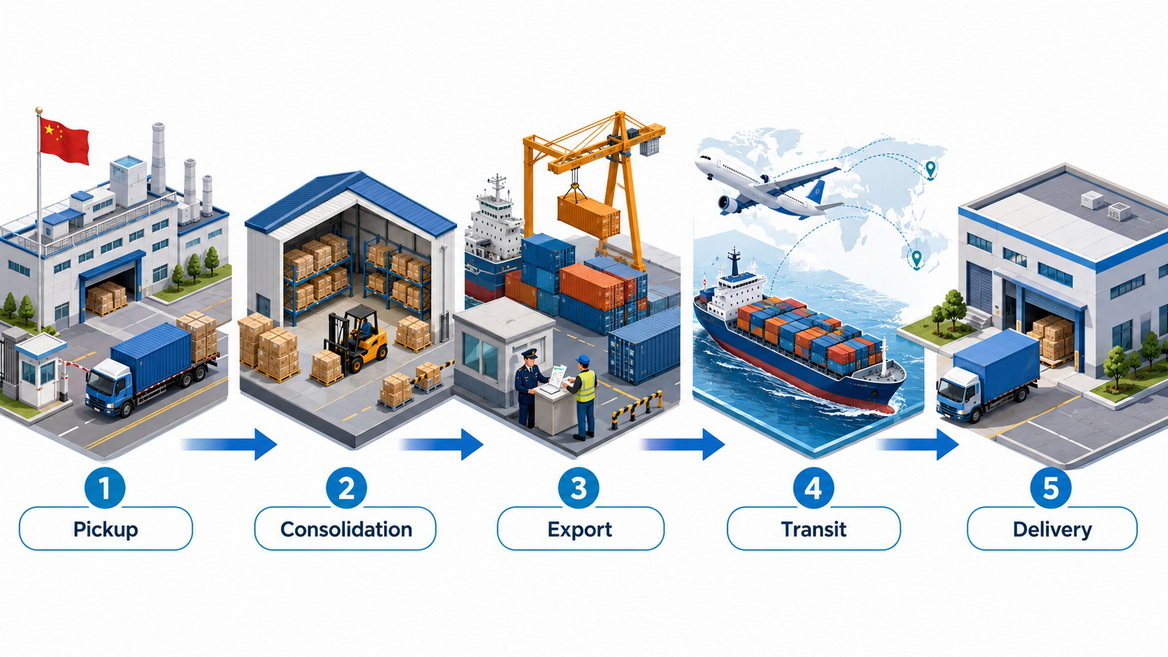
The final stage of a shipment can be more complex than many importers expect. When cargo arrives at the destination port or airport, it may need to go through terminal handling, customs procedures, cargo release, deconsolidation, appointment booking, local trucking, and unloading.
Door-to-door delivery may include different service levels depending on the destination and quotation terms.
Before confirming a shipment, businesses should clarify:
- Whether import customs clearance is included
- Whether import duty and tax are included or excluded
- Who will act as the importer of record
- Whether destination terminal charges are included
- Whether local delivery is to a warehouse, business address, or residential address
- Whether delivery requires an appointment
- Whether unloading is included
- Whether a liftgate, pallet jack, or special vehicle is required
- Whether remote-area charges may apply
- Whether storage, detention, demurrage, or customs inspection charges are excluded
Clear communication before departure is essential. A low freight quote may not represent the true landed cost if it excludes critical destination services.
Comparing freight quotations is not only about selecting the lowest number. Businesses should compare the scope, route, timing, exclusions, and service quality behind each price.
A reliable comparison should include the following areas.
Confirm whether the quotation includes:
- Pickup from the Chinese supplier
- Warehouse handling
- Export customs declaration
- International freight
- Destination terminal charges
- Customs clearance coordination
- Local trucking
- Delivery appointment
- Unloading
- Duty, tax, or VAT/GST
- Cargo insurance
- Documentation fees
Ask for a realistic transit-time range rather than only the fastest possible estimate. Ocean freight, rail freight, air freight, and courier services all have different scheduling patterns and potential disruptions.
For inventory planning, businesses should include time for:
- Supplier production completion
- Cargo pickup
- Export customs processing
- Origin terminal handling
- International transit
- Transshipment, if applicable
- Destination terminal handling
- Import customs procedures
- Final delivery scheduling
A transparent quote should explain known charges clearly and identify costs that may change.
Potential variable charges may include:
- Freight rate adjustments
- Fuel surcharges
- Peak-season surcharges
- Customs inspection fees
- Port storage charges
- Demurrage or detention
- Remote-area delivery fees
- Delivery waiting time
- Additional handling for oversized or hazardous cargo
International shipments require timely communication. Before choosing a freight forwarder, evaluate how quickly and clearly the team responds to questions about documentation, routing, delays, delivery requirements, and destination charges.
A responsive team can make a meaningful difference when an operational issue needs immediate attention.
The lowest freight rate may appear attractive, but it does not always produce the lowest total cost for the business.
The full landed cost of imported goods can be affected by transport, insurance, duties, taxes, customs processing, destination handling, storage, delivery, packaging, inventory carrying costs, and delay-related expenses.
A cheaper shipping option can become more expensive if it leads to:
- A missed retail season
- A delayed production schedule
- Emergency air freight for replacement inventory
- Port storage charges
- Customs delays caused by document errors
- Missed delivery appointments
- Customer cancellations
- Higher warehouse and inventory costs
- Lost sales caused by stock shortages
For example, a business importing seasonal products may ship its main volume by ocean freight while using air freight for a smaller quantity of priority items. This combination can protect product availability without requiring the entire order to move by air.
The best freight strategy balances cost, speed, reliability, visibility, and business impact.
Preparing complete information before requesting a quotation helps freight forwarders offer more accurate route options and pricing.
- Supplier name and pickup address in China
- Destination country, city, postal code, and delivery address
- Cargo-ready date
- Product name and product category
- Commercial invoice value
- HS code, if available
- Total number of packages
- Package dimensions
- Gross weight
- Cargo volume in cubic meters
- Pallet, carton, crate, or loose-cargo details
- Dangerous-goods information
- Battery, liquid, magnetic, fragile, or oversized-cargo details
- Preferred transport method
- Required delivery deadline
- Incoterm agreed with the supplier
- Whether customs clearance is required
- Whether insurance is required
- Whether unloading equipment is needed at delivery
- Which transport method best fits my deadline and budget?
- What charges are included in the quotation?
- Which charges are excluded?
- Can cargo from multiple suppliers be consolidated?
- What documents must my supplier provide?
- Who handles export customs procedures?
- Who coordinates import customs procedures?
- Are duty and taxes included?
- How often will shipment updates be provided?
- What happens if the cargo is delayed or customs requests additional documents?
- What delivery equipment is required at the destination?
GB FREIGHT AGENCY CO., LTD. supports businesses that need a dependable freight-forwarding partner in China. We understand that international shipping is not only about moving boxes from one country to another. It is about protecting delivery schedules, improving supply-chain visibility, controlling logistics costs, and reducing avoidable operational risks.
Our services are designed for businesses shipping products from China to international destinations across Europe, North America, South America, Southeast Asia, the Middle East, Africa, and Oceania.
- Door-to-door delivery from China
- Supplier booking coordination
- Cargo pickup and warehouse handling
- Multi-supplier cargo consolidation
- Export customs declaration support
- Ocean freight services
- Air freight services
- Rail freight services
- Express shipping solutions
- Multimodal freight planning
- Destination handling coordination
- Final-mile delivery arrangements
- Shipment milestone updates
- Cost-conscious route selection
Every shipment has different requirements. Some businesses prioritize the lowest available cost. Others need urgent transit, stable scheduling, careful cargo handling, or support with complex supplier coordination. GB FREIGHT works to create practical freight solutions based on the cargo, route, budget, and delivery objective.
Door-to-door delivery from China gives businesses a more organized way to manage international cargo movements. By coordinating supplier pickup, export documentation, customs procedures, transport, destination handling, and final delivery, it can reduce the complexity of global freight operations.
The most effective shipping plan is not always the fastest route or the lowest quote. It is the solution that matches the business's real needs: reliable delivery timing, transparent costs, accurate documentation, suitable transport methods, and clear communication throughout the shipment journey.
For companies importing goods from China, working with an experienced freight-forwarding partner can make international logistics easier to manage and more predictable from the factory floor to the final destination.
GB FREIGHT AGENCY CO., LTD. provides door-to-door freight solutions for businesses moving cargo from China to worldwide markets. Share your pickup location, destination, cargo details, package dimensions, weight, ready date, and preferred delivery timeline with our logistics team.
We will help assess suitable ocean, air, rail, express, or multimodal transport options and provide a practical shipment plan based on your specific requirements.
Door-to-door shipping from China is an international freight solution that manages cargo movement from the Chinese supplier, factory, or warehouse to the consignee's final address overseas. It may include pickup, export handling, international transportation, destination processing, customs coordination, and local delivery.
No. Door-to-door delivery describes the transport service from origin to destination. DDP is a delivery term that generally places responsibility for delivery, import customs procedures, duty, and taxes on the seller. The exact responsibilities should always be confirmed in the sales contract and freight arrangement.
Air freight is generally better for urgent, high-value, lightweight, or time-sensitive cargo. Sea freight is usually more economical for larger, heavier, and less urgent shipments. The best option depends on budget, cargo volume, destination, inventory requirements, and delivery deadline.
Yes. Cargo consolidation can combine products from multiple suppliers into one shipment when the goods, timing, packaging, and destination requirements are compatible. Consolidation can simplify shipment coordination and may help reduce duplicated handling costs.
A freight quote normally requires the supplier pickup address, destination address and postal code, cargo-ready date, product description, number of packages, dimensions, gross weight, cargo value, desired transport method, and details about special cargo such as batteries, liquids, dangerous goods, or oversized items.
1. UN Trade and Development (UNCTAD). *Review of Maritime Transport 2024.*
https://unctad.org/publication/review-maritime-transport-2024
2. UN Trade and Development (UNCTAD). *Maritime Trade Under Pressure – Growth Set to Stall in 2025.*
https://unctad.org/news/maritime-trade-under-pressure-growth-set-stall-2025
3. World Bank. *Logistics Performance Index: Ability to Track and Trace Consignments.*
https://databank.worldbank.org/metadataglossary/world-development-indicators/series/LP.LPI.TRAC.XQ
4. World Bank. *Logistics Performance Index.*
https://data360.worldbank.org/en/dataset/WB_LPI
5. International Trade Administration, U.S. Department of Commerce. *Know Your Incoterms.*
https://www.trade.gov/know-your-incoterms
6. WallTech (China) Co., Ltd. *How End-to-End Logistics Platforms Manage Global Supply Chains.*
https://www.etowertech.com/news/how-end-to-end-logistics-platforms-manage-global-supply-chains.html


