
Views: 271 Author: GB FREIGHT Publish Time: 2026-08-30 Origin: Site


Content Menu
● Why Global Freight Forwarder Rankings Matter
● Global Ocean Freight Forwarding Market Overview
● Leading Global Freight Forwarders
● What Makes a Good China Freight Forwarder?
● Why China Origin Coordination Is So Important
● Sea Freight From China: FCL vs. LCL
● Understanding Total Shipping Cost From China
● Export Customs and Shipping Documents
● Common Shipping Challenges and How to Reduce Them
>> Multiple Supplier Coordination
● Practical Shipping Preparation Checklist
● Shipping From China With GB FREIGHT AGENCY CO., LTD.
>> What is a freight forwarder?
>> What is the difference between a freight forwarder and a shipping line?
>> How do I choose a freight forwarder from China?
>> Is FCL or LCL better for shipping from China?
>> How long does sea freight from China take?
GB FREIGHT AGENCY CO., LTD. has 15 years of international logistics experience supporting companies that ship goods from China to Europe, North America, South America, Southeast Asia, the Middle East, Africa, and Oceania. From supplier booking coordination and export customs handling to ocean freight and final delivery, we provide practical transport solutions designed around cost, reliability, and shipment visibility.

Global freight forwarder rankings help importers understand which logistics companies operate at significant international scale. Large providers often manage substantial container volumes, work with multiple shipping lines, operate across many countries, and provide a wide range of transport and supply-chain services.
A global ranking can reveal useful information about a company's market position, network reach, and ocean freight capacity. Major freight forwarders may offer strong carrier relationships, established systems, broad destination coverage, and access to specialized logistics services.
However, size alone does not determine whether a freight forwarder is the right choice for a specific shipment from China.
An importer may be shipping one full container, several LCL shipments, oversized machinery, e-commerce inventory, industrial components, or cargo from multiple Chinese factories. Each situation requires different operational support. A large international provider may have strong global resources, but a China-based freight forwarder may offer more direct control over supplier communication, cargo pickup, export documentation, consolidation, port arrangements, and loading schedules.
The most suitable logistics partner is the one that understands the complete shipment process and can manage the details that affect your cost, delivery timeline, and cargo security.
Ocean freight remains one of the most important transport methods for international trade. Most global goods by volume move by sea, including raw materials, machinery, consumer products, industrial equipment, building materials, furniture, automotive parts, and retail inventory.
Global maritime trade continues to evolve as importers respond to changing freight rates, port congestion, vessel schedules, geopolitical disruptions, equipment availability, and inventory planning needs. Recent industry data shows that global seaborne trade has maintained long-term growth, although shipping conditions can vary significantly by trade lane and season.
For businesses sourcing from China, this means freight planning has become more important than ever. Importers should not treat shipping as a final administrative step after production is complete. Freight planning should begin during supplier negotiations, purchase-order confirmation, packaging design, and production scheduling.
Early coordination can help businesses avoid missed vessel cut-off dates, unnecessary warehouse charges, rushed bookings, incorrect cargo information, and avoidable destination delays.
Global freight forwarding is led by companies that handle high volumes of ocean containers and operate broad international transport networks. These providers often offer ocean freight, air freight, rail freight, customs clearance, warehousing, distribution, supply-chain management, and specialized logistics services.
The following companies are commonly recognized among the leading global ocean freight forwarders:
| Freight Forwarder | Headquarters | Main Strengths |
|---|---|---|
| Kuehne + Nagel | Switzerland | Global ocean freight scale, carrier relationships, integrated logistics services |
| Sinotrans | China | Strong China logistics coverage, international freight forwarding, China-origin operations |
| DHL Global Forwarding | Germany | Worldwide freight network, air and ocean freight expertise, supply-chain services |
| DSV | Denmark | Multimodal transport solutions, global forwarding services, international coverage |
| CEVA Logistics | France | Integrated logistics, ocean freight, warehousing, and distribution capabilities |
| Nippon Express | Japan | Strong Asia-Pacific logistics network, international forwarding, specialized transport services |
| C.H. Robinson | United States | Broad logistics network, supply-chain management, multimodal transport support |
| Expeditors | United States | Customs expertise, international freight forwarding, technology-enabled shipment management |
| Kerry Logistics | Hong Kong | Asia-focused logistics services, cross-border transport, freight forwarding capabilities |
| Hellmann Worldwide Logistics | Germany | International freight forwarding, ocean freight, air freight, and contract logistics |
The ranking order of global forwarders can change from year to year. Mergers, carrier agreements, market demand, regional trade growth, and container-volume performance can all affect a company's position.
For importers, the most important lesson is that a company's rank should be treated as one reference point—not the final decision-making factor.
A reliable China freight forwarder should provide more than a freight rate. The forwarder should understand how to connect suppliers, factories, warehouses, ports, shipping lines, customs procedures, and destination delivery into one organized transport plan.
When choosing a freight forwarder from China, consider the following capabilities:
- Supplier communication: The forwarder should be able to coordinate cargo-ready dates, pickup arrangements, packaging details, loading requirements, and shipment instructions with Chinese suppliers.
- China origin coverage: A forwarder should have the ability to arrange cargo collection, warehouse receiving, consolidation, export procedures, and port delivery from the relevant manufacturing regions.
- Clear pricing structure: A quotation should show the main transport costs clearly, including origin charges, ocean freight, destination charges, customs-related services, and final delivery where applicable.
- FCL and LCL flexibility: The company should help you choose between full container load and less-than-container-load shipping based on total cost, cargo volume, transit time, and handling requirements.
- Documentation support: The forwarder should coordinate commercial documents, shipping instructions, bills of lading, packing details, and export-related information accurately.
- Shipment visibility: Importers should receive clear updates about pickup, warehouse receiving, customs release, vessel departure, transshipment, arrival, and delivery milestones.
- Problem-solving ability: Shipping disruptions are common. The most valuable forwarders communicate early, explain the situation clearly, and provide practical alternatives when schedules change.
- Destination support: Depending on the shipping arrangement, the forwarder should be able to coordinate destination customs clearance, port handling, warehouse delivery, appointment scheduling, and final-mile transport.
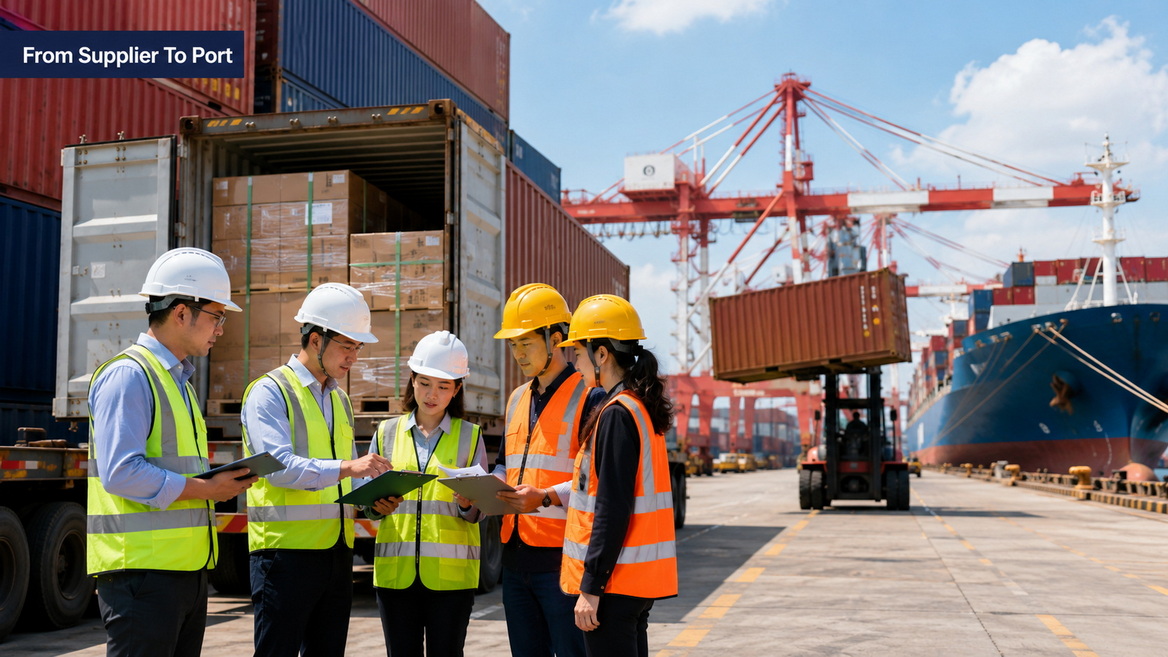
Many international shipping problems begin before cargo arrives at the port.
A supplier may finish production later than expected. Cargo may be packed incorrectly. The carton count may differ from the packing list. A shipment may require inspection, relabeling, palletizing, or consolidation. Multiple suppliers may not be ready at the same time. The container may need to be loaded before a port cut-off date.
These operational details can influence freight cost, loading schedules, document accuracy, and delivery reliability.
A China freight forwarder plays an important role in managing these activities. For businesses buying from several suppliers, consolidation can be especially valuable. Instead of arranging multiple small international shipments, cargo may be collected from different factories and combined into one shipment.
This approach may help reduce repeated handling charges, simplify destination receiving, improve container utilization, and create a more coordinated transport schedule.
GB FREIGHT AGENCY CO., LTD. supports supplier booking coordination and China origin logistics planning to help importers keep shipments organized before they reach the port.
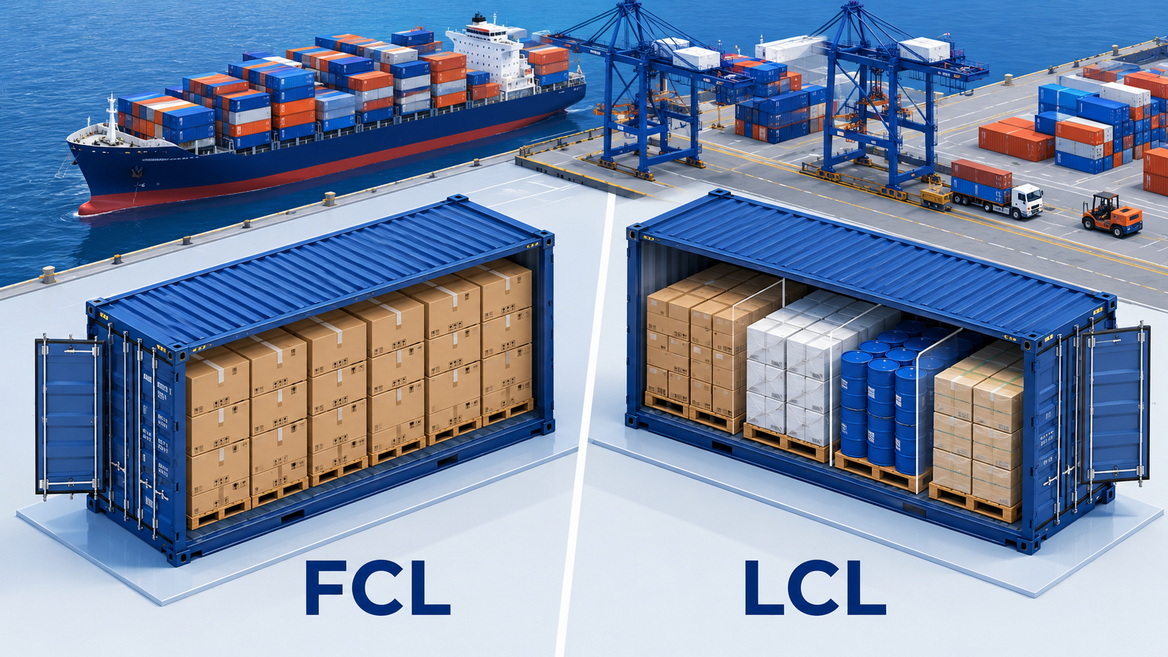
One of the first decisions in international ocean shipping is whether to use FCL or LCL service.
FCL means Full Container Load. The importer reserves a dedicated shipping container, such as a 20-foot container, 40-foot container, or 40-foot high-cube container.
LCL means Less than Container Load. Cargo from multiple shippers is consolidated into one container. Each importer pays for the space used rather than the entire container.
| Shipping Option | Best For | Main Benefits | Important Considerations |
|---|---|---|---|
| FCL Sea Freight | Larger cargo volumes or shipments requiring a dedicated container | Better cargo control, fewer handling points, greater loading flexibility | A full container may not be cost-effective for small shipment volumes |
| LCL Sea Freight | Smaller shipments that cannot fill a full container | Lower initial shipping commitment and access to ocean transport for smaller orders | More handling, consolidation time, and destination charges may apply |
| Supplier Consolidation | Importers purchasing from multiple Chinese suppliers | Combines cargo into one shipment and simplifies logistics coordination | Requires accurate cargo-ready schedules and warehouse receiving management |
| Door-to-Door Shipping | Importers seeking a coordinated end-to-end solution | Simplifies the shipping process from factory pickup to final delivery | Customs obligations and destination requirements should be confirmed in advance |
FCL may be a suitable option when your cargo is large enough to utilize most of a container or when product security, cargo separation, and reduced handling are important.
LCL may be a practical choice for smaller shipments, product testing, sample replenishment, seasonal purchasing, or buyers who do not want to wait until they have enough cargo for a full container.
The final decision should be based on total logistics cost rather than only the ocean freight charge.
Importers often compare freight forwarders by looking only at the quoted ocean freight rate. This can create problems because ocean freight is only one part of the overall shipping cost.
A complete shipping budget may include:
- Factory pickup or domestic trucking in China.
- Warehouse receiving and cargo consolidation.
- Export customs declaration handling.
- Port handling and terminal charges.
- Ocean freight charges.
- Documentation fees.
- Cargo insurance.
- Destination port charges.
- Import customs clearance costs.
- Duties and taxes.
- Final delivery charges.
- Special cargo handling charges.
- Demurrage or detention risk where applicable.
The lowest initial quote is not always the lowest final cost. Importers should request a clear breakdown of expected charges and confirm which costs are included or excluded.
A transparent freight quote gives businesses better control over purchasing decisions, retail pricing, inventory planning, and landed-cost calculations.
A practical way to evaluate shipping cost is:
Total Logistics Cost=Origin Charges+Ocean Freight+Destination Charges+Customs Costs+Final Delivery+Potential Risk Costs
Potential risk costs may include delayed cargo, missed delivery appointments, incorrect documents, storage charges, product damage, customs holds, stock shortages, and production interruptions.
Accurate shipping documents are essential for smooth export processing from China and reliable import clearance at destination.
The required documents can vary depending on the product, country of destination, shipping term, importer requirements, and customs regulations. However, many sea freight shipments require the following core documents:
1. Commercial Invoice
The commercial invoice identifies the seller, buyer, product details, value, quantity, currency, and agreed trade terms.
2. Packing List
The packing list provides information about carton quantity, package type, gross weight, net weight, dimensions, and cargo volume.
3. Bill of Lading Instructions
Shipping instructions are used to prepare the bill of lading. They normally include the shipper, consignee, notify party, cargo description, package details, and release arrangement.
4. Customs Product Information
Customs clearance may require accurate product descriptions, HS codes, material composition, intended use, country of origin, and declared value.
5. Certificates or Product Compliance Documents
Certain products may require certificates, testing reports, licenses, inspection documents, fumigation certificates, or other compliance information.
6. Cargo Insurance Information
If cargo insurance is required, the shipper may need to provide shipment value, product details, route information, and packing information.
Accuracy is essential. Product names, quantities, carton counts, weights, values, and consignee details should be consistent across all shipment documents.
International freight is influenced by many moving parts. Even well-planned shipments can encounter delays or changes. Businesses can reduce risk by understanding the most common challenges in advance.
Shipping lines may adjust sailing schedules because of port congestion, weather conditions, equipment imbalances, operational delays, or route changes.
To reduce the impact, plan bookings early and allow additional time for critical inventory.
If a supplier misses the cargo-ready date, the shipment may miss the planned vessel departure.
To reduce this risk, confirm production schedules early and ask your freight forwarder to coordinate cargo-ready status with suppliers before booking deadlines.
Incorrect weight, dimensions, package counts, product descriptions, or dangerous-goods information can lead to additional charges, shipment delays, or customs issues.
To reduce this risk, provide final cargo data before booking and verify the packing list before cargo leaves the factory.
Some importers focus only on origin freight rates and do not fully understand destination terminal, documentation, customs, or delivery charges.
To reduce surprises, ask for a complete transport cost explanation before confirming the booking.
When several factories are involved, cargo may become ready at different times. This can complicate consolidation and container loading.
To reduce this risk, create one shipment schedule that lists every supplier, pickup address, cargo-ready date, package quantity, and contact person.
Before arranging sea freight from China, prepare the following information:
- Product name and detailed cargo description.
- Supplier name, contact person, and pickup address.
- Cargo-ready date.
- Number of cartons, pallets, crates, or packages.
- Total gross weight and net weight.
- Total cargo volume in CBM.
- Carton dimensions or pallet dimensions.
- Commodity value and commercial invoice details.
- HS code, if available.
- Battery, liquid, magnetic, dangerous-goods, or special cargo information.
- Destination port or complete delivery address.
- Preferred shipping method, including FCL, LCL, port-to-port, or door-to-door service.
- Required delivery date.
- Importer contact information and customs clearance requirements.
Providing complete cargo details at the beginning helps the freight forwarder recommend a more accurate and practical shipping solution.
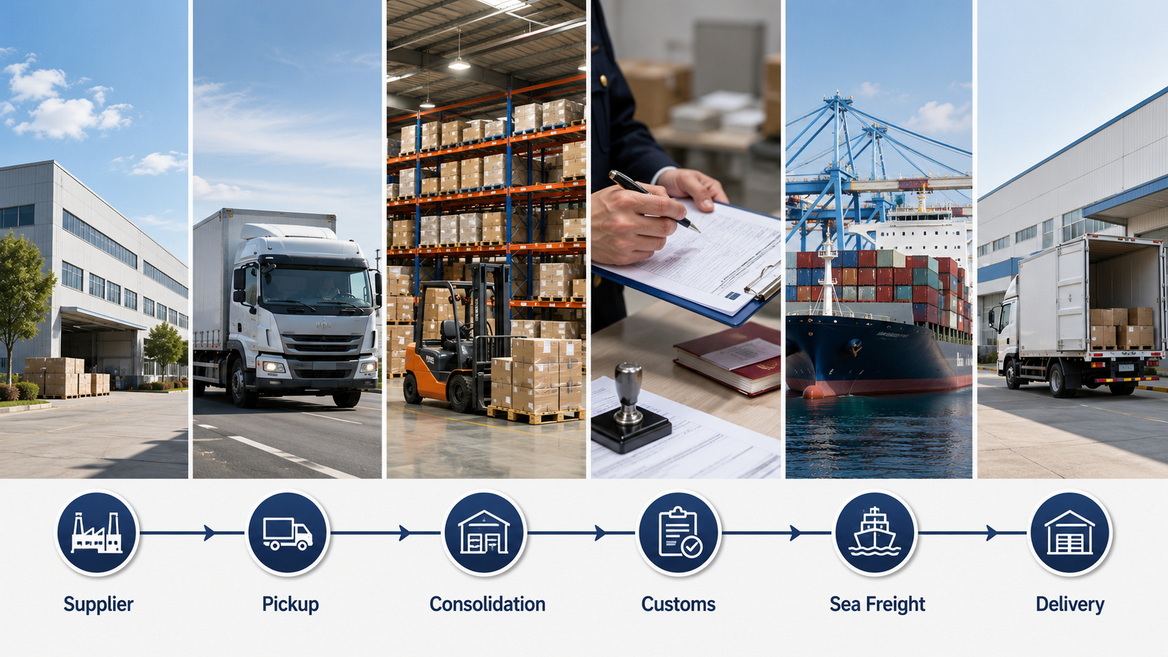
GB FREIGHT AGENCY CO., LTD. provides international logistics solutions for businesses shipping cargo from China to worldwide markets. With 15 years of freight forwarding experience, our team supports importers through the full transport process.
Our services are designed to help customers move cargo from China to:
- Europe.
- North America.
- South America.
- Southeast Asia.
- The Middle East.
- Africa.
- Oceania.
We provide support for supplier coordination, cargo pickup, consolidation, export customs handling, sea freight, shipping documents, destination coordination, and final delivery arrangements.
Our logistics solutions are suitable for a wide range of cargo types, including consumer products, industrial goods, machinery, spare parts, packaging materials, furniture, building products, retail inventory, and consolidated orders from multiple suppliers.
A well-managed shipment begins with clear communication, accurate cargo information, realistic schedules, and a freight forwarding partner that understands China origin operations.
For your next shipment from China, provide your pickup location, destination, cargo dimensions, total weight, volume, product information, and cargo-ready date. GB FREIGHT AGENCY CO., LTD. will help you identify a sea freight solution that fits your shipment requirements, timing, and budget.
A freight forwarder is a logistics company that arranges transportation on behalf of an importer, exporter, or cargo owner. Freight forwarders may coordinate ocean freight, air freight, trucking, customs documentation, warehousing, cargo consolidation, insurance, and final delivery.
A shipping line operates vessels and transports containers by sea. A freight forwarder arranges transport services for customers and coordinates shipping lines, trucking companies, warehouses, customs processes, and destination logistics providers.
Choose a freight forwarder based on China origin coverage, supplier coordination ability, pricing transparency, customs knowledge, communication quality, shipment visibility, destination support, and experience with your cargo type and shipping route.
FCL is generally better for larger cargo volumes, dedicated container use, and lower handling risk. LCL is generally suitable for smaller shipments that do not require a full container. The best option depends on cargo volume, shipping deadline, handling needs, and total logistics cost.
Sea freight transit time depends on the Chinese loading port, destination port, vessel route, transshipment arrangements, carrier schedule, weather conditions, port congestion, customs procedures, and final delivery location. A freight forwarder can provide an estimated transit schedule based on the selected shipping route.
1. [UN Trade and Development (UNCTAD), Review of Maritime Transport 2024]
2. [UNCTAD Data Hub, Maritime and Other Transport: Data Insights]
3. [Top 50 Global Freight Forwarders List 2024]
4. [Global Ocean Freight Forwarders Rankings 2025]
5. [World Customs Organization, Layout Key for Goods Declaration]
6. [World Customs Organization, Conventions and Programmes Concerning Export Controls]


