
Views: 235 Author: GB FREIGHT Publish Time: 2026-08-31 Origin: Site


Content Menu
● Why Major Cargo Airports Matter for Global Shipping
● Top Busiest Cargo Airports Worldwide
● Hong Kong International Airport: A Major Gateway for China Exports
● Shanghai Pudong: A Core Airport for Air Freight From China
● Anchorage: A Key Trans-Pacific Cargo Hub
● Memphis and Louisville: Global Express Shipping Centers
● Frankfurt, Paris, and London: Key European Cargo Gateways
>> Paris Charles de Gaulle Airport
● Dubai and Singapore: Connecting Asia, the Middle East, and Africa
>> Dubai International Airport
● How to Choose the Best Air Freight Airport From China
>> Start With the Supplier Location
>> Compare Door-to-Door Transit Time
>> Calculate Chargeable Weight Correctly
>> Confirm Special Cargo Requirements Early
● A Practical Air Freight Process From China
>> Step 1: Provide Complete Shipment Details
>> Step 2: Choose the Appropriate Shipping Method
>> Step 3: Coordinate With the Supplier
>> Step 4: Track the Shipment Through Final Delivery
● Common Air Freight Mistakes to Avoid
>> Choosing Only the Lowest Quoted Price
>> Providing Incorrect Dimensions or Weight
>> Declaring Cargo Incorrectly
>> Ignoring Packaging Requirements
>> Booking Too Late During Peak Periods
● Why Businesses Choose GB FREIGHT AGENCY CO., LTD.
● Summary
>> What is the busiest cargo airport in the world?
>> Which airport is best for air freight from China?
>> How long does air freight from China take?
>> How is air freight cost calculated?
>> Can I ship lithium batteries by air from China?
The world's busiest cargo airports are not simply places where aircraft load and unload goods. They are critical links in global supply chains, connecting Chinese manufacturers, international buyers, distributors, e-commerce sellers, and end customers across continents.
For businesses shipping products from China, the choice of departure airport, transit hub, airline service, and delivery method can affect freight cost, transit time, customs processing, cargo safety, and inventory availability. A shipment routed through the right airport can help a business respond to urgent orders, avoid stock shortages, and keep international customers satisfied.
GB FREIGHT AGENCY CO., LTD. has more than 15 years of international logistics experience. We provide air freight and integrated transportation solutions for businesses shipping goods from China to Europe, North America, South America, Southeast Asia, the Middle East, Africa, and Oceania. From supplier booking coordination and export customs declaration to air transportation and final delivery, we help customers move cargo quickly, safely, and cost-effectively.

Air freight is an important solution for cargo that must move quickly. It is commonly used when product value is high, inventory is urgently needed, production lines require replacement components, or customers have strict delivery deadlines.
Major cargo airports offer more than high shipment volumes. They often provide better international flight connectivity, more carrier options, stronger handling infrastructure, experienced customs support, and faster access to regional distribution networks.
For importers and exporters, these advantages can make a major difference during peak shipping periods, product launches, seasonal demand spikes, or unexpected supply-chain disruptions.
The world's largest cargo hubs are especially important because they connect production regions in Asia with major consumer markets in North America, Europe, the Middle East, and other destinations. They serve as transfer points for freighter aircraft, express shipments, e-commerce parcels, industrial components, and high-value goods.
However, the busiest airport is not always the best airport for every shipment. The ideal route depends on several practical factors:
- Supplier location in China
- Cargo-ready date
- Destination country and delivery address
- Cargo dimensions and gross weight
- Type of product being shipped
- Customs requirements
- Airline capacity
- Required transit time
- Budget and total landed cost
A professional freight forwarder should compare the complete transportation plan rather than focus only on a low freight rate or a well-known airport name.
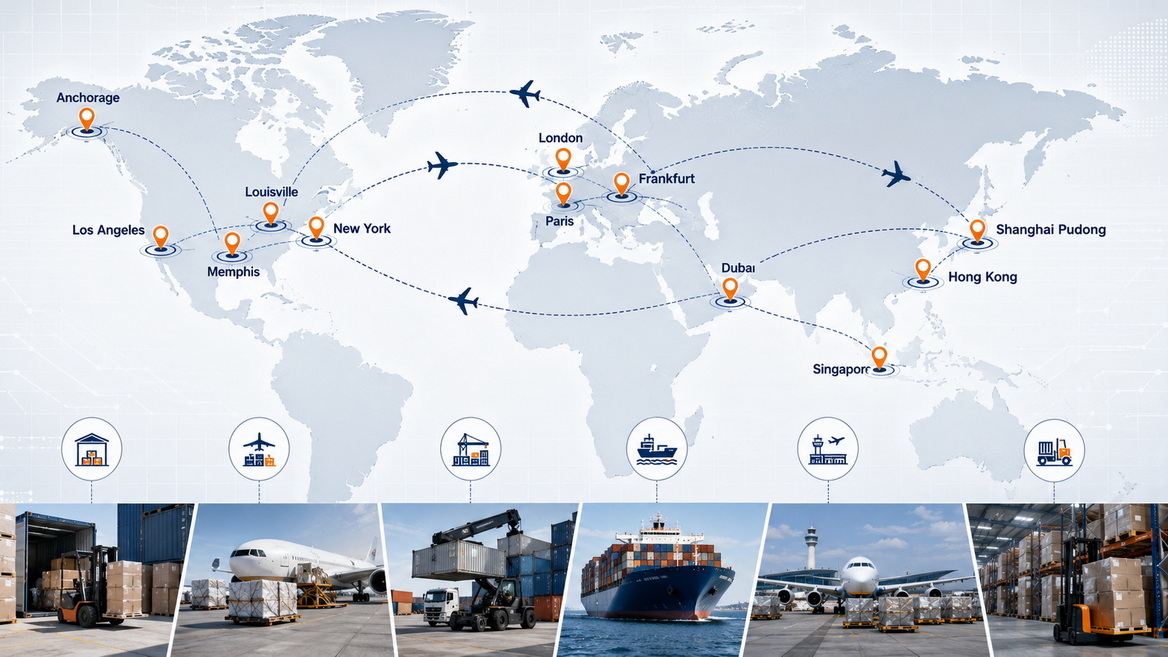
The following airports play an important role in international air freight networks. They connect major production zones, consumer markets, express delivery systems, and regional distribution centers around the world.
| Airport | IATA Code | Key Role in Global Air Freight |
|---|---|---|
| Hong Kong International Airport | HKG | Major China export, e-commerce, and Asia-Pacific cargo hub |
| Memphis International Airport | MEM | Global FedEx Express hub and U.S. distribution center |
| Ted Stevens Anchorage International Airport | ANC | Major trans-Pacific cargo transfer and refueling hub |
| Shanghai Pudong International Airport | PVG | Leading mainland China airport for international cargo exports |
| Louisville Muhammad Ali International Airport | SDF | Global UPS Worldport and express parcel hub |
| Los Angeles International Airport | LAX | Important U.S.-Asia import and export gateway |
| Miami International Airport | MIA | Key hub for Latin America, perishables, and international trade |
| Tokyo Narita International Airport | NRT | Major Northeast Asia cargo gateway |
| Chicago O’Hare International Airport | ORD | Central U.S. distribution and international air freight hub |
| Frankfurt Airport | FRA | Leading European cargo gateway and road feeder network center |
| Paris Charles de Gaulle Airport | CDG | Important European hub for global cargo movements |
| Singapore Changi Airport | SIN | Southeast Asia transshipment and high-tech cargo hub |
| Dubai International Airport | DXB | Middle East gateway connecting Asia, Europe, and Africa |
| London Heathrow Airport | LHR | Important UK market gateway for high-value cargo |
| New York John F. Kennedy International Airport | JFK | Major international cargo airport serving the U.S. East Coast |
Hong Kong International Airport is one of the most important cargo hubs in the world. Its location near the Pearl River Delta gives it a strategic advantage for exporters in southern China.
Manufacturers and suppliers in Shenzhen, Dongguan, Guangzhou, Foshan, Zhongshan, Huizhou, and nearby cities can often access Hong Kong's extensive airline network through cross-border trucking and freight consolidation services.
Hong Kong is particularly important for shipments such as:
- Consumer electronics
- Mobile phone accessories
- E-commerce parcels
- Fashion products
- Footwear
- High-value consumer goods
- Automotive parts
- Urgent samples
- Time-sensitive general cargo
The airport serves a broad range of airlines and cargo operators, creating flexibility for international routes. It can be a strong choice for shipments moving from southern China to the United States, Canada, Europe, the Middle East, Southeast Asia, Australia, and other global markets.
Still, shipping through Hong Kong is not automatically the best solution for every customer. A shipment must be evaluated carefully based on supplier location, trucking cost, customs requirements, available flight capacity, and destination service options.
For example, a supplier located in Shenzhen may be suitable for a Hong Kong routing, while a supplier in Shanghai or Ningbo may benefit from shipping through Shanghai Pudong instead.
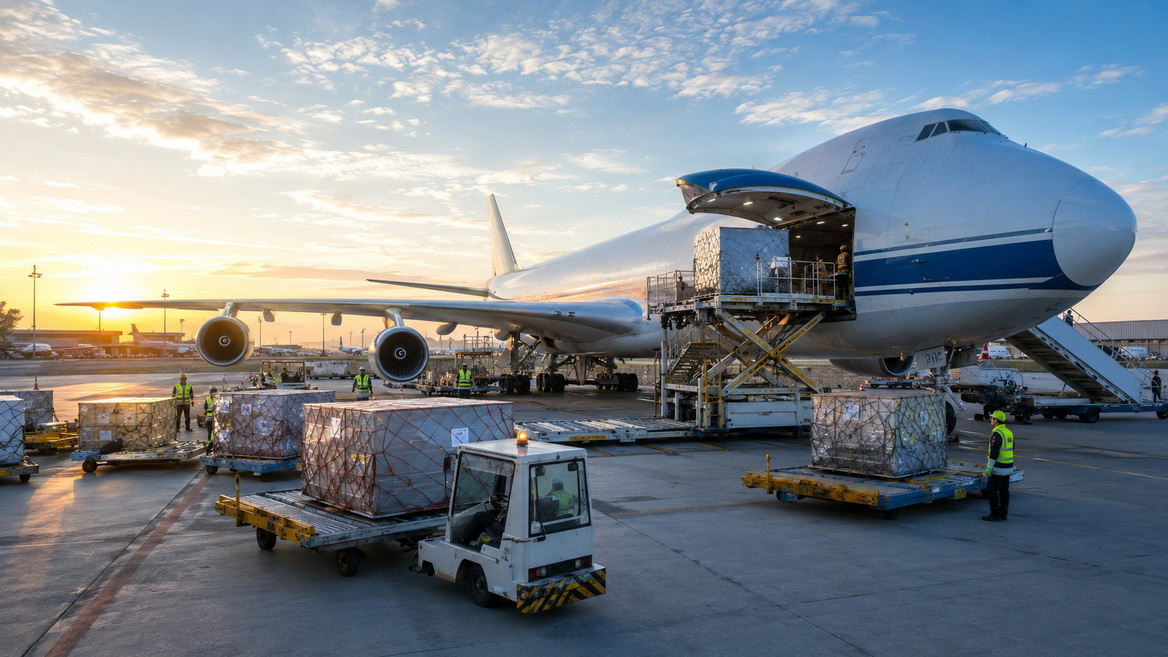
Shanghai Pudong International Airport is one of the most important international air freight gateways in mainland China. It supports the export needs of Shanghai and the wider Yangtze River Delta, one of China's strongest manufacturing and trading regions.
The airport is well positioned for suppliers in:
- Shanghai
- Suzhou
- Ningbo
- Hangzhou
- Wuxi
- Nanjing
- Jiaxing
- Changzhou
- Yiwu
- Anhui and nearby industrial areas
Shanghai Pudong handles a wide range of export cargo, including industrial machinery components, automotive parts, consumer products, garments, electronics, medical devices, laboratory equipment, and urgent spare parts.
For companies importing from eastern China, Shanghai Pudong can provide practical advantages. These include access to international airlines, freight handling facilities, regular cargo flights, and connections to major markets worldwide.
The best route may involve a direct flight, a transfer through another cargo hub, or a combination of air transportation and final-mile truck delivery. The right option depends on your cargo priority and commercial requirements.
Ted Stevens Anchorage International Airport in Alaska is one of the world's most important air cargo hubs because of its location between Asia and North America.
Many cargo flights traveling between China, Japan, South Korea, and North America use Anchorage as a technical stop, refueling location, or transfer point. It may be part of an air freight route even when the shipment's final destination is Los Angeles, Chicago, New York, Toronto, Mexico City, or another city in the Americas.
For shippers, Anchorage shows why it is important to understand the full transport plan. A shipment may have an efficient operational route even if the aircraft stops at one or more airports before reaching its final destination.
The number of stops does not always determine the real transit time. A one-stop route with reliable airline capacity and a well-managed transfer process can sometimes be more dependable than a direct service with limited availability.
When comparing air freight options, businesses should ask about:
- Estimated departure date
- Flight frequency
- Transit airport
- Transfer time
- Cargo cut-off time
- Airline capacity
- Destination handling time
- Customs clearance requirements
- Delivery appointment availability
Memphis International Airport and Louisville Muhammad Ali International Airport are globally recognized cargo hubs because they support the worldwide operations of FedEx Express and UPS.
Memphis is the major global hub for FedEx Express. Louisville is home to UPS Worldport, one of the largest automated package-handling facilities in the world. These airports process large volumes of international parcels, express shipments, documents, samples, and time-sensitive goods.
For businesses shipping smaller, urgent, or high-value products from China to the United States, international express shipping can be an efficient choice.
Express shipping is often suitable for:
- Product samples
- Documents
- E-commerce parcels
- Small electronic products
- Urgent replacement parts
- Low-volume, high-value goods
- Emergency inventory replenishment
- Time-sensitive customer orders
However, express shipping is not always the most economical solution. When shipment weight increases, traditional air freight can often offer a better cost per kilogram.
For example, a 10 kg sample shipment may be suitable for express delivery. A 500 kg commercial shipment on multiple pallets may be more cost-effective through standard air freight with customs clearance and local delivery arrangements.
The best transport method should be selected after comparing the full cost, transit time, cargo type, and customs process.
Europe has several major cargo airports that connect international flights with regional trucking and distribution networks. Frankfurt, Paris Charles de Gaulle, and London Heathrow are particularly important for businesses shipping from China to European destinations.
Frankfurt Airport is one of Europe's leading air freight hubs. It is strategically located in Germany and connected to a strong road freight network that serves neighboring countries.
Cargo arriving in Frankfurt can often be delivered by truck to destinations across Germany, the Netherlands, Belgium, France, Austria, Switzerland, Poland, and other European markets.
Frankfurt is commonly used for:
- Industrial equipment
- Automotive parts
- Medical products
- Electronics
- Fashion products
- High-value goods
- Urgent spare parts
- Commercial samples
Paris Charles de Gaulle is another major European cargo airport. It supports international air freight movements between Asia, Europe, North America, Africa, and the Middle East.
For importers and distributors serving France or nearby European markets, Paris may be a practical gateway. It is also an important hub for express and international parcel networks.
London Heathrow is one of the most important gateways for air cargo entering the United Kingdom. Much of its cargo travels in the belly hold of passenger aircraft, making airline schedules and passenger network capacity important factors.
For shipments destined for London, Manchester, Birmingham, Bristol, or other UK cities, Heathrow may be part of the most efficient route. The final delivery plan should also account for customs procedures, destination handling, local trucking, and any required delivery appointment.
Dubai International Airport and Singapore Changi Airport are essential hubs for businesses moving cargo between China and emerging markets.
Dubai is a major logistics center connecting Asia, Europe, Africa, and the Middle East. It is an important gateway for cargo moving to destinations such as the United Arab Emirates, Saudi Arabia, Qatar, Oman, Kuwait, Bahrain, Kenya, Nigeria, Egypt, and other regional markets.
For Chinese exporters serving Middle Eastern and African buyers, Dubai can provide reliable international connectivity and access to regional distribution systems.
It is commonly used for:
- Electronics
- Consumer goods
- Building materials
- Machinery parts
- Retail inventory
- Automotive components
- E-commerce shipments
- Urgent commercial cargo
Singapore Changi is a major Southeast Asian cargo hub with strong connections across Asia-Pacific. It is particularly relevant for shipments moving from China to Singapore, Malaysia, Indonesia, Thailand, Vietnam, the Philippines, Australia, and other nearby markets.
Singapore is known for its role in technology, electronics, pharmaceutical products, high-value cargo, and regional distribution. It can be an effective transit point when direct capacity to the final destination is limited.
Selecting an airport requires more than checking a flight schedule. The route should be designed around the actual needs of your business and shipment.
The distance between the supplier and airport affects pickup cost, trucking time, handling risk, and cargo readiness.
| Supplier Region in China | Common Airport Options |
|---|---|
| Shenzhen, Dongguan, Guangzhou | SZX, CAN, HKG |
| Shanghai, Suzhou, Ningbo, Hangzhou | PVG, HGH, NGB |
| Beijing, Tianjin, Hebei | PEK, PKX, TSN |
| Xiamen, Fuzhou, Quanzhou | XMN, FOC |
| Qingdao, Jinan, Dalian | TAO, TNA, DLC |
| Chengdu, Chongqing, Xi’an | CTU, CKG, XIY |
A shipment from Dongguan may move efficiently through Shenzhen, Guangzhou, or Hong Kong. A shipment from Suzhou may be better routed through Shanghai Pudong. A shipment from Chengdu may use Chengdu Tianfu or connect through another major Chinese gateway.
The correct decision depends on cargo readiness, destination, airline capacity, and the total transportation cost.
Flight time is only one part of the overall air freight process. The complete transit timeline may include:
1. Supplier confirms goods are ready.
2. Cargo is collected from the supplier.
3. Shipment is delivered to a warehouse or airport terminal.
4. Export customs documents are prepared.
5. Cargo completes security screening and airline acceptance.
6. The aircraft departs from China.
7. Cargo may transfer through a transit hub.
8. Shipment arrives at the destination airport.
9. Import customs clearance is completed.
10. Final delivery is arranged to the consignee.
A shipment can be delayed before the aircraft departs if packing lists are inaccurate, cartons are not ready, export documents are incomplete, cargo dimensions change, or restricted items were not declared in advance.
Reliable planning is often more valuable than a promised transit time that cannot be achieved.
Air freight cost is generally calculated based on the higher of actual weight and volumetric weight.
If the actual gross weight is 65 kg, the airline usually charges based on 112 kg because the shipment occupies the equivalent cargo space of 112 kg.
This calculation is especially important for lightweight but bulky products, including display materials, furniture components, packaging products, plastic goods, apparel, toys, and foam-based items.
Reducing carton dimensions, avoiding unnecessary empty space, using efficient pallet sizes, and improving stackability can help lower air freight costs.
Some products require special handling, supporting documents, labels, packaging, or airline approval before they can travel by air.
Examples include:
- Lithium batteries
- Battery-powered products
- Cosmetics
- Liquids
- Perfumes
- Aerosols
- Magnets
- Chemicals
- Industrial materials
- Medical products
- Temperature-sensitive cargo
- Products with pressurized components
- High-value cargo
Always provide complete cargo information before booking. Early disclosure helps prevent cargo rejection, delays, storage fees, repacking costs, and missed flights.
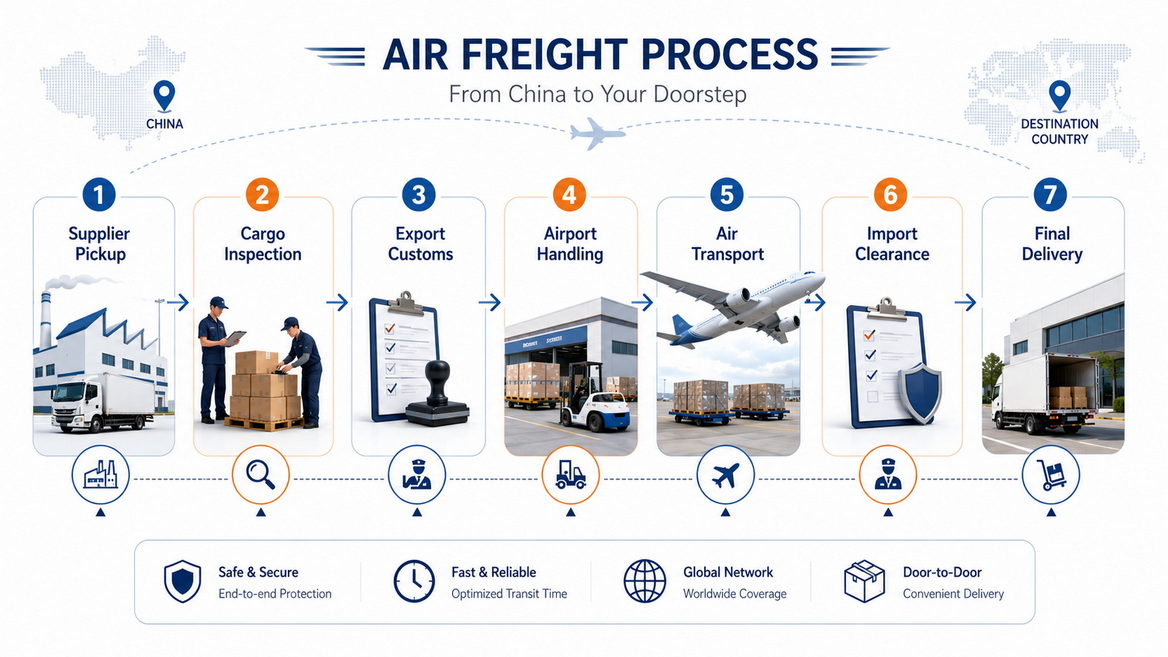
A well-managed air freight shipment requires coordination between the supplier, freight forwarder, airline, airport warehouse, customs authorities, destination broker, and delivery provider.
To prepare a practical freight plan, provide:
- Supplier name and pickup address in China
- Destination airport or complete delivery address
- Number of packages
- Carton or pallet dimensions
- Gross weight
- Product description
- Cargo-ready date
- Required delivery date
- Commodity value
- Whether the cargo contains batteries, liquids, magnets, or other special goods
- Preferred service type
Accurate information helps avoid unexpected charges and routing changes.
There are three common air transportation options:
| Service Type | Suitable For | Main Advantage |
|---|---|---|
| Airport-to-airport air freight | Experienced importers with their own customs and delivery arrangements | Competitive freight cost |
| Door-to-door air freight | Businesses seeking coordinated pickup, transportation, clearance, and delivery | Greater convenience |
| International express service | Small, urgent, or high-value shipments | Fast transport and tracking |
The best method depends on shipment size, urgency, cargo type, destination customs requirements, and the consignee's ability to manage import procedures.
Supplier coordination is one of the most important stages in international shipping.
The supplier must prepare the cargo correctly and provide accurate shipment details. Common issues include inaccurate dimensions, incomplete commercial invoices, incorrect product descriptions, delayed production, insufficient packaging, and undeclared restricted goods.
GB FREIGHT AGENCY CO., LTD. can coordinate with suppliers in China to arrange booking instructions, cargo pickup, warehouse delivery, export customs support, and airline handling.
After cargo is accepted by the airline, it moves through the selected air freight route. Depending on the service scope, the shipment may require transfer handling, import customs clearance, local terminal release, and final-mile delivery.
Clear communication throughout the process helps customers plan inventory, warehouse receiving, customer delivery, and internal production schedules.
Businesses can reduce delays and unnecessary expenses by avoiding several common mistakes.
A low freight rate may exclude important charges or rely on a transit plan with limited capacity. Always confirm whether the quote includes pickup, export handling, customs services, fuel surcharge, destination charges, and final delivery.
Airlines and airport warehouses can remeasure shipments. If actual dimensions are larger than the booking information, the chargeable weight may increase.
The product description on the commercial invoice should match the actual goods. Incorrect declarations can lead to customs queries, cargo rejection, delays, or penalties.
Air cargo can be handled multiple times during pickup, warehouse processing, loading, transfer, customs inspection, and delivery. Strong export packaging protects goods and reduces the risk of damage.
Airline capacity can tighten during holiday seasons, promotional events, product launches, and periods of disruption in ocean freight markets. Early planning gives businesses more route options and better cost control.
International air freight requires detailed planning, supplier communication, customs coordination, cargo handling knowledge, and reliable overseas delivery support.
GB FREIGHT AGENCY CO., LTD. provides tailored air freight solutions for businesses shipping from China to worldwide destinations. We focus on practical routing, clear communication, reliable coordination, and cost-conscious transportation planning.
Our services include:
- Air freight from China to global destinations
- Supplier booking coordination
- Cargo pickup and consolidation
- Export customs declaration support
- Airport-to-airport shipping
- Door-to-door air freight solutions
- Worldwide delivery coordination
- Air freight solutions for Europe, North America, South America, Southeast Asia, the Middle East, Africa, and Oceania
- Support for urgent, high-value, general, and selected special cargo shipments
- Shipment planning based on cargo dimensions, destination, and delivery requirements
Every shipment has different commercial priorities. Some customers need the fastest available departure. Others need a balance between speed and freight cost. Some require supplier collection and door delivery, while others only need airport-to-airport transport.
Our role is to help customers identify the most suitable route for their cargo, budget, and required delivery schedule.
The busiest cargo airports in the world form the backbone of international air freight. Hong Kong, Shanghai Pudong, Anchorage, Memphis, Louisville, Los Angeles, Frankfurt, Dubai, Singapore, and other major hubs connect China's manufacturing base with buyers and businesses around the world.
For companies shipping from China, selecting the right airport is not just about finding the nearest location or the cheapest rate. It requires an understanding of supplier location, cargo type, chargeable weight, airline capacity, customs procedures, transit routing, and destination delivery needs.
A well-planned air freight shipment can help businesses reduce lead times, maintain inventory flow, respond to urgent customer demand, and support international growth.
GB FREIGHT AGENCY CO., LTD. is ready to provide dependable air freight solutions from China to worldwide destinations. Share your cargo details, supplier location, destination, shipment dimensions, and delivery requirement with our logistics team to receive a transportation plan tailored to your business needs.
Hong Kong International Airport is widely recognized as one of the world's leading cargo airports. It is a major gateway for cargo moving between China, Asia-Pacific markets, North America, Europe, and other international destinations.
The best airport depends on your supplier's location, cargo type, destination, flight availability, transit-time requirement, and shipping budget. Common China export airports include Shanghai Pudong, Guangzhou, Shenzhen, Hong Kong, Beijing, Xiamen, Qingdao, Chengdu, and Chongqing.
Air freight transit time depends on the origin airport, destination, airline schedule, transfer route, customs clearance, and final delivery arrangement. Airport-to-airport service can take several days, while door-to-door delivery includes additional time for supplier pickup, export customs, import customs clearance, and local delivery.
Air freight is usually charged based on actual weight or volumetric weight, whichever is higher. Volumetric weight is calculated from the shipment's dimensions. Additional costs may include pickup, export handling, customs services, terminal charges, fuel surcharge, destination handling, customs clearance, and final delivery.
Lithium batteries and battery-powered products may be accepted for air transportation, but they are subject to strict packaging, labeling, documentation, and airline approval requirements. Full battery details should be provided before booking.
1. Airports Council International (ACI) World. "World's Busiest Airports Revealed in Final Global Rankings."
[https://aci.aero/2025/07/08/worlds-busiest-airports-revealed-in-final-global-rankings/]
2. Freightos. "Top 15 Busiest & Largest Cargo Airports in the World."
[https://www.freightos.com/freight-resources/busiest-cargo-airports-worldwide/]
3. International Air Transport Association. "Air Cargo Market Analysis."
[https://www.iata.org/en/publications/economics/]
4. Airports Council International North America. "Airports Council Releases 2024 North American Airport Traffic Rankings."
5. U.S. Department of Transportation, Bureau of Transportation Statistics. "Top 25 Airports by Landed Weight of All-Cargo Operations."


