
Views: 251 Author: GB FREIGHT Publish Time: 2026-10-19 Origin: Site


Content Menu
● What Is the Cheapest Way to Ship Internationally?
>> Compare Shipping Methods Before Comparing Prices
● Why Sea Freight Is Often the Cheapest Shipping Option
>> LCL Shipping: Share Container Space
>> FCL Shipping: Compare the Complete Container Cost
● When Air Freight Can Be the More Economical Decision
>> Use a Split Shipment Instead of Flying Everything
● Calculate the Full Landed Cost Before Booking
>> Check These Commonly Overlooked Charges
● Reduce Shipping Costs by Understanding Chargeable Weight
>> A Practical Volumetric Weight Example
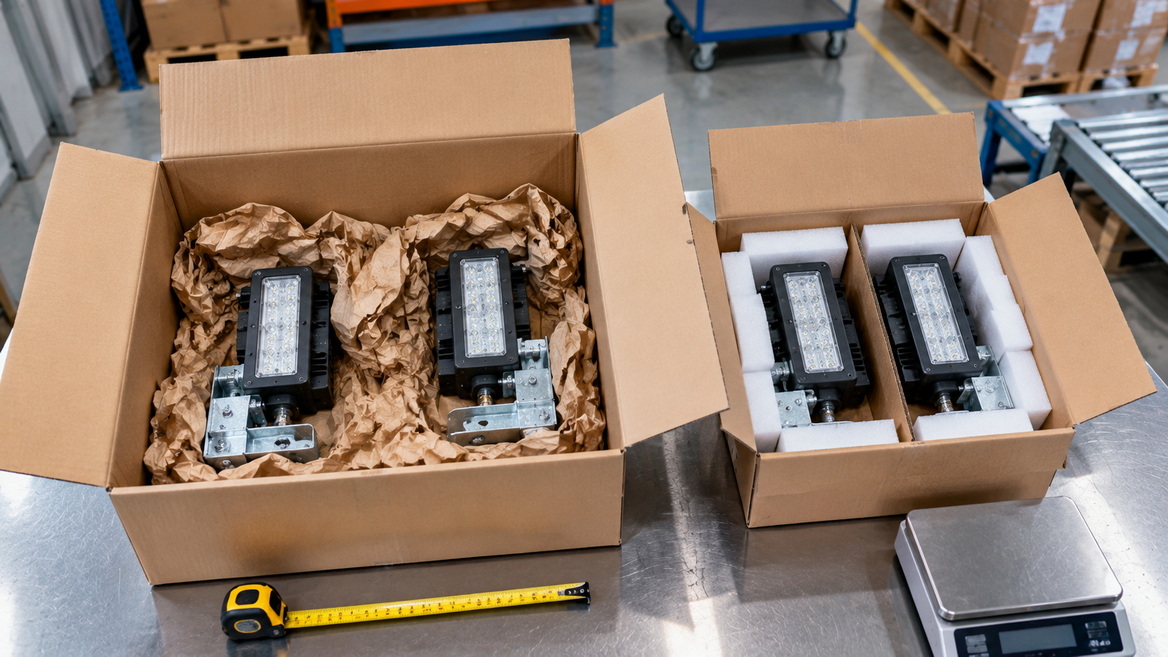
>> Improve Packaging Without Increasing Damage Risk
● Consolidate Orders From Multiple Chinese Suppliers
>> Build a Consolidation Plan Before Collection
● Clarify Incoterms and Customs Responsibilities
>> Compare EXW, FCA, FOB, DAP, and DDP Carefully
>> Prepare Accurate Shipment Information
● How to Request Comparable Freight Quotes From China
● Plan Your Shipment With GB FREIGHT AGENCY CO., LTD.
>> What Is the Cheapest Way to Ship Large Orders Internationally?
>> Is LCL Always Cheaper Than FCL?
>> How Can I Lower Air Freight Costs From China?
>> Does Door-to-Door Shipping Include Customs Duties?
>> Can a Freight Forwarder Guarantee the Cheapest Price?
The cheapest way to ship internationally from China depends on your cargo, delivery deadline, and destination—not simply the lowest freight rate. Sea freight is usually the most economical choice for larger, non-urgent shipments. Air freight can make better commercial sense when delivery speed protects sales or keeps production running.
At GB FREIGHT AGENCY CO., LTD., we bring 15 years of international logistics experience to businesses shipping from China worldwide. Our approach starts with a practical question: which transport plan delivers your goods at the lowest reasonable total cost?
This guide explains how to compare shipping methods, identify overlooked charges, and prepare a shipment that is easier to quote accurately.

For commercial cargo, the answer usually falls into three categories:
- Small samples and urgent parcels: compare express courier services.
- Moderate shipments with flexible deadlines: compare less-than-container-load sea freight.
- Larger orders: request full-container-load quotations alongside other suitable options.
There is no universal weight or volume at which one service becomes cheapest. Minimum charges, cargo density, local handling, and delivery distance can change the result.
Your goal should be total cost, not the lowest advertised price per kilogram or cubic meter.
| Shipping method | Often suitable for | Main cost consideration | Main limitation |
|---|---|---|---|
| Express courier | Samples and small urgent orders | Chargeable weight and delivery surcharges | Costs can rise quickly with size |
| Air freight | Time-sensitive commercial cargo | Chargeable weight plus airport and delivery fees | Higher transport cost for bulky goods |
| LCL sea freight | Smaller, non-urgent commercial shipments | Cargo volume, weight, and local charges | Consolidation and destination handling |
| FCL sea freight | Larger orders or dedicated-container needs | Container cost and utilization | Paying for unused capacity |
Compare services using the same collection point, delivery address, and scope. A port-to-port quotation cannot be fairly compared with a door-to-door quotation.
Sea freight generally works best when businesses can exchange longer lead times for lower transport costs, particularly with bulky cargo.
However, "ocean freight" is only one part of the invoice. Collection, export procedures, terminal handling, destination charges, and inland delivery still matter.
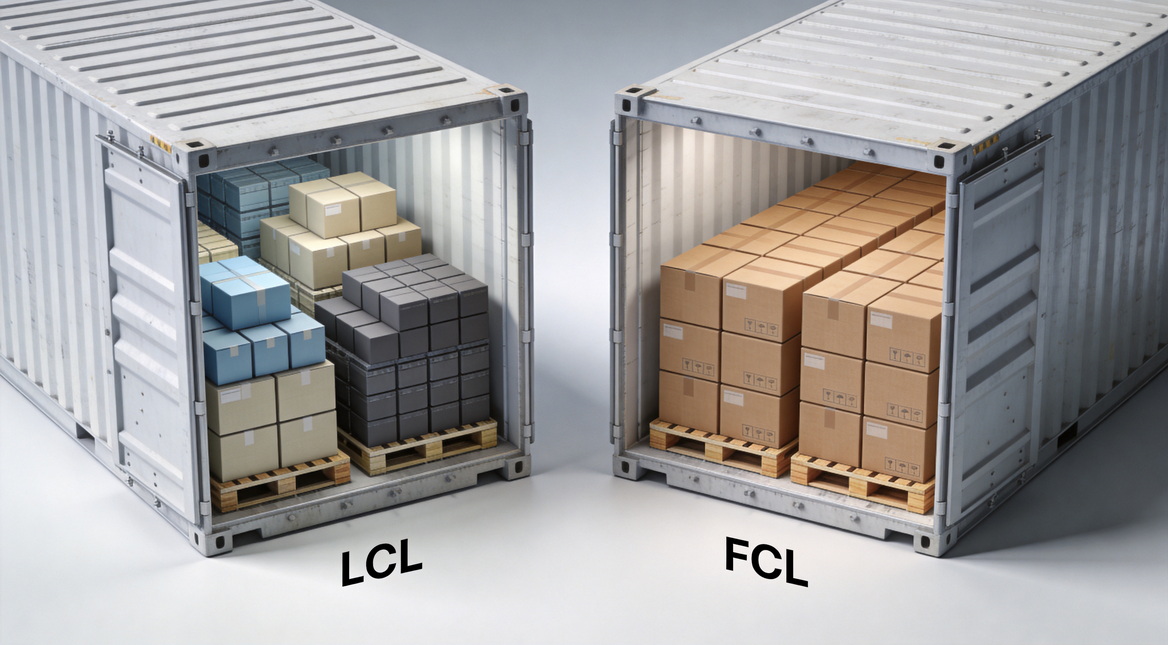
Less-than-container-load shipping combines cargo from multiple shippers in one container.
It can suit businesses that do not have enough goods to justify a dedicated container. However, small shipments may face minimum charges, and destination handling can materially affect the final bill.
Before booking, ask:
- What volume and weight will be billed?
- Which origin and destination charges are included?
- Are there minimum handling fees?
- Does the quotation include customs clearance and delivery?
A low LCL ocean rate does not automatically mean a low delivered cost.
Full-container-load shipping reserves a container for your shipment.
It can become more economical as shipment size increases, but the crossover point varies by route and local charges. There is no reliable universal rule that every shipment above a particular cubic volume should use FCL.
Request both options when your order is large enough for either to be plausible. Also consider handling requirements, cargo compatibility, and unloading arrangements.
Air freight usually costs more to transport substantial cargo, but freight charges do not tell the entire commercial story.
A delayed component may interrupt production. A missed launch may reduce sales. An urgent replacement shipment may cost more than the original saving.
Compare the additional air freight cost with the realistic business cost of waiting.
Consider a hypothetical importer preparing a product launch.
Only part of the order is needed immediately. Rather than sending everything by air, the importer could ship the launch quantity by air and move the balance by sea.
This is an illustrative planning scenario, not a reported customer result.
The approach works only when the urgent quantity is defined carefully. Allow for separate documentation, clearance, and delivery charges before deciding whether splitting the shipment saves money overall.
Landed cost includes the product purchase price and the costs required to bring it to the agreed destination.
For transport comparisons, keep the product value consistent and examine all logistics and import-related charges.
A useful planning formula is:
> Landed cost = product cost + origin charges + international transport + insurance + destination charges + applicable duties and taxes + final delivery.
Avoid counting the same expense twice when a quotation bundles several services.
| Cost category | Questions to ask |
|---|---|
| Supplier collection | Is pickup included, and from which address? |
| Export handling | Are documentation and export clearance included? |
| Main transport | Which surcharges are included, and how long is the rate valid? |
| Destination handling | Who pays terminal or deconsolidation charges? |
| Import clearance | Are brokerage fees included? |
| Duties and taxes | Are these estimated separately or included under stated assumptions? |
| Final delivery | Does the price cover the actual receiving address and unloading requirements? |
| Storage and equipment | What free time and subsequent charges apply? |
Ask the forwarder to identify exclusions in writing. Clear exclusions are more useful than an unexplained "all-in" label.
For air freight, the billed weight generally reflects the greater of actual gross weight and volumetric weight.
This means lightweight, bulky packaging can cost more than its scale weight suggests.
A commonly used air freight calculation is:
> Volumetric weight in kilograms = length × width × height in centimeters ÷ 6,000.
Suppose a carton measures 60 × 50 × 40 centimeters and weighs 12 kilograms.
Its volumetric weight is 20 kilograms. Under this calculation, the chargeable weight would therefore be 20 kilograms, before any applicable rounding or minimum-charge rules.
Confirm the divisor and calculation method for the specific service. Courier products may use different rules.
Useful adjustments include:
- Removing unnecessary empty space.
- Choosing carton dimensions that fit the product.
- Reviewing whether retail packaging can be nested safely.
- Avoiding unnecessary pallet overhang.
- Keeping required cushioning and structural protection.
Ask your supplier for final packed dimensions, not product dimensions. Request an updated quotation if packaging changes.
The cheapest carton is not a saving if it leads to damaged goods.
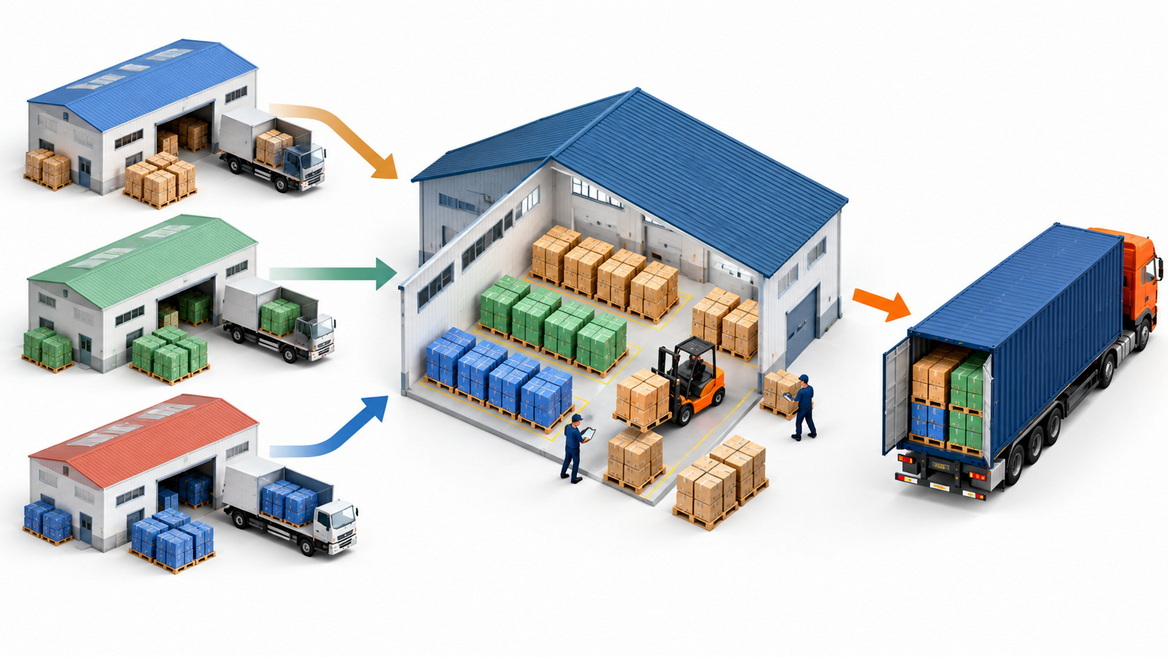
When several suppliers are involved, separate international shipments may duplicate collection, documentation, handling, and delivery charges.
Consolidation can bring compatible orders together before export.
However, it also creates additional coordination requirements. Goods may arrive on different dates, and waiting for one supplier can delay the entire shipment.
1. Confirm each supplier's cargo-ready date.
2. Collect carton quantities, dimensions, and gross weights.
3. Check whether the goods can travel together.
4. Identify labeling, inspection, or repacking requirements.
5. Compare warehouse and waiting costs against expected transport savings.
For some orders, shipping one late supplier separately is better than holding everything.
A forwarder should explain both options rather than treating consolidation as an automatic saving.
Trade terms allocate responsibilities, costs, and risks between buyer and seller.
They help explain why two apparently similar quotations may cover very different services.
- EXW can leave substantial collection and export arrangements with the buyer.
- FCA identifies delivery to the carrier at a named place and can suit different transport modes.
- FOB is intended for sea or inland waterway transport.
- DAP generally leaves import clearance and import duties with the buyer.
- DDP places broader delivery and import-related obligations on the seller.
Always specify the named place and applicable rules version. Ask whether the party offering the service can actually fulfill the stated responsibilities in the destination country.
Do not choose a quotation solely because it carries a familiar abbreviation.
Provide a consistent commercial invoice and packing list, with clear product descriptions, quantities, values, weights, and country-of-origin information.
Confirm classification and destination requirements with the responsible customs professional.
Never reduce declared values or misdescribe products to make a shipment appear cheaper. Transport savings should come from better planning, not inaccurate declarations.
Accurate shipment data helps forwarders identify suitable options and reduces avoidable quotation changes.
Send each provider the same information:
1. Supplier pickup address and destination address.
2. Product description and intended use.
3. Carton or pallet count.
4. Packed dimensions and gross weight.
5. Cargo-ready date and required delivery date.
6. Agreed trade term and named place.
7. Details of batteries, liquids, magnets, or other special characteristics.
8. Required insurance, clearance, and delivery services.
Ask for an itemized quotation showing inclusions, exclusions, estimated transit scope, rate validity, and payment terms.
Also ask what happens if the supplier misses the planned departure. The cheapest booking is less useful if its contingency costs are unclear.
GB FREIGHT AGENCY CO., LTD. provides sea freight and air freight solutions for businesses shipping from China to Europe, North America, South America, Southeast Asia, the Middle East, Africa, and Oceania.
With 15 years of international logistics experience, we coordinate supplier bookings, export customs clearance, transportation, and final delivery arrangements.
Our role is to help you compare workable options—not simply present the lowest headline rate.
Send us your cargo details, supplier location, destination, and delivery deadline. Request a route-specific comparison with clearly stated service coverage and charges so you can choose a shipping plan that fits your budget and operational needs.
Sea freight is generally worth comparing first for large, non-urgent orders. Request both LCL and FCL quotations where appropriate, including origin charges, destination handling, clearance, and delivery.
No. LCL can suit smaller shipments, but minimum charges and local handling may reduce its advantage. Compare complete quotations using your actual cargo volume, weight, and delivery requirements.
Review packaging dimensions, consolidate suitable cargo, and avoid sending non-urgent inventory by air. Confirm the chargeable-weight calculation before booking. Smaller packaging helps only if it preserves adequate product protection.
Not necessarily. Door-to-door describes delivery scope, not automatically who pays import duties or taxes. Check the trade term, quotation exclusions, and customs responsibilities in writing.
A forwarder can compare suitable services, but no provider can reliably guarantee the lowest price across every route and shipment. Evaluate quotation completeness, execution capability, communication, and the consequences of delays.
1. eTower — "How to Shipping Internationally in A Cheapest Way?"
Original article reviewed for its discussion of freight forwarders, carrier comparison, sea freight, discounts, alternative origins, and packaging. Used as a starting point, not as evidence for route-specific savings. [etowertech]
2. DHL Global Forwarding — "Calculating Chargeable Weight by Air, Ocean, Road and Rail."
Technical basis for comparing actual and volumetric weight and for the air freight calculation using a 6,000 divisor. The carton example in this article is illustrative. [dhl]
3. Maersk — "Less-than-Container Load: LCL Logistics & Shipping."
Basis for explaining shared-container shipping, cargo-volume considerations, and the shipment-dependent comparison between LCL and FCL. Carrier-specific limits should not be generalized to every service. [maersk]
4. International Trade Administration — "Determine Total Export Price."
Basis for the landed-cost framework, including product value, insurance, freight, tariffs, taxes, and other fees. [trade]
5. International Trade Administration — "Know Your Incoterms."
Basis for explaining how trade terms allocate transportation, insurance, documentation, customs, cost, and risk responsibilities. [trade]
6. International Trade Administration — "Know Your Incoterms: An Overview."
Supporting guidance on buyer and seller responsibilities for import duties and taxes and the importance of clarifying payment obligations. [beta.trade]


