
Views: 285 Author: GB FREIGHT Publish Time: 2026-10-22 Origin: Site


Content Menu
● Why Norway Matters in International Air Freight
>> What the Latest Industry Figures Mean for Buyers
● Selection Criteria: How These Providers Were Evaluated
● Comparison Table: Five Air Freight Providers Serving Norway-Bound Supply Chains
● 1. GB FREIGHT AGENCY CO., LTD.
>> Best-Fit Application: China-Origin Coordination for Norway-Bound Buyers
>> Core Strengths and Customized Support
>> Best-Fit Application: Structured International Supply Chains
>> Core Strengths and Customized Support
>> Best-Fit Application: International Business Cargo with Defined Service Options
>> Core Strengths and Customized Support
● 4. DSV
>> Best-Fit Application: Global Transport Programs and Multimodal Requirements
>> Core Strengths and Customized Support
>> Best-Fit Application: Norwegian and Scandinavian Distribution Integration
>> Core Strengths and Customized Support
● Technical Air Freight Requirements Buyers Should Understand
>> Capacity Means Accepted Cargo, Not Merely a Published Departure
>> Product Compliance and Transport Compliance Are Different
>> Norwegian Import Responsibility Must Be Explicit
● Buyer's Guide: From Supplier Verification to a Controlled Trial Shipment
>> Step 1: Verify the Contracting Company
>> Step 2: Issue One Comparable Shipment Brief
>> Step 3: Compare Complete Charges
>> Step 4: Run a Representative Trial
● An Overlooked Procurement Trap: "Arrived" Is Not the Same as Delivered
● FAQ
>> 1. How can I verify that a forwarder's certification has not expired?
>> 2. Who is responsible if the forwarder uses the wrong customs classification?
>> 3. Does a door-to-door quotation mean the forwarder handles all Norwegian VAT obligations?
>> 4. Can battery-containing OEM products be booked as ordinary general cargo?
>> 5. How should we handle changing carton dimensions after the factory receives a quotation?
The right air freight partner for Norway is not necessarily the company offering the lowest rate per kilogram. It is the provider that can secure suitable capacity, manage customs responsibilities, protect cargo integrity, and deliver consistently to your receiving location.
This guide compares five providers relevant to Norway-bound supply chains: GB FREIGHT AGENCY CO., LTD., Kuehne+Nagel, DHL Global Forwarding, DSV, and ColliCare Logistics. GB FREIGHT is included first as a China-origin coordination option, not as a Norway-headquartered operator. The remaining companies provide established Norwegian operations or Norway-specific freight services.
The central purchasing principle is accountability. Before appointing a long-term partner, evaluate the complete shipment chain: supplier collection, export documentation, airline acceptance, international transport, import clearance, and final delivery.
Unlike a manufacturing supplier assessment, air freight due diligence does not revolve around factory output, material grades, or production MOQ. Its closest equivalents are confirmed transport capacity, minimum shipment charges, cargo acceptance controls, operational qualifications, and shipment-level performance.

Norway's importance in air cargo comes from its trade flows and logistics infrastructure rather than the manufacture of air freight services.
Avinor identifies seafood, oil, and gas as important drivers of Norwegian cargo demand. Its cargo overview describes Oslo Airport as a major full-freighter hub, handling approximately 200,000 tonnes of air freight annually. This is an airport-level indication of market scale, not a verified 2025 national cargo total.
For procurement teams, these trade flows make Norway a relevant market for temperature-sensitive cargo, time-critical industrial supplies, and international replenishment shipments.
Norwegian coverage also extends beyond Oslo. For example, Kuehne+Nagel lists operations in Oslo, Bergen, Stavanger, Ålesund, Trondheim, and Kristiansand, while ColliCare describes multiple Norwegian locations and domestic distribution capabilities. Buyers should therefore evaluate the destination delivery network alongside the international flight routing.
IATA's full-year 2025 results, published in January 2026, show that global air cargo demand increased by 3.4% compared with 2024, measured in cargo tonne-kilometres. Available capacity increased by 3.7%, while international demand rose by 4.2%.
These figures describe the global market. They do not prove that capacity is readily available on a particular China–Norway routing.
The practical implication is to request lane-specific evidence: current departures, cargo acceptance conditions, available booking options, and recovery arrangements when a shipment misses its planned flight.
This is a fit-based shortlist, not an independently audited ranking. Public company information supports the profiles, but published information alone cannot verify actual on-time performance, negotiated airline allocations, or the quality of an individual account team.
The following framework is suitable for procurement evaluation:
| Evaluation area | Suggested weight | Evidence to request |
|---|---|---|
| Routing and capacity suitability | 25% | Proposed itinerary, booking status, alternatives |
| Customs and cargo compliance | 20% | Written responsibility matrix and acceptance checklist |
| Total landed-cost transparency | 20% | Itemized origin, transport, destination, and delivery charges |
| Communication and exception handling | 15% | Named contacts, escalation process, reporting examples |
| Norway delivery coverage | 10% | Delivery arrangements for the actual receiving postcode |
| Cargo-specific experience | 10% | Relevant shipment references and handling procedures |
These weights are a proposed purchasing framework, not measured scores assigned to the companies.
OEM and ODM support also require a logistics-specific interpretation. Forwarders do not design or manufacture the buyer's products. Their relevant contribution is coordinating shipments from contract manufacturers, checking shipping documentation, arranging consolidation, and supporting customized delivery workflows.
Air freight providers generally do not publish a factory-style production capacity or universal MOQ. Capacity changes by route, date, dimensions, cargo type, and airline acceptance. The table therefore distinguishes published service scope from details that require a written quotation.
| Provider | History | Main fit and market coverage | Capacity evidence | MOQ or minimum-charge position | Certification or qualification position |
|---|---|---|---|---|---|
| GB FREIGHT AGENCY CO., LTD. | Reports 15 years of experience in the supplied company brief; incorporation year not verified | China-origin coordination for international buyers | Confirm routing, airline space, and destination handling for each shipment | No universal minimum verified; request minimum billable charges | Contact page does not establish specific accreditation; request documentation |
| Kuehne+Nagel | Group founded in 1890; Norwegian organization established in 1990 | Global supply chains requiring Norwegian local coverage | Global network and Norwegian operations documented; lane allocation requires confirmation | Shipment-specific quotation required | Verify the applicable legal entity, site, and service scope |
| DHL Global Forwarding | DHL brand founded in 1969; not the founding date of every forwarding entity | International business cargo, including standard and temperature-controlled services | Norway-specific air freight offering documented; shipment capacity requires confirmation | Shipment-specific quotation required | Verify qualifications relevant to the contracted service |
| DSV | Founded in 1976; Schenker acquisition completed in 2025 | Global air freight and integrated Norwegian logistics | Global air freight services documented; booking protection requires confirmation | Shipment-specific quotation required | Check the contracting entity and relevant operating qualifications |
| ColliCare Logistics | Current group journey began in 2007 | Norway and Scandinavia-focused logistics with international connections | General, priority, charter, and courier services documented | Shipment-specific quotation required | Publicly describes IATA-certified air freight capability; verify current entity-level status |
Company history and service descriptions are supported by the companies' published information. No airline allocation, minimum shipment size, or certificate validity has been independently audited for this comparison.
GB FREIGHT AGENCY CO., LTD. lists its head office in Shenzhen, China, together with branch contacts in Hong Kong and Malaysia. Its published service menu includes air freight, customs clearance, warehouse services, door-to-door delivery, and multimodal transport.
According to the company information supplied for this article, GB FREIGHT brings 15 years of international logistics experience and supports shipments from China to Europe and other major world regions. Its exact incorporation year was not established by the reviewed contact page.

The company's service portfolio makes it relevant for buyers seeking to coordinate several origin-side tasks through one contact. Its website identifies multi-supplier consolidation and dangerous-goods logistics among its solution categories. These are stated service offerings rather than evidence that every shipment type or Norway routing is automatically accepted.
For small and medium-sized brands working with Chinese OEM or ODM suppliers, a useful discussion would cover:
- Collection from multiple production sites.
- Matching shipping documents to the purchase order.
- Consolidating goods with different readiness dates.
- Separating urgent replenishment from less time-sensitive cargo.
- Establishing a tailored reporting and approval process.
GB FREIGHT's flexibility, communication efficiency, and cost competitiveness should be tested through an actual shipment proposal. They should not be assumed from company size or marketing language.
Before awarding a China-to-Norway shipment, request the proposed Norwegian clearance and delivery arrangements, the responsible destination partner, a complete charge schedule, and cargo-specific acceptance requirements.
The reviewed page does not substantiate a Norwegian office, proprietary airline capacity, or a particular certification. It also does not establish a dedicated research department. For this type of business, assess service development through practical evidence such as routing alternatives, reporting tools, and process improvements.
Kuehne+Nagel was founded in Bremen in 1890. Its Norwegian organization states that it was established in 1990 and now operates across several Norwegian cities, with more than 200 employees in the country.
Its Norway offering includes air freight, sea freight, road transport, project logistics, customs clearance, transport insurance, and digital services. The group connects its local Norwegian organization with a network spanning almost 100 countries.
Kuehne+Nagel is a relevant candidate for buyers seeking international coordination combined with Norwegian local coverage.
For OEM and ODM supply chains, the relevant customization is logistical: aligning origin collection, international forwarding, customs activity, and delivery with the buyer's purchasing process. Request a shipment-specific operating procedure rather than assuming that every service is included in the standard air freight quotation.
Ask which Norwegian team owns the account, which locations handle the cargo, and whether the proposed service includes destination delivery.
For a smaller account, also test the response process. A large global network does not remove the need for a named contact, clear escalation authority, and written exception procedures.
The DHL brand dates to 1969. That date should not be interpreted as the incorporation year of every DHL Global Forwarding legal entity.
DHL Global Forwarding's Norway air freight page presents services for business cargo, including standard air freight, urgent options, and temperature-controlled transport. Its stated market coverage is global.
DHL Global Forwarding is worth evaluating when a buyer needs a defined international forwarding service rather than treating every shipment as a parcel delivery.
For manufacturers and private-label brands, the quotation discussion should establish cargo handling requirements, origin responsibilities, destination arrangements, and any special controls associated with the product.
Temperature-controlled availability should be confirmed for the actual route and handling chain, not inferred from a general service description.
Confirm that the quotation comes from the intended DHL business unit and specifies the correct service.
Ask whether the proposed transit time includes collection, export processing, import clearance, and final delivery. Also distinguish an estimated departure from confirmed airline acceptance.
DSV was founded in Denmark in 1976. It completed its acquisition of Schenker on April 30, 2025, and its Norwegian website now describes the combined DSV and Schenker organization.
DSV publishes global air freight services with daily worldwide departures. Its Norwegian information describes combined capabilities across air freight, sea freight, road transport, and contract logistics.
DSV is a relevant option for buyers whose air freight requirements sit within a wider transport program.
For OEM and ODM sourcing, a purchasing team can assess how DSV would manage urgent air shipments alongside routine replenishment and destination distribution. The scope must be established in the proposal rather than assumed from the group's overall service portfolio.
The acquisition makes organizational continuity an important procurement question.
DSV's Norwegian page indicates that customers may continue accessing Schenker systems during the transition. Buyers should therefore confirm the contracting entity, booking platform, operational contact, invoicing process, and claims procedure applicable to their account.
This is also why DSV and Schenker should not be presented as two unrelated competitors in a current shortlist.
ColliCare's published history traces its current journey to 2007, when a Norwegian team acquired NHG Trans. The predecessor business dated to 1974. ColliCare states that its air freight business developed through the acquisition of ScanCargo in Oslo in 2011.
The company is headquartered in Norway and lists its own offices across several European countries, China, and India, supported by an international agent network.
ColliCare offers general and special cargo, express and priority shipments, chartering, and on-board courier services. Its Norwegian distribution and warehousing activities make it relevant for buyers assessing the connection between international arrival and local delivery.
For OEM and ODM importers, the useful customization is the connection between inbound freight, storage, order handling, and distribution. Buyers should identify which tasks are performed directly and which depend on partners.
ColliCare publicly describes IATA-certified air freight capability. Request the current accreditation details for the entity handling the shipment, together with cargo-specific acceptance confirmation.
Also compare the final delivery plan for the actual receiving address. Norwegian coverage should be evaluated by shipment requirements, not merely by the existence of a national network.
A forwarder's published service network is not a shipment-level capacity guarantee.
For each booking, request:
1. The proposed origin and destination airports.
2. Any transfer points.
3. Cargo acceptance conditions.
4. Booking status and applicable cut-off times.
5. Recovery arrangements if the planned departure is unavailable.
For oversize, restricted, or temperature-sensitive cargo, obtain written acceptance before goods leave the factory.
A product approval document should not be treated as a complete air transport acceptance package.
Lithium-ion batteries illustrate the distinction. DHL identifies lithium-ion batteries under UN3480 and UN3481 as Class 9 dangerous goods, while its battery guidance identifies UN 38.3 testing as an important transport requirement. Acceptance depends on the actual battery configuration and applicable shipping conditions.
Before booking battery-containing products, provide accurate product descriptions and request a cargo-specific document checklist. Do not assume that a general safety data sheet resolves every requirement.
Norwegian Customs states that the importer remains responsible for compliant importation even when a forwarding agent submits the declaration. It also explains that commodity classification affects duties, taxes, charges, and restrictions.
For VAT-registered businesses, import VAT is calculated and reported to the Norwegian Tax Administration. Customs declarations and supporting documentation remain necessary.
A door-to-door quotation should therefore identify the importer, customs representative, document owner, and party responsible for tax reporting.

Check that the quotation, service agreement, bank beneficiary, and insurance documents refer to the intended legal entity.
Where an accreditation or certificate is claimed, request the certificate number, issuing organization, scope, covered locations, and validity dates. Do not rely on a logo alone.
Send every shortlisted provider the same information:
- Collection address and receiving postcode.
- Cargo-ready date.
- Commodity description and proposed classification.
- Number of packages, dimensions, and gross weight.
- Stackability and packaging details.
- Battery, liquid, magnetic, or other special characteristics.
- Required delivery date.
- Agreed commercial terms and importer details.
This reduces the risk of comparing quotations built on different assumptions.
Request separate figures for collection, export handling, documentation, security-related handling, air transport, destination handling, customs services, and final delivery.
Ask which charges are fixed, estimated, conditional, or payable by another party. Also request the chargeable-weight method, minimum charge, quotation validity, and conditions for remeasurement.
A low transport rate is not meaningful if essential destination services remain unpriced.
The logistics equivalent of a sample order is a controlled trial shipment.
Choose cargo that resembles your normal orders in dimensions, product type, documentation, and delivery requirements. Evaluate:
- Booking response quality.
- Document accuracy.
- Milestone reporting.
- Handling of changes.
- Delivery performance.
- Variance between quoted and invoiced charges.
A convenient trial shipment that excludes your normal complications provides limited evidence for a long-term contract.
A useful internal control is to define exactly what each shipment milestone means.
A quotation may emphasize arrival at an airport, while the purchase order requires delivery to a warehouse. Those are different performance obligations.
Require the proposed workflow to distinguish:
1. Airline acceptance.
2. Aircraft departure.
3. Arrival at the stated gateway.
4. Cargo availability for collection.
5. Customs release.
6. Final delivery.
Then ask who owns each interval and which charges can arise while cargo waits.
This prevents a common comparison error: treating two quotations as equivalent when one ends at an airport and the other includes clearance and delivery. The safeguard is a written handover map with named responsibilities—not merely a shorter advertised transit time.
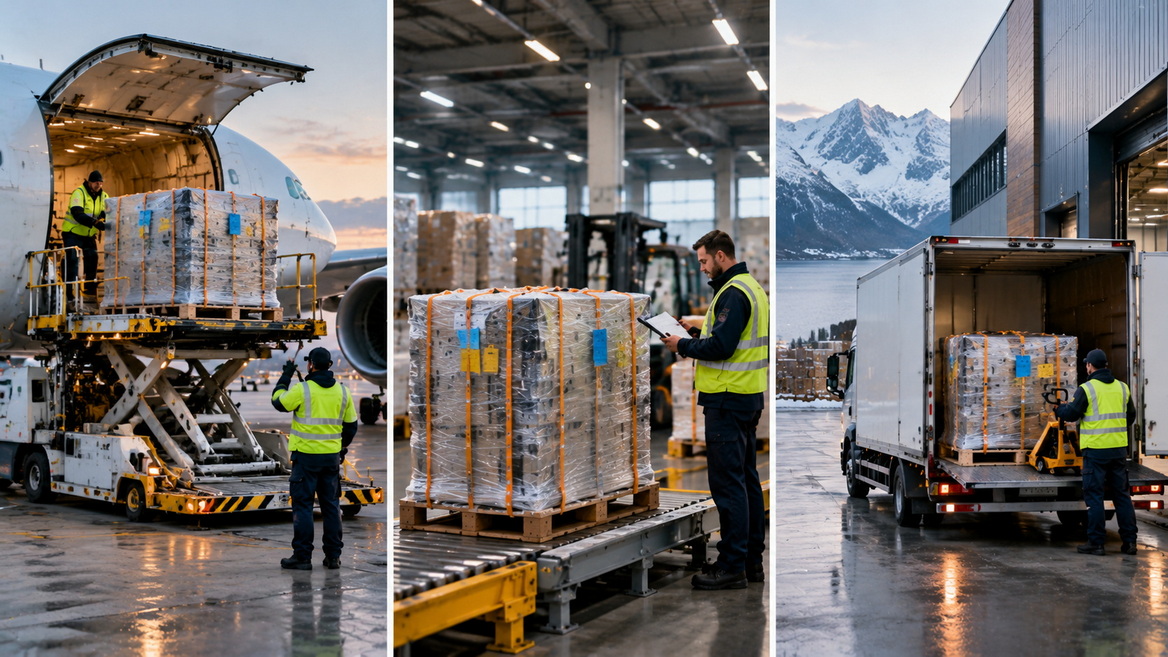
Choosing a top air freight forwarder in Norway requires matching the provider to the operating problem.
GB FREIGHT is relevant for China-origin coordination; Kuehne+Nagel, DHL Global Forwarding, and DSV offer extensive international service portfolios; ColliCare brings a Norway-headquartered network with Scandinavian distribution relevance. These are different purchasing propositions, not proof of an absolute ranking.
For a China-to-Norway project, send GB FREIGHT your supplier locations, cargo details, readiness dates, and receiving postcode. Request an itemized proposal identifying routing, destination responsibilities, cargo acceptance requirements, and available delivery options. Its published contact details include service@gb-freight.com and +86-755-25851060.
Request the complete certificate or accreditation record rather than a cropped image. Check the legal entity, certificate number, scope, covered site, issue date, expiry date, and issuing body.
Where possible, confirm the record directly with the issuer. Also ask whether the qualification applies to the office and service actually handling your shipment. A group-level claim should not replace shipment-specific due diligence.
Norwegian Customs states that the importer remains responsible for compliant importation even when a forwarding agent handles clearance. The importer should therefore review the proposed classification and retain the supporting product information. Contractual responsibility for an agent's error requires separate review of the service agreement.
Not necessarily. Obtain a written statement of who acts as importer and who handles customs representation, tax payment, and reporting.
Norwegian Customs explains that VAT-registered businesses calculate and report import VAT to the Norwegian Tax Administration. A transport service description does not, by itself, define those responsibilities.
Do not assume so. The product configuration matters, including whether batteries are shipped separately, packed with equipment, or installed in equipment.
Lithium-ion batteries are subject to dangerous-goods requirements, and UN 38.3 documentation is an important part of the transport compliance assessment. Submit the exact product and battery information before requesting acceptance.
Make final packed dimensions and weight an approval checkpoint before collection.
Require the forwarder to explain its measurement method and provide supporting measurements when the charge changes. If production packaging is still being developed, treat the initial freight quotation as provisional and compare options using the final packed shipment—not the product's unpacked dimensions.


