
Views: 241 Author: GB FREIGHT Publish Time: 2026-10-20 Origin: Site


Content Menu
● What Does Amazon FBA Processing Time Actually Include?
>> Understand the Main Shipment Statuses
● How Long Does Amazon FBA Receiving Take?
>> Measure Your Own Receiving Performance
● Why FBA Shipments from China Experience Delays
>> Packaging and Labeling Do Not Match the Shipment Plan
>> Box Contents Differ from Submitted Information
>> Transportation and Delivery Are Poorly Coordinated
● Seven Steps to Reduce Amazon FBA Processing Delays
>> 1. Confirm Shipment Instructions Before Suppliers Pack
>> 2. Check Labels at Every Packaging Level
>> 3. Submit Accurate Box-Content Information
>> 4. Follow Destination-Specific Packing Requirements
>> 5. Coordinate the Final Delivery Appointment
>> 6. Retain a Complete Shipment Evidence File
>> 7. Review Exceptions, Not Just Tracking Updates
● A Practical Troubleshooting Workflow for Delayed Shipments
● Build a Replenishment Buffer Around Sellable Inventory
>> Illustrative Inventory Planning Example
● Should You Use Sea Freight, Air Freight, or a Buffer Warehouse?
● How GB FREIGHT Supports Shipments from China
>> Why Does My FBA Shipment Show Delivered but Not Received?
>> Can a Freight Forwarder Speed Up Amazon Check-In?
>> Does Faster Shipping Always Reduce FBA Processing Time?
>> When Should I Request an Investigation for Missing Units?
>> Is Reserved Inventory the Same as Lost Inventory?
Long Amazon FBA processing times can leave inventory unavailable when customers are ready to buy. To reduce Amazon FBA receiving delays, sellers shipping from China need more than fast transportation. Accurate shipment data, compliant packaging, coordinated delivery appointments, and clear tracking all matter.
At GB FREIGHT AGENCY CO., LTD., we bring 15 years of international logistics experience to shipments moving from China to worldwide markets. Our approach is to separate what a freight forwarder can control from what happens inside Amazon's fulfillment network.
The central distinction is simple: delivered does not necessarily mean checked in, fully received, or ready for immediate customer fulfillment.
This guide explains how to prepare shipments correctly, identify where delays occur, and build a more reliable replenishment process.

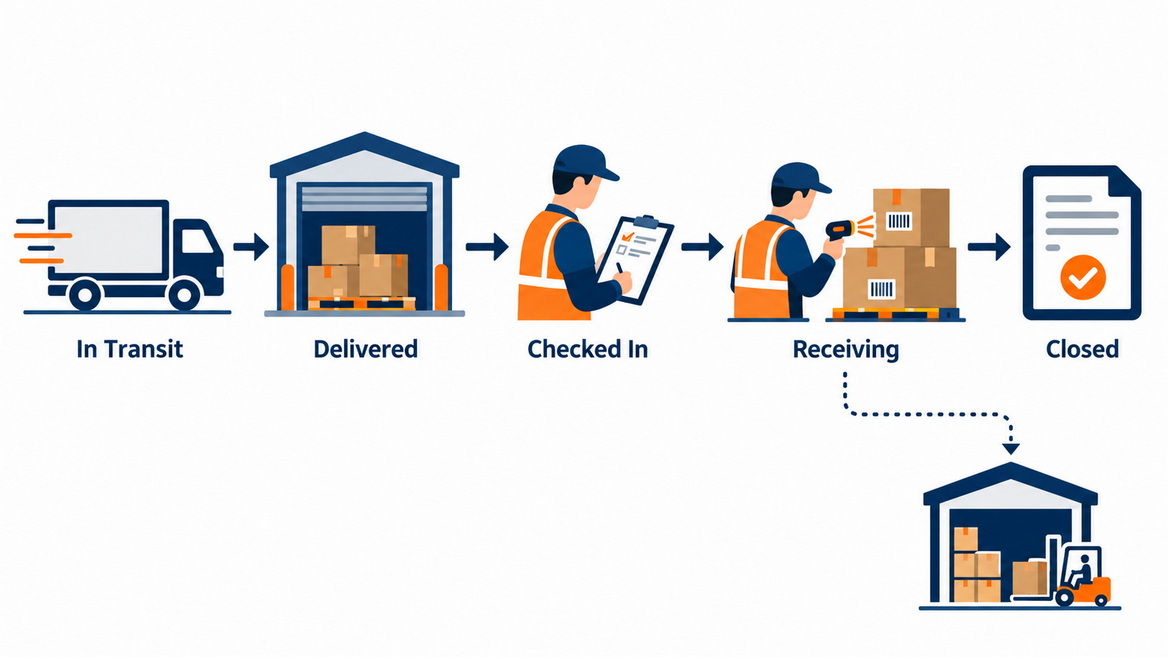
"FBA processing time" often describes several different stages. Treating them as one event makes troubleshooting difficult.
For international sellers, the complete journey includes:
1. Supplier preparation and shipment booking.
2. Export customs clearance and departure from China.
3. International transportation.
4. Import customs clearance and destination handling.
5. Final-mile delivery to the assigned facility.
6. Amazon check-in, receiving, and any subsequent inventory processing.
Only the final stages take place within Amazon's receiving network. A customs hold and a fulfillment-center backlog require different responses.
| Stage | What it generally indicates | What sellers should check |
|---|---|---|
| In transit | Cargo is moving toward its destination | Carrier tracking and current transport milestone |
| Delivered | The carrier reports delivery | Proof of delivery and destination address |
| Checked in | Amazon has registered the shipment’s arrival | Shipment events and receiving progress |
| Receiving | Amazon has started scanning shipment contents | Expected versus received quantities |
| Closed | The shipment’s receiving workflow has closed | Remaining discrepancies and investigation eligibility |
Inventory may also enter reserved categories, including customer orders, fulfillment-center transfers, or additional processing. These categories do not all indicate missing goods.
There is no reliable universal receiving deadline for every shipment, marketplace, and fulfillment center.
The original Freightos guide describes an average of two to six days. Sellers should not interpret that figure as an Amazon service commitment or use it as their only replenishment assumption.
Actual timing depends on receiving capacity, shipment condition, documentation accuracy, product requirements, and subsequent transfers.
For unresolved discrepancies, follow the investigation eligibility information displayed in your account rather than an arbitrary waiting period.
Track four intervals separately:
- Cargo ready to international departure.
- Departure to destination release.
- Destination release to confirmed delivery.
- Confirmed delivery to receipt and inventory availability.
This reveals where your inventory is actually waiting.
A shipment can arrive at port on schedule yet miss its planned delivery appointment. Another may reach Amazon quickly but require additional internal processing. A single "shipping time" figure hides both problems.
Unreadable labels, outdated carton identifiers, and incorrect product preparation can interrupt receiving.
One important distinction is often overlooked: product identification, FBA box identification, and carrier routing labels serve different purposes.
"One barcode per package" is therefore an oversimplification. Sellers should apply the identifiers required for each packaging level while removing or covering obsolete, conflicting labels where instructed.
A supplier may substitute a carton, change a quantity, or mix product variations after shipment information has been submitted.
When the physical shipment no longer matches its records, discrepancies become harder to investigate.
Accurate box-content information should describe what is actually packed, not what the original purchase order expected.
Ocean arrival, customs release, warehouse availability, trucking capacity, and Amazon delivery appointments are separate milestones.
A vessel's arrival date is not a fulfillment-center receiving date.
Planning only around the sailing schedule can leave insufficient time for destination handling and final delivery.
Provide the supplier with the current shipment instructions before final packing begins.
Confirm:
- Product identifiers and quantities.
- Unit preparation requirements.
- Carton contents and dimensions.
- Unique box labels.
- Assigned delivery destinations.
- Palletization requirements, where applicable.
Do not assume instructions from a previous shipment remain suitable. Requirements can vary by marketplace, product category, and shipment workflow.
Request photographs of representative units, cartons, and completed pallets before collection.
Check that labels are readable, unobstructed, and positioned on suitable flat surfaces rather than across seams or corners.
Each shipping carton requires its own applicable FBA box identifier. Palletized shipments also need the required pallet labels.
Do not replace box labels with pallet labels or reuse one carton's unique identifier across multiple boxes.

Reconcile the packing list against the shipment plan before dispatch.
Check SKU, variation, condition, and quantity at carton level. If the supplier changes the packing configuration, update the relevant shipment information before handover.
Missing or inaccurate information can create additional handling. However, a fixed claim that every affected shipment will take an extra seven to ten days is not a dependable planning rule.
Use suitable cartons and protective materials that meet the applicable requirements.
Do not infer carton or pallet limits from warehouse equipment dimensions. A facility's ability to handle a large pallet does not mean every oversized shipment is acceptable.
For fragile, liquid, sharp, expiry-dated, or regulated products, confirm the relevant preparation requirements separately.
If cargo will be repacked at a destination warehouse, make sure the revised shipment still matches its identifiers and records.
For freight deliveries requiring an appointment, confirm which party is responsible for booking it.
The carrier should have accurate shipment references, pallet or carton counts, and destination details.
If the load changes after booking, notify the delivery coordinator. Avoid letting the supplier, forwarder, warehouse, and trucker work from different versions of the shipment.
Keep shipment records together rather than requesting them after a problem develops.
Include:
- Supplier invoices and packing lists.
- Shipment IDs and carton-label records.
- Photographs taken before collection.
- Bills of lading and carrier references.
- Delivery appointment details.
- Proof of delivery.
- Expected and received quantities by SKU.
These records support troubleshooting and any eligible investigation. They do not automatically establish that a reimbursement is due.
A useful update should explain what changed and what happens next.
"Cargo arrived" is incomplete. Ask whether that means arrival at port, customs release, arrival at a warehouse, or delivery to Amazon.
For every exception, record the responsible party, next action, and next review date.
When a shipment appears stuck, diagnose the stage before choosing an action.
| Situation | First action | Useful supporting records |
|---|---|---|
| Carrier reports delivery, but Amazon has not checked it in | Compare delivery details with the assigned destination | Proof of delivery and shipment reference |
| Receiving has started, but quantities remain incomplete | Review shipment events and item-level quantities | Packing list and box-content records |
| Inventory is received but reserved | Check the reservation category | Reserved Inventory report |
| A closed shipment has unexplained shortages | Check investigation eligibility and required documents | Ownership records and transport documents |
| Cargo has not reached Amazon | Identify the transport or customs exception | Tracking, clearance status, and appointment details |
Seller discussions include reports of delivered shipments remaining unchecked in and investigation dates moving. These are useful examples of seller concerns, not representative statistics.
Keep a clear case history when seeking support. Repeatedly describing the problem without shipment references and supporting evidence makes the issue harder to assess.
The best protection against receiving delays is not simply choosing faster transport. It is allowing enough time between replenishment decisions and expected stock depletion.
A practical planning model is:
Reorder point = expected demand during replenishment lead time + safety stock.
Include supplier preparation, international transportation, customs clearance, final delivery, and receiving variability in that lead time.
Suppose a seller averages 20 units per day and plans around a 50-day replenishment cycle.
Expected demand during that cycle is 1,000 units. If the seller adds a 15-day safety buffer, another 300 units are needed.
The illustrative reorder point becomes 1,300 units.
This is a planning example, not a customer result or a recommended buffer for every business. Seasonal demand, cash flow, storage costs, and forecast accuracy should influence the final decision.
Sea freight can suit planned replenishment where the schedule allows for its full door-to-door lead time.
Air freight may help selected urgent shipments reach the destination sooner. It does not guarantee faster processing after Amazon receives them.
A destination buffer warehouse offers another option: hold inventory outside Amazon and release smaller replenishment shipments when appropriate.
| Option | Potential advantage | Main trade-off |
|---|---|---|
| Sea freight | Cost-conscious replenishment planning | More inventory tied up during transit |
| Air freight | Faster international transportation | Higher transport expense |
| Destination buffer warehouse | Greater flexibility over dispatch timing | Additional storage and handling costs |
| Mixed-mode replenishment | Separates urgent stock from routine volume | More coordination and shipment records |
Compare total cost and stockout exposure rather than freight rates alone. Smaller shipments are not automatically processed faster, and splitting cargo can introduce additional charges and complexity.

GB FREIGHT AGENCY CO., LTD. provides transportation solutions for businesses shipping from China to Europe, North America, South America, Southeast Asia, the Middle East, Africa, and Oceania.
Our services cover supplier booking coordination, export customs clearance, transportation, and final delivery.
For Amazon-bound cargo, the practical objective is to align supplier readiness, shipment records, transport milestones, and destination delivery arrangements.
A forwarder can coordinate these external processes. It cannot control Amazon's internal receiving queue or guarantee inventory availability by a particular date.
To request a tailored shipping plan, send GB FREIGHT your pickup location, destination marketplace, shipment volume, carton details, cargo-ready date, product category, and required stock-availability window. We can then discuss a cost-effective route and the preparation responsibilities for your shipment.
Carrier delivery confirmation and Amazon receiving are separate events. First verify the destination and proof of delivery, then review shipment events and follow the applicable support workflow.
A forwarder can reduce avoidable transport and delivery problems through accurate records and coordinated handover. It cannot guarantee priority within Amazon's receiving operation.
No. Faster transport may shorten the international journey, but it does not remove receiving backlogs, labeling problems, or subsequent fulfillment-center processing.
Check the shipment's current investigation eligibility and instructions in your account. Submit the requested ownership and transport evidence when the workflow permits research.
No. Reserved units may be allocated to customer orders, transferring between facilities, or undergoing additional processing. Check the reservation category before treating them as missing.
1. Freightos — "How To Avoid Long Processing Times with Amazon FBA." Original article used as the restructuring baseline; its timing estimates and general packaging advice are qualified rather than presented as universal rules. [freightos]
2. Amazon Seller Central — "Shipping and routing requirements." Official guidance covering shipping cartons, unique FBA box identifiers, pallet labels, and freight delivery coordination. [sellercentral.amazon]
3. Amazon Seller Central — "Seller requirements for LTL, FTL, and FCL deliveries." Official guidance on palletized deliveries and label placement. [sellercentral.amazon]
4. Amazon Seller Central — "Troubleshoot receiving issues." Official guidance on receiving stages, destination checks, discrepancies, and investigation eligibility. [sellercentral.amazon]
5. Amazon Seller Central Forums — "Mastering Shipment Reconciliation: A Step-by-Step Guide." Guidance on checking eligibility, reviewing discrepancies, and preparing ownership and transport documentation. [sellercentral.amazon]
6. Amazon Seller Central Forums — "Demystifying Reserved Inventory: What Sellers Need to Know." Explanation of customer-order reservations, fulfillment-center transfers, and additional processing. [sellercentral.amazon]
7. Amazon Seller Central Forums — "FBA shipment was delivered but has not checked in" and "FBA Investigation Eligibility Date Keeps Increasing." Qualitative seller-reported concerns used for troubleshooting context, not statistical claims. [sellercentral.amazon]


