
Views: 233 Author: GB FREIGHT Publish Time: 2026-08-04 Origin: Site


Content Menu
● Air freight vs ocean freight at a glance
● When air freight is the smarter choice
● When ocean freight makes more sense
● Cost is not just freight rate
● Transit time and schedule risk
● A practical decision framework
● Expert view from a freight-forwarding perspective
● Recommended shipping strategy
● FAQ
>> 1. Is air freight always better for urgent parts?
>> 2. Is ocean freight too slow for manufacturing supply chains?
>> 3. What types of manufacturing parts usually ship by air?
>> 4. What types of manufacturing parts usually ship by sea?
>> 5. Can I combine air freight and ocean freight?
For urgent manufacturing parts, the right choice is usually clear: air freight wins on speed, while ocean freight wins on cost and capacity. The best shipping mode depends on how fast the part is needed, how much it weighs, how valuable it is, and how much production delay would cost.
When a production line stops, every hour can affect output, labor efficiency, and customer delivery commitments. In that situation, logistics is not just a transport decision; it is a business continuity decision. That is why manufacturers often compare air freight and ocean freight before choosing a route for critical parts.

| Factor | Air Freight | Ocean Freight |
|---|---|---|
| Speed | Fastest option, often 3–7 days on common routes | Slower, often 15–45 days depending on route and port pair |
| Cost | Higher, usually priced by chargeable weight | Lower, often best for large or heavy shipments |
| Best for | Urgent, high-value, lightweight, or time-critical parts | Bulk cargo, heavier parts, and non-urgent replenishment |
| Risk profile | Short transit time can reduce delay exposure | Longer transit time increases schedule exposure |
| Capacity | Limited by aircraft space and weight rules | Better for large volume and palletized freight |
Air freight is usually the better option when the part is needed immediately, the production line is waiting, or the shipment value is high enough to justify the premium. It is also a strong choice for small components, samples, electronics, precision parts, and emergency replacement items.
Use air freight when:
- The part is needed to restart production now.
- The shipment is light but expensive.
- The cost of downtime is higher than the freight premium.
- You are shipping a small quantity of critical SKUs.
- The item has a short lead-time tolerance.
For urgent manufacturing parts, the real comparison is often freight cost versus downtime cost, not air versus ocean rate alone.

Ocean freight is usually the better fit when the shipment is large, heavy, and planned in advance. If you are moving raw materials, machine components in volume, or replenishment stock, sea freight can dramatically reduce logistics cost per unit.
Use ocean freight when:
- The order is not time-sensitive.
- The shipment volume is large.
- The cargo is heavy or bulky.
- You want the lowest landed transportation cost.
- You can build inventory earlier to avoid stockouts.
Ocean freight is often the right answer for planned manufacturing supply chains, but it is usually too slow for urgent line-stop situations.
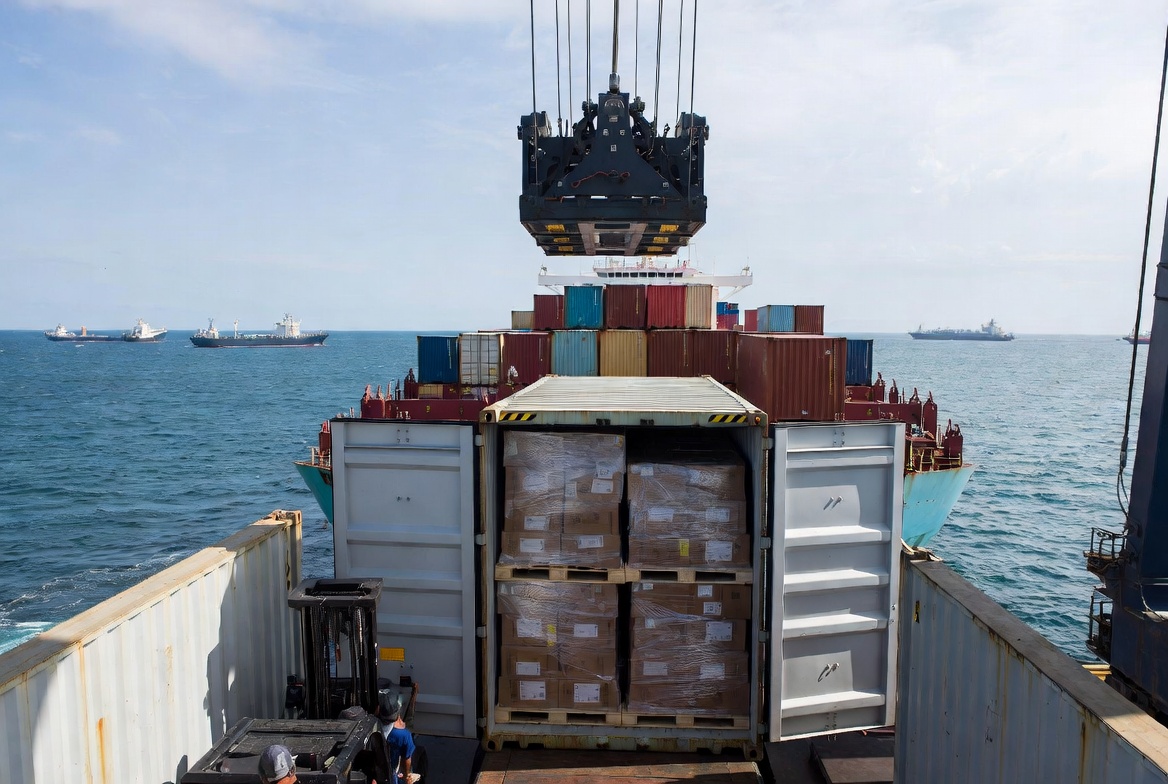
Many shippers compare the quoted rate and stop there, but that approach can be misleading. A cheaper ocean shipment can become expensive if it causes a missed production window, expedited local trucking, overtime labor, or a lost customer delivery.
A practical cost model should include:
1. International freight.
2. Export handling and customs clearance.
3. Destination charges and inland delivery.
4. Inventory carrying cost.
5. Production delay risk.
This is why urgent parts often justify air freight even when the per-kilogram price is much higher.
Transit time is the clearest difference between the two modes. Air freight is far faster and more predictable for urgent shipments, while ocean freight is more exposed to vessel schedules, port congestion, and longer door-to-door lead times.
For manufacturing, that difference matters because a single delayed bearing, valve, sensor, or CNC component can interrupt an entire production chain. If the part is mission-critical, speed is not a luxury; it is a safeguard for output continuity.
Not every part should be treated the same. A small, high-value precision component may be ideal for air freight, while a heavy cast-metal part may be better suited to ocean freight if time allows.
Common examples:
- Air freight: circuit boards, sensors, molds, samples, small replacement kits, urgent spare parts.
- Ocean freight: steel components, bulk hardware, machine frames, production materials, oversized parts.
The best mode depends on the part's urgency, value density, and physical profile, not only on its destination.
A fast decision process can help teams avoid guesswork. Before booking, ask these questions:
1. Is the production line waiting for this part?
2. How many days of inventory remain?
3. What is the value of one day of delay?
4. Is the cargo small enough for air freight economics?
5. Can partial shipment solve the immediate shortage?
If the answer to the first three questions is serious risk, air freight is usually the safer option. If the shipment is planned, heavy, and replenishment-based, ocean freight is usually better.
From a freight-forwarding point of view, the best shipping plan is rarely "air or ocean only." A more effective strategy is often to split urgency from volume. Send the emergency quantity by air, then move the balance by sea to control total logistics cost.
This hybrid approach works especially well for manufacturers with unstable demand, seasonal spikes, or global buyers that cannot tolerate stockouts. It allows operations teams to protect production continuity while keeping long-term freight spend under control.
Many buyers make the same mistakes when choosing between air and ocean freight. Avoid these issues:
- Choosing the lowest quote without calculating downtime cost.
- Sending non-urgent heavy cargo by air.
- Booking ocean freight too late for a production deadline.
- Ignoring customs lead time at origin and destination.
- Forgetting that packaging size can affect chargeable weight.
A good logistics decision should protect both the production schedule and the total landed cost.
If your manufacturing part is truly urgent, start with air freight. If the shipment is part of a planned replenishment cycle, ocean freight is usually the better commercial choice. For many exporters, the most efficient plan is to combine both methods based on urgency and stock policy.
For companies shipping from China to Europe, North America, South America, Southeast Asia, the Middle East, Africa, and Oceania, a freight partner with strong coordination in booking, customs clearance, and final delivery can reduce delays and improve reliability.
If you are sourcing urgent manufacturing parts from China, prepare the part name, dimensions, weight, pickup address, destination port or airport, and required delivery date before requesting a quote. That information makes route planning faster and helps identify whether air freight, ocean freight, or a split shipment is the most efficient solution.
No. Air freight is better when speed matters most, but if the part is not truly urgent, ocean freight may offer far better value.
Not always. It works well for planned replenishment, bulk parts, and inventory that can be ordered ahead of time.
Urgent spares, small precision components, electronic parts, samples, and high-value items often move by air.
Heavy machine parts, bulk materials, oversized components, and non-urgent replenishment cargo usually move by sea.
Yes. Many manufacturers air-ship urgent quantities first and move the balance by sea to balance speed and cost.
- [DHL Global Forwarding — Choosing between air and ocean freight] [dhl]
- [Freightos — Ocean freight rates and shipping insights] [freightos]
- [CFC — Air Freight Shipping from China: A Complete Guide] [cargofromchina]
- [ch-shipping]
- [newfly.jywl]
- [jd-link]
- [freightamigo]


