
Views: 212 Author: GB FREIGHT Publish Time: 2026-08-08 Origin: Site


Content Menu
● Air Freight vs Railway Freight: Quick Comparison
● When Air Freight Is Best for Industrial Equipment
>> Best Air Freight Cargo Types
● When Railway Freight Is Best for Industrial Equipment
>> Best Railway Freight Cargo Types
● Transit Time: Speed Beyond the Main Journey
● Cost Comparison: Look Beyond the Freight Rate
>> Railway Freight Cost Drivers
● Cargo Size, Packaging, and Handling Limits
>> Air Freight Handling Considerations
>> Railway Freight Handling Considerations
● Expert Decision Framework for Importers
>> Choose Railway Freight When
● A Practical Shipment Scenario
● How to Prepare an Accurate Freight Inquiry
● FAQ
>> 1. Is air freight or railway freight cheaper for industrial equipment?
>> 2. Can heavy machinery be shipped by air freight?
>> 3. How is air freight charged for industrial equipment?
>> 4. Is railway freight available from China to North America or South America?
>> 5. What documents are needed to export industrial equipment from China?
>> 6. Can railway freight provide door-to-door delivery?
>> 7. Which is more suitable for urgent spare parts: air freight or railway freight?
For cross-border industrial equipment shipments, air freight and railway freight solve very different business problems. Air freight is built for urgency, while railway transportation creates a practical middle ground between speed, capacity, and transport cost—especially on China–Europe industrial supply chains.
At GB FREIGHT AGENCY CO., LTD., our team has supported international shipments from China for 15 years, from supplier booking coordination and export customs declaration to overseas delivery. In practice, the right mode is rarely determined by freight price alone. Equipment value, production downtime, cargo dimensions, destination access, customs readiness, and the cost of delayed installation all matter.
This guide compares air freight vs railway freight for cross-border industrial equipment, helping importers, manufacturers, distributors, and project buyers select the option that protects both their delivery schedule and total landed cost.
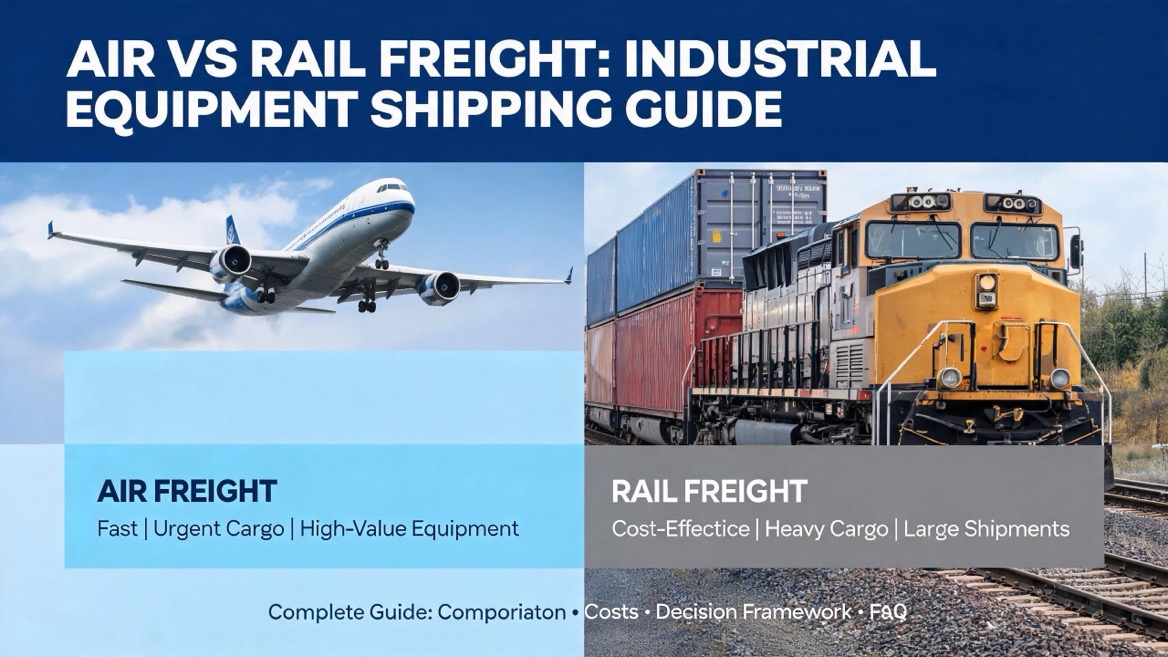
| Factor | Air Freight | Railway Freight |
|---|---|---|
| Typical transit speed | Fastest option, often days rather than weeks | Faster than ocean transport, generally measured in weeks |
| Freight cost | Usually the highest | Typically lower than air freight for suitable routes |
| Best cargo profile | Urgent, high-value, compact equipment and spare parts | Heavy, containerized, larger-volume equipment |
| Geographic reach | Worldwide airport network | Best for rail-connected corridors, particularly China–Europe |
| Capacity | Limited by aircraft type, dimensions, and airline acceptance | Strong capacity for containers and high-volume industrial cargo |
| Shipment flexibility | Frequent flight schedules on major lanes | Fixed rail departures and terminal schedules |
| Environmental profile | Higher emissions intensity | Lower-emission option for long overland movement |
| Main risk | High chargeable weight and airline restrictions | Terminal congestion, schedule changes, and border transfers |
The core decision is simple: choose air freight when every day of delay carries a substantial financial cost; choose railway freight when the cargo is heavy, the route is rail-accessible, and you need a faster alternative to ocean shipping without air freight's premium.
Air freight is not normally the first choice for a complete heavy machine. It becomes the right choice when the cost of waiting is greater than the cost of flying.
For example, a factory may have a production line stopped because one servo drive, CNC controller, hydraulic valve block, sensor, or precision spindle is unavailable. In that situation, sending the replacement by rail may save freight money but extend downtime. A fast air shipment can be the more economical business decision.
- Fast international transit for urgent industrial equipment, samples, tools, and replacement parts
- Broad airport coverage across Europe, North America, South America, Southeast Asia, the Middle East, Africa, and Oceania
- Suitable for high-value cargo that requires faster replenishment
- Effective for project-critical components needed before equipment commissioning
- Easier to combine with express customs procedures on certain routes
- Frequent departures from major Chinese airport gateways
Air cargo rates are commonly based on chargeable weight, which is the higher of actual gross weight or volumetric weight. The standard international calculation commonly uses 6,000 cubic centimetres per kilogram. This matters greatly for industrial equipment packed in large but lightweight wooden crates.
Volumetric Weight (kg)=Length (cm)×Width (cm)×Height (cm)/6000
A 120 × 100 × 100 cm crate has a volumetric weight of 200 kg. Even if the actual equipment weighs only 120 kg, the airline may charge based on 200 kg. For this reason, crate design and packaging dimensions can materially affect an air freight quotation.
Air freight is usually most appropriate for:
- CNC machine spare parts
- Automation controllers and PLC modules
- Industrial laser components
- Precision measuring instruments
- Medical or laboratory equipment components
- Urgent mould parts and tooling inserts
- Electronics used in production equipment
- High-value samples for customer approval
- Emergency replacement parts for overseas factories
For these shipments, the buyer should focus on the cost of business interruption, rather than only the freight rate per kilogram.
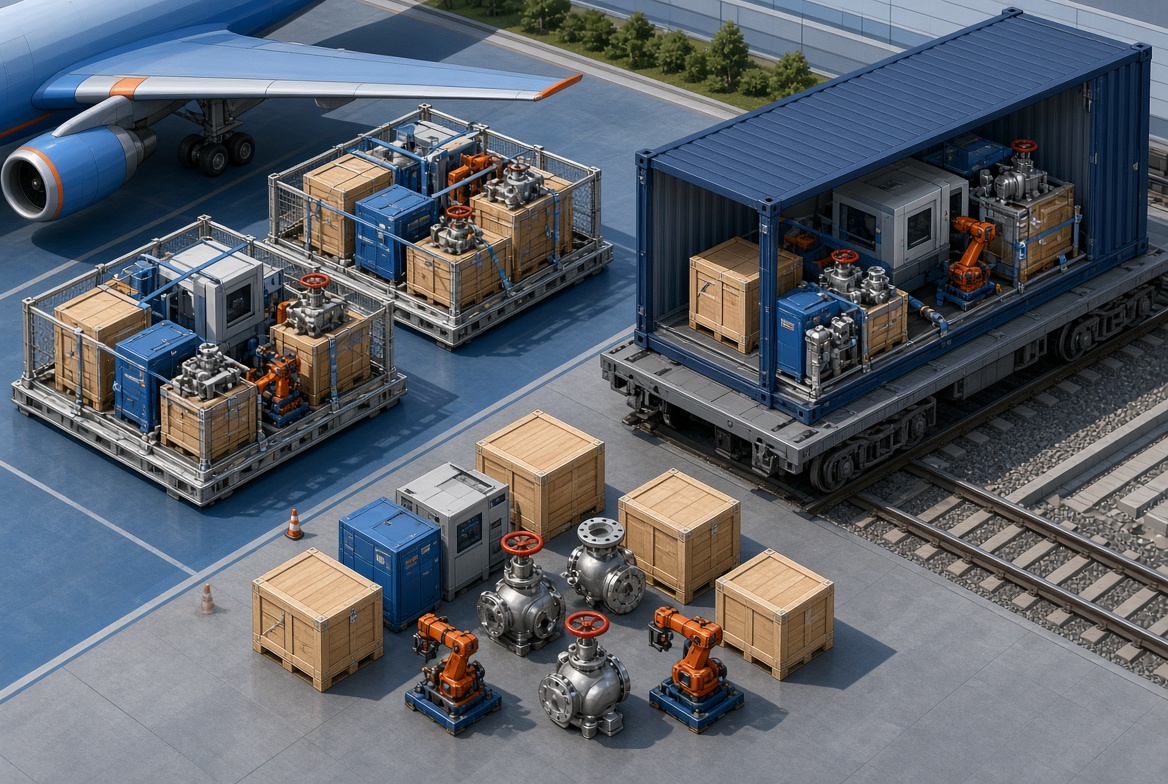
Railway freight is often the more balanced choice for China-to-Europe industrial equipment shipments. It is particularly useful when air freight is too expensive, ocean freight is too slow, and the final destination is accessible through a rail-and-truck delivery network.
For many manufacturers, railway transportation offers a valuable planning window. It allows them to ship machinery, production equipment, industrial components, and containerized goods more quickly than conventional ocean routes while keeping costs below a comparable air freight movement.
- Better cost control for heavy or higher-volume industrial cargo
- Useful transit speed for China–Europe supply chains
- Suitable for full-container loads and consolidated shipments
- Lower dependence on aircraft dimensions and payload limits
- More practical for machinery packed in wooden cases, pallets, or containers
- Supports stable replenishment planning for predictable demand
- Can support lower-emission transport objectives
Rail is not a universal replacement for air freight. It requires a commercially viable rail corridor, compatible origin and destination handling, available terminal capacity, and time for terminal transfers. However, where these conditions are in place, it can be an excellent option for companies moving equipment on a regular schedule.
Railway freight is usually a strong option for:
- Packaged CNC machines and machine tools
- Production-line modules
- Industrial pumps, motors, and valves
- Packaging machinery
- Automotive parts in regular replenishment volumes
- LED production equipment
- Factory fixtures and assembly equipment
- Industrial raw materials and semi-finished goods
- Machinery components shipped in containers
- Spare-parts inventory that is important but not emergency-critical
A train can carry far more industrial cargo than an aircraft. That capacity advantage is especially relevant for exporters shipping multiple crates, oversized wooden cases, or cargo with a high gross weight.
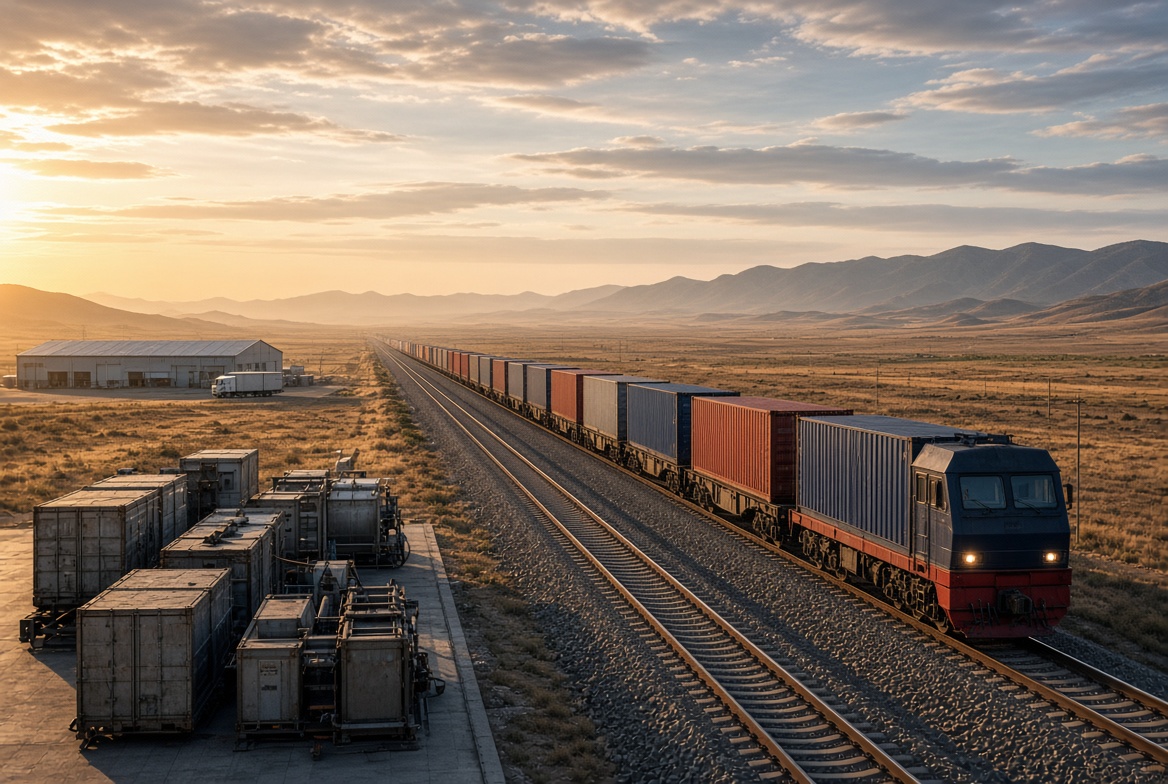
A common mistake is comparing only flight time with train movement time. The more useful comparison is door-to-door transit time.
Air freight may move quickly in the air, but the shipment still needs supplier collection, export declaration, cargo screening, airport handling, flight booking, destination customs clearance, and final-mile delivery. Railway freight also includes collection, terminal receiving, export procedures, rail movement, border operations, destination terminal handling, customs clearance, and trucking to the consignee.
| Delivery Stage | Air Freight | Railway Freight |
|---|---|---|
| Supplier pickup | Usually quick with booked capacity | Requires alignment with terminal cut-off |
| Export customs | Fast when documents are complete | Requires complete documentation before departure |
| Main transport | Usually the fastest | Moderate and schedule-based |
| Border or transit procedures | Generally airport-based handling | May involve multiple border and gauge-transfer operations |
| Destination clearance | Can be rapid for prepared shipments | Depends on terminal, customs status, and local trucking |
| Final delivery | Flexible truck delivery from airport | Usually requires terminal-to-door trucking |
For urgent air freight, document errors can cause a delay that eliminates much of the speed advantage. For rail freight, missing a terminal cut-off may mean waiting for the next available departure. In both cases, pre-shipment preparation is a major driver of delivery reliability.
Air freight is generally priced per chargeable kilogram. Railway freight may be priced by container, cubic volume, gross weight, consolidation terms, route, and final delivery requirements. Neither quote should be evaluated in isolation.
A useful procurement decision compares the full transport cost:
Total Logistics Cost=Freight+Origin Charges+Customs+Insurance+Destination Charges+Inventory Cost+Downtime Risk
- Actual weight and volumetric weight
- Airline capacity and seasonal demand
- Departure airport and destination airport
- Cargo dimensions, especially oversized pieces
- Fuel and security surcharges
- Dangerous goods classification, if applicable
- Airport handling and destination delivery distance
- Customs clearance complexity
- Container type and cargo loading plan
- Origin and destination rail terminals
- Full-container or consolidated service
- Cargo weight, volume, and special handling needs
- Terminal charges and border transfer operations
- First-mile pickup and last-mile trucking
- Customs clearance arrangements
- Route availability and departure schedule
For industrial equipment, a detailed packing list is essential. It should identify each package's dimensions, gross weight, net weight, commodity description, packaging material, serial numbers where relevant, and any battery, liquid, magnetic, or dangerous-goods characteristics.
Industrial equipment is rarely "standard cargo." It may include irregular dimensions, sensitive surfaces, hydraulic systems, batteries, high-value electronics, or wooden packaging that must comply with destination requirements.
Aircraft cargo holds and loading equipment impose strict practical limits. A shipment may be physically heavy, too tall, too wide, or unable to fit through the cargo door of the selected aircraft. Before committing to air freight, confirm:
1. Exact crate dimensions after final packing
2. Gross weight of each package
3. Stackability and lifting points
4. Whether the cargo can be loaded into an aircraft unit load device
5. Whether batteries, lubricants, magnets, or pressure vessels are present
6. Required aircraft type for oversized or heavy pieces
A crate designed for ocean or rail transport may not automatically be suitable for air shipment. Overbuilt packaging can add significant chargeable weight, while inadequate protection can create damage risk during airport handling.
Railway freight handles larger and heavier cargo more naturally, but loading still requires planning. Shippers should assess container dimensions, center of gravity, lashing points, blocking and bracing, moisture protection, and whether the cargo can safely move through terminal operations.
For machinery shipped in a container, the loading plan should show the position of every crate, securing method, weight distribution, and unloading requirements. This reduces the likelihood of cargo movement, terminal refusal, damage claims, and difficulties at destination.
After coordinating industrial equipment shipments from Chinese suppliers, the most reliable approach is to decide by shipment purpose—not by transport mode preference.
- A production line is stopped or likely to stop
- The shipment is a critical spare part
- The cargo is compact and high in value
- The consignee has a hard installation or exhibition deadline
- Inventory shortage would create lost sales or contractual penalties
- The destination is not well connected to a practical rail corridor
- You need the broadest global destination coverage
- The shipment moves between China and a rail-connected Eurasian destination
- Equipment is heavy, dense, or shipped in multiple crates
- The delivery date is important but not an emergency
- You need better cost control than air freight can provide
- The cargo is containerized or can be securely container-loaded
- Your company has a predictable purchasing and production schedule
- You want a faster alternative to long ocean transit
Consider a European buyer importing equipment components from Shenzhen:
- Scenario A: A 75 kg CNC controller is required to restore a stopped machining center. The unit is compact, high-value, and urgently needed. Air freight is normally the logical choice because each day of downtime may exceed the transport premium.
- Scenario B: The buyer is importing six wooden cases of packaging-machine modules weighing 4,800 kg in total. Installation is scheduled several weeks ahead, and the destination can be served through a European rail terminal plus truck delivery. Railway freight may provide a more commercially balanced solution.
- Scenario C: A complete production line includes oversized sections that cannot be accepted on a standard passenger aircraft. The shipment may require rail, sea, breakbulk, or a multimodal solution rather than conventional air freight.
The lesson is clear: urgency, density, dimensions, and business consequences should determine the mode.
A freight forwarder can only design a dependable option when the shipment information is complete. Before requesting an air freight or railway freight quote, prepare the following:
1. Pickup city and full supplier address in China
2. Destination city, postal code, and delivery requirement
3. Commodity description and intended use
4. Number of packages
5. Dimensions and gross weight of every package
6. Commercial invoice value and currency
7. Cargo-ready date
8. Required delivery date
9. Photos of cargo and packaging
10. Battery, liquid, magnet, wood packaging, or dangerous-goods information
11. Whether customs clearance and final delivery are required
12. Whether cargo insurance is needed
This information enables the forwarder to compare realistic routing options, identify restrictions early, and avoid quotations that change after cargo arrives at the warehouse or terminal.
Air freight and railway freight are not competitors in every situation. They are complementary tools for managing different industrial supply-chain risks.
Choose air freight for urgent, compact, high-value industrial equipment and replacement parts. Choose railway freight for heavier, larger, or containerized cargo moving on suitable cross-border rail corridors where cost discipline and predictable transit matter.
GB FREIGHT AGENCY CO., LTD. can evaluate your shipment from supplier pickup in China through export customs clearance, international transport, destination clearance support, and final delivery. Send your packing list, cargo-ready date, and destination details to receive a transport plan tailored to your equipment, deadline, and budget.
Railway freight is generally more economical for heavy, high-volume, or containerized industrial equipment on suitable routes. Air freight may still offer better overall value when a delayed part would stop production or delay an important project.
Yes, but airline acceptance depends on each package's dimensions, weight, cargo-door limits, aircraft availability, and handling requirements. Very large or heavy machinery may require specialized aircraft, charter service, or another transport method.
Air freight is commonly charged on the higher of actual gross weight or volumetric weight. Large wooden crates can therefore be expensive even when the machinery itself is not especially heavy.
Railway freight is most relevant for overland China–Eurasia routes and regional land movements. For North America, South America, Africa, Southeast Asia, the Middle East, and Oceania, air freight has broader direct international coverage, while multimodal solutions may be required for larger cargo.
Common documents include a commercial invoice, packing list, export declaration information, transport documents, and product-specific certificates where required. The exact requirements depend on the commodity, destination, trade terms, and customs regulations.
Yes. Railway freight can be arranged as a multimodal service that combines supplier pickup, export handling, rail movement, destination terminal operations, customs procedures, and final truck delivery.
Air freight is usually more suitable. It offers the fastest long-distance movement and is especially valuable when equipment downtime, missed production, or a customer deadline creates a high cost of delay.
1. [International Air Transport Association (IATA), Cargo Agent's Handbook Resolution 801—air-cargo weight and volume charging rules] [iata]
2. [International Air Transport Association (IATA), Cargo Handling Manual—door-to-door cargo handling procedures] [iata]
3. [European Commission, Freight Transport Statistics—modal split data] [ec.europa]
4. [European Commission, EU Transport in Figures: Statistical Pocketbook] [transport.ec.europa]
5. [European Commission, Sustainable Transport and Investment Plan—freight transport and emissions context] [transport.ec.europa]
6. [European Environment Agency, Greenhouse Gas Emissions from Transport in Europe] [eea.europa]
7. [UNIS, Air Freight Forwarding vs Rail Freight—mode selection overview] [unisco]


