
Views: 283 Author: GB FREIGHT Publish Time: 2026-08-29 Origin: Site


Content Menu
>> What Is Usually Included in DDP Shipping?
>> Why DDP Is Popular With New Importers
>> What Is Usually Included Under FOB?
● DDP Shipping vs FOB Shipping: Main Differences
>> Understanding Total Landed Cost
>> DDP Shipping Cost Advantages
>> FOB Shipping Cost Advantages
>> Example: DDP vs FOB Shipping Costs
● Customs Responsibilities and Import Compliance
>> Key Customs Factors to Check
>> Why Importer of Record Matters
>> DDP Does Not Remove All Buyer Risk
● When Should First-Time Importers Choose DDP?
● When Should First-Time Importers Choose FOB?
● A Practical Decision Checklist
● A Note About FOB and Container Shipping
● How GB FREIGHT AGENCY Supports Global Shipments From China
● Summary
>> Is DDP shipping suitable for first-time importers?
>> Who pays customs duty under FOB shipping?
>> Does DDP shipping include import duties and taxes?
>> Is FOB shipping cheaper than DDP shipping?
>> Can FOB be used for air freight shipments?
For first-time importers sourcing goods from China, the choice between DDP shipping service and FOB shipping affects far more than the freight price. It determines who controls the cargo journey, who manages customs procedures, when responsibility transfers, and whether your first shipment arrives with predictable costs or unexpected problems.
DDP offers a more complete delivery solution. FOB gives buyers more control over the international transportation process. Neither option is always better. The right decision depends on your shipment size, product type, destination country, buying frequency, customs readiness, and business growth plans.
GB FREIGHT AGENCY CO., LTD. has more than 15 years of international logistics experience supporting cargo movements from China to Europe, North America, South America, Southeast Asia, the Middle East, Africa, and Oceania. From supplier booking coordination and export customs clearance to sea freight and final delivery, we help customers select practical transportation solutions based on real shipment requirements.
This guide compares DDP shipping from China and FOB shipping from China in detail, helping first-time importers understand costs, risks, customs responsibilities, and the best situations for each shipping term.

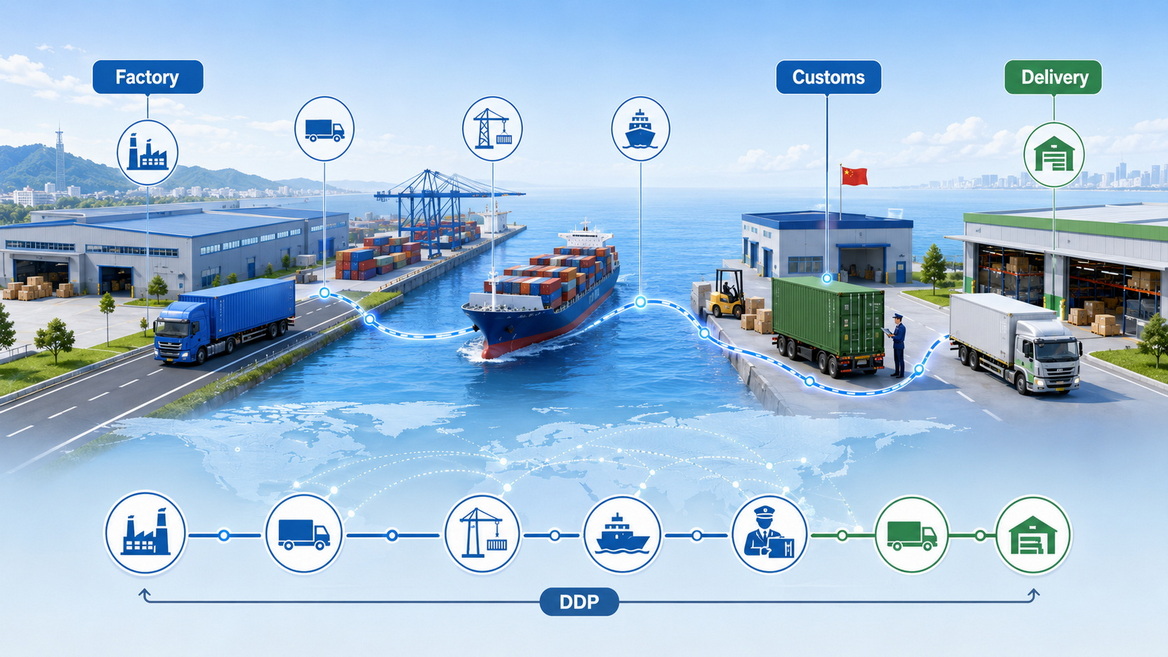
DDP means Delivered Duty Paid. It is a shipping arrangement in which the seller takes broad responsibility for transporting goods to an agreed destination in the buyer's country.
In a standard DDP shipment, the seller or appointed freight forwarder coordinates the transportation process from China to the destination. This often includes export handling, international freight, destination customs clearance, applicable import duty and tax payments, and final delivery.
The buyer usually receives the goods at the agreed address without having to arrange separate ocean freight, customs brokerage, or local trucking.
A DDP shipping service may include the following steps:
- Cargo pickup from the supplier or factory in China
- Booking coordination with shipping lines, airlines, rail operators, or trucking providers
- Export customs declaration in China
- Port, airport, terminal, and document handling
- International sea freight, air freight, rail freight, or truck transportation
- Destination customs clearance
- Import duty and tax payment, when included in the service scope
- Local delivery to a warehouse, business address, fulfillment center, or other agreed location
The exact scope must always be confirmed before cargo moves. A DDP quotation may differ depending on the product, shipping route, country of import, delivery address, and customs requirements.
For a buyer making an early purchase from China, DDP can make international shipping easier to manage. Instead of working with several separate service providers, the buyer receives a more integrated transportation arrangement.
DDP can be a good fit when:
- You are importing from China for the first time
- You do not have a customs broker in the destination country
- You need door-to-door delivery
- You are shipping to a warehouse, office, retail store, or fulfillment center
- You prefer a clearer estimated shipping budget
- You are ordering standard products with straightforward import requirements
- You want one logistics provider to coordinate the major transport stages
For smaller orders, samples, replenishment shipments, and trial purchases, DDP may reduce administrative work and make the shipping process easier to understand.
However, importers should still know what is happening behind the all-in quote. A professional shipping arrangement should clearly explain the destination, transportation method, tax treatment, delivery conditions, customs process, and any charges that may not be included.
FOB means Free On Board. It is a widely used shipping term for ocean freight shipments, especially for cargo exported from China by sea.
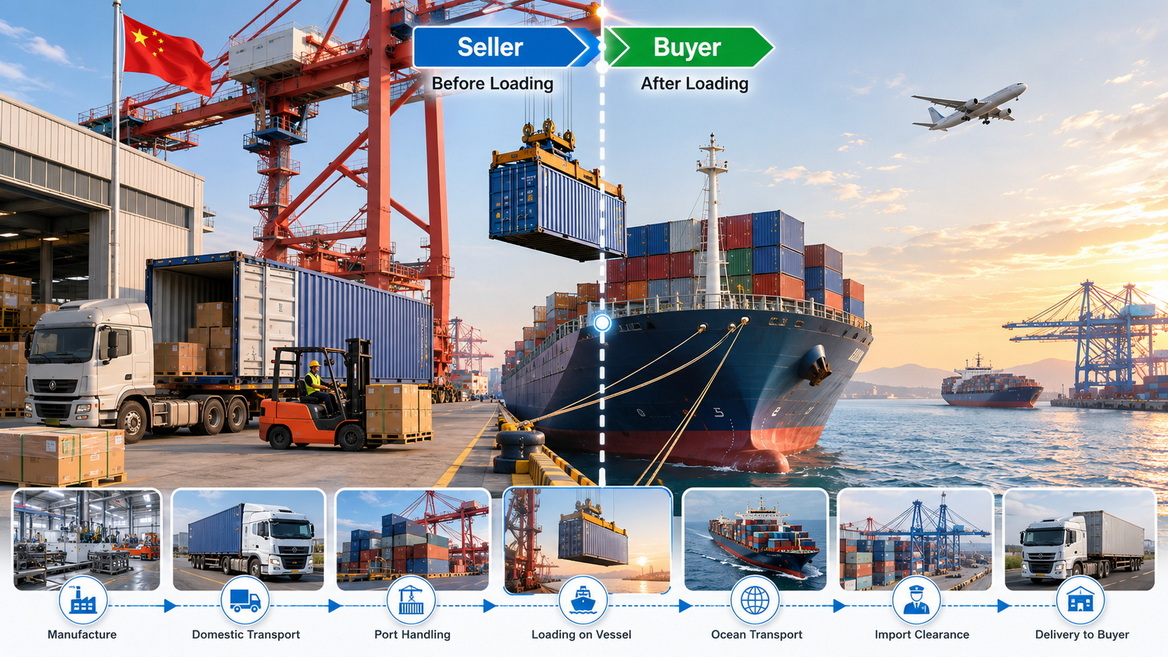
Under FOB shipping, the Chinese supplier is responsible for preparing the cargo for export, completing export customs procedures, transporting the goods to the agreed port of shipment, and loading the goods on board the vessel.
Once the cargo is loaded on the vessel, responsibility transfers to the buyer.
For example:
> FOB Shanghai, Incoterms® 2020
This means the seller is responsible for the cargo until it has been loaded onto the vessel at the port of Shanghai. After loading, the buyer normally arranges and pays for the international sea freight, cargo insurance, customs clearance at destination, import duties, taxes, port charges, and final delivery.
The seller's FOB responsibilities usually include:
- Preparing goods for export
- Packaging cargo for international transportation
- Transporting cargo from the factory to the departure port
- Completing export customs formalities in China
- Handling origin-side documentation
- Delivering cargo to the terminal
- Loading cargo on board the nominated vessel
The buyer's FOB responsibilities usually include:
- Selecting a freight forwarder or shipping line
- Booking international sea freight
- Paying ocean freight charges
- Arranging cargo insurance if needed
- Handling destination customs clearance
- Paying import duties and taxes
- Paying destination port and terminal charges
- Organizing final delivery from the port to the warehouse
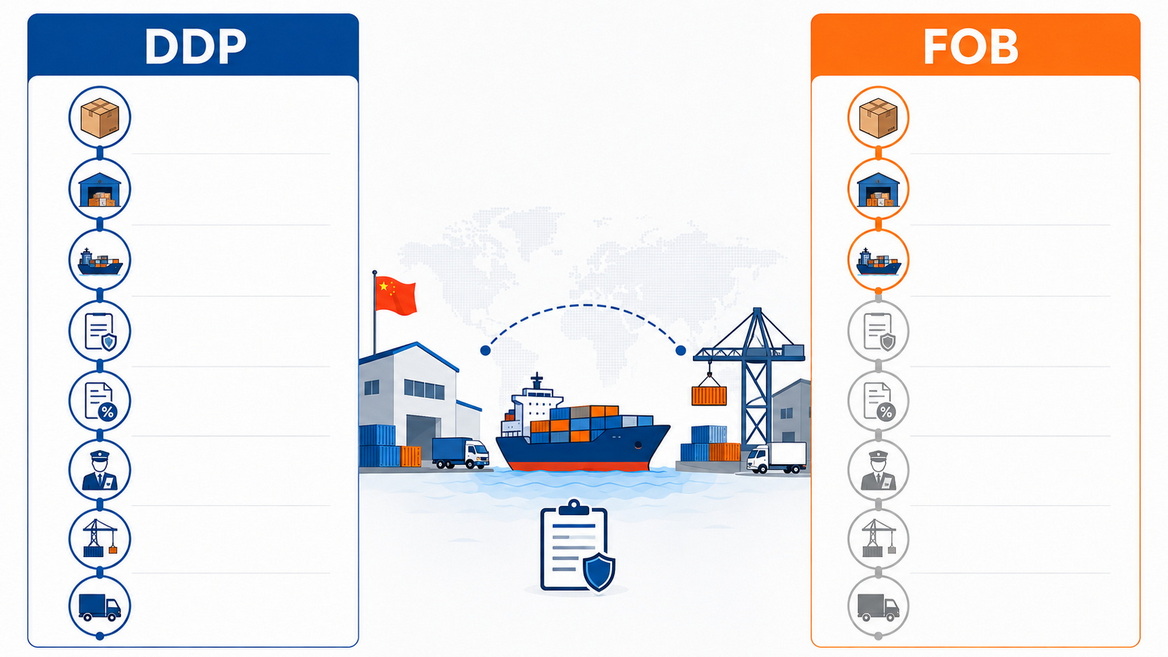
The biggest difference between DDP and FOB is the division of responsibility.
With DDP, the seller or freight forwarder manages most of the logistics journey until the goods arrive at the agreed destination. With FOB, the seller manages the origin side in China, while the buyer manages freight and import activities after the cargo is loaded on the vessel.
| Shipping Factor | DDP Shipping Service | FOB Shipping |
|---|---|---|
| Full term | Delivered Duty Paid | Free On Board |
| Suitable transport mode | Sea, air, rail, truck, and multimodal shipments | Sea freight and inland waterway shipments |
| Best for | First-time buyers seeking simplicity | Importers seeking control and flexibility |
| Origin pickup | Often arranged by seller or freight forwarder | Usually managed by supplier before port delivery |
| Export customs in China | Seller handles it | Seller handles it |
| International freight | Seller or appointed forwarder arranges it | Buyer or buyer’s forwarder arranges it |
| Destination customs clearance | Usually arranged by seller or forwarder | Buyer arranges it |
| Import duties and taxes | Usually paid by seller when included in the quote | Usually paid by buyer |
| Importer of record | Must be confirmed before shipping | Usually buyer or buyer’s appointed entity |
| Risk transfer | Usually near the final delivery point, before unloading | When cargo is loaded onto the vessel |
| Destination charges | Often included but must be confirmed | Normally paid by buyer |
| Freight cost visibility | Convenient but may have less cost detail | Greater cost transparency |
| Consolidating cargo from suppliers | Less flexible | More suitable |
| Long-term import strategy | Suitable for simple or occasional shipments | Suitable for growing, repeat import programs |
A common question is whether DDP shipping is cheaper than FOB shipping.
The answer depends on the shipment. DDP may look more expensive because the quotation can include transportation, customs processing, taxes, and delivery. FOB may initially look cheaper because it only covers the supplier's responsibility through loading at the Chinese port.
The most important number is not the freight quote. It is the total landed cost.
Your total landed cost includes every expense required to move the goods from the supplier to your final destination.
Total Landed Cost=Product Cost+Origin Charges+International Freight+Insurance+Import Duty+Import Tax+Customs Clearance+Destination Charges+Final Delivery
Under DDP, many of these items are combined into one transportation quotation. Under FOB, the buyer receives separate charges from different service providers or receives a more detailed quotation from their freight forwarder.
DDP can offer cost advantages when the buyer values convenience and needs a more predictable shipping budget.
Potential advantages include:
- Fewer separate invoices to manage
- Easier budgeting for first shipments
- Door-to-door transportation planning
- Less time spent coordinating multiple providers
- Lower risk of missing a logistics step
- More convenient delivery to inland addresses
- Reduced need to arrange destination trucking independently
The key advantage is not always a lower price. It is simpler cost management.
FOB can offer stronger long-term cost control, especially for buyers importing regularly from China.
Potential advantages include:
- More control over ocean freight selection
- Ability to compare multiple freight quotations
- Better visibility into port, customs, and delivery charges
- Easier cargo consolidation from multiple Chinese suppliers
- Greater negotiating power as shipment volume grows
- More accurate internal landed-cost tracking
- Better ability to select insurance, customs, and final-mile delivery partners
For a buyer importing several containers each year, FOB often becomes a more efficient structure than relying on a supplier's all-in shipping offer.
Imagine that a buyer is importing furniture accessories from Ningbo, China, to a warehouse in Los Angeles.
| Cost Item | DDP Shipping Option | FOB Shipping Option |
|---|---|---|
| Product value | $10,000 | $10,000 |
| Supplier export handling | Included | Included under FOB Ningbo |
| Ocean freight and destination handling | Included | $2,100 |
| Import duties and processing | Included | $850 |
| Customs brokerage and bond expenses | Included or arranged by seller | $250 |
| Final warehouse delivery | Included | $450 |
| Estimated total landed cost | $13,900 | $13,650 |
In this example, FOB appears less expensive. However, the buyer must manage freight booking, customs brokerage, duty payment, destination coordination, and delivery.
If a buyer is unfamiliar with the process, a delay or missing document can create storage fees, missed warehouse appointments, port charges, or customs-related costs. Those unexpected expenses can quickly reduce the apparent savings of FOB.
For a first shipment, a transparent DDP solution may be worth a slightly higher price. For recurring shipments, FOB often provides better opportunities to improve cost efficiency.
Customs compliance is one of the most important parts of international shipping. A low freight rate cannot protect an importer from delays, penalties, product seizure, or unexpected charges if the shipment is not declared correctly.
Whether you choose DDP or FOB, the goods must comply with the laws and import requirements of the destination country.
Before goods leave China, importers should confirm:
- The correct HS code or commodity classification
- The accurate declared value of the goods
- The country of origin
- Applicable import duty rates
- Import VAT, GST, sales tax, or similar taxes
- Product labeling requirements
- Product testing, certificates, or regulatory approvals
- Restricted-product rules
- Anti-dumping or additional tariff exposure
- Packaging requirements
- Wood packaging compliance requirements
- Documentation requirements for the destination market
Products such as electronics, toys, medical devices, cosmetics, food-contact products, batteries, wireless equipment, chemicals, and children's products may have additional requirements.
The importer of record is the party responsible for making correct customs declarations and meeting destination-country import obligations.
This role can include responsibility for:
- Customs entry documentation
- Product classification
- Customs valuation
- Import duty payment
- Tax payment
- Product compliance documentation
- Regulatory recordkeeping
- Communication with customs authorities
In an FOB shipment, the buyer is commonly the importer of record or appoints an entity to perform this role.
In a DDP shipment, the seller or logistics provider may coordinate import clearance, but the arrangement must be legally and operationally clear. The buyer should understand who is named in the customs process and how taxes, duties, and compliance records will be handled.
DDP can simplify the shipping workflow, but it does not remove the need for product knowledge and responsible supplier selection.
Before agreeing to DDP shipping, buyers should ask:
1. What HS code will be used for the goods?
2. What customs value will be declared?
3. Who will act as the importer of record?
4. Are import duty and tax included in the quoted price?
5. What happens if customs inspects the shipment?
6. Are storage, examination, delivery appointment, or remote-area charges included?
7. Does the product need specific certification, testing, or labeling?
A freight forwarder should be able to explain the transportation process clearly. If the shipping arrangement is vague, the price is unusually low, or customs procedures cannot be explained in detail, the importer should request clarification before releasing the cargo.
DDP is often a practical choice for buyers who want a more complete transportation solution and do not yet have a logistics network in the destination market.
Choose a DDP shipping service when:
- You are placing your first purchase order from China
- You want door-to-door delivery
- You do not have an established customs broker
- You are shipping smaller volumes or trial orders
- You need delivery to a warehouse or inland location
- You want fewer service providers to coordinate
- You prefer a more predictable transportation budget
- Your products have standard and clearly understood import requirements
- You need a simple process for samples, e-commerce inventory, or small replenishment shipments
DDP can be especially useful when a company is testing a new product category or supplier relationship. It allows the buyer to focus more on product quality, sales planning, inventory preparation, and customer demand.
However, the buyer should still request a clear written description of what the service includes and excludes.
FOB is often the stronger choice for buyers who plan to build a long-term importing system.
Choose FOB shipping when:
- You expect to import regularly from China
- You are buying from several suppliers
- You want to consolidate cargo into one shipment
- You are shipping LCL or FCL sea freight
- You want to select your own freight forwarder
- You want separate and transparent freight quotations
- You have access to a customs broker
- You want detailed control over the logistics process
- You need accurate landed-cost reporting
- You want to negotiate shipping independently from the supplier's product price
FOB can give importers more flexibility. For example, if three suppliers are located in Ningbo, Shenzhen, and Guangzhou, a buyer can use a freight forwarder to coordinate factory pickups and consolidate the cargo before international shipment.
This approach can reduce duplicated freight charges and provide better shipment visibility.
Before selecting DDP or FOB, review your shipment using the questions below.
- You want a simple door-to-door shipping arrangement
- You are unfamiliar with customs procedures
- You are shipping a smaller or lower-volume order
- You do not have a customs broker
- You need a single transportation quotation
- You want to reduce administrative workload
- You are testing a new supplier or product category
- You do not need to consolidate multiple suppliers
- You want more control over sea freight
- You plan to import frequently
- You are buying from several Chinese factories
- You want to consolidate cargo
- You need detailed cost visibility
- You have a trusted freight forwarder
- You have a customs broker or import process
- You want to improve your logistics costs over time
- You are shipping larger LCL or FCL volumes
FOB is designed for ocean freight and inland-waterway shipments. It is not the right term for air freight, courier shipments, rail transport, or many multimodal shipping arrangements.
For containerized ocean freight, some buyers and logistics professionals prefer FCA, or Free Carrier, because containers are often delivered to a terminal or carrier before the vessel is physically loaded.
Still, FOB remains commonly used in global trade negotiations for sea freight shipments from China. The most important requirement is that both buyer and seller understand the exact handover point, cost allocation, documentation responsibility, and risk transfer point.
GB FREIGHT AGENCY CO., LTD. provides international logistics solutions for businesses shipping goods from China to worldwide markets.
With 15 years of experience in international freight forwarding, we support transportation from supplier coordination to export procedures, international transit, and final delivery.
Our services can support:
- Sea freight for LCL and FCL shipments
- Supplier pickup coordination across China
- Cargo consolidation from multiple factories
- Export customs declaration support
- Port, terminal, and documentation coordination
- DDP shipping service planning
- FOB sea freight planning
- Delivery coordination at destination
- Route planning from China to Europe, North America, South America, Southeast Asia, the Middle East, Africa, and Oceania
Every shipment has different requirements. The most suitable transportation solution depends on cargo dimensions, product category, destination, shipping timeline, customs requirements, supplier location, and delivery conditions.
DDP shipping and FOB shipping serve different import needs.
DDP shipping is generally more convenient for first-time importers who want a simplified door-to-door process. It can reduce the number of providers involved and make it easier to estimate transportation costs. The buyer should still confirm customs responsibilities, tax treatment, delivery scope, and importer-of-record arrangements before shipping.
FOB shipping gives buyers more control over international freight, customs, and destination delivery. It is often a better long-term choice for importers who plan to ship regularly, consolidate cargo, compare freight rates, and develop stronger visibility into total landed costs.
The best decision is not based only on a freight quote. It should be based on the full shipping process, the product's import requirements, the buyer's experience level, the destination market, and the long-term sourcing strategy.
For shipments from China, a clear transportation plan helps prevent delays, unexpected charges, and avoidable customs problems. Understanding DDP and FOB before confirming an order gives first-time importers a stronger foundation for successful international trade.
Yes. DDP shipping can be suitable for first-time importers because it provides a more complete transportation process, often including freight, import handling, customs clearance, and delivery to the final address. Buyers should still confirm the quotation scope and customs responsibilities in writing.
Under FOB shipping, the buyer usually pays import duties, taxes, customs clearance fees, destination port charges, and final delivery expenses. The seller normally manages export procedures and loading at the agreed Chinese port.
DDP shipping generally includes import duties and taxes as part of the seller's responsibility. However, the buyer should confirm whether the quote includes duty, VAT, GST, customs inspection costs, storage fees, remote-area charges, and delivery appointment charges.
FOB can be less expensive for frequent importers because it allows more control over freight rates, cargo consolidation, customs brokerage, and delivery arrangements. DDP may offer better value for a first shipment when simplicity, coordination, and predictable costs are more important than managing each logistics stage independently.
No. FOB is intended for sea freight and inland-waterway transport. For air freight, courier, rail, or multimodal shipments, other shipping terms may be more appropriate.
1. International Chamber of Commerce. [Incoterms® 2020]
2. European Commission, Access2Markets. [Guide for Import of Goods]
3. International Trade Administration. [Know Your Incoterms]
4. European Commission. [VAT One Stop Shop]
5. Flexport. [Importing into the EU: FAQs]
6. Kuehne+Nagel. [Incoterms 2020: International Trade Regulations]
7. Mohawk Global Logistics. [To DDP or Not to DDP? That Is the Question]


