
Views: 226 Author: GB FREIGHT Publish Time: 2026-09-13 Origin: Site


Content Menu
● What Is DDP Transportation Service?
>> Why DDP Is Popular for Industrial Equipment Imports
>> Typical CIF Shipping Responsibilities
● DDP Transportation Service vs CIF Shipping: Main Differences
● Risk Transfer: Why It Matters for Machinery and Equipment
● Cost Comparison: Why CIF Can Look Less Expensive
>> Common CIF Destination Charges
>> Why DDP Provides Better Cost Visibility
● Total Landed Cost for Industrial Equipment
● Insurance Considerations for Industrial Equipment
>> Cargo Insurance Documents to Review
● Packaging and Handling Requirements for Industrial Machinery
>> Important Packaging Measures
>> When Special Equipment Is Needed
● Customs Compliance and Documentation
● A Practical Example: Packaging Machine Shipment From China
>> Option Two: DDP Transportation Service
● When DDP Transportation Service Is the Better Choice
● When CIF Shipping Is the Better Choice
● How to Choose Between DDP and CIF
● Summary
>> Is DDP shipping more expensive than CIF shipping?
>> Does CIF shipping include import customs clearance?
>> Does DDP include import duties and taxes?
>> Who is responsible for unloading cargo under DDP?
>> Is CIF insurance enough for expensive industrial equipment?
When importing industrial equipment from China, the choice between a DDP transportation service and CIF shipping can affect your budget, customs process, delivery timeline, insurance protection, and operational workload.
For buyers sourcing machinery, production-line equipment, factory tools, electrical components, pumps, packaging machines, or heavy industrial parts, shipping is not simply about moving cargo from one port to another. It is about controlling risk, avoiding unexpected charges, protecting valuable equipment, and ensuring the shipment reaches the final destination in usable condition.
GB FREIGHT AGENCY CO., LTD. has more than 15 years of international freight experience supporting businesses that ship cargo from China to Europe, North America, South America, Southeast Asia, the Middle East, Africa, and Oceania. From supplier booking coordination and export customs declaration to sea freight and final delivery, our work has shown that the right shipping term depends on the importer's experience, cargo type, destination requirements, and desired level of control.
This guide explains the differences between DDP shipping from China and CIF shipping for industrial equipment, helping importers make a practical and informed decision.
> Key takeaway: DDP is generally a door-to-door solution with more responsibility placed on the seller or logistics provider. CIF is generally a port-to-port arrangement that gives the buyer more control after shipment but also creates more import-side responsibility.
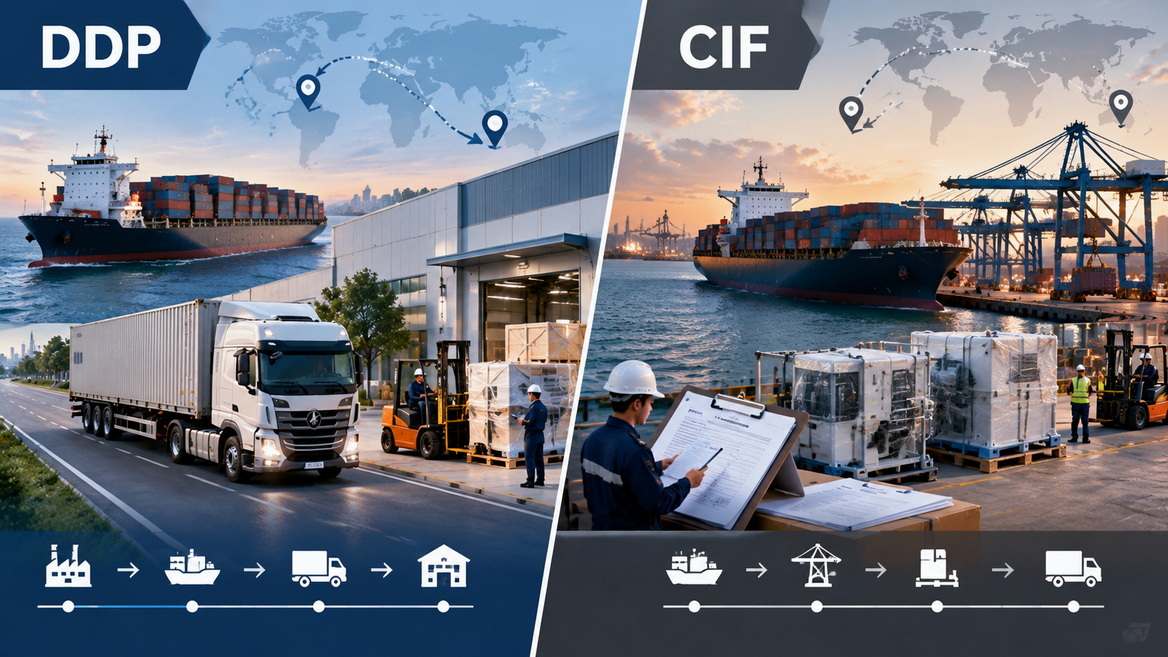
DDP, meaning Delivered Duty Paid, is a shipping arrangement in which the seller is responsible for delivering goods to a named place in the buyer's destination country.
For industrial equipment shipments, a DDP transportation service can cover the entire logistics journey from China to the buyer's final address.
The shipping scope may include:
- Supplier pickup in China
- Cargo consolidation from multiple suppliers
- Export packing and labeling coordination
- Export customs declaration
- Sea freight, air freight, rail freight, or multimodal transportation
- Destination port handling
- Import customs clearance
- Import duty and tax payment
- Inland trucking
- Delivery to a warehouse, factory, project site, or commercial address
Under a standard DDP arrangement, the seller carries the transport cost and cargo risk until the goods arrive at the agreed destination and are ready for unloading.
This makes DDP a practical option for buyers that want a more streamlined shipping process.
Industrial buyers are usually focused on production, maintenance, project delivery, factory expansion, or equipment installation. They may not have a dedicated import department capable of managing destination customs, terminal handling, inland trucking, and delivery appointments.
A DDP solution can reduce the number of parties that the buyer needs to manage.
Instead of separately coordinating with a Chinese supplier, freight forwarder, shipping line, customs broker, port terminal, trucking company, and warehouse team, the buyer may work with one primary logistics coordinator.
DDP can be especially suitable for the following cargo types:
- Packaging machinery
- CNC equipment
- Machine parts and spare parts
- Industrial pumps and valves
- Warehouse racking systems
- Electrical cabinets and control systems
- Compressors and generators
- Factory automation equipment
- Standard mechanical tools
- Palletized industrial components
However, DDP should never be selected only because it appears simple. Importers should still confirm how customs clearance, tax payments, cargo insurance, and delivery conditions will be handled.
CIF, meaning Cost, Insurance and Freight, is a shipping term used for sea freight and inland-waterway transport.
Under CIF shipping, the seller arranges and pays for transportation from China to the named destination port. The seller also obtains marine cargo insurance for the shipment.
However, the buyer should understand one important detail: the seller's responsibility for cargo risk ends much earlier than the vessel's arrival date.
Under CIF, risk transfers from the seller to the buyer once the industrial equipment is loaded on board the vessel at the Chinese port of departure.
This means that even though the seller pays the ocean freight and provides insurance, the buyer becomes responsible for the cargo risk after loading at origin.
| Shipping Activity | Seller Under CIF | Buyer Under CIF |
|---|---|---|
| Export packing and marking | Yes | No |
| Inland transport in China | Yes | No |
| Export customs clearance | Yes | No |
| Loading cargo on board vessel | Yes | No |
| Ocean freight to named port | Yes | No |
| Marine cargo insurance | Yes, minimum required level | May purchase additional cover |
| Risk after cargo is on board | No | Yes |
| Destination terminal handling | Often buyer responsibility, subject to contract | Yes |
| Import customs clearance | No | Yes |
| Import duty, VAT/GST, and taxes | No | Yes |
| Customs broker appointment | No | Yes |
| Inland delivery from port | No | Yes |
CIF can work well for experienced importers that already have customs brokers, local trucking partners, warehouse capacity, and internal shipping procedures.
For new importers, CIF may create more work than expected after the vessel arrives.
The most important difference between DDP and CIF is not simply the freight rate. It is the allocation of cost, responsibility, risk, customs work, and final delivery obligations.
| Comparison Factor | DDP Transportation Service | CIF Shipping |
|---|---|---|
| Main transport scope | Usually door-to-door | Port-to-port |
| Suitable transport modes | Any mode, including sea, air, rail, and trucking | Sea or inland waterway only |
| Seller handles export clearance | Yes | Yes |
| Seller handles import clearance | Yes | No |
| Seller pays import duty and taxes | Yes | No |
| Seller arranges final delivery | Yes, to the named destination | No, unless separately contracted |
| Risk transfer point | At the agreed destination, ready for unloading | Once goods are loaded on board the vessel in China |
| Insurance obligation | No formal Incoterm obligation, but seller carries risk to destination | Seller must arrange minimum cargo insurance |
| Buyer’s logistics workload | Low | High |
| Buyer’s customs control | Lower | Higher |
| Cost visibility | Convenient but requires detailed verification | Often lower initial freight quote, but more destination charges |
| Best for | Buyers seeking simplicity and single-party coordination | Experienced importers with local customs and logistics capability |
Risk transfer is one of the most important factors when shipping industrial equipment.
A shipment may involve rough road transport, container loading, lifting operations, vessel movement, weather exposure, transshipment, port congestion, customs inspections, and inland delivery. High-value machinery can be damaged by vibration, moisture, improper lashing, insufficient packaging, forklift impact, or delayed handling.
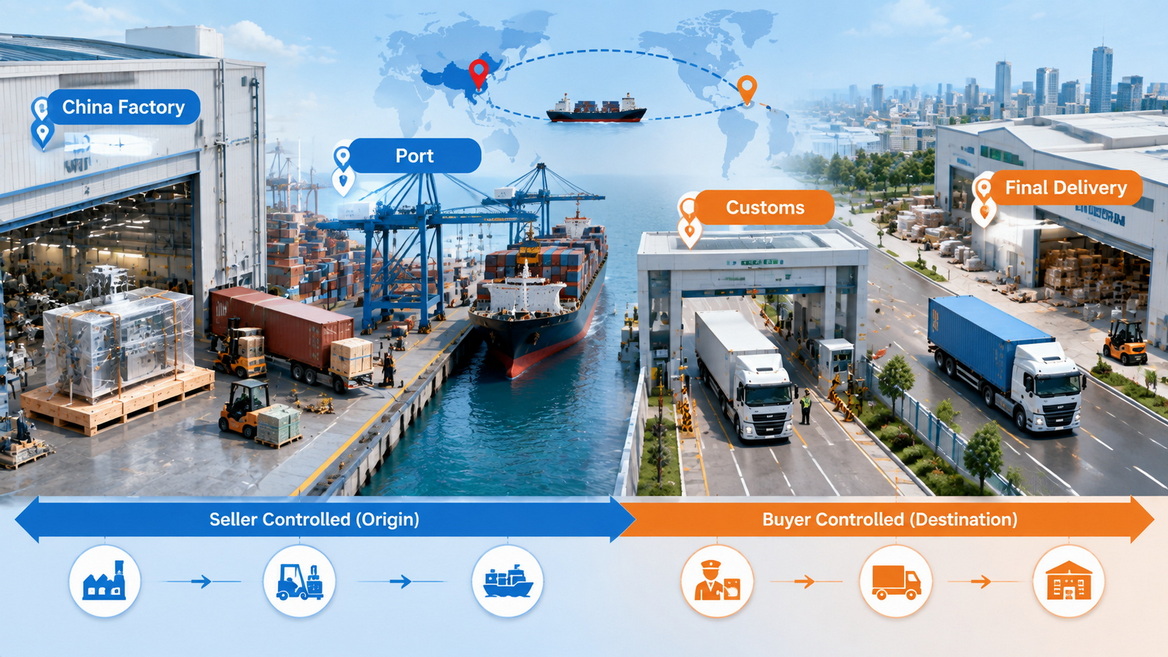
Under DDP shipping, the seller generally remains responsible for cargo risk until the equipment reaches the agreed delivery location.
For example, if the agreed term is:
DDP, Factory Address in Toronto, Canada
the seller or appointed logistics provider is responsible for the shipment through the China export process, ocean freight, Canadian import process, inland trucking, and delivery to the named factory location.
The buyer normally receives the equipment when it is placed at the agreed location and ready for unloading.
This structure can help buyers reduce operational uncertainty, especially if they do not have a local logistics team.
Under CIF shipping, risk transfers when the cargo is loaded onto the vessel at the Chinese port.
For example, if the agreed term is:
CIF Port of Santos, Brazil
the seller arranges the shipment to Santos and pays ocean freight to the port. However, once the machinery is loaded on board the vessel in China, the buyer assumes the risk.
If damage occurs during the sea journey, transshipment, unloading, or cargo handling after the risk-transfer point, the buyer may need to rely on the insurance policy and cargo-claims process.
This is why importers should carefully review the insurance certificate, coverage level, exclusions, deductibles, and claims procedure before shipment.
CIF shipping often appears less expensive in the supplier's initial quotation because it includes fewer destination-side services.
A typical CIF quotation may include:
- Product price
- Export packing
- China inland transport
- Export customs processing
- Basic marine insurance
- Ocean freight to the destination port
However, after the vessel arrives, the buyer may face additional local expenses.
- Port terminal handling charges
- Documentation fees
- Delivery order fees
- Container release charges
- Customs broker charges
- Import duties
- VAT, GST, or sales tax
- Customs inspection fees
- Cargo examination fees
- Warehouse or terminal storage
- Demurrage charges
- Detention charges
- Inland trucking
- Heavy-haul transportation
- Oversized cargo permits
- Crane or forklift services
- Delivery appointment charges
For large machinery, these charges can be significant.
A buyer may receive a competitive CIF freight rate, only to discover that the total cost of port handling, import clearance, inland delivery, and equipment unloading is much higher than expected.
A properly prepared DDP quotation usually includes more of the transport chain in one price.
This can make budgeting easier because the buyer receives a clearer estimate of the total landed cost.
However, importers should always ask for a detailed scope of service.
A complete DDP quotation should identify:
1. The full delivery address and postal code
2. The equipment description
3. Total number of packages
4. Package dimensions
5. Gross weight and total volume
6. Shipping method and proposed route
7. Customs-clearance scope
8. Included import duty and tax scope
9. Destination handling charges
10. Final delivery conditions
11. Insurance coverage
12. Excluded charges and special conditions
A clear shipping scope protects both the buyer and the logistics provider from misunderstanding.
When comparing DDP transportation service and CIF shipping, buyers should not compare only the ocean-freight price.
The better comparison is the total landed cost.
Total Landed Cost=Equipment Value+Freight+Insurance+Port Charges+Customs Costs+Duties and Taxes+Inland Delivery+Handling Costs
For industrial equipment, additional handling costs may include:
- Export crating
- Wooden-case packaging
- Moisture barrier protection
- Vacuum packing
- Heavy-lift loading
- Container blocking and bracing
- Lashing and securing
- Flat-rack or open-top container use
- Breakbulk handling
- Special delivery permits
- On-site lifting support
A lower ocean-freight rate does not always result in a lower total shipping cost.
Industrial equipment can be expensive, heavy, fragile, and difficult to replace. Even relatively small damage can affect performance, calibration, warranty coverage, or installation schedules.
CIF includes a basic marine cargo-insurance requirement. However, this basic coverage may not provide the level of protection required for high-value or specialized machinery.
Buyers should review whether the insurance covers:
- Water damage
- Moisture and condensation
- Theft or pilferage
- Forklift damage
- Cargo shifting
- Partial loss
- Container damage
- Transshipment damage
- General average contributions
- Machinery breakdown during transport
- Delay-related loss
- Packaging defects
Not all risks are covered by a standard cargo-insurance policy.
For high-value equipment, buyers may want to request additional cargo protection before shipment begins.
Before shipment, confirm the following information:
- Insured party name
- Cargo description
- Cargo value
- Voyage route
- Port of loading
- Port of discharge
- Policy coverage level
- Exclusions
- Deductible amount
- Claims contact details
- Survey requirements
- Claim submission deadline
If machinery arrives damaged, fast action is important. The consignee should take photos, inspect the cargo before signing delivery paperwork, note visible damage, retain packaging materials, and notify the relevant parties promptly.
Industrial equipment should not be treated as ordinary cargo.
A professionally prepared shipping plan should consider the equipment's dimensions, weight distribution, lifting points, fragile components, electrical systems, and environmental sensitivity.
For industrial machinery shipped from China, consider:
- Heavy-duty wooden crates
- ISPM 15-compliant wood packaging
- Steel frames for heavy equipment
- Vacuum-sealed moisture protection
- Desiccant bags
- Corrosion-prevention wrapping
- Shock indicators
- Tilt indicators
- Reinforced base frames
- Lashing points
- Internal protection for control panels
- Clear lifting instructions
- Serial-number identification
- Waterproof labels
- Center-of-gravity markings
For heavy equipment, correct lashing and container loading are essential. Poor weight distribution can create equipment damage, container damage, safety risks, and claims disputes.
Some industrial cargo requires specialized shipping equipment, including:
- Open-top containers for cargo loaded from above
- Flat-rack containers for oversized or heavy machinery
- Refrigerated containers for temperature-sensitive goods
- Breakbulk vessels for very large project cargo
- RoRo vessels for wheeled machinery
- Heavy-lift trucks for inland transportation
- Cranes and rigging teams for final unloading
For these shipments, CIF may provide more destination-side control to experienced buyers. DDP can still be suitable when the logistics provider has the capability to arrange compliant project delivery to the final destination.
Whether you choose DDP or CIF, accurate shipping documentation is essential.
Industrial equipment shipments may be delayed if product descriptions, HS codes, declared values, country-of-origin details, or packing-list information are incomplete or inconsistent.
Common shipping documents may include:
- Commercial invoice
- Packing list
- Bill of lading
- Certificate of origin
- Insurance certificate
- Export declaration
- Product specification sheet
- HS code information
- Import license, where required
- Product compliance certificates
- Fumigation certificate for wooden packaging
- Inspection certificate, where required
- Serial-number list
- Machinery manual or technical documentation
Some industrial products require additional review because of electrical, environmental, energy-efficiency, safety, pressure-equipment, or product-certification requirements.
Buyers should not assume that a DDP arrangement eliminates the need for accurate product information. The supplier and importer should provide complete and truthful cargo details before booking.
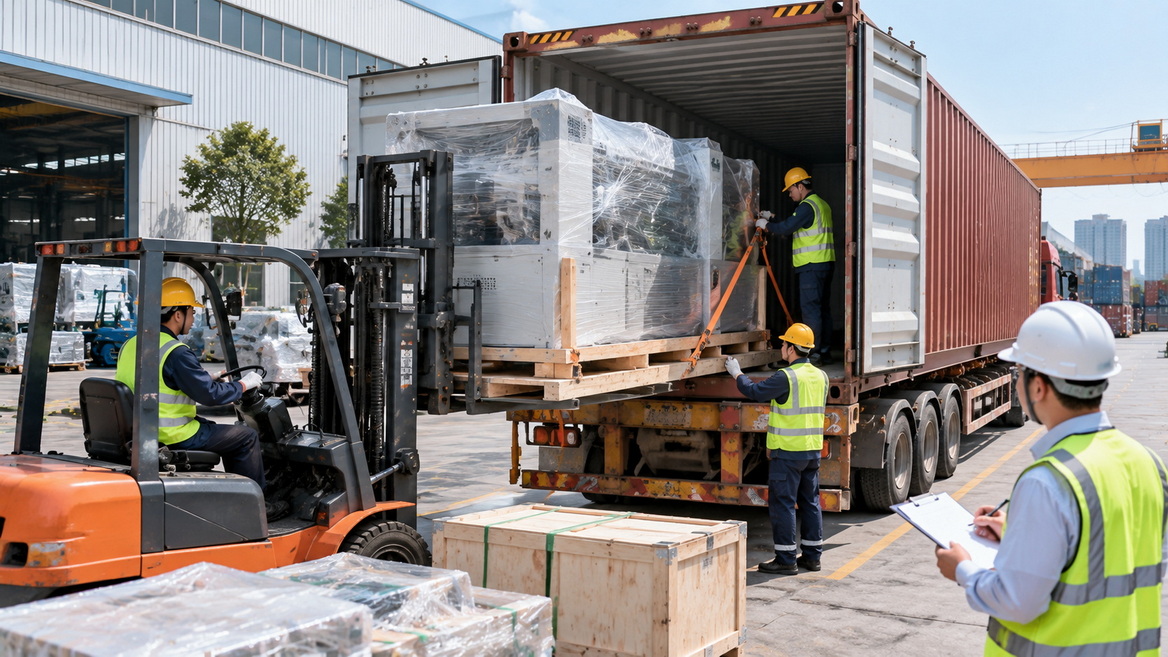
Consider a company importing an automatic packaging machine from China to a warehouse in the United States.
The machine is packed in two wooden crates and one accessory pallet. The total gross weight is 4,800 kilograms. The buyer needs delivery to a commercial warehouse with a loading dock.
The supplier offers:
CIF Port of Los Angeles
The supplier handles export packing, China customs declaration, ocean freight, and basic cargo insurance.
After the shipment arrives in Los Angeles, the buyer must arrange:
- Customs broker services
- Import clearance
- Duty and tax payment
- Terminal handling
- Container release
- Trucking to the warehouse
- Delivery appointment
- Unloading equipment
- Storage management if cargo collection is delayed
This solution can work well for a buyer with an established U.S. import team and reliable local transport partners.
The supplier or freight forwarder offers:
DDP to the buyer's warehouse in the United States
The provider arranges export operations, ocean transportation, import clearance, tax and duty payment, and final trucking.
The buyer mainly needs to prepare the receiving location, delivery appointment, forklift capacity, and unloading team.
For an importer without a dedicated logistics department, this can be a more manageable option.
The important point is that neither option is automatically better. The best choice depends on the buyer's experience, cost priorities, destination network, and shipment complexity.
DDP is often a suitable choice when:
- You are importing industrial equipment from China for the first time
- You do not have a local customs broker
- You do not have an internal import or logistics team
- You need delivery directly to a warehouse, factory, or commercial address
- You want a more predictable shipping budget
- You are consolidating cargo from several Chinese suppliers
- You want one logistics coordinator for the shipment
- You prefer to reduce destination-port coordination
- Your equipment has standard import requirements
- Your delivery location is accessible for commercial trucks
DDP can reduce administrative work and simplify the supply chain. It is particularly valuable when the buyer prefers to focus on equipment installation, production planning, and business operations rather than international transport management.
CIF shipping may be a better option when:
- You have a professional customs broker in the destination country
- You regularly import equipment from China
- You can manage duties, taxes, and customs documents internally
- You have reliable trucking and warehouse partners
- You want greater control of destination port handling
- You need to arrange specialized machinery transport after port arrival
- You want to select your own insurance coverage
- You are shipping full containers on a regular basis
- Your company can manage demurrage and detention risk
- You need detailed visibility into local logistics charges
CIF can offer more operational flexibility, especially for experienced importers with established destination-side infrastructure.
Before confirming your shipping term, ask these questions:
1. Does your company have the ability to manage import customs clearance?
2. Do you have a local customs broker and inland trucking partner?
3. Can your warehouse receive heavy machinery safely?
4. Does the destination site have a loading dock, forklift, crane, or rigging team?
5. Are import duties and taxes clearly understood?
6. Does the equipment require special permits or product certifications?
7. Is the cargo standard, oversized, fragile, or high value?
8. Do you need final delivery to a factory, warehouse, or project site?
9. Is total landed-cost predictability more important than direct logistics control?
10. Does your company have the resources to manage insurance claims if needed?
If your answers show limited customs and destination logistics capability, DDP may be the more practical choice.
If your business has strong import experience and wants greater control over destination handling, CIF may offer a better long-term structure.
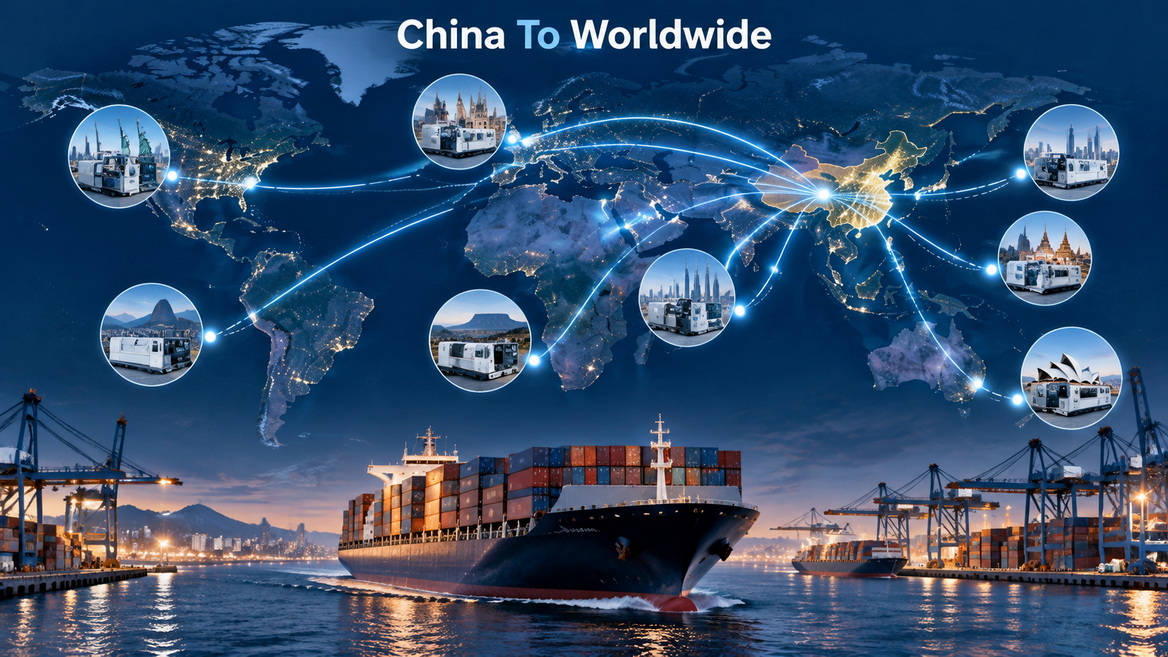
DDP transportation service and CIF shipping both support international industrial equipment shipments from China, but they serve different types of buyers.
DDP shipping is generally better for buyers seeking a simpler, door-to-door process. It can include export coordination, freight, customs clearance, duties, taxes, and final delivery. This reduces the buyer's workload and can improve cost predictability.
CIF shipping is generally better for experienced importers that can manage customs clearance, destination-port charges, inland delivery, insurance review, and local logistics. It can provide more control, but the buyer assumes risk once the cargo is loaded on board the vessel in China.
For industrial equipment, the final decision should be based on more than freight price. Cargo value, packaging requirements, import compliance, destination infrastructure, insurance coverage, customs capability, and total landed cost should all be considered.
GB FREIGHT AGENCY CO., LTD. supports businesses shipping industrial equipment from China to worldwide destinations. By reviewing cargo specifications, destination requirements, and delivery conditions before booking, importers can build a safer, clearer, and more efficient logistics plan.
DDP may have a higher quoted price because it includes more services, such as destination customs clearance, duties, taxes, and final delivery. However, CIF may lead to additional local charges after the vessel arrives. The best comparison is the total landed cost rather than the ocean-freight rate alone.
No. Under CIF shipping, the seller normally handles export customs procedures in China. The buyer is generally responsible for import customs clearance, duties, taxes, customs broker fees, destination port charges, and inland delivery.
DDP usually includes import customs clearance and payment of applicable duties and taxes. However, the buyer should always confirm the exact scope in writing because tax treatment, cargo type, destination regulations, and delivery requirements can affect the quotation.
Under standard DDP terms, the seller delivers the equipment to the agreed location ready for unloading. The buyer is normally responsible for unloading unless the shipping agreement specifically includes a forklift, crane, tail-lift service, rigging team, or inside delivery.
Basic CIF insurance may not provide enough protection for expensive, fragile, or highly specialized machinery. Buyers should review the insurance policy carefully and consider requesting broader coverage for risks such as moisture damage, theft, cargo shifting, forklift damage, and partial loss.
1. International Chamber of Commerce. [Incoterms® 2020]
2. International Trade Administration, U.S. Department of Commerce. [Know Your Incoterms]
3. Maersk. [Delivered Duty Paid (DDP) Incoterms® Explained]
4. ICC Academy. [Incoterms® 2020: DAP or DDP?]
5. Kuehne+Nagel. [Incoterms 2020 Guide]
6. UN Trade and Development. [Review of Maritime Transport 2024]


