
Views: 258 Author: GB FREIGHT Publish Time: 2026-10-13 Origin: Site


Content Menu
● What Is Multimodal Transport Compared with Single-Mode Shipping?
>> Multimodal transport: connecting different transport modes
>> Single-mode shipping: defining the comparison correctly
>> Multimodal vs intermodal transport
● Multimodal Transport vs Single-Mode Shipping: Comparison Table
● Cost Comparison: Calculate More Than the Freight Rate
>> Compare equivalent service boundaries
>> Include inventory and disruption costs
● Transit Time and Reliability: Measure Delivery, Not Departure
>> Why faster linehaul can still mean later delivery
>> Build a realistic reliability measure
● Cargo Handling, Liability, and Customs Responsibilities
● Disruption Planning for Global Supply Chains
>> Expert planning insight: protect critical quantities first
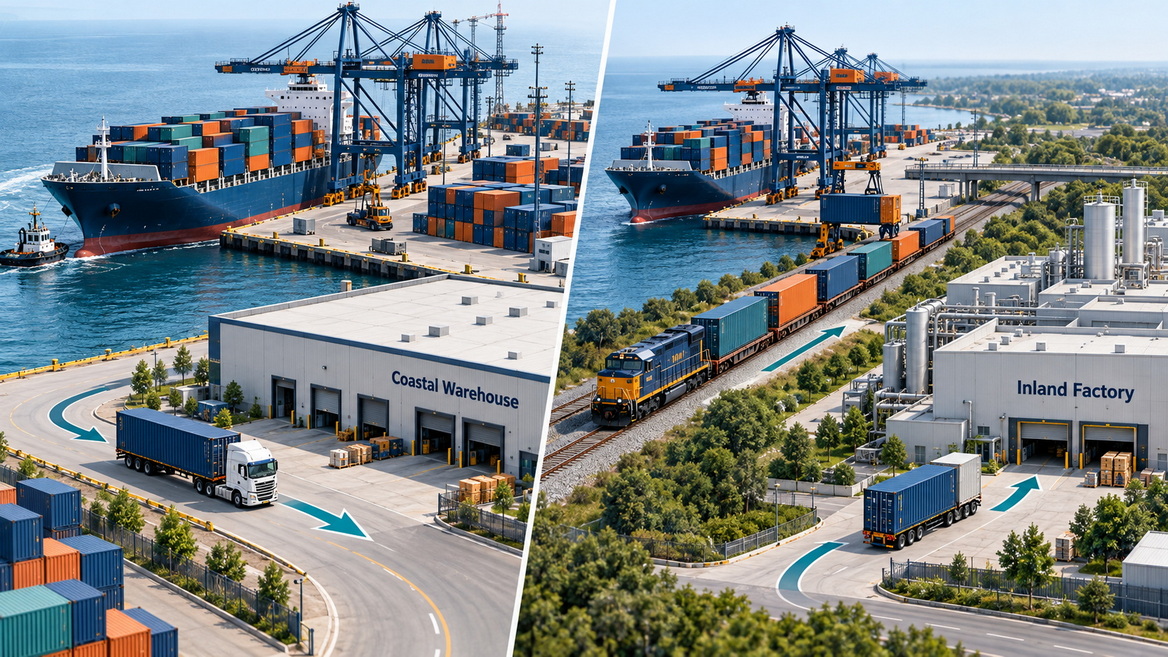
● Practical Scenario: Coastal Warehouse vs Inland Factory
● How to Choose the Right Shipping Strategy from China
>> Step 1: Define the shipment accurately
>> Step 2: Set the real delivery requirement
>> Step 3: Request comparable route proposals
>> Step 4: Test the weak points
● Plan Your Door-to-Door Delivery with GB FREIGHT AGENCY CO., LTD.
>> Is multimodal transport always cheaper than single-mode shipping?
>> Is door-to-door ocean freight considered multimodal transport?
>> Does multimodal shipping always use one contract?
>> Which option is better for urgent shipments?
>> Is multimodal transport more sustainable?
Multimodal transport vs single-mode shipping is a practical decision about cost, delivery reliability, and operational control. For businesses importing from China, the right choice depends on the complete journey—not simply whether ocean freight, air freight, rail, or trucking offers the lowest rate.
Multimodal transport combines two or more transport modes. Single-mode shipping uses one mode within a defined transport scope. Neither is automatically better. The strongest solution matches your cargo, delivery deadline, destination infrastructure, and tolerance for disruption.
At GB FREIGHT AGENCY CO., LTD., our planning perspective is straightforward: optimize the complete journey, not an isolated freight leg. With 15 years of international logistics experience, we help businesses coordinate shipments from China through supplier booking, export customs clearance, transportation, and final delivery.

Multimodal transport moves goods using at least two modes, such as truck–ocean–truck or truck–rail–truck. Each mode serves a different purpose: trucks connect facilities, while ocean vessels and trains handle suitable long-distance movements.
For international multimodal transport arranged under a multimodal contract, an operator coordinates the agreed movement. However, the phrase "multimodal" alone does not prove that your booking includes one contract or one party accepting responsibility throughout. Check the actual terms.
A truck shipment from one warehouse to another is a straightforward single-mode example. Port-to-port ocean freight is also single-mode within that quoted scope.
However, an "ocean shipment" collected by truck and delivered inland by truck is multimodal across its full door-to-door journey. The main freight leg and the complete transport chain are different things.
This distinction prevents misleading comparisons between a port-to-port rate and a door-to-door quotation.
Intermodal transport typically uses multiple modes while keeping goods in the same loading unit, such as a container, without handling the goods themselves when modes change.
Multimodal describes the combination of modes more broadly. Contract arrangements should be checked separately; they cannot reliably be inferred from these labels alone.
| Decision factor | Multimodal transport | Single-mode shipping |
|---|---|---|
| Transport structure | Two or more modes across the defined journey | One mode across the defined journey |
| Cost potential | Can combine economical linehaul with local access | Can be economical when one mode serves the required route |
| Delivery speed | Depends on connections, transfers, and clearance | Depends on the selected mode and service |
| Handling | More interfaces; sealed containers may limit cargo handling | Fewer modal transfers within the quoted scope |
| Coordination | Requires aligned schedules and handover information | Usually simpler within the quoted scope |
| Geographic reach | Connects factories, gateways, and inland destinations | Limited to locations accessible by that mode |
| Disruption exposure | More connection points, but potential routing alternatives | Fewer interfaces, but dependence on one transport network |
| Accountability | Depends on contracts and subcontracting terms | Also depends on the booked service and contract |
The table highlights trade-offs, not universal rankings. A well-managed multimodal route may outperform a poorly scheduled single-mode service, and the reverse is equally possible.
Before comparing multimodal transport costs with single-mode shipping rates, align the starting point, destination, cargo specifications, and included services.
Request a breakdown covering:
- Supplier pickup and origin handling.
- Export customs clearance and documentation.
- Main transport and transfer charges.
- Destination terminal handling and customs brokerage.
- Final delivery and unloading arrangements.
- Applicable duties, taxes, and insurance.
- Potential storage, demurrage, detention, and waiting charges.
Separate predictable charges from conditional costs. An apparently cheaper quotation may exclude the destination expenses needed to complete delivery.
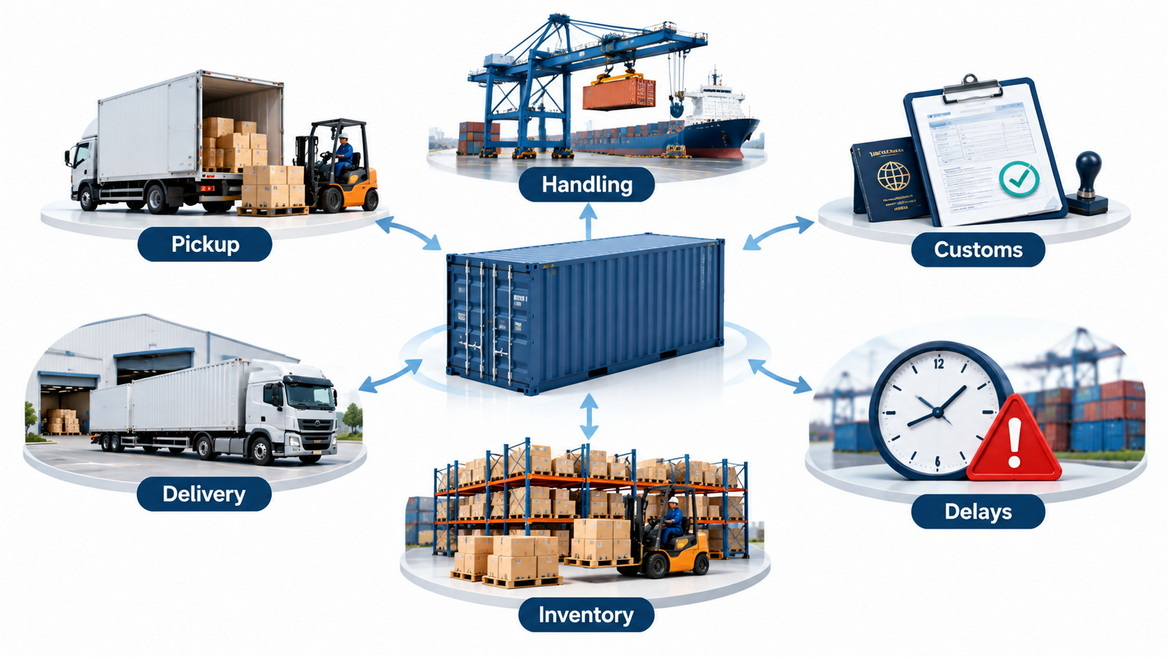
A useful planning model is:
Total logistics cost = transport charges + handling and clearance + inventory carrying cost + expected disruption cost.
Keep duties and taxes consistent across alternatives. They affect landed cost but may not change merely because you select another transport mode.
For illustration, assume an alternative route costs $900 more but releases $100,000 of inventory eight days earlier. At an assumed annual carrying rate of 20%, the carrying-cost reduction is approximately $438.
Speed alone does not justify the $900 premium in this example. Avoided stockouts or production downtime might, but those benefits need separate estimates. These figures are hypothetical, not market rates or a client result.
Air transport may shorten the main international movement, but supplier readiness, terminal acceptance, customs processing, and delivery appointments still influence arrival.
Multimodal journeys add connection requirements. Missed cutoffs, delayed container availability, or incomplete paperwork can consume the time saved by a faster leg.
Ask your forwarder for:
1. Cargo-ready and collection dates.
2. Terminal cutoffs and planned departures.
3. Transfer windows and connection buffers.
4. Customs-document submission deadlines.
5. Expected delivery ranges and exception procedures.
Compare cargo-ready-to-delivery estimates, not just airport-to-airport or port-to-port transit times.
Request historical on-time delivery information for comparable routes when available. Define "on time" against the agreed warehouse delivery date, rather than vessel departure.
Where shipment history exists, compare median delivery time with a conservative percentile, such as the 90th percentile. A route that looks fast on average may require significantly more safety stock if its delivery times vary widely.
More interfaces create more opportunities for miscommunication, but they do not automatically mean more product damage. A sealed container can transfer between modes without unpacking its contents.
By contrast, consolidated shipments may require additional loading, unloading, or sorting. Packaging should reflect the actual handling plan, cargo weight, fragility, and storage conditions.
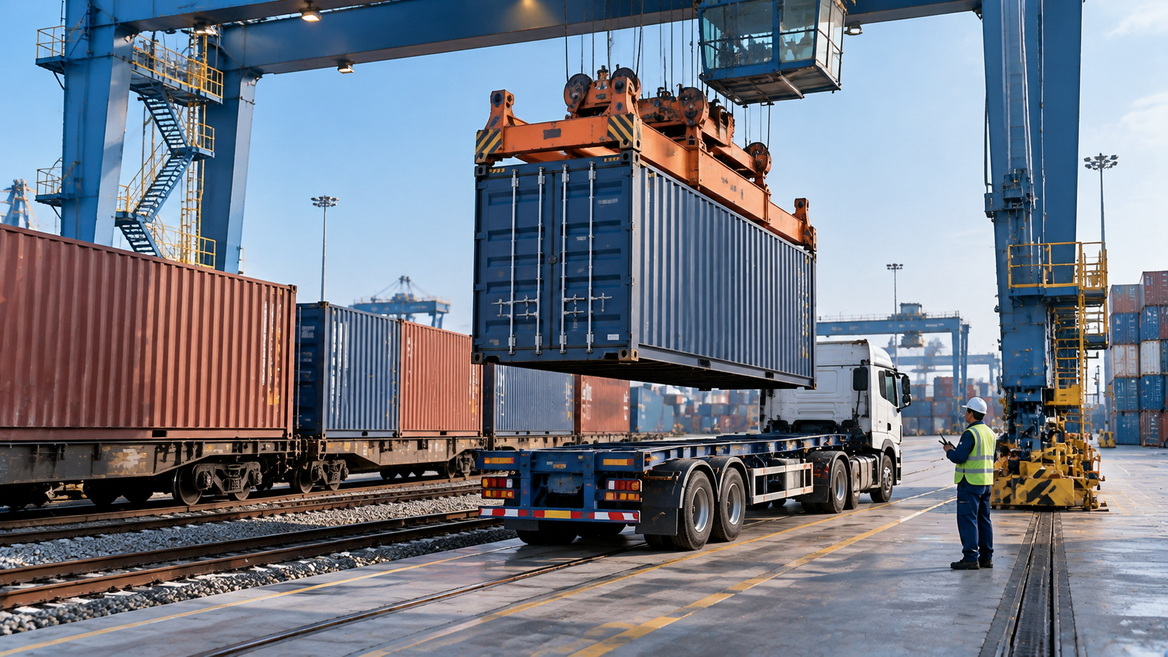
Before booking, clarify:
- Which party contracts each leg and receives claims.
- Whether liability changes between transport stages.
- Insurance coverage, exclusions, deductibles, and claim deadlines.
- Importer-of-record responsibilities and destination requirements.
- Who pays when inspection or failed delivery creates extra costs.
Incoterms allocate specified responsibilities between buyer and seller; they do not replace the transport contract or cargo insurance.
Rules including FCA, CPT, CIP, DAP, DPU, and DDP can apply to any mode or combination of modes. FOB, CFR, CIF, and FAS are reserved for sea or inland waterway transport.
Door-to-door delivery does not automatically mean DDP. Confirm import clearance, duties, taxes, and unloading obligations explicitly.
UN Trade and Development's Review of Maritime Transport 2024 reports that more than 80% of world trade volume is carried by sea. It also highlights how disruption at chokepoints, including the Suez and Panama Canals, can extend routes and increase costs.
This does not make multimodal transport disruption-proof. A truck–ocean–truck shipment still depends heavily on its ocean leg.
Meaningful resilience requires an executable alternative: available capacity, suitable gateways, compliant documentation, workable transit time, and an approved budget.
For shipments from China to Europe, North America, South America, Southeast Asia, the Middle East, Africa, or Oceania, assess destination access individually. Port capacity, inland connections, customs requirements, and delivery restrictions differ by lane.
When a replenishment shipment faces delay, consider separating the minimum quantity needed to maintain operations from the remaining cargo.
An urgent portion may justify faster transport while the balance follows an economical route. This is a shipment-allocation strategy, not necessarily one multimodal consignment, and it requires separate cost and compliance checks.
Consider two hypothetical buyers sourcing manufactured goods from China. These are planning examples, not documented customer case studies.
Buyer A receives full containers near a destination seaport and maintains generous inventory coverage. Ocean-led transport with short truck connections may offer a practical balance of capacity and cost.
Buyer B receives components at an inland factory with a firm production deadline. The longer inland movement makes rail connections, truck availability, terminal dwell, and delivery appointments more important.
A lower ocean rate may lose its advantage if the inland connection is slow or expensive. Conversely, a coordinated ocean–rail–truck route may suit Buyer B if schedules and transfer capacity support the deadline.
The lesson is not that inland buyers always need more modes. It is that destination access must be evaluated before choosing the main transport service.
Provide commodity descriptions, dimensions, gross weight, packaging, cargo value, supplier location, destination address, and cargo-ready date. Disclose batteries, hazardous materials, temperature requirements, or oversized dimensions early.
Distinguish a preferred arrival date from a deadline that would interrupt production or sales. This determines whether faster transport creates measurable commercial value.
Ask for the same shipment scope, named delivery point, trade term, inclusions, exclusions, and quotation validity. Require the mode sequence and planned handovers.
Ask what happens after a missed connection, customs inspection, unavailable delivery slot, or delayed supplier release. Identify the decision-maker and potential extra charges.
Choose the option that meets the required service level at an acceptable total cost. Track pickup, departure, transfer, clearance, and final delivery against the agreed plan.
GB FREIGHT AGENCY CO., LTD. brings 15 years of international logistics experience to shipments from China, supporting supplier booking coordination, export customs clearance, transportation, and final delivery.
Send us your cargo details, supplier location, destination address, cargo-ready date, and required delivery date. Request a route-specific comparison of suitable transport options, with service boundaries and exclusions clearly stated, before committing your shipment.
No. Savings depend on distance, cargo volume, terminal charges, and transfer efficiency. Compare complete shipment costs using identical service boundaries.
Usually, yes, when trucks collect and deliver cargo around the ocean leg. Port-to-port ocean freight remains single-mode within that narrower scope.
No. International multimodal services may operate under a multimodal contract, but using multiple modes does not itself prove unified contractual responsibility. Review the booking terms.
Choose the route that meets the actual delivery deadline. Faster main transport is useful only when pickup, clearance, connections, and final delivery also support timely arrival.
Not automatically. Emissions depend on the mode mix, distances, load factors, equipment, and detours. Compare shipment-specific estimates using consistent calculation boundaries rather than assuming more modes mean lower emissions.
1. United Nations Economic and Social Commission for Asia and the Pacific — "Introduction," publication chapter on multimodal transport. Provides definitions of multimodal and intermodal transport, including the distinction between multiple transport modes and movement in the same loading unit. [unescap]
2. UN Trade and Development — Review of Maritime Transport 2024: Navigating Maritime Chokepoints, published October 22, 2024. Supports the maritime trade-volume figure and discussion of chokepoint disruption, extended routes, and rising costs. The article identifies this as a dated report, not a current freight-rate forecast. [unctad]
3. International Trade Administration, U.S. Department of Commerce — "Know Your Incoterms." Explains the purpose of the rules and lists the seven rules applicable to any transport mode or combination of modes. [trade]
4. International Chamber of Commerce — "Incoterms® 2020." Provides authoritative clarification of selected delivery and insurance provisions, including differences between DAP and DPU and between CIP and CIF insurance requirements. [iccwbo]
5. United Nations Economic Commission for Europe — White Paper on Integrated Track and Trace for Multimodal Transportation. Provides background on integrating shipment information across transport contracts and modes, relevant to the article's handover and visibility discussion. [unece]


