
Views: 236 Author: GB FREIGHT Publish Time: 2026-08-18 Origin: Site


Content Menu
● Ocean Freight vs Air Freight: The Core Difference
● When Ocean Freight Is Best for Seasonal Inventory
>> Use Ocean Freight When You Have These Conditions
>> Ocean Freight Risks to Plan Around
● When Air Freight Is Best for Seasonal Inventory
>> Use Air Freight When You Have These Conditions
>> Air Freight Risks to Plan Around
● Compare Total Landed Cost, Not Freight Cost Alone
● A Practical Seasonal Freight Planning Framework
>> Step 1: Identify the Non-Negotiable Arrival Date
>> Step 2: Segment Products by Commercial Risk
>> Step 3: Reserve Capacity Before Peak Demand
>> Step 4: Use a Split-Mode Strategy
● How GB FREIGHT Supports Seasonal Shipments From China
● Choose the Right Freight Mix
● FAQ
>> Is ocean freight always cheaper than air freight?
>> How far in advance should I book ocean freight for seasonal inventory?
>> When should a business use air freight for seasonal stock?
>> Can I ship part of an order by sea and part by air?
>> Is LCL ocean freight suitable for seasonal inventory?
>> What information is needed for a freight comparison?
Seasonal inventory planning is where freight decisions become commercial decisions. For importers moving goods from China into Europe, North America, South America, Southeast Asia, the Middle East, Africa, or Oceania, the choice between ocean freight and air freight determines not only arrival speed, but also cash flow, stock availability, margin protection, and customer experience.
At GB FREIGHT AGENCY CO., LTD., we have spent 15 years coordinating supplier bookings, export customs clearance, international transportation, and final delivery from China. In practice, the best approach is rarely "always choose sea" or "always choose air." Strong seasonal planning combines both modes according to product value, sales deadlines, inventory risk, and route conditions.

Ocean freight is generally the better option for large-volume seasonal inventory that can be planned well in advance. Air freight is designed for speed, urgent replenishment, high-value goods, and shipments where the cost of being out of stock is greater than the additional transport cost.
Globally, maritime transport moves more than 80% of merchandise trade by volume, which explains why ocean shipping remains the backbone of international inventory movement. However, container capacity, port congestion, geopolitical disruptions, weather, customs processing, and peak-season demand can all affect actual delivery schedules.
Air cargo serves a different role. It is particularly useful when a seasonal sales window is short, a production delay has occurred, or inventory needs to reach a warehouse before a campaign, promotion, trade show, or holiday period. IATA reported that global air-cargo demand, measured in cargo tonne-kilometres, increased 5.6% year over year in January 2026.
| Factor | Ocean Freight | Air Freight |
|---|---|---|
| Typical delivery speed | Slower, often several weeks door to door | Faster, often several days door to door |
| Transport cost | Lower per unit and per cubic metre | Higher per kilogram and volumetric weight |
| Best for | Large, stable, forecastable inventory | Urgent, high-value, lightweight inventory |
| Capacity | Suitable for FCL and LCL shipments | Limited by airline space, aircraft capacity, and cargo rules |
| Seasonal risk | More exposed to port, vessel, and schedule delays | More exposed to peak-air capacity constraints and rate spikes |
| Inventory in transit | Higher because goods travel longer | Lower because goods arrive faster |
| Carbon intensity | Generally lower per tonne-kilometre | Generally higher per tonne-kilometre |
| Planning horizon | Usually requires earlier planning | Can support late changes, but at a cost |
The important point is simple: lower freight cost does not always mean lower total cost. A low-cost ocean shipment that arrives after the selling season may create markdowns, lost sales, excess storage, and damaged customer confidence.
Ocean freight is usually the preferred method when demand forecasts are reliable and a business can place purchase orders early enough. It works especially well for bulky, heavy, low-to-medium-value products such as furniture, building materials, machinery, household goods, textiles, consumer packaged goods, and retail replenishment inventory.
For many China export shipments, full container load service offers the most predictable unit economics. A 20-foot or 40-foot container can spread logistics costs across a large number of products, reducing landed cost per unit.
- A stable demand forecast based on prior sales history.
- A seasonal launch date that is still several weeks away.
- Products with lower value relative to their weight or volume.
- Sufficient warehouse capacity at destination.
- A purchase order large enough for FCL, or enough time to consolidate LCL cargo.
- Flexibility to hold safety stock before the seasonal demand peak.
- A product range that does not become obsolete quickly.
For example, a retailer importing outdoor furniture for the summer season may ship its main volume by ocean freight from China months ahead of the selling period. The products are bulky, freight-sensitive, and normally need substantial warehouse space. Sending them by air would usually reduce profit margins dramatically.
- Lower unit cost: Ocean freight is often the most economical option for high-volume cargo.
- Better suitability for oversized, heavy, and containerized goods.
- More practical for stock-building programs across multiple SKUs.
- Flexible container choices, including 20GP, 40GP, 40HQ, refrigerated containers, open-top containers, and flat racks.
- Greater ability to combine supplier cargo through consolidation and buyer's consolidation programs.
Ocean freight requires disciplined planning because the vessel transit is only one part of the journey. A real shipping timeline also includes factory readiness, booking confirmation, container loading, customs declaration, port gate-in, vessel departure, transshipment, destination clearance, deconsolidation where applicable, and inland delivery.
Container markets can become volatile. UN Trade and Development reported that the Shanghai Containerized Freight Index averaged 2,496 points in 2024, up 149% from 2023, while spot rates reached $3,600 per container in July 2024. This illustrates why companies should not rely on last year's freight budget when planning a future peak season.
For ocean freight, we recommend building a time buffer, not merely calculating standard transit days. A shipment that normally takes 30 days port to door should not necessarily be planned on a 30-day lead time.
Air freight is the preferred option when speed protects revenue. It is particularly effective for fashion items, consumer electronics, spare parts, promotional products, health-related goods, premium accessories, samples, replacement stock, and time-sensitive campaign inventory.
A typical air shipment may arrive much sooner than an ocean shipment, but the difference in cost can be substantial. Industry route guides commonly estimate air freight as roughly four to eight times faster than ocean freight, while air transport can be eight to sixteen times more expensive per kilogram. Actual results depend on route, chargeable weight, cargo dimensions, fuel surcharges, airport handling, and delivery location.
- A key product is at risk of stockout.
- A supplier has finished production later than planned.
- A promotion, event, launch, or holiday deadline cannot move.
- Goods have high value but low physical weight.
- Inventory has a short selling window.
- The business needs urgent spare parts to prevent production downtime.
- The margin lost from delayed sales is greater than the additional airfreight cost.
A useful example is an e-commerce brand selling limited-edition holiday electronics. The main inventory may move by sea in advance, but a supplier delay could leave the brand short of its best-selling SKU. Instead of flying the complete order, the business can send only the fast-moving item by air. This protects sales while keeping the majority of freight spend under control.
- Fast replenishment: Air cargo reduces the time products remain in transit.
- Better support for urgent launches and promotional deadlines.
- Lower risk of missing short selling windows.
- Useful for sample shipments, quality-approved first orders, and emergency stock.
- Can reduce inventory carrying costs for high-value products.
- Often provides more frequent departure opportunities than vessel schedules.
Air freight capacity tightens during major retail and e-commerce peaks. High demand before year-end holidays, major shopping festivals, and regional events can lead to higher rates, space shortages, and slower airport handling. Air cargo demand also changes quickly with global trade conditions and passenger-network capacity.
Businesses should also review cargo restrictions early. Batteries, dangerous goods, liquids, magnets, and temperature-sensitive products may require special documentation, packaging, labels, declarations, or routing arrangements. Incorrect paperwork can delay a shipment even when the transport mode itself is fast.
The most common seasonal-planning mistake is comparing only the ocean freight quote with the air freight quote. A better method is to compare the total commercial cost of each decision.
| Cost Area | Ocean Freight Impact | Air Freight Impact |
|---|---|---|
| Freight charge | Usually lower | Usually higher |
| Inventory carrying cost | Higher due to longer transit | Lower due to shorter transit |
| Warehouse and storage | May increase if stock arrives too early | May decrease when inventory is replenished closer to demand |
| Stockout risk | Higher if planning buffers are too small | Lower for urgent replenishment |
| Markdown risk | Higher if goods miss the season | Lower when goods arrive before the sales window |
| Working capital | Tied up longer in in-transit goods | Released sooner through faster availability |
| Sales opportunity | Can be missed during disruptions | Better protected for short deadlines |
A practical calculation is:
Total Decision Cost=Freight Cost+Inventory Carrying Cost+Storage Cost+Expected Stockout Cost+Expected Markdown Cost
For a low-value, bulky product, ocean freight almost always wins. For a high-margin product with a short selling period, air freight may be economically justified even when its invoice cost is much higher.

The strongest inventory plans begin before production starts. Businesses should map their sales calendar backward from the destination delivery deadline rather than forward from the supplier's estimated completion date.
Define the date goods must be available for sale, at the destination warehouse, retailer, fulfillment center, or project site. Do not use vessel arrival or airport arrival as the final deadline.
Include time for:
- Import customs clearance.
- Duty and tax processing where applicable.
- Cargo release.
- Warehouse receiving appointment.
- Palletization, labeling, and quality checks.
- Final-mile delivery.
- Marketplace or retail distribution processing.
Classify each product based on sales value, demand certainty, size, and deadline sensitivity.
- Core volume: Stable, predictable products suitable for ocean freight.
- High-value fast movers: Products that may justify air freight if stock becomes critical.
- Test products: Smaller quantities that may move by air before larger ocean orders.
- Slow-moving stock: Products that should avoid expensive expedited shipping.
- Deadline-critical stock: Event, campaign, or seasonal items requiring a strict arrival plan.
Peak-season freight planning should include early carrier-space discussions and flexible booking strategies. Shipping rates and equipment availability can move sharply as demand rises. Ocean freight may be most economical, but late bookings can reduce carrier options and increase rollover risk.
For major retail seasons, businesses should confirm production readiness and booking requirements early. A shipment is not protected simply because a supplier says the cargo will be ready.
For many importers, the best answer is a sea-air inventory strategy:
- Ship 80% to 95% of predictable inventory by ocean freight.
- Keep 5% to 20% of the budget or product volume available for urgent air replenishment.
- Use air freight only for priority SKUs, launch inventory, replacement components, or delayed production batches.
- Review sales velocity weekly during the season and release air cargo only when the projected stockout cost is higher than the transport premium.
This approach reduces the risk of overusing air freight while still protecting revenue when actual demand differs from forecasts.
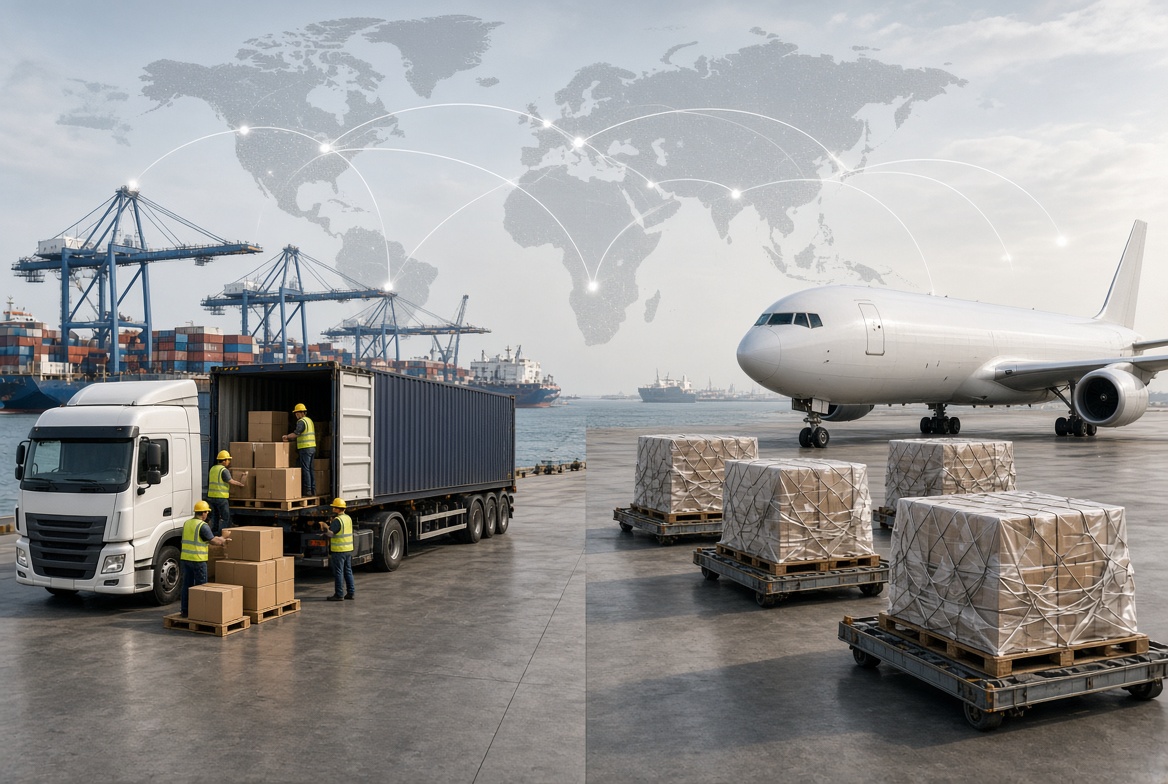
Effective seasonal logistics requires more than booking freight. It depends on coordination between suppliers, origin operations, customs teams, carriers, destination agents, and final-delivery providers.
GB FREIGHT AGENCY CO., LTD. supports businesses shipping from China by coordinating:
- Supplier pickup and cargo readiness follow-up.
- FCL and LCL ocean freight booking.
- Standard and priority air freight arrangements.
- Export customs declaration and documentation support.
- Cargo consolidation from multiple Chinese suppliers.
- Route and transit-time planning.
- Destination customs and delivery coordination where arranged.
- Shipment visibility and exception management.
Our operational experience shows that the most costly issues often start before cargo reaches the port or airport. Missing documents, late supplier handovers, incorrect marks, unsuitable packaging, incomplete cargo details, and unrealistic cut-off assumptions can all affect a seasonal launch.
Ocean freight is the foundation for planned, high-volume seasonal inventory. Air freight is the contingency tool for protecting sales, resolving delays, and supporting high-value or time-sensitive stock. The most resilient supply chains use both with a clear decision framework.
Before your next seasonal purchase order, assess your delivery deadline, product value, shipment volume, forecast confidence, storage cost, and stockout exposure. Then build a mode mix that protects both your margin and your customer promise.
Need a China-to-destination freight plan for your next seasonal inventory cycle? Contact GB FREIGHT AGENCY CO., LTD. with your cargo details, supplier locations, target delivery date, and destination. Our team can help compare ocean, air, and split-shipment options before you commit to a booking.
For large, heavy, or bulky shipments, ocean freight is generally much cheaper per unit. However, the final decision should include inventory carrying costs, stockout risk, missed sales, storage, and potential markdowns.
The right lead time depends on the route, destination, cargo type, and season. Begin planning months before the required warehouse arrival date, and include contingency time for production, booking, port operations, customs, and inland delivery.
Use air freight when a product is high-value, fast-moving, deadline-critical, or at immediate risk of stockout. It is also useful when a supplier delay threatens a campaign, launch, or seasonal sales period.
Yes. A split-mode approach is often the most cost-effective solution. Move the main quantity by ocean freight and send a smaller, priority quantity by air to protect availability.
LCL can work for smaller seasonal orders or multi-supplier consolidation. However, it usually requires additional handling and can take longer than FCL because cargo must be consolidated at origin and deconsolidated at destination.
Provide the cargo ready date, pickup location, destination, product description, number of packages, dimensions, gross weight, estimated volume, shipment terms, required delivery date, and any special cargo requirements.
- UN Trade and Development, "[Review of Maritime Transport 2025]"
- UN Trade and Development, "[Maritime trade under pressure – growth set to stall in 2025]"
- International Air Transport Association, "[Air Cargo Market Analysis: January 2026]"
- International Air Transport Association, "[Global Outlook for Air Transport: December 2025]"
- U.S. Bureau of Transportation Statistics, "[Latest Supply Chain and Freight Indicators]"
- Freightos, "[Shipping Delays and Freight Cost Increases]"
- ExFreight, "[Air vs Ocean Freight: Cost, Transit Time, and Decision Framework]"


