
Views: 282 Author: GB FREIGHT Publish Time: 2026-08-15 Origin: Site


Content Menu
● Understanding the Two Transport Options
>> What Is Ocean Freight for Heavy Machinery?
>> What Is Multimodal Transport for Heavy Machinery?
● Ocean Freight vs Multimodal Transport: Key Differences
● Cost Comparison for Heavy Machinery Shipments
>> When Ocean Freight Usually Costs Less
>> Why Multimodal Transport Can Deliver Better Total Value
● Transit Time and Delivery Reliability
>> Multimodal Transport and Schedule Control
● Cargo Safety: The Deciding Factor for Heavy Equipment
>> Ocean Freight Cargo Protection
>> Multimodal Transport Cargo Protection
● How to Choose the Right Solution
>> Ocean Freight Is Usually Best When
>> Multimodal Transport Is Usually Best When
● A Practical Pre-Shipment Checklist
● Build the Route Around the Machine
● Ship Heavy Machinery From China With Confidence
● FAQ
>> 1. Is ocean freight cheaper than multimodal transport for heavy machinery?
>> 2. Can heavy machinery be shipped in a container?
>> 3. What is the safest way to ship heavy machinery from China?
>> 4. Should I choose port-to-port or door-to-door shipping?
>> 5. How long does ocean freight take from China?
>> 6. Which trade terms are suitable for multimodal machinery transport?
>> 7. What information is needed for a heavy machinery freight quote?
Shipping heavy machinery from China is rarely a simple "port-to-port" decision. For equipment such as excavators, CNC machines, crushers, generators, agricultural machinery, and production lines, the right choice between ocean freight and multimodal transport affects not only freight cost, but also cargo safety, delivery reliability, customs coordination, and the risk of delays at the final destination.
At GB FREIGHT AGENCY CO., LTD., we have supported international shipments from China for 15 years. In our experience, ocean freight for heavy machinery is often the most economical choice for port-based destinations and large, non-urgent cargo. Multimodal transport for heavy machinery is usually the stronger solution when the consignee needs delivery beyond the port, the cargo has complex dimensions, or several transport stages must be managed under one coordinated plan.
The best option depends on the machinery itself, the delivery location, the commercial terms, and how much operational risk your business is prepared to manage.

Ocean freight moves machinery from a Chinese port to a destination port by sea. Depending on cargo dimensions, weight, and packing condition, the shipment may move as:
- FCL container freight, such as 20GP, 40GP, 40HQ, open-top, or flat-rack containers
- LCL freight for smaller crated machinery or spare parts
- Breakbulk shipping for machinery that cannot be containerized
- RoRo shipping for self-propelled or towable equipment
- Project cargo shipping for oversized, heavy, or technically complex machinery
For exporters shipping from Shanghai, Ningbo, Qingdao, Shenzhen, Guangzhou, Tianjin, or Xiamen, ocean freight is commonly used for long-distance trade routes to Europe, North America, South America, the Middle East, Africa, Southeast Asia, and Oceania.
Ocean freight is particularly effective when the buyer can collect cargo at the destination port or has an established local logistics team.
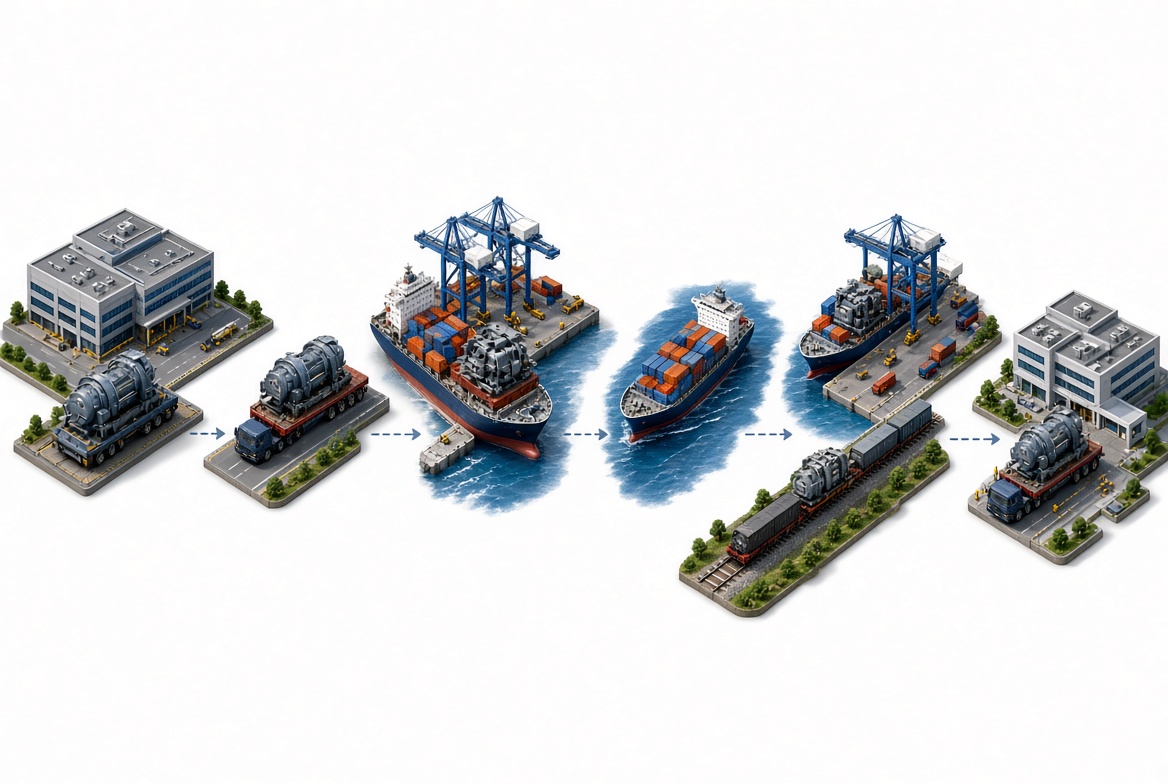
Multimodal transport uses two or more transport methods under one coordinated shipping plan. A typical movement may include:
1. Trucking from the Chinese factory to a port or rail terminal
2. Export customs declaration in China
3. Sea freight, rail freight, or a combination of main-carriage modes
4. Destination-port handling and customs clearance support
5. Inland trucking, rail delivery, or specialized last-mile transport
6. Delivery to the buyer's factory, warehouse, construction site, mine, or distribution center
For example, a Chinese manufacturer may ship a heavy press machine from Jiangsu to a factory in Poland. The cargo can be trucked to Shanghai, shipped by sea to a European port, cleared, then moved by road to the final industrial site. That full movement is a multimodal transport solution.
The key advantage is coordination. Instead of the shipper managing separate suppliers for domestic collection, port handling, international shipping, customs documents, and inland delivery, one freight partner manages the transport chain.
| Factor | Ocean Freight | Multimodal Transport |
|---|---|---|
| Main scope | Port-to-port or port-based shipment | Factory-to-port, port-to-door, or door-to-door movement |
| Cost structure | Often lower for sea-leg freight | Higher total cost, but may reduce coordination costs |
| Best for | Large-volume cargo, flexible delivery schedules | Cargo requiring inland delivery and unified control |
| Cargo handovers | More parties may be involved | Fewer handover points for the shipper to manage |
| Delivery control | Buyer or shipper often arranges destination services | Forwarder can coordinate the full route |
| Transit predictability | Depends heavily on port and vessel schedules | Depends on every transport leg, but can offer better visibility |
| Suitable machinery | Containerized, breakbulk, RoRo, project cargo | Oversized, fragile, site-delivery, or time-sensitive machinery |
| Documentation complexity | More manageable for port-to-port terms | Requires stronger coordination across transport modes |
| Risk management | Risk may increase after port arrival if parties are fragmented | Better continuity when one logistics provider manages the route |
Ocean freight is a transport mode. Multimodal transport is a delivery strategy. In many cases, ocean freight is one important part of a multimodal movement rather than a competing alternative.
Ocean freight can be more cost-effective when:
- The machinery fits safely in a standard or special container
- The destination is close to the discharge port
- The consignee has a customs broker and trucking partner
- The cargo is not highly urgent
- The buyer accepts responsibility after port arrival
- The shipping agreement is based on port terms such as FOB, CFR, or CIF
For a shipment of several containerized machine tools from Ningbo to Los Angeles, Rotterdam, Jebel Ali, or Santos, port-to-port ocean freight may provide the lowest visible freight rate.
However, the lowest ocean freight quote is not always the lowest landed cost. Importers should also evaluate destination terminal handling charges, customs clearance fees, container demurrage, detention, crane requirements, inland trucking, escort permits, and unloading equipment.
Multimodal transport often costs more on the quotation because it includes more services. Yet it may create better commercial value when the cargo needs to reach an inland destination.
For heavy machinery, the largest financial risks often occur outside the sea voyage:
- Incorrect cargo dimensions before booking
- Lack of suitable loading equipment at the supplier's factory
- Delays caused by incomplete export or import paperwork
- Damage during port handling or inland transport
- Inadequate lashing, blocking, and bracing
- Missed delivery appointments at factories or job sites
- Unplanned crane, forklift, or low-bed trailer charges
A properly planned door-to-door transport solution can reduce these risks. It gives the shipper one route plan, one responsibility structure, and one operational team to contact when exceptions occur.
Practical rule: compare total landed cost, not only the ocean freight rate.
Sea freight is generally the most practical choice for long-distance, heavy, and non-urgent international shipments. It can move high volumes at a lower cost than air freight, especially for industrial machinery.
But transit time is not limited to sailing days. A realistic plan should include:
- Supplier cargo readiness
- Export booking lead time
- Trucking or factory loading
- Export customs processing
- Port gate-in and vessel cut-off
- Vessel departure and transshipment
- Destination discharge
- Import customs release
- Inland transport and final delivery
The World Bank's logistics performance research emphasizes that supply-chain reliability depends on more than transport speed. Customs efficiency, infrastructure, tracking capability, logistics services, and timeliness all influence the movement of goods across borders.
Multimodal transport does not automatically mean faster delivery. It means the shipment is planned across multiple stages from the beginning.
For example, if machinery must arrive at an automotive plant in Mexico, a freight plan may need to account for vessel schedule, port congestion, customs clearance, inland permits, cross-border requirements, and delivery windows at the plant. A port-only ocean freight solution may leave the importer to coordinate these critical steps separately.
A strong multimodal plan improves reliability by confirming:
- Pickup date from the Chinese supplier
- Packing and loading method
- Suitable container or breakbulk booking
- Port cut-off and documentation schedule
- Import clearance responsibilities
- Inland vehicle type and capacity
- Delivery appointment and unloading arrangement
For project cargo, schedule control is often more valuable than the lowest initial quote.
Heavy machinery can be costly, irregularly shaped, sensitive to vibration, and difficult to replace. A shipping plan must protect the cargo at every stage.
For containerized machinery, cargo safety depends on professional preparation before the container reaches the terminal. Important measures include:
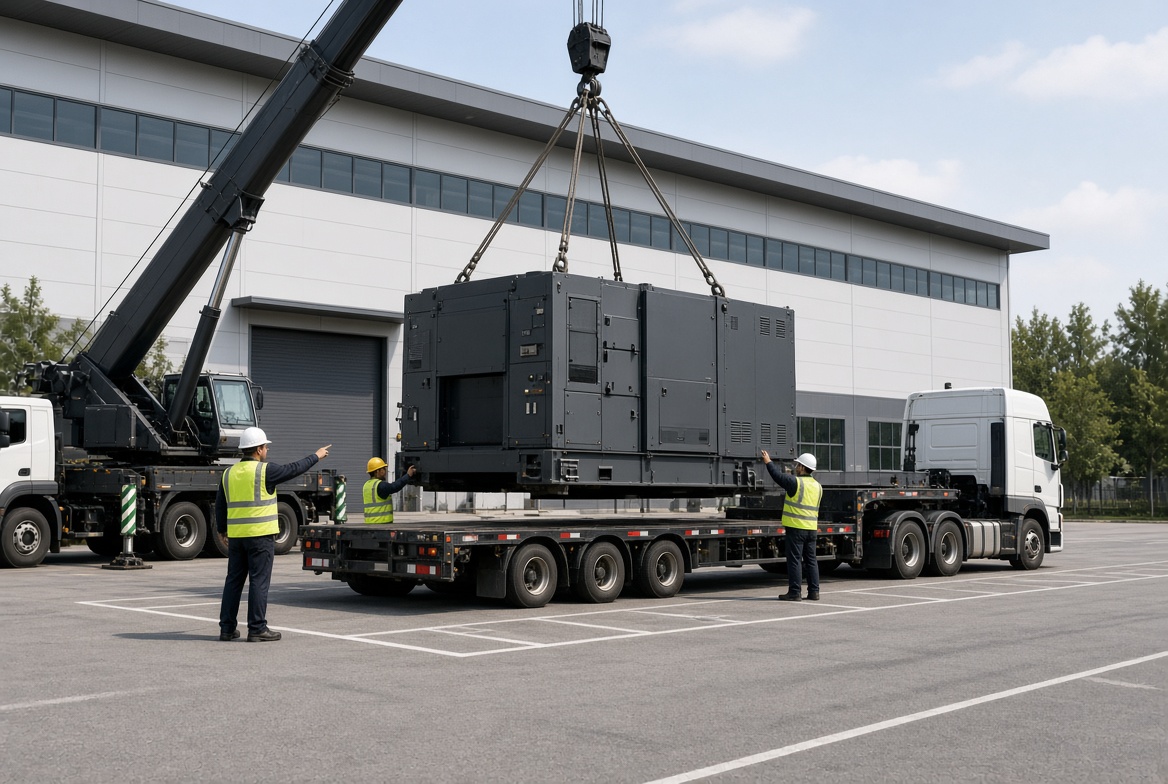
- Verifying gross weight, dimensions, center of gravity, and lifting points
- Selecting the correct container type
- Using export-grade packing, moisture protection, and corrosion prevention
- Installing wooden blocking, steel bracing, chains, straps, and lashing materials
- Preventing movement during vessel rolling and pitching
- Photographing cargo condition before loading and after securing
- Preparing a lashing or securing plan for complex cargo
For flat-rack, open-top, breakbulk, and RoRo shipments, securing standards are even more important because the equipment may be exposed to weather, handling operations, and multiple lifting stages.
Multimodal transport requires cargo protection across more handling events. Machinery may move between factory, truck, terminal, vessel, destination terminal, customs area, and final delivery vehicle.
This means packaging must be designed for the full route—not merely for ocean exposure.
A complete assessment should consider:
| Risk Area | Recommended Control |
|---|---|
| Factory loading | Confirm crane capacity, lifting points, and loading sequence |
| Container loading | Verify weight distribution and container payload limits |
| Sea voyage | Use appropriate lashing, moisture barriers, and anti-rust protection |
| Port handling | Use accurate cargo marks and handling instructions |
| Inland trucking | Match machinery dimensions to trailer type and road restrictions |
| Final unloading | Confirm site access, ground conditions, crane or forklift availability |
A shipment can arrive safely at the port but still fail at final delivery. This is why machinery exporters should evaluate the complete logistics chain.
Use ocean freight when your shipment is suitable for port-based handling and the buyer can manage destination operations efficiently.
Choose multimodal transport when final delivery is operationally complex, geographically remote, or commercially important.
- The cargo is delivered to a major port
- The consignee has import clearance capability
- The machinery is containerized or suitable for breakbulk or RoRo
- Delivery timing is flexible
- You need the most competitive international sea-leg rate
- The buyer purchases under FOB, CFR, or CIF terms
- Delivery is required to an inland factory, warehouse, project site, or mine
- The equipment is oversized, overweight, or fragile
- The consignee needs door-to-door coordination
- Several suppliers in China need to be consolidated
- The shipment requires special trailers, permits, escorts, or lifting arrangements
- You want a single point of operational communication
- Delivery delays could affect installation, production, or construction schedules
Before requesting a freight quotation, prepare the following information. It allows the freight forwarder to recommend the right ocean freight or multimodal transport solution.
1. Cargo details: quantity, dimensions, gross weight, net weight, and total volume
2. Machinery condition: new, used, self-propelled, dismantled, crated, or uncrated
3. Loading requirements: crane, forklift, ramp, lifting points, or special equipment
4. Origin location: exact supplier address and cargo-ready date in China
5. Destination: port only, warehouse, factory, construction site, or remote project location
6. Trade terms: EXW, FCA, FOB, CFR, CIF, CPT, CIP, DAP, DPU, or DDP
7. Documentation: commercial invoice, packing list, HS code, export licenses, certificates, and country-specific requirements
8. Insurance needs: cargo value, coverage scope, and claims contact process
9. Final-delivery conditions: road access, unloading equipment, appointment rules, and local permits
For shipments involving more than one transport mode, trade terms should match the delivery arrangement. The International Trade Administration notes that Incoterms® 2020 contains seven rules applicable to any mode or modes of transport, while FAS, FOB, CFR, and CIF are intended for sea or inland-waterway transport.
The most common mistake in heavy machinery logistics is choosing transport based only on a freight rate or a port name.
A better approach is to begin with the machine:
- Can it fit in a standard container without unsafe overloading?
- Is a flat rack, open top, breakbulk vessel, or RoRo service more suitable?
- Does it need anti-rust wrapping or moisture protection?
- Can the destination facility receive it safely?
- Who is responsible if customs clearance or inland delivery is delayed?
- What happens if the port cannot release the cargo immediately?
At GB FREIGHT AGENCY CO., LTD., we recommend confirming the cargo profile and final delivery requirements before selecting the transport method. This helps avoid unsuitable equipment bookings, avoidable handling charges, and costly schedule disruptions.
Global shipping continues to face route disruptions and operational uncertainty. UN Trade and Development has highlighted vulnerabilities affecting major maritime routes, reinforcing the value of resilient planning and contingency options for international cargo movements.
Ocean freight is ideal when you need an economical port-to-port solution for heavy machinery. Multimodal transport is ideal when your shipment requires coordinated movement from the Chinese supplier to the final destination.
GB FREIGHT AGENCY CO., LTD. can assess your machinery dimensions, weight, packing condition, origin location, destination requirements, and delivery timeline. We then recommend a practical transport plan covering booking coordination, export customs declaration, international shipping, destination handling, and final delivery support.
Send us your cargo list, packing details, pickup address, destination, and required delivery date to receive a tailored freight solution from China.
Usually, ocean freight has a lower visible freight cost because it covers mainly the sea leg. Multimodal transport includes additional services such as factory pickup, customs coordination, destination handling, and inland delivery. The best comparison is total landed cost.
Yes. Many machines can move in standard containers, open-top containers, or flat-rack containers. The decision depends on dimensions, weight, center of gravity, packaging, and loading method. Oversized machinery may require breakbulk or RoRo shipping.
The safest method depends on the machine and route. Essential controls include correct equipment selection, professional packing, accurate weight data, cargo lashing, moisture protection, careful lifting, cargo insurance, and verified unloading arrangements at destination.
Choose port-to-port shipping if your buyer has reliable customs and inland logistics resources. Choose door-to-door or multimodal transport if you want one coordinated plan from the supplier in China to the final delivery location.
Transit time varies by destination port, carrier schedule, transshipment, customs processing, and inland delivery requirements. A complete delivery estimate should include pickup, export handling, sailing time, import clearance, and final transportation.
FCA, CPT, CIP, DAP, DPU, and DDP can be used for any mode or combination of modes. The correct term depends on where delivery occurs, who arranges carriage, who bears risk, and who completes import formalities.
Provide cargo dimensions, gross weight, packing method, number of pieces, Chinese pickup address, destination address or port, cargo-ready date, equipment condition, HS code if available, and requested trade terms.
1. [World Bank — World Bank Releases Logistics Performance Index 2023]
2. [World Bank Open Knowledge Repository — The New Logistics Performance Index]
3. [International Trade Administration — Know Your Incoterms]
4. [UN Trade and Development — Review of Maritime Transport]
5. [UN Trade and Development — Review of Maritime Transport 2023]


