
Views: 241 Author: GB FREIGHT Publish Time: 2026-10-09 Origin: Site


Content Menu
● What Logistics Management Software Should Do
>> Understand the Different Software Categories
>> Map the Complete Shipping Journey
>> Examine Tracking Data Carefully
● Nine Logistics Management Software Options
>> 2. SAP Transportation Management
>> 3. Oracle Transportation Management
>> 5. Descartes
>> 6. e2open
>> 8. FarEye
● Selecting Software for China-Origin Shipping
>> Build a Weighted Evaluation Scorecard
>> Measure Improvements Against a Baseline
>> Interpret Customer Reviews Carefully
>> Calculate the Full Ownership Cost
>> Connect Technology With Freight Expertise
>> What Is the Best Logistics Management Software for Freight Forwarders?
>> What Is the Difference Between a TMS and an ERP?
>> Do Importers Need Their Own Logistics Software?
>> Can Software Guarantee On-Time International Delivery?
>> How Much Does Logistics Management Software Cost?
Logistics management software helps businesses coordinate shipments, control transport costs, and understand where cargo sits between supplier pickup and final delivery. For companies sourcing from China, choosing the right platform means looking beyond attractive dashboards to the workflows that support dependable door-to-door delivery services.
At GB FREIGHT AGENCY CO., LTD., we bring 15 years of international logistics experience to China-origin shipping. Our services cover supplier booking coordination, export customs clearance, international transportation, and final delivery to destinations worldwide.
From a freight-forwarding perspective, the most useful software is not necessarily the platform with the longest feature list. It is the system that helps people coordinate handoffs, identify problems early, and keep customers informed.
This guide compares nine logistics software options and explains how to evaluate them against real shipping requirements. It is a researched shortlist rather than a hands-on product test or universal ranking. Inclusion does not indicate that GB FREIGHT uses, resells, or endorses these platforms.

"Logistics management software" covers several product categories with different responsibilities.
A transportation management system, or TMS, focuses on planning, executing, and monitoring transportation. A warehouse management system, or WMS, supports warehouse activities. An enterprise resource planning system, or ERP, connects wider business functions, including finance and inventory.
Freight-forwarding software concentrates on shipment jobs, documentation, overseas agents, and customer coordination. Delivery management software focuses more closely on the final mile.
These categories overlap, but they are not interchangeable. A strong delivery-routing platform may still need another system for international freight documentation. An ERP may require specialist integrations for carrier booking and shipment execution.
Before comparing products, identify the operational problem you need to solve.
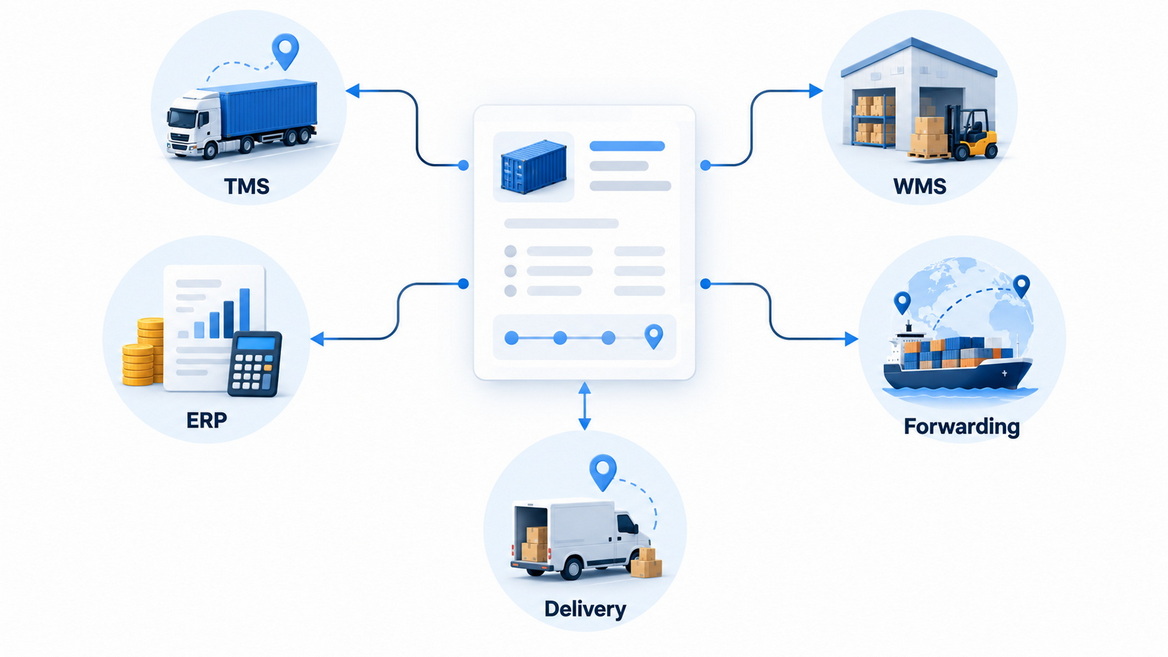
For businesses importing from China, software evaluation should follow the cargo from origin to destination:
- Supplier readiness and booking confirmation.
- Pickup, consolidation, and export documentation.
- International transportation and transshipment milestones.
- Destination clearance and delivery arrangements.
- Proof of delivery and final invoice reconciliation.
The practical question is not simply whether a dashboard displays a shipment. It is whether the team can identify the next action, the responsible party, and the information needed to move the cargo forward.
"Real-time visibility" can mean different things across platforms. Ask which updates come directly from carriers, which rely on partners, and which require manual entry.
An estimated arrival time is not a confirmed delivery appointment. A location update does not establish that customs clearance is complete.
Useful visibility explains the source, timestamp, and meaning of each event. It also helps users distinguish confirmed milestones from estimates.
The following shortlist covers forwarding platforms, transportation systems, enterprise applications, and delivery tools. Their suitability depends on your operating model, existing systems, shipment volume, and regional requirements.
| Software option | Primary role | Main evaluation question |
|---|---|---|
| CargoWare by WallTech | Freight-forwarding management | Can it coordinate shipment jobs and agent workflows? |
| SAP Transportation Management | Enterprise transportation management | How well does it fit your SAP environment? |
| Oracle Transportation Management | Global transportation planning and execution | Can it represent your multimodal shipping requirements? |
| NetSuite Logistics ERP | Financial and operational business management | Which transport workflows need external integrations? |
| Descartes | Logistics, forwarding, and trade solutions | Which applications cover your specific requirements? |
| e2open | Connected supply chain and logistics | Does its network support your trading partners? |
| Kuebix by FreightWise | Shipper-focused transportation management | Are your carriers, shipment types, and lanes supported? |
| FarEye | Last-mile delivery management | Can it improve destination delivery execution? |
| Trimble Transportation | Transportation technology portfolio | Which products match your fleet or shipper requirements? |
CargoWare is a cloud management and collaboration platform designed for international freight forwarders. Its published scope includes marketing, operations, cargo tracking, and data analytics.
It is a relevant starting point for forwarding businesses seeking a shipment-centered working environment.
Request a demonstration covering a complete China-origin shipment, including supplier coordination, partner handoffs, and customer updates. Check document handling, user permissions, accounting interfaces, and local support.
CargoWare and CargoWise are different products. Confirm the exact product name when requesting demonstrations and commercial proposals.
SAP Transportation Management supports transportation planning, freight procurement, order management, and logistics execution. Its capabilities include connections with order and delivery information within the SAP environment.
It deserves consideration when transportation must integrate closely with existing SAP business processes.
However, brand familiarity does not establish operational fit. Request a demonstration using your actual order structure, freight agreements, and delivery constraints.
Evaluate configuration effort, integration dependencies, and the skills required to maintain the proposed solution.
Oracle Transportation Management supports global transportation planning and execution. Its published capabilities cover multimodal and multileg movements, carrier collaboration, shipment monitoring, and transportation financial processes.
It is relevant to businesses coordinating complex transport networks.
During evaluation, test whether the system can represent your consolidation points, service requirements, routing alternatives, and freight settlement rules.
For cross-border shipments, clarify which customs and trade workflows require additional applications or integrations. Transportation management should not be assumed to cover every compliance requirement.
NetSuite emphasizes the connection between financial management and logistics operations. Its logistics ERP offering supports integration with transportation and warehouse tools.
It is particularly relevant when fragmented billing, inventory information, and financial reporting create operational problems.
However, an ERP should not automatically be treated as a replacement for specialist forwarding software.
Separate native functionality from partner applications. Confirm who supports each integration and how shipment costs become customer invoices, supplier payments, and financial reports.
Descartes offers a portfolio covering transportation management, freight forwarding, customs compliance, delivery, and logistics connectivity.
Its forwarding solutions address shipment management and information exchange between logistics participants.
This breadth makes it worth evaluating when a business needs operational tools alongside trade-related capabilities. Nevertheless, Descartes is not one uniform package.
Request a module-level proposal. Confirm country coverage, transaction charges, implementation responsibilities, and the data exchanged between the proposed applications.
e2open positions its platform around connected supply chain processes, including logistics and global trade. Its logistics offering addresses transportation across modes, legs, and regions.
It is relevant when coordination across suppliers, carriers, and other trading partners is a priority.
Businesses encountering older BluJay references should request current product names and a clear explanation of the proposed contractual scope.
A network's practical value depends on relevant connections. Verify your specific partners rather than assuming that every required connection is already available.
Kuebix's current official website identifies the platform as Kuebix by FreightWise. It describes multimodal freight management, shipment planning, execution, tracking, and analytics for midmarket and larger shippers.
It merits evaluation for carrier comparison and day-to-day freight execution.
China-origin importers should test the international and destination workflows they require rather than relying on general capability descriptions.
Check carrier connectivity, invoicing functions, and support ownership. Historical references to Kuebix under Trimble should not replace verification of its current supplier arrangements.
FarEye focuses on delivery management. Its published capabilities include routing, delivery scheduling, capacity planning, branded tracking, and delivery network coordination.
It is relevant when destination delivery performance and customer communication are major operational priorities.
Evaluate appointment handling, failed deliveries, delivery notifications, and proof-of-delivery processes.
For importers, last-mile software is one component of the wider logistics architecture. It does not automatically replace supplier coordination, export documentation, or international forwarding workflows.
Trimble offers a transportation technology portfolio spanning transportation management, visibility, mapping, maintenance, and procurement.
Its products address different users, including carriers, shippers, logistics intermediaries, and service operations.
Evaluate specific products rather than the portfolio name alone.
Request a clear architecture showing the applications, interfaces, and support arrangements included in the proposal. Distinguish quoted capabilities from functions that require additional products.
A structured scorecard helps prevent attractive demonstrations from overshadowing operational requirements.
The following weights are an illustrative framework, not an industry benchmark. Adjust them to reflect your shipment profile and business priorities.
| Evaluation area | Suggested weight | Evidence to request |
|---|---|---|
| Workflow fit | 30% | Demonstration using your shipment scenario |
| Partner connectivity | 20% | Confirmed carrier and agent interfaces |
| Visibility quality | 15% | Event sources, timestamps, and exception handling |
| Total ownership cost | 15% | Itemized commercial proposal |
| Security and governance | 10% | Access controls and audit evidence |
| Implementation and support | 10% | Delivery plan and escalation commitments |
Score each area from one to five, then apply the weights.
Document the evidence behind each score. Where a requirement is essential, treat it as a pass-or-fail condition rather than allowing strengths elsewhere to compensate for its absence.

Use a representative China-to-Europe shipment as a pilot scenario. The following exercise is illustrative, not a reported GB FREIGHT customer case.
1. Enter supplier details, cargo dimensions, readiness date, and delivery requirements.
2. Record booking confirmation and attach the commercial invoice and packing list.
3. Assign responsibility for origin handover, departure, arrival, and final delivery.
4. Introduce a simulated missing document or revised arrival estimate.
5. Check whether the system identifies an exception owner and records the response.
6. Complete delivery confirmation and reconcile expected versus actual charges.
The most revealing moment is often the exception. A useful platform makes the next step clear instead of simply generating another alert.
Record current performance before starting the pilot.
Useful measures include manual updates per shipment, missing milestones, exception response time, invoice discrepancies, and completed delivery records.
Define each measure precisely. For example, distinguish the time an exception becomes visible from the time someone acknowledges it and the time it is resolved.
Do not transfer a vendor's advertised savings percentage directly to your business. Your results depend on shipment mix, data quality, user adoption, and the work the implementation actually replaces.
Kuebix publishes feedback from Shawna M., a fleet/freight manager at Mallory Safety & Supply, praising support responsiveness. Trimble publishes comments from Evans Distribution Systems executive Tony Trocki about integration and customization.
These are vendor-published testimonials, not independent verification of typical results.
They identify useful questions for procurement: How quickly does support respond? Who owns integration problems? What assistance is included after implementation?
Ask prospective vendors for references from customers with comparable shipment types and operating requirements. No GB FREIGHT customer reviews were supplied for this article, so none are presented as evidence of company performance.
Request costs for implementation, migration, training, interfaces, transaction volumes, support, and future configuration changes.
Also clarify how data can be exported when the contract ends.
For door-to-door delivery services, define responsibility at every handoff. Software can organize tasks and documents, but the commercial agreement must still establish who handles clearance, destination charges, and delivery appointments.

Software supports coordination; it does not replace the people responsible for shipping decisions and operational follow-through.
GB FREIGHT provides China-origin transportation solutions to Europe, North America, South America, Southeast Asia, the Middle East, Africa, and Oceania.
Whether your priority is cost control, delivery coordination, or clearer shipment communication, begin with a defined service scope.
Share your supplier location, cargo details, destination, and required delivery date with GB FREIGHT to request a tailored shipping proposal. Ask for the transportation plan, included services, estimated schedule, and cost assumptions to be explained clearly before booking.
The best fit depends on shipment jobs, documentation, agent coordination, and financial requirements. Begin with forwarding-specific workflows, then test shortlisted platforms against representative shipments rather than choosing solely by brand.
A TMS focuses on transportation planning and execution. An ERP connects broader business functions, especially finance and inventory. They can work together, but their core responsibilities differ.
Not always. First assess whether your freight forwarder's reporting and communication meet your requirements. A dedicated platform becomes more relevant when internal teams coordinate multiple providers, consolidate shipment information, or reconcile complex freight costs.
No. Software can improve coordination and visibility, but it cannot eliminate every transportation or clearance disruption. Evaluate how it identifies exceptions, assigns responsibility, and supports corrective action.
There is no reliable universal price. Compare proposals using the same user numbers, modules, shipment volumes, integrations, and support requirements. Include implementation expenses and ongoing operating costs, not just subscription fees.
- [eTower / WallTech — 9 Best Logistics Management Software of 2026]. Original article used as the starting point for the nine-product shortlist and content restructuring. [etowertech]
- [WallTech — CargoWare Introduction]. Supports CargoWare's international freight-forwarding positioning and published management capabilities. [etowertech]
- [CargoWise — Official Website]. Used to distinguish CargoWise from CargoWare; CargoWise is not an additional entry in this shortlist. [cargowise]
- [SAP — Transportation Management Features]. Supports descriptions of transportation planning, freight management, order management, and execution. [sap]
- [SAP — Transportation Management]. Supports the product's transportation-management scope and integration positioning. [sap]
- [SAP — What Is a Transportation Management System?]. Supports the explanation of TMS responsibilities and functionality. [sap]
- [Oracle — Transportation Management]. Supports the discussion of global planning, multimodal transportation, carrier collaboration, monitoring, and financial processes. [oracle]
- [Oracle — Transportation and Global Trade Management Documentation]. Supports the distinction between transportation operations and global trade functionality. [docs.oracle]
- [NetSuite — Logistics ERP and Logistics Management Software]. Supports ERP positioning and connections with transportation and warehouse tools. [netsuite]
- [Descartes — Official Website]. Supports the overview of its logistics, transportation, compliance, and connectivity portfolio. [descartes]
- [Descartes — Solutions for Freight Forwarders]. Supports descriptions of freight-forwarding software and shipment information exchange. [descartes]
- [e2open — Official Website]. Supports connected supply chain, logistics, global trade, and partner-network positioning. [e2open]
- [Kuebix by FreightWise — Official Website]. Supports current branding, published freight-management capabilities, and the attributed Shawna M. testimonial. Customer comments are vendor-published. [kuebix]
- [Kuebix — Trimble Acquisition Announcement, January 9, 2020]. Provides historical context only; it is not used to establish current ownership or contracting arrangements. [kuebix]
- [FarEye — Official Website]. Supports delivery-management positioning and published routing, scheduling, capacity, and visibility capabilities. [fareye]
- [Trimble Transportation — Official Website]. Supports the transportation technology portfolio and the attributed Tony Trocki testimonial. Customer comments are vendor-published. [transportation.trimble]


