
Views: 288 Author: GB FREIGHT Publish Time: 2026-09-25 Origin: Site


Content Menu
● What Does FCA Mean in Shipping?
>> A Practical FCA Shipping Example
● FCA Responsibilities for Sellers and Buyers
>> FCA at the Seller's Factory
>> FCA at a Warehouse, Port, or Airport
● When FCA Is a Good Choice for China Imports
>> When Another Shipping Term May Work Better
● FCA vs EXW vs FOB for Shipments from China
>> FCA vs EXW
>> FCA vs FOB
● Why the Named FCA Place Matters
>> Strong FCA Wording for Container Shipments
● FCA and China Export Customs Clearance
>> Documents Commonly Required for FCA Export Shipments
>> Customs Preparation Before Cargo Is Ready
>> FCA Letter-of-Credit Preparation Checklist
● How to Manage an FCA Shipment from China
>> 1. Confirm the FCA Clause Before Placing the Order
>> 2. Appoint a Freight Forwarder with China Experience
>> 3. Provide Complete Booking Instructions
>> 4. Verify Cargo Details Before Pickup
>> 5. Track the Full Shipment Journey
● Common FCA Shipping Mistakes
>> Assuming FCA Includes International Freight
>> Treating FCA as a Complete Contract
>> Failing to Coordinate Supplier and Forwarder
>> Ignoring Destination-Country Requirements
>> What does FCA mean in international shipping?
>> Who handles export customs clearance under FCA?
>> Is FCA better than FOB for container shipping from China?
>> Does FCA include freight from China to the destination country?
>> Who pays for loading under FCA?
When importing goods from China, the trade term written in your purchase contract can directly affect cost control, customs responsibilities, cargo risk, and delivery reliability. FCA, meaning Free Carrier, is one of the most practical terms for containerized sea freight, air freight, rail freight, road freight, and multimodal shipments.
Under FCA Incoterms® 2020, the Chinese seller prepares the goods, completes export customs clearance, and delivers the shipment to the carrier or another party nominated by the buyer at an agreed location. From that point, the buyer normally takes responsibility for the main international transport, cargo insurance, import customs clearance, taxes, duties, and final delivery.
For importers buying products from China, FCA can provide a clearer division of responsibilities than EXW and may be more suitable than FOB for many container shipments. However, the arrangement only works smoothly when both parties define the exact handover point, loading responsibility, documentation requirements, booking instructions, and delivery timeline.
> Professional logistics insight: Most FCA shipping disputes do not arise because buyers or suppliers misunderstand the term itself. They happen because the contract uses unclear wording such as "FCA China," "FCA Shenzhen," or "FCA Shanghai" without identifying the specific warehouse, terminal, airport, container yard, or factory handover point.

FCA stands for Free Carrier. It is a trade term used in international commercial contracts that defines where the seller's delivery obligation ends and where the buyer's risk begins.
Under FCA, the seller delivers goods that have been cleared for export to the carrier, freight forwarder, warehouse operator, terminal, or other person nominated by the buyer. Delivery must take place at the agreed named place.
After delivery occurs at that location, the buyer normally bears the risk of loss or damage to the goods. The buyer also normally arranges the international freight movement from China to the destination country.
FCA can be used for nearly every transport method, including:
- Ocean freight
- Air freight
- Rail freight
- Road freight
- Courier services
- Multimodal transport
- Containerized shipping
- Less-than-container-load shipments
- Full-container-load shipments
This flexibility makes FCA especially useful for businesses importing from China to Europe, North America, South America, Southeast Asia, the Middle East, Africa, and Oceania.
A German importer purchases industrial equipment from a manufacturer in Ningbo, China. The sales contract states:
> FCA Ningbo Port Container Terminal, China, Incoterms® 2020
The supplier prepares the machinery, packs it for export, completes China export customs formalities, and delivers the cargo to the buyer's nominated freight forwarder at the named terminal.
Once the freight forwarder receives the cargo at the agreed delivery location, the buyer normally becomes responsible for:
- International sea freight from Ningbo to Germany
- Marine cargo insurance
- Destination port charges
- Import customs clearance
- Import duty and VAT
- Inland trucking to the final warehouse
- Delivery appointment arrangements
The supplier is not automatically responsible for shipping the goods to Germany simply because the shipment begins in China. The exact point stated in the FCA clause determines when delivery occurs and when risk transfers.
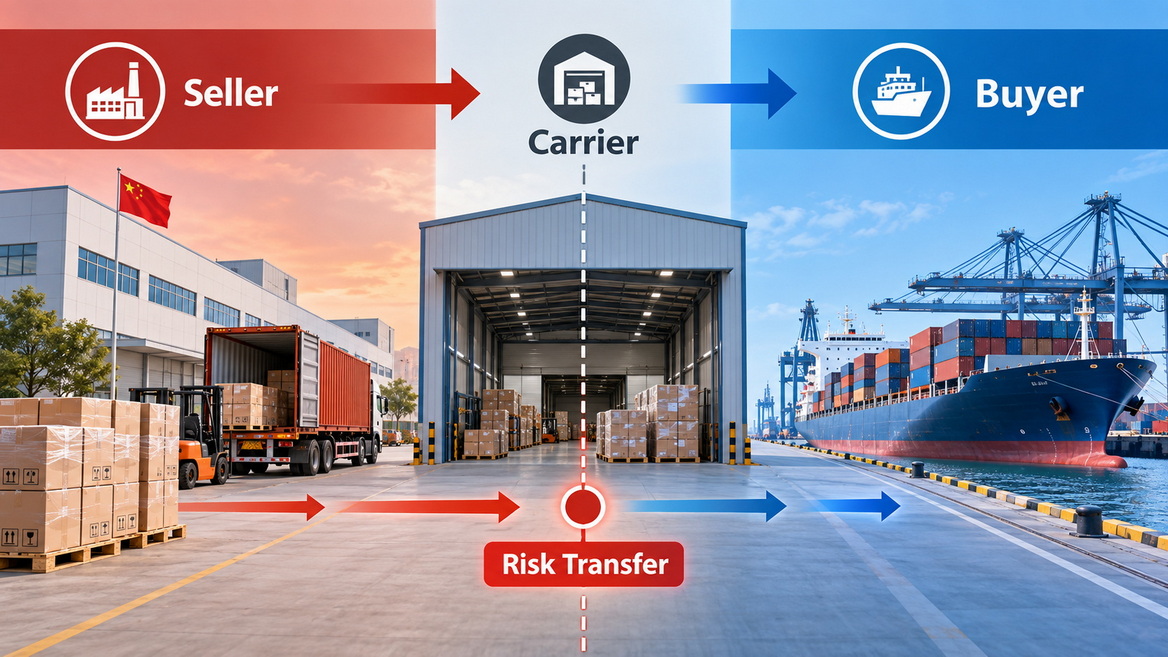
FCA creates a shared logistics structure. The seller manages the shipment up to the named delivery location, while the buyer manages the shipment from that point onward.
| Shipping Responsibility | Seller’s Responsibility | Buyer’s Responsibility |
|---|---|---|
| Product manufacturing | Yes | No |
| Export-ready packaging | Yes | No |
| Commercial invoice | Yes | Receives and uses the document |
| Packing list | Yes | Receives and uses the document |
| Export customs clearance | Yes | Supports with required information if needed |
| Export licenses and permits | Yes, where applicable | May provide end-use or destination information |
| Delivery to the named FCA location | Yes | Nominates the carrier or receiving party |
| Loading at seller’s factory | Yes, if delivery occurs at seller premises | Receives cargo after loading |
| Main freight from China | Usually no | Yes |
| Cargo insurance | Usually no | Yes |
| Import customs clearance | No | Yes |
| Import duties and taxes | No | Yes |
| Delivery to final destination | Usually no | Yes |
The most important point is that FCA delivery is not always the same as collection from the supplier's factory. The named place may be the supplier's warehouse, a consolidation warehouse, a port terminal, an airport cargo terminal, an inland container depot, or another agreed logistics facility.
If the FCA location is the supplier's factory or warehouse, the seller must load the cargo onto the vehicle arranged by the buyer or the buyer's freight forwarder.
For example:
> FCA Supplier Factory, Dongguan, China, Incoterms® 2020
In this situation, the seller loads the shipment onto the truck sent by the buyer's nominated freight forwarder. Risk normally transfers after the goods are loaded onto that vehicle.
This option is useful when the buyer's logistics provider collects cargo directly from a supplier. It can also work well when multiple suppliers are located in the same industrial area.
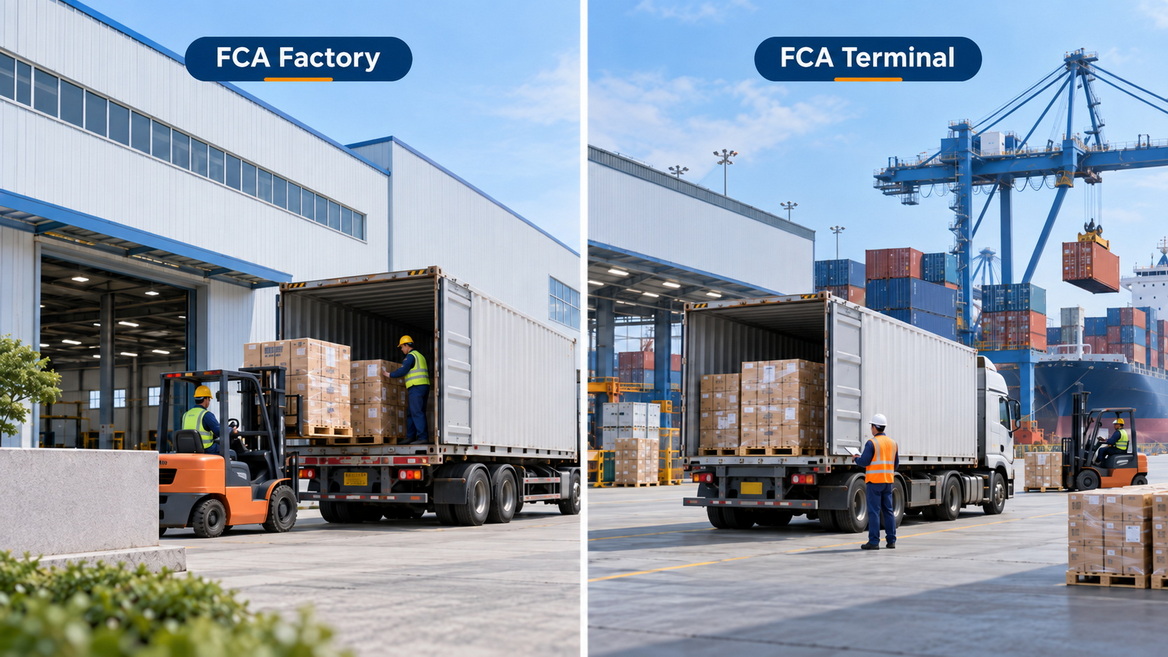
If the named location is somewhere other than the supplier's premises, the seller must transport the cargo to that location and deliver it to the buyer's nominated carrier or receiving party.
For example:
> FCA Freight Forwarder Warehouse, Shenzhen, China, Incoterms® 2020
or:
> FCA Shanghai Pudong International Airport Cargo Terminal, China, Incoterms® 2020
Under this arrangement, the supplier is normally responsible for local delivery to the specified location and export customs clearance. The buyer's risk begins once the cargo has been handed over according to the agreed terms.
The contract should clearly identify the warehouse, terminal, address, delivery point, and cargo receiving requirements. A broad city name is not enough.
FCA is often an effective option for experienced buyers who want greater control over shipping from China. It works particularly well when the buyer has a preferred freight forwarder, needs to consolidate cargo from several suppliers, or wants better oversight of freight costs and shipment schedules.
- You are importing containerized cargo from China.
- You need the supplier to complete China export customs clearance.
- You use your own freight forwarder or have negotiated freight rates.
- You want to combine cargo from multiple Chinese suppliers.
- You ship by air freight, sea freight, rail freight, or multimodal transport.
- You need visibility over bookings, transit time, routing, and destination charges.
- You want a logistics provider to coordinate supplier communication and shipment planning.
- You are purchasing regular volumes and want to compare freight options independently.
- Your cargo requires specialized handling, consolidation, inspection, or documentation support.
FCA is frequently used for businesses importing machinery, electronics, furniture, packaging materials, industrial components, consumer products, textiles, tools, automotive parts, and other commercial cargo from China.
For buyers sourcing from multiple factories, FCA can simplify consolidation. Instead of managing separate international shipments from each supplier, a freight forwarder can collect goods from different locations, bring them to a consolidation warehouse, verify cargo details, arrange export procedures, and ship the combined cargo under one transport plan.
FCA may not be ideal in every situation. Buyers should consider alternatives if they do not have a reliable logistics partner in China or if they want the supplier to control more of the shipping process.
Another trade term may be more suitable when:
- The buyer has no freight forwarder with China export capability.
- The supplier prefers to arrange the full shipment.
- The buyer does not want to manage freight bookings or destination charges.
- The shipment is small and urgent and is better handled by express courier.
- The supplier offers a competitive delivered-price solution.
- The destination customs process is complicated and requires a full delivered service.
- The buyer needs delivery directly to a warehouse, job site, retailer, or fulfillment center.
The right shipping arrangement depends on the product, shipment volume, transport mode, cargo value, destination country, delivery timeline, and level of buyer control required.
FCA is often compared with EXW and FOB because these are common terms used by Chinese suppliers. However, the three options create very different responsibilities.
| Topic | EXW | FCA | FOB |
|---|---|---|---|
| Seller handles export customs clearance | Usually no | Yes | Yes |
| Buyer arranges main freight | Yes | Yes | Yes |
| Suitable for air, sea, rail, road, and multimodal transport | Yes | Yes | No |
| Seller loads at its own premises | Usually no | Yes, if delivery is at seller’s premises | Depends on shipment process |
| Suitable for containerized freight | Can be difficult for foreign buyers | Often suitable | Can be less practical |
| Risk transfers | At seller’s premises before loading, unless otherwise agreed | At delivery to the nominated carrier or party | When goods are loaded on board the vessel |
| Buyer controls freight booking | Yes | Yes | Yes |
EXW means Ex Works. Under EXW, the seller makes the goods available at its factory, warehouse, or another agreed location. The buyer is generally responsible for loading, export customs clearance, transportation, freight booking, and import clearance.
For overseas buyers, EXW can create practical difficulties. A foreign company may not have the ability to arrange export declarations in China, communicate with customs authorities, manage loading requirements, or resolve documentation issues with the supplier.
FCA is usually more workable because the seller completes export clearance. If the seller delivers goods at its own factory, the seller also loads the cargo onto the vehicle sent by the buyer's freight forwarder.
For many importers, this makes FCA a safer and more operationally realistic choice than EXW.
FOB means Free On Board. It is designed for sea or inland-waterway shipments. Under FOB, the seller's delivery obligation is completed when the goods are loaded on board the vessel nominated by the buyer.
For container shipments, this can be less straightforward because containers are often handed to the carrier at a port terminal or container yard before they are physically loaded onto a vessel. The supplier may have limited control over the later vessel-loading process.
FCA is often more suitable for containerized cargo because the seller can deliver the container to the buyer's nominated carrier at the agreed terminal or freight facility. The buyer then assumes risk from that point.
For many modern container shipments from China, FCA reflects the actual logistics handover more accurately than FOB.
The FCA named place is one of the most important details in the shipping contract. It determines where the seller's responsibility ends and where the buyer's responsibility begins.
A vague FCA clause can create disputes about:
- Local trucking costs
- Warehouse receiving charges
- Container delivery arrangements
- Terminal handling fees
- Export customs filing
- Loading and unloading responsibility
- Cargo damage before handover
- Missed cargo cutoffs
- Storage fees
- Demurrage and detention exposure
- Delayed documents
- Responsibility for inspection or cargo rejection
> FCA Shenzhen, China
This wording is incomplete. Shenzhen has multiple ports, airports, warehouses, logistics parks, container yards, and freight facilities. It does not tell the supplier where to deliver the goods.
> FCA [Freight Forwarder Warehouse Name], [Full Address], Shenzhen, China, Incoterms® 2020. Seller shall complete export customs clearance and deliver cargo to the buyer-nominated carrier before the agreed cargo cutoff.
> FCA [Named Container Terminal or Forwarder Warehouse], [City], China, Incoterms® 2020. The seller shall complete export customs clearance and deliver the cargo to the buyer's nominated carrier at the agreed delivery point. The buyer shall provide the booking number, carrier details, cargo cutoff, container release information, and shipping instructions within the agreed time.
A strong FCA clause should contain six key details:
1. The term FCA.
2. The exact delivery location.
3. The full warehouse address, terminal name, or facility information.
4. The agreed delivery point within that location.
5. The applicable version: Incoterms® 2020.
6. Special requirements for loading, documentation, booking, inspection, and cargo cutoff.
One of the major advantages of FCA for shipments from China is that the seller completes export customs clearance. The supplier is generally better positioned to provide manufacturing information, export documentation, packing details, product specifications, and customs declaration data.
However, successful customs clearance depends on accurate information from both buyer and seller.
- Commercial invoice
- Packing list
- Sales contract or purchase order
- Product descriptions
- HS code information
- Export declaration information
- Export licenses or permits, where required
- Booking confirmation
- Shipping instructions
- Dangerous goods documentation, if applicable
- Battery declarations, if applicable
- Certificates of origin, where required
- Wooden packaging or fumigation documents, where required
- Product compliance documents requested by the destination country
The seller's responsibility for export customs clearance does not remove the buyer's responsibility for import compliance. Buyers should confirm destination-country product standards, import permits, labeling rules, product certifications, tax registration requirements, and customs documents before production begins.
Many shipping delays occur before a container reaches the port or before an aircraft departs. Common causes include incomplete product descriptions, inconsistent invoices, incorrect carton quantities, missing battery declarations, unclear HS classification, or documents that do not match the physical cargo.
Before booking a shipment, buyers should confirm:
- Whether the product HS code is correct.
- Whether the cargo contains batteries, chemicals, magnets, liquids, powders, food-contact materials, or restricted components.
- Whether the destination requires certificates, permits, inspections, or testing reports.
- Whether the commercial invoice matches the purchase order.
- Whether the packing list matches the final carton and pallet count.
- Whether the importer-of-record information is complete.
- Whether the consignee can clear the goods upon arrival.
- Whether cargo insurance is required for the shipment.
Early document preparation reduces the risk of delayed export clearance, missed vessel cutoffs, storage charges, cargo rollovers, and destination customs problems.
FCA can be used when payment is made through a letter of credit, but the documentary process needs careful coordination.
Some letters of credit require an on-board bill of lading. Under FCA, the seller may deliver cargo to the buyer's carrier at a warehouse, terminal, or container yard before the shipment is loaded onto a vessel. This can create a document gap if the seller needs proof that the goods were loaded on board.
The parties can agree that the buyer instructs the carrier to issue an on-board bill of lading to the seller once the cargo has been loaded onto the vessel. This arrangement can help the seller meet documentary payment requirements.
However, it must be arranged before shipment. It should be reflected in the sales contract, the letter of credit wording, the booking instructions, and the transport document requirements.
- State the FCA named place clearly in the sales contract.
- Confirm the required bill of lading wording before booking.
- Ask whether an on-board bill of lading is necessary.
- Confirm that the carrier can issue the requested transport document.
- Ensure the buyer provides carrier instructions in time.
- Match consignee, notify party, cargo description, marks, and dates across all documents.
- Confirm the document presentation deadline.
- Review transport-document requirements before cargo handover.
An on-board bill of lading arrangement does not change the FCA handover point. It is a documentation solution, not a change in the division of freight costs or cargo risk.
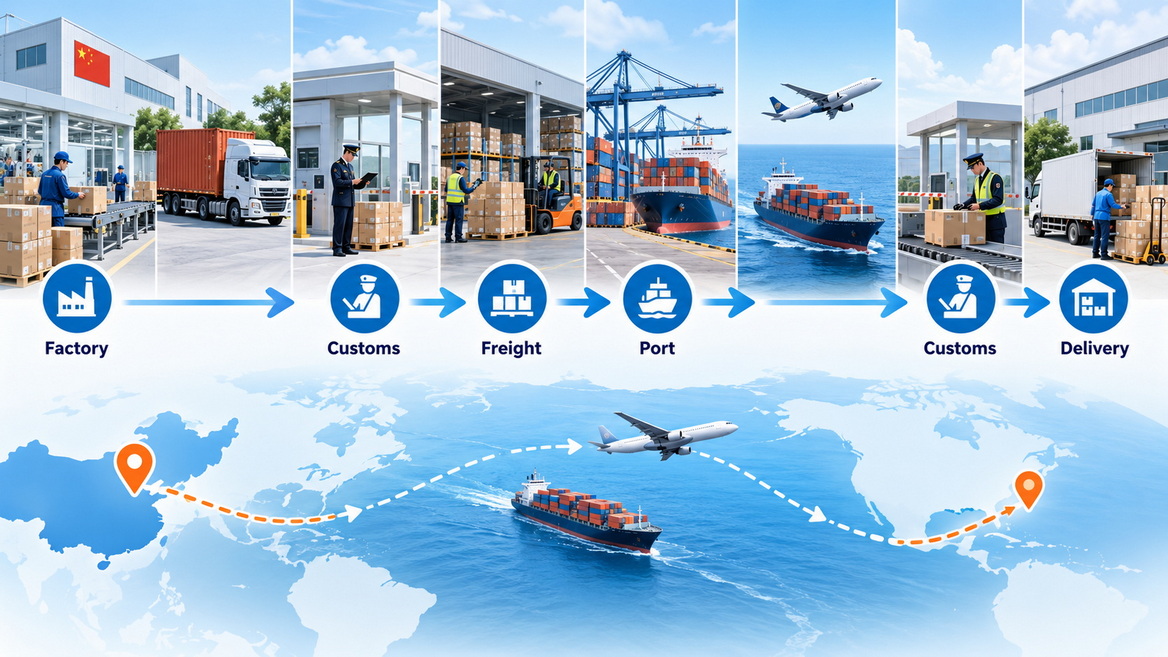
A successful FCA shipment depends on coordinated communication between the buyer, supplier, freight forwarder, carrier, customs broker, and destination delivery provider.
Confirm the exact named place, loading responsibility, export customs responsibility, booking party, delivery timeline, and applicable Incoterms® version before production begins.
Do not wait until the cargo is finished. Late clarification can lead to higher trucking costs, missed cutoffs, warehouse refusal, incorrect shipping documents, or disputes over who should pay origin charges.
A reliable freight forwarder should be able to communicate with the supplier, issue booking instructions, coordinate pickup or delivery, arrange export procedures, review documents, monitor cargo milestones, and organize the international transport process.
GB FREIGHT AGENCY CO., LTD. has 15 years of international logistics experience supporting businesses that ship goods from China to global markets. We provide cost-effective transport solutions that can cover supplier booking coordination, export customs clearance, sea freight, air freight, rail freight, multimodal transport, cargo consolidation, and final delivery arrangements.
The supplier should receive clear and complete logistics instructions, including:
- Freight forwarder contact details
- Booking number
- Cargo-ready date
- Warehouse delivery address or pickup location
- Cargo cutoff date and time
- Carrier information
- Container release details, if applicable
- Required labels and shipping marks
- Loading requirements
- Documentation instructions
- Dangerous goods or battery handling requirements
- Destination delivery requirements, if relevant
Clear instructions reduce the chance that cargo is delivered to the wrong location, misses a cutoff, arrives without documents, or is rejected by the receiving warehouse.
Before cargo pickup or supplier delivery, confirm the final shipment details:
- Number of cartons
- Number of pallets
- Gross weight
- Net weight
- Dimensions
- Packaging type
- Product description
- Commodity value
- HS code
- Cargo-ready date
- Dangerous goods status
- Battery status
- Required export documents
- Required destination documents
For high-value products, fragile cargo, regulated goods, or large industrial equipment, buyers may also consider pre-shipment inspection, loading supervision, photo confirmation, or specialized packing review.
Shipment visibility should begin before the vessel or aircraft departs. Important milestones include:
- Cargo-ready confirmation
- Pickup date
- Supplier delivery date
- Warehouse receiving confirmation
- Export customs declaration status
- Container gate-in date
- Vessel departure or flight departure
- Transshipment status
- Destination arrival
- Import customs clearance
- Delivery appointment
- Proof of delivery
Monitoring these milestones helps buyers identify delays early and communicate with suppliers, customers, warehouses, and internal teams before problems affect production schedules or inventory availability.
A clause such as "FCA Guangzhou" is too general. It does not identify the warehouse, terminal, airport, port, or delivery point.
Always state the full named location.
FCA does not normally include ocean freight, air freight, destination customs clearance, import taxes, or final delivery. Buyers should request a clear freight-cost breakdown before confirming the shipment.
FCA defines delivery obligations, cost allocation, customs roles, and risk transfer. It does not determine product quality, payment terms, ownership transfer, cargo insurance coverage, liability limits, delay penalties, or dispute resolution.
These matters should be addressed separately in the commercial agreement.
A supplier may not know the buyer's booking number, cargo cutoff, receiving schedule, document requirements, or cargo-label instructions. Poor coordination can result in missed sailings, storage charges, delayed export customs clearance, shipment rollovers, and avoidable logistics costs.
The supplier handles export customs clearance in China, but the buyer is generally responsible for import clearance at destination. Product regulations, duties, VAT, labeling requirements, permits, and certifications should be checked before cargo leaves China.
FCA gives buyers more control over transport from China, but it also requires careful planning. A clear shipping clause, accurate documentation, supplier coordination, cargo tracking, and early customs preparation can prevent delays and unnecessary costs.
GB FREIGHT AGENCY CO., LTD. provides international freight solutions for businesses shipping from China to Europe, North America, South America, Southeast Asia, the Middle East, Africa, and Oceania. Our team supports supplier booking coordination, cargo pickup, export customs clearance, consolidation, sea freight, air freight, rail freight, and final delivery planning.
Whether you are moving one shipment or consolidating cargo from multiple Chinese suppliers, a properly managed FCA arrangement can improve cost visibility, reduce handover disputes, and create a more reliable transport process from factory to final destination.
Share your supplier location, product details, shipment weight and dimensions, cargo-ready date, destination, and preferred transport method to receive a practical shipping plan tailored to your business.
FCA means Free Carrier. The seller delivers export-cleared goods to the carrier or another party nominated by the buyer at an agreed named location. Once delivery occurs, the buyer normally assumes cargo risk and arranges the main freight movement.
The seller is generally responsible for export customs clearance under FCA. The buyer is generally responsible for import customs clearance, duties, taxes, and destination-country compliance.
FCA is often more suitable for containerized cargo because delivery can occur at a warehouse, container yard, freight terminal, or port facility before the container is loaded onto the vessel. FOB transfers risk when the goods are on board the vessel, which may not match the actual container handover process.
No. Under FCA, the buyer normally arranges and pays for the main international freight after delivery at the agreed FCA location. The buyer also normally arranges cargo insurance, import customs clearance, destination charges, and final delivery.
If the named place is the seller's premises, the seller loads the goods onto the vehicle arranged by the buyer. If delivery occurs at another location, such as a warehouse or terminal, unloading from the seller's truck is generally the buyer's responsibility unless the parties agree otherwise.
1. International Chamber of Commerce. [Incoterms® 2020]
2. International Chamber of Commerce. [Incoterms® Rules]
3. ICC Academy. [Incoterms® 2020: EXW or FCA?]
4. Freightos. [FCA Tips and Tricks]
5. Trade Finance Global. [FCA (Free Carrier) Incoterms® 2020 Rule]
6. Lexology. [A Practical Overview of ICC Incoterms 2020]
7. SSLT Global. [FCA vs FOB: Which Incoterm Should You Use for Container Shipping?]


