
Views: 273 Author: GB FREIGHT Publish Time: 2026-09-30 Origin: Site


Content Menu
● FCL vs. LCL: Which Is Better for Your Cargo?
>> How to compare the total cost
● Which FCL Container Size Should You Choose?
● What Goes Into an FCL Shipping Quote?
>> How do demurrage and detention differ?
● How Does FCL Shipping From China Work?
● Plan Import Filings Before the Vessel Loads
● Match Incoterms to the Actual Handover
● Build a Delay-Resistant Delivery Plan
● How GB FREIGHT AGENCY CO., LTD. Supports China-Origin Shipments
● Frequently Asked Questions About FCL Shipping
>> Does FCL mean the container must be full?
>> At what volume does FCL become cheaper than LCL?
>> Can a 40-foot container carry twice the weight of a 20-foot container?
>> What documents are commonly needed for an FCL shipment from China?
>> Who is responsible for the verified gross mass?
FCL shipping from China gives one shipper the use of an entire container, even when the cargo does not fill it completely. For importers, the real decision is not simply whether a 20-foot or 40-foot container is available. It is whether full container load sea freight offers the right balance of total cost, cargo handling, transit planning, and delivery control for a specific order.
GB FREIGHT AGENCY CO., LTD. has 15 years of international logistics experience helping businesses ship from China to Europe, North America, South America, Southeast Asia, the Middle East, Africa, and Oceania. From supplier booking coordination and export customs clearance to ocean transportation and final delivery, our goal is to help customers choose a cost-effective shipping plan that fits their cargo and destination requirements.

FCL stands for full container load. A shipper books a container for its own cargo rather than sharing container space with other shippers. The container may still have unused space. By contrast, LCL, or less than container load, combines shipments from multiple shippers and generally requires consolidation and deconsolidation.
FCL can reduce the number of times goods are handled during groupage operations. It also gives the shipper more control over how cartons, pallets, or equipment are arranged inside the container. However, FCL does not eliminate port handling, transshipment, customs examinations, or damage risk. Good packaging, loading, and documentation still matter.
A sealed container is not a substitute for shipment records. Record the seal number, check it against the transport documents, and document any authorized seal change after an inspection.
Neither option is automatically cheaper or faster. Compare them against the same origin, destination, delivery point, and included services.
| Decision factor | FCL shipping | LCL shipping |
|---|---|---|
| Space purchased | Use of an entire container | A share of consolidated space |
| Typical fit | Larger orders or cargo needing more loading control | Smaller orders that do not justify a container |
| Cargo handling | No routine groupage consolidation with other shippers | Additional consolidation and deconsolidation are typical |
| Pricing approach | Container-based freight plus applicable local charges | Often based on chargeable volume or weight plus local charges |
| Final delivery | Requires container trucking, unloading, and return planning | Delivery follows the consolidation provider's arrangements |
There is no universal volume threshold at which FCL becomes cheaper than LCL. Around 13 cubic meters may be a useful point at which to request both quotes, but it is not a fixed rule. A shipment's weight, dimensions, trade lane, local fees, and delivery requirements can change the result.
Imagine that an LCL option costs $450 in shipment-specific charges plus $110 per chargeable cubic meter. Imagine an FCL option totals $2,100 for the same covered services. At 15 chargeable cubic meters, the two hypothetical totals would match. Above or below that point, the more economical choice could change.
These are illustrative figures, not current freight rates. A real comparison must also account for origin charges, destination handling, trucking, customs services, potential storage, and the time needed to unload. If a full container forces a buyer to purchase unwanted inventory, include that carrying cost too.
For purchasing teams, the most useful measure may be landed logistics cost per saleable unit. This shows whether a lower freight rate actually improves the economics of the order.
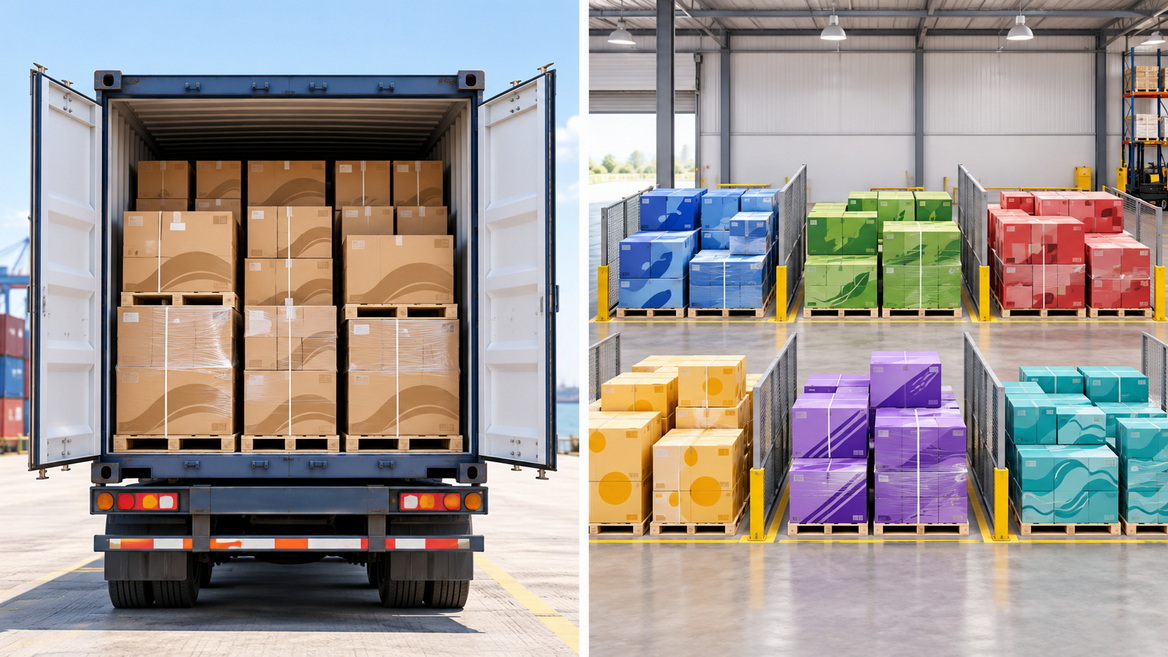
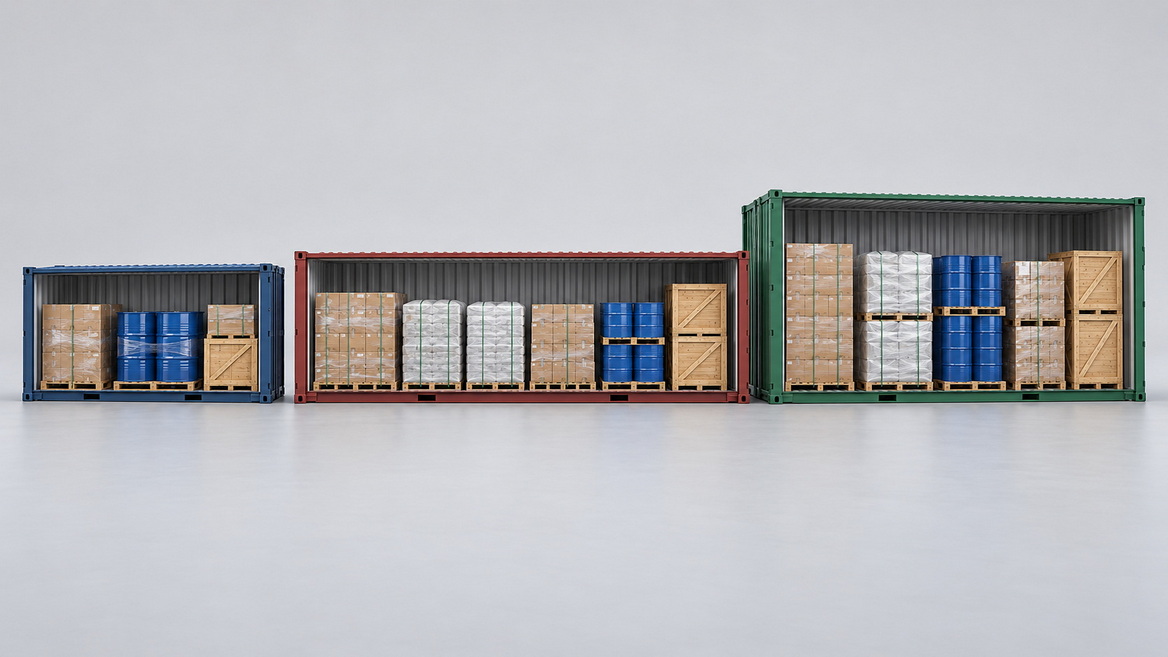
The most common dry-container choices are a 20-foot standard, a 40-foot standard, and a 40-foot high-cube container. Published carrier equipment specifications provide a starting point, not a guaranteed loading allowance.
| Dry container | Example internal volume | Example maximum payload | Main planning question |
|---|---|---|---|
| 20-foot standard | 33 m³ | 28,200 kg | Is the cargo relatively dense or compact? |
| 40-foot standard | 67 m³ | 28,800 kg | Will the pallet layout and carton dimensions fit? |
| 40-foot high cube | 76 m³ | 28,620 kg | Will the additional height improve the loading plan? |
A 40-foot container provides much more space than a 20-foot container, but not twice the payload. Dense goods may reach a weight restriction before the container looks full. Lightweight goods may reach a volume or door-clearance limit first.
Before booking, confirm the actual equipment specification and any carrier, port, road, axle, or bridge restrictions. Ask the supplier for carton dimensions, pallet sizes, gross weights, stackability, and loading photographs where available. Allow space for securing materials and check whether the receiving warehouse can unload the chosen equipment.
Refrigerated, hazardous, and oversized cargo need a separate review. Do not use dry-container volume figures to plan these shipments.
A useful quote explains what is included, what is excluded, and who pays each charge. It should also identify the route, container type, service scope, quote validity, and proposed delivery point.
- Origin charges: Supplier pickup, container positioning, export documentation, customs processing, and origin terminal fees, as applicable.
- Ocean charges: Base freight and any applicable carrier surcharges.
- Destination charges: Terminal handling, customs brokerage, duties and taxes, inland trucking, unloading, and empty-container return, depending on the agreed scope.
- Conditional charges: Cargo insurance, inspections, storage, demurrage, detention, and truck waiting time.
Not every charge applies to every shipment. Ask which amounts are fixed, estimated, conditional, or billed at actual cost. A port-to-port rate should not be compared directly with a warehouse-delivery quote.
Container freight indices can provide market context, but they are not a shipment-specific, all-in price. They do not tell you what your import duties will be, whether a local truck can access your site, or how much time you will have to return the empty container. Request a dated, itemized quotation for the actual shipment.
Demurrage generally relates to keeping a container at a terminal after its permitted free period. Detention generally relates to retaining equipment outside the terminal beyond the allowed time. Contracts and tariffs determine the applicable terms and charges.
Before the vessel arrives, confirm when free time starts, whether weekends count, the daily rates, and whether extra time can be arranged. Track container availability, customs release, pickup, delivery, and empty return as separate events. Do not assume that a customs release automatically means the container is ready for pickup.
A container booking is only one step. A reliable shipping plan assigns an owner and a deadline to every handoff.
1. Confirm the cargo details. Collect the product description, package count, dimensions, gross weight, cargo value, and required delivery date. Flag batteries, chemicals, and other regulated products early.
2. Agree on responsibilities. Confirm the sales contract's named place and Incoterms rule. Identify who handles export clearance, import clearance, insurance, and final delivery.
3. Choose equipment and routing. Compare container availability, port pairs, schedules, possible transshipment, and inland connections.
4. Coordinate the booking. Align the supplier's production date with container pickup, terminal receiving, shipping-instruction cutoff, and verified gross mass deadline.
5. Inspect, load, and secure. Check the empty container's condition. Record package counts, loading photographs, seal number, and the information needed to establish the container's verified gross mass.
6. Complete export and departure checks. Confirm that commercial documents match the booking details and that the container was actually loaded onto the intended vessel.
7. Prepare destination delivery. Coordinate the destination broker, any advance filings, customs release, truck appointment, unloading capacity, and empty return.
A packed container must have its verified gross mass, often called VGM, communicated in time for ship stowage planning. The shipper is responsible for obtaining and documenting it. Where the applicable method is approved, the mass can be verified by weighing the packed container or by calculating the contents and securing materials together with the container's tare mass.
Do not wait until the container reaches the terminal to resolve a discrepancy in cargo weight or shipping instructions. The supplier, shipper, and forwarder should agree on the document review process before loading day.
Destination requirements can create a deadline before the container leaves China. For U.S.-bound ocean cargo, the importer or its agent must arrange the required Importer Security Filing. The relevant information must generally reach U.S. Customs and Border Protection no later than 24 hours before the cargo is loaded onto the vessel destined for the United States.
Ask a qualified U.S. customs broker to confirm the data and responsibilities for the specific entry. Supplier names, product details, and shipping records should be gathered early enough to correct inconsistencies before the cutoff.
Other destinations have different advance-data and customs requirements. An EU import, for example, should not be managed with a copied U.S. checklist. Product-specific licenses or certificates may also be necessary. Confirm requirements with the destination broker based on the actual product, importer, and route.
Practical step: Create a document checklist with one named owner for every filing. Put its internal review deadline ahead of the carrier's external cutoff.
A quote for delivery to a warehouse does not, by itself, decide who bears risk or pays import charges under the sales contract. The named Incoterms rule and place must match the transaction.
Under Incoterms 2020, FCA transfers risk when the seller delivers the goods to the buyer's nominated carrier at the agreed place. FOB transfers risk when the goods are on board the vessel at the named loading port. For containerized goods handed over at a factory or terminal before loading, FCA may better reflect the physical handover.
At destination, DAP and DDP can both involve delivery to a named place, but their import responsibilities differ. Under DAP, the buyer generally handles import clearance and charges. Under DDP, the seller takes on those obligations. Before agreeing to DDP, check whether the seller can legally meet the import requirements in the destination country.
For example, "FCA supplier facility, Ningbo, Incoterms 2020" and "DAP buyer warehouse, Rotterdam, Incoterms 2020" describe different handovers and responsibilities. They are examples, not recommended terms for every shipment. Ask the commercial team and logistics provider to reconcile the sales contract with the transport quote before approving either.
A low ocean rate can lose its advantage if the container arrives when the warehouse cannot unload it. The final delivery plan should be reviewed before departure, then updated as the vessel's arrival estimate changes.
Ask these questions before confirming a route:
- Is the quoted transit estimate port-to-port or door-to-door?
- Does the service include transshipment, and who will monitor schedule changes?
- Who confirms container availability and customs release at destination?
- Can the warehouse receive and unload the container on the proposed date?
- Who books the truck, checks the empty-return location, and monitors the return deadline?
Consider a hypothetical importer whose 40-foot container arrives on Monday, but whose warehouse has no unloading slot until the following week. The solution may not be a faster vessel. It may be an earlier warehouse booking, different delivery arrangement, or sufficient free time negotiated before arrival.
Physical risk should also be planned for. An industry estimate puts the number of containers lost at sea in 2025 at approximately 1,478 out of more than 280 million transported. That proportion is small, but it does not guarantee the safety of an individual shipment. Review cargo securing, packaging, insurance terms, and the records needed to support a claim.

A practical FCL plan links the supplier's ready date, carrier cutoffs, customs work, vessel schedule, and importer's delivery capacity. With 15 years of international logistics experience, GB FREIGHT AGENCY CO., LTD. provides sea freight solutions from China and can coordinate supplier bookings, export customs clearance, transportation, and final delivery within the agreed service scope.
Our stated service reach includes Europe, North America, South America, Southeast Asia, the Middle East, Africa, and Oceania. The right recommendation depends on the actual shipment, not a blanket claim that FCL is always best. Depending on cargo volume, equipment needs, and delivery constraints, an LCL alternative or a different routing may deserve consideration.
FCL shipping works best when container selection, total-cost comparison, document cutoffs, and final delivery are planned as one process. Confirm the responsibilities behind the quote, not just the sea freight rate. That gives your purchasing and receiving teams a clearer basis for choosing between FCL and LCL.
Send GB FREIGHT AGENCY CO., LTD. your cargo dimensions and weight, supplier location, destination address, ready date, and preferred Incoterms rule. Request an itemized FCL quote from China alongside an LCL alternative, and choose the option that fits your total cost and delivery requirements.
No. FCL means one shipper books the use of a container for its cargo. A partially filled container can still move as FCL, although its cost per unit of cargo may be higher than an LCL option.
There is no fixed break-even volume. Around 13 cubic meters is a reason to compare quotations, not a guarantee that FCL will cost less. Weight, route, local charges, and final delivery can change the answer.
No. It offers substantially more internal space, but its published maximum payload may be similar. Check the actual container specification and applicable road or port restrictions before loading.
A commercial invoice, packing list, transport document, and applicable customs declarations are common starting points. Additional licenses, certificates, or advance filings depend on the product and destination. Confirm the final list with the relevant customs specialists.
The shipper named on the transport document is responsible for obtaining and communicating the verified gross mass in time. A service provider may help by agreement, but its involvement should be clearly arranged.
1. [Freightos, "FCL Shipping: The Complete Guide to Shipping Procedures, Containers, and Pricing"]. Used as the article being restructured and for its introductory FCL/LCL discussion and approximate volume comparison. Market commentary tied to earlier years was not reused.
2. [Maersk, "Our Fleet: Equipment Specifications"]. Source of the illustrative dry-container volumes and maximum payloads in the equipment table.
3. [International Maritime Organization, "Verification of the Gross Mass of a Packed Container"]. Source for verified-gross-mass methods, responsibility, and loading requirements.
4. [International Chamber of Commerce Academy, "FCA & FOB Incoterms 2020 Explained: Key Differences"]. Source for the FCA/FOB handover and risk distinctions.
5. [International Chamber of Commerce Academy, "DAP & DDP Incoterms 2020 Explained: Key Differences"]. Source for import clearance and charge responsibilities under DAP and DDP.
6. [U.S. Customs and Border Protection, "Import Security Filing (ISF): When to Submit to CBP"]. Source for the U.S. ocean-import advance filing deadline.
7. [Federal Maritime Commission, "FMC Publishes Final Rule on Detention and Demurrage Billing Practices"]. Background on U.S. billing requirements for detention and demurrage.
8. [Freightos, "Freightos Baltic Index: Global Container Price Index"]. Background on container freight benchmarks and their distinction from shipment-specific quotations.
9. [World Shipping Council, "Containers Lost at Sea"]. Source for the estimated 2025 container-loss figure and global container volume.
10. GB FREIGHT AGENCY CO., LTD., company description supplied for this assignment. Source for the stated 15 years of experience, services, and destination regions; no independent customer reviews were supplied or represented as verified testimonials.


