
Views: 249 Author: GB FREIGHT Publish Time: 2026-10-05 Origin: Site


Content Menu
>> The Four Freight Classification Factors
● How to Calculate Freight Density
>> Step-by-Step Freight Density Calculation
>> Freight Density Calculation Example
>> Why the Correct Chart Matters
● Why Density Is Not the Only Freight Class Factor
>> Stowability
>> Handling
>> Liability
● Freight Class and LCL Shipping Are Different
>> How LCL Chargeable Volume Works● How to Reduce Freight Reclassification Charges
>> Common Data Errors That Increase Shipping Costs
● Practical Guidance for Importers Shipping From China
>> Information to Prepare Before Booking
>> Why Final Packing Details Matter
● Reliable Freight Planning Starts With Accurate Cargo Data
>> What is a freight class density calculator?
>> How do I calculate freight density?
>> Is freight density the same as freight class?
>> What is the difference between LTL freight class and LCL shipping?
>> Why did my freight carrier change the shipping charge?
A freight class density calculator helps shippers estimate how a U.S. domestic LTL shipment may be classified before pickup. By calculating freight density in pounds per cubic foot, businesses can prepare more accurate shipment details, compare carrier quotes more effectively, and reduce the risk of reclassification charges after freight has been collected.
For importers moving cargo from China, freight density is especially important when an international shipment includes a final domestic delivery leg. A shipment may travel by LCL ocean freight from China and then move by truck from the destination port or warehouse to its final consignee. Although ocean LCL charges and U.S. LTL freight class are calculated differently, accurate cargo dimensions, packaging details, and gross weight are essential for both.
GB FREIGHT AGENCY CO., LTD. has more than 15 years of international logistics experience supporting businesses that ship cargo from China to Europe, North America, South America, Southeast Asia, the Middle East, Africa, and Oceania. From supplier booking coordination and export customs clearance to international transportation and final delivery, our team helps businesses plan practical and cost-effective freight solutions for LCL shipments and other cargo types.

Freight class is a standardized system used mainly for less-than-truckload (LTL) freight transportation in the United States. It helps carriers evaluate how a shipment uses trailer space, how difficult it is to handle, how safely it can be loaded with other cargo, and how much risk it presents during transportation.
Freight classes commonly range from Class 50 to Class 500.
In general:
- Lower freight classes often apply to dense, compact, durable, and easy-to-handle cargo.
- Higher freight classes often apply to lightweight, bulky, fragile, difficult-to-stack, hazardous, or high-risk cargo.
- A higher freight class commonly results in a higher transportation rate.
- The correct freight class may depend on more than weight and dimensions alone.
For many standard shipments, density is the most practical starting point. However, the final class may also be affected by the product itself, the packaging method, the cargo shape, and any special transportation requirements.
Freight classification typically considers four major transportation characteristics:
1. Density
2. Stowability
3. Handling
4. Liability
Understanding these factors helps importers avoid a common mistake: assuming that the heaviest shipment always receives the lowest freight class. Weight alone does not determine freight class. A shipment must be evaluated based on how much space it occupies and how easily it can move through a carrier's network.
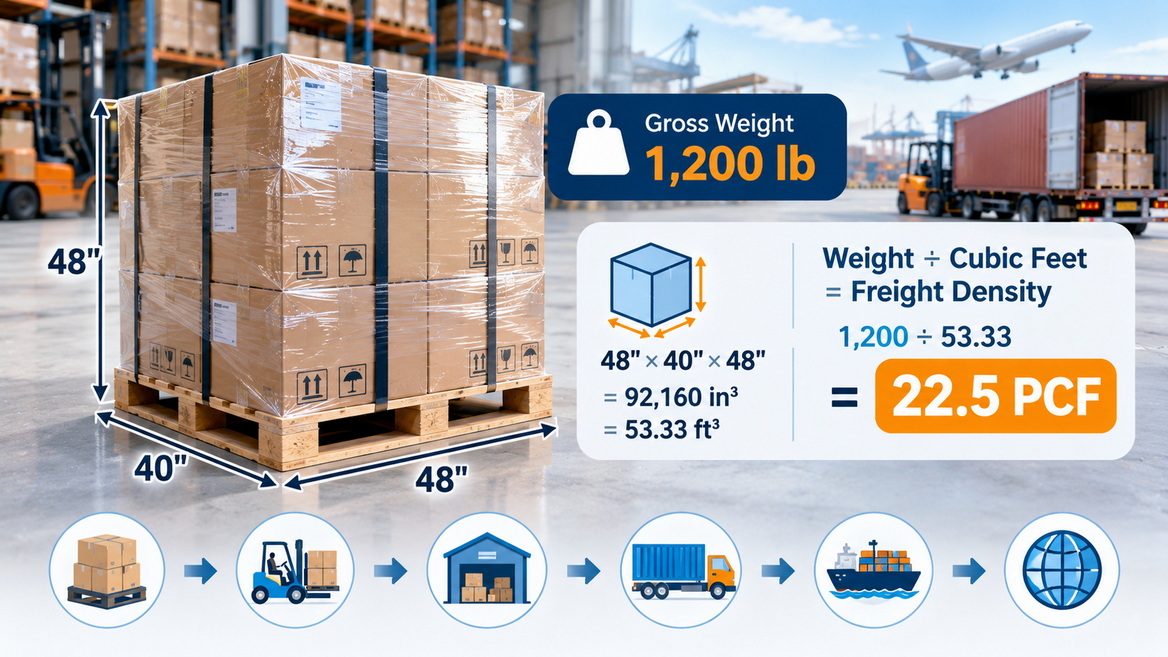
Freight density is usually expressed as pounds per cubic foot, often abbreviated as PCF.
After calculating total cubic feet, divide the total gross weight by the total volume.
Use the following process to estimate shipment density before arranging domestic LTL delivery:
1. Count all shipping units
Include pallets, skids, crates, cartons, drums, bundles, and other packaged freight units.
2. Measure final outside dimensions
Measure the full length, width, and height after cargo has been packed and prepared for transport. Include pallets, wood framing, cartons, wrapping, protective materials, and any overhang.
3. Confirm gross shipment weight
Use the gross weight rather than net product weight. Gross weight includes the products, carton, pallet, crate, inner packaging, straps, stretch wrap, and protective materials.
4. Calculate cubic feet
Multiply the length, width, and height in inches. Divide the result by 1,728.
5. Calculate pounds per cubic foot
Divide the total gross weight in pounds by the total cubic feet.
6. Compare the density with a freight class chart
Use a current density chart as an initial reference for applicable density-based freight.
7. Review special freight conditions
Consider whether the shipment is stackable, fragile, hazardous, high value, oversized, irregularly shaped, or difficult to load.
Assume a pallet is being delivered from a U.S. destination warehouse to a customer after arriving from China.
The final packed pallet details are:
- Length: 48 inches
- Width: 40 inches
- Height: 48 inches
- Gross weight: 1,200 pounds
The shipment density is 22.5 PCF.
For standard density-based freight, 22.5 PCF may fall into a lower freight-class category than lightweight or bulky cargo. However, the final classification should still reflect the actual commodity, packaging, handling needs, and transport risks.
The table below provides a practical guide for shipments that are classified primarily by density.
| Freight Density | Typical Freight Class |
|---|---|
| Less than 1 PCF | 400 |
| 1 to less than 2 PCF | 300 |
| 2 to less than 4 PCF | 250 |
| 4 to less than 6 PCF | 175 |
| 6 to less than 8 PCF | 125 |
| 8 to less than 10 PCF | 100 |
| 10 to less than 12 PCF | 92.5 |
| 12 to less than 15 PCF | 85 |
| 15 to less than 22.5 PCF | 70 |
| 22.5 to less than 30 PCF | 65 |
| 30 to less than 35 PCF | 60 |
| 35 to less than 50 PCF | 55 |
| 50 PCF or higher | 50 |
The relationship between density and freight class is generally simple:
- Higher density usually means a lower freight class.
- Lower density usually means a higher freight class.
- Dense cargo often uses trailer space more efficiently.
- Bulky cargo can take up considerable trailer capacity even when its actual weight is low.
For example, a pallet containing metal fasteners may be very heavy for its size. This type of cargo often has a higher density and may receive a lower class. A pallet containing plastic displays, lightweight furniture components, or empty packaging materials may occupy more space relative to its weight, resulting in lower density and potentially a higher freight class.
Freight classification standards can change, and older online freight class charts may not reflect the newest density ranges. Some legacy charts include density breaks that no longer apply to every density-based classification.
Before booking transportation, use the current freight classification guidance and confirm the commodity description with the carrier, broker, or freight professional when the shipment has unusual characteristics.
A density calculation is useful, but it does not guarantee the final freight class. Two shipments with identical density can receive different classifications if one is more difficult to load, more fragile, harder to store, or more likely to create a loss or damage risk.
Stowability refers to how effectively freight can be loaded, stacked, and transported with other goods.
Cargo may create stowability challenges when it is:
- Extra-long, oversized, or unusually heavy
- Cylindrical, irregularly shaped, or unstable
- Non-stackable due to weak packaging or a non-load-bearing top
- Restricted from being placed near certain cargo types
- Subject to special separation requirements
- Difficult to secure inside a trailer or container
For example, a long machine part may be dense and durable. However, if it is too long to fit efficiently with standard pallets, it can reduce available loading space. This may influence the shipping cost even if the calculated density appears favorable.
Handling refers to the labor, equipment, skills, and safety procedures needed to move freight.
Handling issues may arise when cargo requires:
- Special lifting equipment
- Oversized forklifts or cranes
- Extra labor during loading and unloading
- Non-standard pickup or delivery procedures
- Careful positioning due to fragile components
- Additional securing, blocking, or bracing
A wood crate containing industrial machinery may have good density. But if it has no forklift pockets, cannot be safely stacked, or requires specialized lifting points, it may involve more handling work than a regular pallet.
Liability refers to the possibility of loss, damage, theft, spoilage, leakage, contamination, or harm to other freight.
Cargo may present higher liability when it includes:
- High-value products
- Fragile goods
- Perishable items
- Chemicals or hazardous materials
- Liquids, aerosols, or batteries
- Electronics vulnerable to shock or moisture
- Goods that may damage nearby freight
Packaging quality matters significantly. Strong export packaging, clear labels, accurate marks, and appropriate palletization can reduce avoidable handling problems throughout the logistics process.
Businesses importing from China should clearly separate U.S. domestic freight class from international LCL ocean freight pricing.
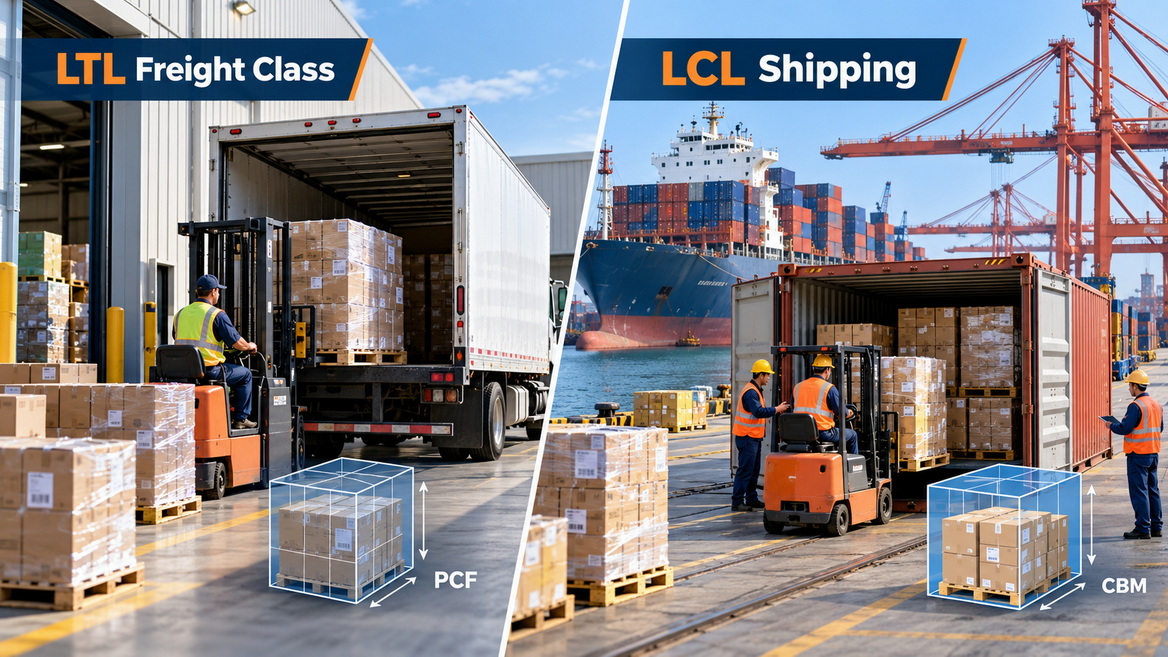
Freight class is primarily associated with domestic LTL transportation, particularly in the United States. LCL shipping applies when cargo does not fill an entire container and shares container space with freight from other shippers.
| Topic | U.S. Domestic LTL Freight | International LCL Ocean Freight |
|---|---|---|
| Main transport purpose | Domestic or regional truck delivery | Shared-container ocean transportation |
| Common measurement | Pounds per cubic foot | Cubic meters and gross weight |
| Main pricing basis | Freight class, cargo characteristics, lane, service requirements | Chargeable volume, gross weight, origin and destination charges |
| Common shipment stage | Port, warehouse, or distribution center to final customer | China supplier or consolidation warehouse to destination port |
| Common concern | Incorrect class, reweigh, reclassification | Incorrect CBM, missing cargo data, destination charges |
LCL freight charges are often based on a weight-or-measure principle. This means the chargeable amount may depend on which is greater:
- The shipment's volume in cubic meters
- The shipment's gross weight converted into a chargeable measurement basis
This is why light but bulky cargo can have relatively high LCL transportation costs. A shipment of foam products, furniture components, packaging materials, or plastic displays may weigh little but occupy substantial container space.
Freight reclassification charges occur when the actual shipment differs from the information submitted during booking. A carrier may inspect, weigh, or measure the cargo after pickup and issue a revised invoice if the shipment is larger, heavier, differently packaged, or incorrectly classified.
The most effective way to reduce these surprises is to prepare accurate information before booking.
Use this checklist before cargo pickup:
- Measure freight after final packaging is complete.
- Include pallet height, wood crate thickness, wrapping, and product overhang.
- Confirm gross weight rather than product net weight.
- Describe the cargo accurately and specifically.
- Identify the material and intended use of the goods.
- State whether cargo is stackable.
- Confirm whether forklifts can safely move the shipment.
- Identify batteries, liquids, chemicals, magnets, aerosols, or dangerous goods early.
- Take clear photos of packed cargo and labels.
- Confirm the pickup address, destination address, and contact information.
- Review the shipping terms before confirming transport.
- Request a clear breakdown of origin, ocean, destination, customs, and delivery charges.
The following mistakes regularly cause quote revisions, delivery delays, and unexpected charges:
| Common Error | Potential Result |
|---|---|
| Using product dimensions instead of final package dimensions | Understated CBM or cubic feet |
| Providing net weight instead of gross weight | Incorrect density calculation |
| Omitting pallet or crate dimensions | Reclassification or revised LCL charges |
| Describing cargo only as “general goods” | Delayed classification review |
| Not declaring hazardous components | Booking rejection, delay, or compliance issues |
| Assuming all pallets are stackable | Additional handling or loading restrictions |
| Comparing ocean freight rates only | Missed origin or destination costs |
A complete freight quote should reflect the total transport journey rather than only one segment. For LCL cargo shipped from China, this may include supplier pickup, consolidation, export customs declaration, port handling, ocean freight, destination deconsolidation, customs clearance support, domestic delivery, and local accessorial services when required.
For many importers, the real challenge is not calculating one freight figure. It is collecting correct cargo information from suppliers before the goods are ready to ship.
A supplier may initially provide only product size and net weight. Those numbers are useful for production planning, but they are not always sufficient for transportation planning. Once goods are packed into export cartons, palletized, protected with corner boards, wrapped with stretch film, or loaded into crates, both the total dimensions and gross weight can change.

To plan an LCL shipment or door-to-door delivery from China, prepare the following details:
- Product name and detailed cargo description
- HS code, when available
- Supplier pickup address in China
- Destination port, city, or postal code
- Number of packages
- Final outer dimensions for each package
- Gross weight for each package and total shipment weight
- Packaging type
- Whether cargo is stackable
- Whether cargo contains batteries, liquids, magnets, chemicals, or other regulated components
- Commercial invoice and packing list details
- Agreed Incoterms
- Required cargo-ready date
- Final consignee contact information
Consider a buyer importing 20 cartons of industrial components from Shenzhen.
The supplier may initially report:
- Net weight: 500 kg
- Product cartons: 20 cartons
- Estimated volume: 2 CBM
After export packing, the shipment may become:
- Gross weight: 620 kg
- Two export pallets
- Final volume: 2.8 CBM
- Non-stackable due to product design
- Additional wrapping and wooden protection required
The final shipment may cost more than the initial estimate because the actual cargo occupies more space, weighs more, and may require different handling. Confirming final cargo data before booking helps prevent this type of adjustment.
Freight density, freight class, CBM, gross weight, packaging, and cargo characteristics all influence the final cost and operational handling of an international shipment. The most reliable shipping plan begins with complete information and final packed dimensions.
For domestic LTL freight, calculate density in pounds per cubic foot and confirm whether the goods have any special handling, stowability, or liability considerations. For LCL shipments from China, calculate final CBM, verify gross weight, and consider the full route from supplier pickup through destination delivery.
GB FREIGHT AGENCY CO., LTD. supports businesses with LCL consolidation, supplier coordination, export customs clearance, international freight planning, and final delivery arrangements from China to global destinations. Our logistics team focuses on practical transport options that match the cargo, route, timing, and delivery requirements of each shipment.
Share your final packing list, cargo photos, pickup city, destination, and shipping terms with GB FREIGHT AGENCY CO., LTD. to receive a transport plan based on your actual shipment details.
A freight class density calculator estimates freight density by dividing shipment weight by total cubic feet. It is commonly used to help estimate a likely U.S. LTL freight class before pickup.
Divide the total gross shipment weight in pounds by total shipment volume in cubic feet. If dimensions are measured in inches, multiply length × width × height and divide by 1,728 to calculate cubic feet.
No. Freight density is one factor used to estimate freight class. The final class may also depend on cargo stowability, handling requirements, product value, fragility, liability, and packaging.
LTL freight class is mainly used for domestic trucking in the United States. LCL shipping refers to ocean freight for cargo that shares container space with goods from other shippers. LCL pricing commonly considers cubic meters and gross weight.
A carrier may change the charge if the actual shipment is heavier, larger, differently packaged, non-stackable, or assigned to a different freight class than originally declared.
1. National Motor Freight Traffic Association. [Shippers: Solve Your Freight Classing Woes]
2. National Motor Freight Traffic Association. [Decoding Density: The Freight Factor You Can't Afford to Overlook]
3. National Motor Freight Traffic Association. [National Motor Freight Classification]
4. National Motor Freight Traffic Association Help Center. [NMFC Changes FAQ: Handling, Stowability and Liability Issues]
5. Freightos. [Freight Class Density Calculator]
6. Allison Shipping. [How to Calculate CBM for Ocean Freight Shipments]


