
Views: 265 Author: GB FREIGHT Publish Time: 2026-09-14 Origin: Site


Content Menu
● What Is Accounts Payable in International Freight Forwarding?
● Why Freight Accounts Payable Management Matters
● How Freight Financial Platforms Improve Invoice Management
>> Invoice Capture and Data Entry
>> Cost Allocation by Shipment
● A Practical Accounts Payable Workflow for Freight Forwarders
>> Step 1: Collect Complete Shipment Information
>> Step 2: Build a Transparent Freight Quote
>> Step 3: Confirm the Delivery Responsibility
>> Step 4: Record Expected Costs Before Booking
>> Step 5: Review Invoices and Resolve Exceptions
>> Step 6: Close the Shipment Financially
● Documentation Accuracy Protects Shipment Costs
>> Key Details That Must Match
● Selecting the Right Freight Financial Platform
>> Essential Platform Features
● Managing Multi-Currency Freight Costs
● How GB FREIGHT Supports China-to-World Door-to-Door Shipping
● Summary
>> What is a freight financial platform?
>> Why is accounts payable important in freight forwarding?
>> What is included in door-to-door shipping from China?
>> Is door-to-door shipping the same as DDP?
>> How can freight forwarders reduce invoice errors?
International freight forwarding depends on far more than moving cargo from one port to another. Behind every successful shipment is a complex network of suppliers, carriers, customs brokers, trucking companies, warehouses, airlines, shipping lines, and destination delivery partners.
For a China freight forwarder providing door-to-door delivery services, managing accounts payable accurately is essential. Every shipment may involve multiple invoices, currencies, charges, and service providers. If these costs are not properly verified and assigned, a business can face payment errors, delayed supplier settlements, inaccurate quotations, and reduced shipment profitability.
GB FREIGHT AGENCY CO., LTD. has more than 15 years of international logistics experience supporting businesses that ship goods from China to destinations across Europe, North America, South America, Southeast Asia, the Middle East, Africa, and Oceania. From supplier booking coordination and export customs declaration to international freight and final delivery, every service stage must be connected to reliable financial management.
Freight financial platforms for managing accounts payable help logistics companies control these processes. They connect operational shipment data with financial records, making it easier to validate invoices, monitor transportation costs, approve payments, and understand the true cost of every shipment.

Accounts payable refers to the money a freight forwarder owes to suppliers and service partners. In global logistics, these partners may include ocean carriers, airlines, trucking companies, customs brokers, warehouses, overseas agents, insurance providers, and delivery companies.
Unlike a simple domestic delivery, an international shipment may create costs at multiple stages. A shipment moving from a supplier in China to a customer warehouse overseas may include charges for pickup, export handling, main freight, customs processing, destination handling, and final-mile delivery.
For example, a door-to-door shipment from Shenzhen to Los Angeles may involve:
- Supplier pickup from a factory or warehouse in China
- Export declaration and customs documentation
- Trucking to the port or airport
- Origin terminal handling
- Ocean freight or air freight
- Destination terminal charges
- Import clearance support
- Customs duties and taxes, where applicable
- Inland delivery to the final consignee
- Cargo insurance, storage, inspection, or special handling
Each cost must be connected to the correct shipment file. Without this connection, finance teams may struggle to understand whether a shipment was profitable, whether a carrier charge was correct, or whether a customer quotation covered all expected costs.
A freight financial platform creates a structured system for handling these costs. It enables logistics teams to compare invoices against approved quotes, booked rates, cargo details, transport milestones, and customer billing records.
The goal is not only to pay invoices faster. The goal is to make every freight cost visible, traceable, and controllable.

Door-to-door delivery provides customers with a more convenient shipping experience. Instead of arranging separate suppliers for pickup, export formalities, freight, customs support, and delivery, the customer can work with one freight forwarder throughout the shipment journey.
However, a complete door-to-door service also requires stronger financial control.
When a freight forwarder manages multiple service stages, it may receive invoices from several companies in several countries. These invoices may be issued in USD, EUR, CNY, GBP, AED, AUD, CAD, or other currencies. Charges may also arrive at different times, especially when destination agents submit invoices after the cargo has already been delivered.
This creates several common financial risks.
| Freight AP Challenge | Potential Problem | Business Impact |
|---|---|---|
| Incorrect shipment matching | An invoice is connected to the wrong shipment reference | Cost records and customer billing become inaccurate |
| Unverified freight rates | A supplier bills above the confirmed rate | The forwarder may lose profit on the shipment |
| Duplicate invoice payment | The same invoice is entered or paid more than once | Direct and avoidable financial loss |
| Missing destination charges | Overseas costs arrive after the shipment is closed | Profitability reporting becomes unreliable |
| Currency inconsistency | Different exchange rates are applied to similar costs | Margin calculations become distorted |
| Slow approval processes | Invoices wait too long for operational confirmation | Supplier relationships and cash flow may suffer |
| Unsupported extra charges | Detention, storage, inspection, or handling fees are not reviewed | Customers may face unexpected charges or disputes |
A well-managed accounts payable process protects both the freight forwarder and its customers. It helps ensure that transport costs are reviewed before payment, unexpected charges are investigated, and every shipment remains financially transparent.
Freight financial platforms are designed to bring financial control into the logistics workflow. Instead of keeping transport documents, supplier invoices, rate sheets, and payment records in separate folders or spreadsheets, the platform connects them in one place.
Freight invoices can arrive in many formats. Some carriers provide digital invoices, while smaller trucking companies, warehouses, or destination agents may send PDFs by email. A financial platform can capture invoice data through uploads, email workflows, supplier portals, electronic integrations, or manual entry.
Important invoice details may include:
- Supplier name
- Invoice number
- Invoice date
- Payment due date
- Shipment number
- Booking reference
- Bill of lading number
- Air waybill number
- Container number
- Currency
- Charge type
- Tax amount
- Total amount due
The invoice should be linked to a unique shipment record. This prevents confusion when similar shipments move at the same time or when one customer has multiple orders.
A supplier invoice should not be treated as automatically correct. It should be checked against the expected cost recorded when the shipment was quoted or booked.
For example, if a confirmed ocean freight rate was USD 1,800 per 40-foot container, but the carrier invoice shows USD 2,150, the difference should be reviewed before payment.
The variance may be legitimate. It could result from a surcharge, overweight fee, storage charge, equipment imbalance charge, cargo amendment, or port-related expense. But the charge should have documented support.
A reliable invoice verification process compares three key areas:
1. The agreed rate recorded in the quotation, rate confirmation, or carrier contract.
2. The actual shipment information such as weight, volume, container type, route, dates, and service scope.
3. The supplier invoice submitted for payment.
This type of matching allows the finance and operations teams to identify unexpected charges early.
International freight costs should be allocated to the correct shipment, customer, trade lane, and service stage.
A shipment from Ningbo to Germany may include export trucking, customs declaration, ocean freight, port charges, destination handling, duty advances, and final delivery. When these costs are recorded separately, the freight forwarder can see the full cost structure of the shipment.
Useful cost-allocation categories include:
- Origin pickup
- Export documentation
- Export customs declaration
- Origin terminal handling
- Ocean freight
- Air freight
- Rail freight
- Freight insurance
- Destination handling
- Import clearance support
- Duties and taxes
- Warehouse handling
- Storage
- Final-mile delivery
- Special cargo handling
This structure helps logistics companies understand which service elements create the highest costs and which routes offer the most stable margins.
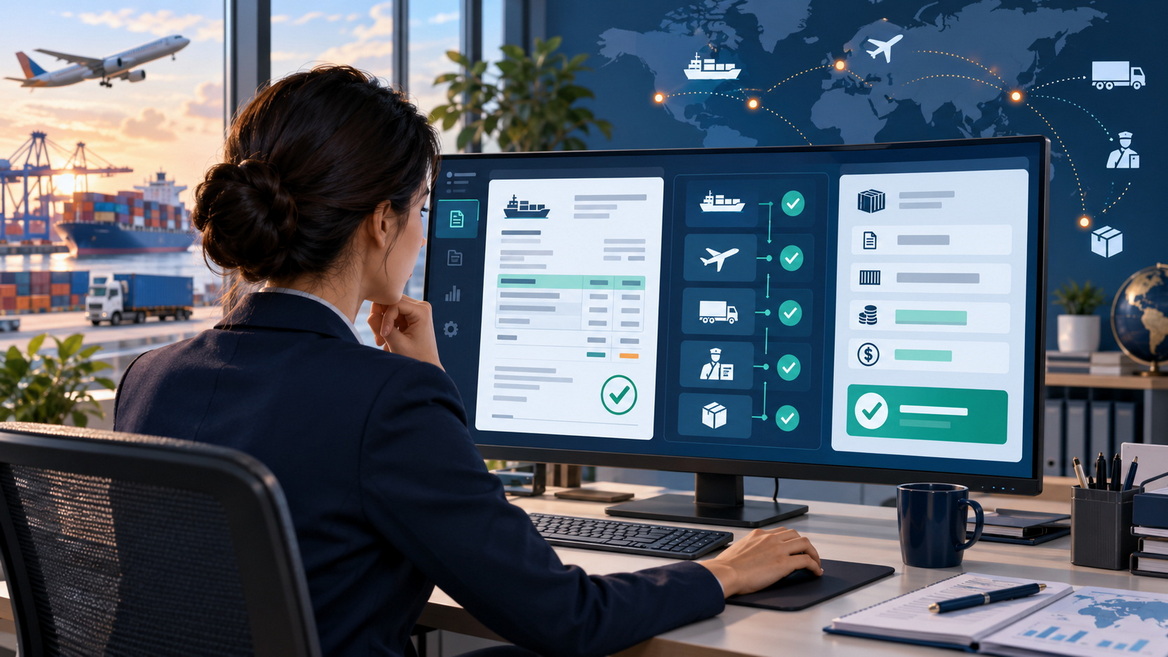
A strong AP process starts before the invoice arrives. It begins when the shipment is quoted and continues until all costs have been reviewed and the shipment file is closed.
The quality of financial control depends on the quality of shipment information. Before quoting or booking a shipment, collect all relevant cargo and delivery details.
Important information includes:
- Product name and cargo description
- Supplier address in China
- Pickup location
- Destination country and city
- Final delivery address and postal code
- Number of cartons, pallets, or crates
- Carton dimensions
- Total gross weight and net weight
- Cargo-ready date
- Transport mode preference
- Delivery deadline
- Incoterms® requirement
- Product value and commercial invoice details
- Battery, liquid, magnetic, dangerous goods, or special cargo information
- Importer information where needed
Accurate cargo information helps reduce quotation errors. It also helps ensure that later supplier invoices are reviewed using correct shipment data.
A freight quote should clearly define what is included and what is not included. A low freight rate may appear attractive at first, but it can become expensive if origin, destination, customs, storage, or delivery charges are unclear.
A detailed door-to-door freight quotation may include:
- Pickup from the supplier
- Export customs declaration
- China origin handling
- Ocean, air, rail, or express transportation
- Destination handling
- Customs clearance service scope
- Delivery to the final address
- Cargo insurance options
- Duties and taxes, if included
- Storage terms
- Delivery appointment fees
- Special handling charges
- Possible additional charges or exclusions
A clear quotation is not only helpful for the customer. It also becomes the financial benchmark for invoice verification later in the shipping process.
The phrase "door-to-door delivery" is widely used in international logistics, but it can mean different service levels. It is important to define which party is responsible for pickup, export clearance, international transport, import clearance, taxes, duties, and final delivery.
For example, Delivered Duty Paid, commonly known as DDP, places substantial responsibility on the seller or shipping party. Under this arrangement, the seller may be responsible for transportation, import clearance, duties, taxes, and delivery to the named destination.
However, the practical feasibility of a duty-paid service depends on the destination country, cargo type, importer requirements, tax registration rules, and customs regulations. Each shipment should be reviewed carefully before confirming the delivery structure.
A professional freight forwarder should clearly explain:
- Who is responsible for export clearance
- Who is responsible for import clearance
- Whether duties and taxes are included
- Whether the importer must provide local documentation
- Whether unloading is included
- Whether delivery is to a residence, warehouse, commercial facility, port, or airport
- Whether an appointment is required for delivery
Before cargo moves, the forwarder should create an expected-cost record. This record provides the financial baseline for the shipment.
The record should include:
| Cost Category | Information to Record |
|---|---|
| Carrier or supplier | Service provider name and contact details |
| Service type | Ocean freight, air freight, trucking, customs support, warehousing, or delivery |
| Agreed rate | Approved amount and charging basis |
| Currency | Currency used for the invoice and payment |
| Payment terms | Due date and agreed settlement terms |
| Shipment reference | Booking number, container number, bill of lading, or air waybill |
| Expected charges | Freight, handling, delivery, surcharge, or customs-related amounts |
| Customer revenue | Selling price charged to the customer |
| Margin estimate | Expected revenue minus expected supplier cost |
This process allows the operations team to identify likely cost issues before payment is due.
Once an invoice arrives, it should be reviewed against the expected-cost record. If all details match, the invoice can move through the approval process quickly.
If a difference appears, the invoice should be placed into an exception workflow.
Common invoice exceptions include:
- Incorrect freight rate
- Incorrect currency
- Duplicate invoice number
- Weight or volume discrepancy
- Incorrect container type
- Unapproved surcharge
- Missing shipment reference
- Unexpected storage charge
- Incorrect destination delivery fee
- Duty or tax amount that does not match customs records
Not every difference is a billing mistake. Freight rates can change because of operational factors. However, each variance should be supported by documentation and approved by the appropriate person.
A clear exception process prevents small invoice errors from becoming recurring financial losses.
The shipment should not be considered fully closed immediately after final delivery. Some costs may arrive later, especially destination charges, customs adjustments, storage invoices, or overseas-agent bills.
Before closing the financial file, review:
- Customer invoice status
- Supplier invoices received
- Supplier payments completed
- Credit notes issued
- Outstanding disputes
- Destination charges
- Duty and tax records
- Cargo claims or damage costs
- Final gross profit
- Differences between quoted cost and actual cost
This final review is valuable for future pricing. It helps the freight forwarder identify which routes, carriers, and service combinations produce stable results.
Financial control and customs compliance are closely connected. If shipping documents contain inconsistent cargo details, the shipment may face delays, additional document work, inspections, storage costs, or customs-related disputes.
The commercial invoice is particularly important because it provides the transaction details for the goods. It normally includes information about the seller, buyer, product description, quantity, value, currency, country of origin, and delivery terms.
The packing list provides physical cargo details, such as carton count, package type, dimensions, gross weight, net weight, and shipping marks.
A freight forwarder should compare key information across the shipment documents before cargo moves.
- Product descriptions
- Quantity and unit of measurement
- Declared commercial value
- Currency
- Country of origin
- Gross weight and net weight
- Carton count
- Dimensions and volume
- Buyer and seller information
- Consignee and importer information
- Delivery address
- Shipping marks
- Incoterms®
- Bill of lading or air waybill details
When document information is consistent, the freight team can quote more accurately, customs processes can proceed more smoothly, and invoices can be audited with greater confidence.

A freight financial platform should match the operational reality of international logistics. A basic accounting system may record supplier invoices, but it may not provide the shipment-level visibility needed for global freight forwarding.
The best platform should support multiple currencies, multiple service providers, and multiple transportation modes.
- Shipment-level cost tracking
- Multi-currency invoice management
- Freight rate-card management
- Supplier invoice capture
- Invoice approval workflows
- Duplicate invoice detection
- Rate variance alerts
- Automated cost allocation
- Freight audit support
- Document attachment and storage
- Carrier and supplier performance reporting
- Payment status tracking
- Job profitability reports
- Customs and destination cost visibility
- Integration with transport, warehouse, customer, and accounting systems
A useful platform should also provide a clear audit trail. Finance staff should be able to see who entered an invoice, who reviewed it, why a variance was approved, and when payment was completed.
This level of visibility supports stronger internal control and helps freight forwarders make better decisions when negotiating rates, selecting service partners, and preparing customer quotations.
International freight forwarding often involves costs in different currencies. A China freight forwarder may receive origin charges in CNY, ocean freight in USD, destination delivery costs in EUR, and customer revenue in another currency.
Without a consistent currency-management process, a shipment may appear profitable at booking but show a reduced margin after exchange-rate changes.
A practical multi-currency process should include:
- Recording the original invoice currency
- Recording the company reporting currency
- Applying a defined exchange-rate policy
- Tracking exchange-rate gains or losses
- Reviewing foreign-currency exposure on major shipments
- Maintaining clear documentation for adjustments
- Avoiding manual rate changes without approval
For long transit shipments, currency changes can affect actual logistics costs. This is especially relevant for ocean freight, project cargo, and shipments that involve multiple overseas suppliers.
Clear currency controls help create more reliable shipment profitability reports.
GB FREIGHT AGENCY CO., LTD. provides international logistics solutions for businesses shipping goods from China to markets around the world. Our service process can include supplier coordination, booking arrangements, export declaration support, international freight, destination coordination, and final delivery.
We understand that every shipment has different requirements. A small parcel shipment may require express delivery. A large-volume order may be better suited to FCL ocean freight. A time-sensitive shipment may require air freight, while an inland European destination may benefit from a rail and truck combination.
Our logistics solutions can support shipments from China to:
- Europe
- North America
- South America
- Southeast Asia
- The Middle East
- Africa
- Oceania
The best shipping method depends on cargo size, cargo type, budget, destination, delivery deadline, customs requirements, and the customer's preferred level of service.
By coordinating the shipment from supplier pickup through final delivery, GB FREIGHT helps customers manage complex logistics with clearer communication and better operational visibility.
Freight financial platforms play an important role in managing accounts payable for international logistics companies. They help freight forwarders capture invoices, verify rates, allocate costs, control payment approvals, track supplier balances, and measure shipment profitability.
For door-to-door shipping from China, financial visibility is especially important because every shipment may involve multiple suppliers, multiple currencies, customs-related costs, and destination delivery charges.
A strong process begins with accurate shipment data, continues with transparent quotations and expected-cost records, and ends with a complete financial review after delivery. When finance and operations work from the same shipment information, freight forwarders can reduce invoice disputes, improve cost control, protect margins, and provide a more reliable customer experience.
For businesses planning shipments from China, choosing a freight partner that understands both operational execution and shipment cost management can make international delivery more predictable from the first booking through final delivery.
A freight financial platform is a system used by logistics companies to manage shipment costs, supplier invoices, payment approvals, freight audits, and profitability reporting. It connects operational freight data with financial records.
Freight forwarding involves many service providers, including carriers, trucking companies, warehouses, customs brokers, and overseas agents. Accounts payable management helps ensure that each supplier invoice is correct, approved, and assigned to the right shipment.
Door-to-door shipping can include supplier pickup, export handling, international transportation, destination customs support, and final delivery. The exact scope depends on the agreed service terms, cargo type, destination country, and delivery requirements.
Not always. Door-to-door shipping describes transportation from the supplier's location to the final destination. DDP is a specific delivery term that may include transportation, import clearance, duties, taxes, and delivery responsibilities. The exact responsibility must be confirmed before shipment.
Freight forwarders can reduce invoice errors by recording agreed supplier rates before booking, assigning unique shipment references, reviewing invoices against shipment data, creating approval workflows, and documenting all invoice exceptions.
1. [Freight Financial Platforms for Managing Accounts Payable — eTowerTech]
2. [Common Export Documents — International Trade Administration]
3. [Commercial Invoice Requirements — U.S. Customs and Border Protection]
4. [Know Your Incoterms — International Trade Administration]
5. [Delivered Duty Paid (DDP) Incoterms Explained — Maersk]
6. [Incoterms 2020: DAP or DDP? — ICC Academy]
7. [Freight Audit and Payment Best Practices — Shipware]
Estimated Word Count: Approximately 2,330 words


