
Views: 225 Author: GB FREIGHT Publish Time: 2026-10-10 Origin: Site


Content Menu
● What Does a Freight Forwarder Do?
>> Freight Forwarder vs. Customs Broker
>> When Should You Use a Forwarder?
>> Step 1: Define Your Shipment
>> Step 2: Confirm Trade Responsibilities
>> Step 3: Choose the Transport Mode
>> Step 4: Prepare Customs Documents
>> Step 5: Review Destination Requirements
>> Step 6: Track Delivery Handoffs
● How to Compare Freight Forwarders
>> Compare Complete Shipping Costs
>> Build a Landed-Cost Comparison
>> Ask Questions That Reveal Expertise
>> Read Customer Reviews Critically
>> Plan Your Shipment With GB FREIGHT
>> What Does a Freight Forwarder in China Do?
>> Can a Freight Forwarder Handle Customs Clearance?
>> How Much Does Shipping From China Cost?
>> Does Door-to-Door Shipping Include Duties?
>> What Documents Are Needed for Customs Clearance?
Choose a freight forwarder in China with confidence. Learn how customs clearance, shipping documents, Incoterms, freight costs, and delivery coordination work, and discover how GB FREIGHT helps businesses plan cost-effective international shipments from Chinese suppliers to overseas destinations.
A freight forwarder in China helps businesses coordinate international shipping, customs clearance, and delivery from Chinese suppliers to overseas destinations. Choosing the right partner, however, requires more than comparing freight rates. You need to understand who manages each shipment stage, which documents support clearance, and what your quotation actually includes.
At GB FREIGHT AGENCY CO., LTD., we bring 15 years of international logistics experience to shipping from China. Our services cover supplier booking coordination, export customs clearance, transportation, and final delivery. We help businesses evaluate cost-effective shipping solutions to Europe, North America, South America, Southeast Asia, the Middle East, Africa, and Oceania.
This guide explains how freight forwarding works, how to prepare your shipment, and how to select a partner whose services match your cargo and commercial priorities.

A forwarder coordinates the movement of goods between suppliers, carriers, customs service providers, and receiving businesses. Its value lies in connecting these parties through a practical shipping plan.
Depending on the agreed service scope, a freight forwarder may arrange:
- Supplier collection and shipment booking.
- Cargo consolidation and warehouse handling.
- Export documentation and customs clearance coordination.
- Ocean, air, or multimodal transportation.
- Destination handling and import clearance coordination.
- Final delivery and shipment milestone updates.
Not every quotation includes every service. Port-to-port shipping, for example, does not automatically cover delivery to your warehouse. Ask for written confirmation of the starting point, destination, and included responsibilities.
Freight forwarding and customs brokerage are related, but they are not interchangeable.
| Role | Main responsibility | What buyers should verify |
|---|---|---|
| Freight forwarder | Coordinates transportation and shipment handoffs | Route coverage, service scope, communication, and quotation exclusions |
| Customs broker | Handles customs formalities where authorized | Local authorization, product knowledge, and required importer information |
| Carrier | Performs the contracted transport movement | Routing, transport conditions, and cargo acceptance |
| Importer | Meets applicable import obligations | Classification, valuation, permits, and responsible-party arrangements |
A forwarder may provide customs services directly where permitted or coordinate with authorized local partners. Do not assume that a China-based company holds customs brokerage authorization in every destination.
For U.S. imports, appointing a broker does not remove the importer's obligation to exercise reasonable care over entry information. Product classification, declared value, and applicable requirements still need informed review.
A forwarder is especially useful when you manage multiple suppliers, unfamiliar destination requirements, or shipments involving several transport providers.
The question is not simply whether you can book transport yourself. It is whether your team can manage documentation, deadlines, handoffs, and exceptions without disrupting its core work.
For routine shipments, a clear process may matter more than a complicated service package. For regulated or unusual cargo, specialist capability becomes essential.
An effective shipping plan starts before the goods leave the factory. The following workflow helps reduce uncertainty between purchase order completion and final delivery.
Provide your forwarder with a complete shipment brief:
- Product description, material, and intended use.
- Supplier collection address and destination address.
- Package count, dimensions, and gross weight.
- Cargo-ready date and required delivery date.
- Proposed HS classification, if available.
- Agreed Incoterm and named location.
- Details of batteries, liquids, magnets, chemicals, or oversized cargo.
Avoid descriptions such as "accessories" or "general merchandise." Specific information helps the forwarder assess transport suitability and identify questions for customs specialists.
Flag unusual characteristics early. A product that appears ordinary commercially may still require special transport handling.
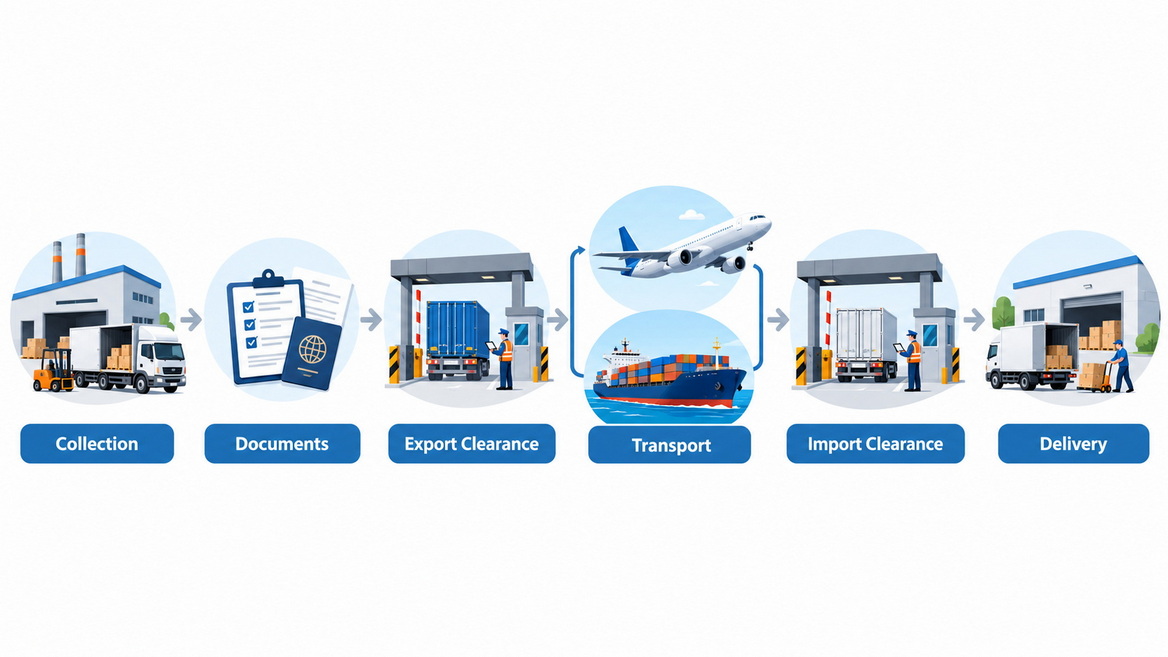
Incoterms allocate specified delivery obligations, costs, and risks between sellers and buyers. Agree on them in the sales contract rather than inferring them from a freight quotation.
| Term | Practical consideration for China sourcing |
|---|---|
| EXW | Check who can arrange collection and complete export formalities |
| FCA | Specify the delivery location and handover point precisely |
| FOB | Use for sea or inland-waterway transport, not air shipments |
| DAP | Confirm how the buyer will handle import clearance and duties |
| DDP | Verify whether the seller can legally fulfill destination import obligations |
For containerized or multimodal movements, evaluate FCA rather than automatically selecting FOB. FCA is generally more appropriate when the seller delivers goods to the carrier at a terminal before vessel loading.
Include the named place and rule version. "FCA supplier warehouse, Shenzhen, Incoterms® 2020" is more informative than "FCA China."
A door-to-door transport offer does not automatically mean duties and taxes are included.
Your transport choice should reflect the delivery deadline, cargo dimensions, and total shipment economics.
| Option | Often suitable for | Main trade-off |
|---|---|---|
| Air freight | Urgent, relatively lightweight, or high-value cargo | Higher transport cost and chargeable-weight considerations |
| LCL ocean freight | Smaller shipments sharing container capacity | Consolidation handling and destination charges |
| FCL ocean freight | Cargo requiring a dedicated container | Container utilization and equipment availability |
| Multimodal transport | Routes benefiting from combined transport methods | Additional handoffs and route-specific coordination |
Do not compare only the main transport leg. Collection, terminal processing, consolidation, customs clearance, and delivery all contribute to the actual schedule.
Ask for an estimated delivery window and its assumptions. A carrier schedule is not a guarantee of warehouse arrival.
Common shipment documents include a commercial invoice, packing list, and relevant transport document. Certificates, licenses, or product-specific information may also be required.
Before submitting documents, check:
1. Product descriptions agree across the invoice and packing list.
2. Package quantities and weights match the shipment.
3. Declared values accurately reflect the transaction.
4. Shipper, consignee, and responsible-party details are correct.
5. Classification and origin information have been reviewed.
6. Destination-specific requirements are addressed.
The first six digits of an HS code provide an internationally harmonized classification framework, but destination tariff schedules can require additional digits. Do not assume a supplier's code is sufficient for every import market.
Accuracy matters more than document appearance. A polished invoice cannot compensate for an incomplete product description or incorrect valuation.
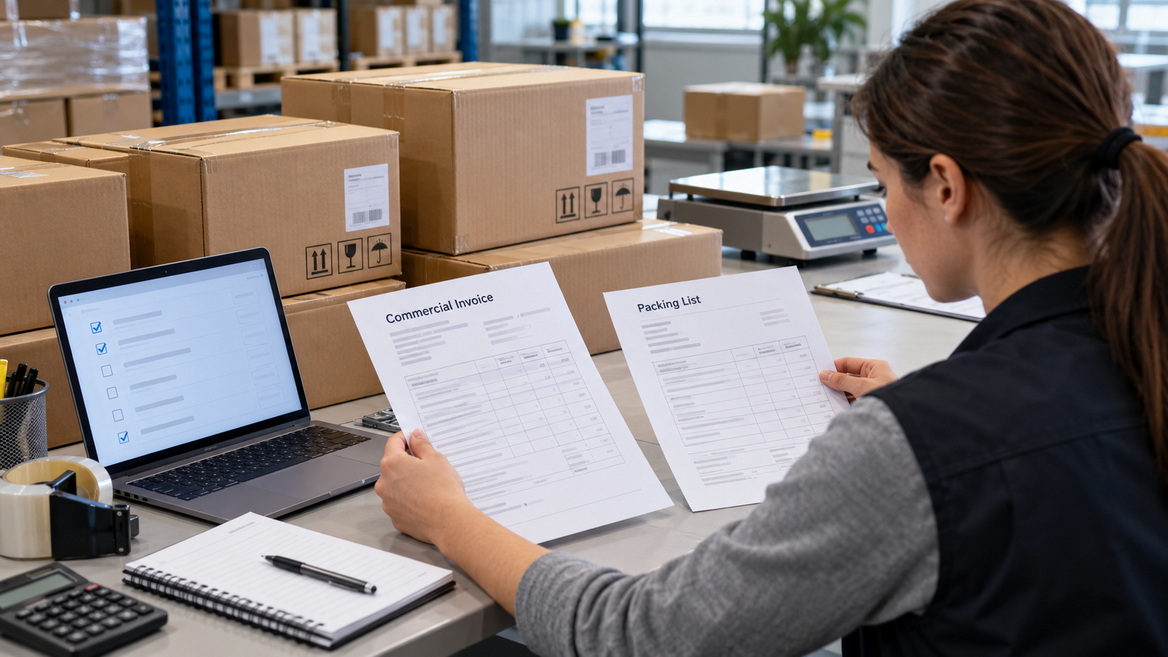
Export clearance in China and import clearance overseas are separate processes.
Before departure, identify who will act as the importer, who will submit the customs entry, and who will pay duties, taxes, inspections, or other applicable charges.
Requirements differ between markets and products. Goods subject to food, medical, electrical, chemical, or other regulatory controls may require additional review.
Request a destination document checklist before booking. Discovering a missing authorization after arrival can create storage costs and disrupt delivery.
Shipment visibility should extend beyond a vessel or flight departure.
Useful milestones include collection, export release, departure, arrival, import release, delivery appointment, and proof of delivery.
When an exception occurs, request three things: the cause, the next action, and the next update time. "Delayed at customs" is less useful than an explanation of the missing information and who must provide it.
The best freight forwarder for your business is not necessarily the largest provider or the company offering the lowest opening price. It is the partner whose capabilities match your cargo, route, and operational expectations.
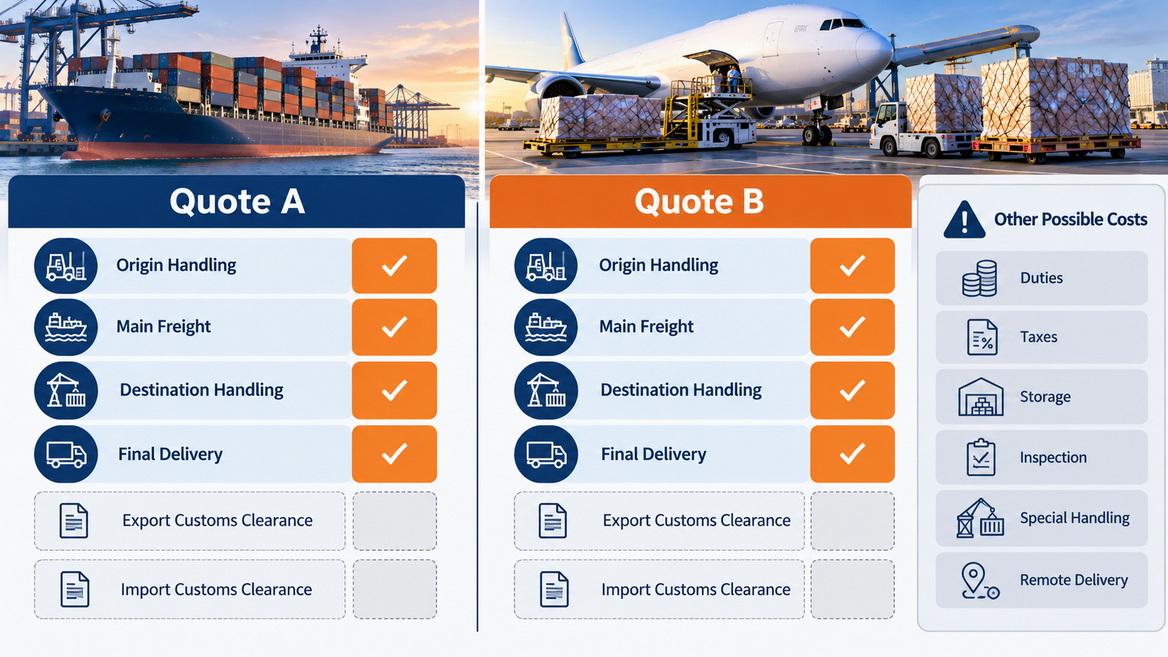
A reliable quotation separates known charges from estimates and conditional expenses.
Ask whether the offer includes:
- Supplier pickup and origin handling.
- Export customs service charges.
- Main freight and applicable surcharges.
- Destination terminal or warehouse handling.
- Import customs brokerage.
- Final delivery and appointment requirements.
- Cargo insurance, if requested.
- Duties, taxes, inspections, and storage exclusions.
Check quotation validity and currency. Ask which charges can change if dimensions, weight, routing, or cargo readiness differ from the original brief.
A lower freight line can produce a higher overall invoice when destination fees are excluded.
Consider a hypothetical shipment receiving two offers. One includes only ocean freight. The other includes ocean freight, origin handling, and destination delivery.
Comparing the headline totals would be misleading. First, place both quotations into the same cost framework.
Landed cost typically considers product cost, transport, handling, applicable duties and taxes, insurance, and other expenses needed to bring goods to the intended destination. Your finance team should define how recoverable taxes and internal costs are treated.
The practical lesson is simple: normalize the scope before negotiating the price.
This example illustrates a comparison method, not a customer case or a claimed saving.
Ask about free time, cargo availability notifications, delivery appointments, and container return requirements before the shipment departs.
Demurrage, detention, and storage can arise from different activities and contractual arrangements. Request the applicable definitions, tariff basis, and charging periods instead of treating them as interchangeable fees.
For U.S. shipments, verify current Federal Maritime Commission requirements rather than relying on older summaries. A December 2025 regulatory change removed a provision of the 2024 billing regulations following a court decision.
Keep arrival notices, release confirmations, collection records, and equipment return evidence. These records help your team check charges and investigate disputes.
Before appointing a forwarder, ask:
1. Who coordinates the Chinese supplier and overseas delivery partner?
2. Which services are performed directly and which use partners?
3. Who reviews customs documentation before departure?
4. What cargo restrictions apply to the proposed route?
5. What happens if the goods miss the planned departure?
6. Which costs are excluded or payable at destination?
7. Who manages communication when a shipment is delayed?
Specific answers reveal more than broad claims about global coverage.
Request confirmation for your actual shipment rather than assuming that experience in one market translates to every route or commodity.
A useful review describes the service, route, shipment circumstances, and how the provider handled a problem. A generic five-star statement provides little operational insight.
Look for recurring observations about quotation transparency, document support, communication, and delivery coordination.
For negative feedback, examine both the complaint and the response. Customs inspections or weather disruptions are not always within a forwarder's control, but communication and escalation remain important.
Use reviews alongside service documentation and shipment-specific discussions, not as a substitute for them.
Successful shipping from China depends on clear responsibilities, accurate documents, realistic scheduling, and transparent costs. A capable forwarder connects these elements into a coordinated plan.
GB FREIGHT AGENCY CO., LTD. supports businesses through supplier booking coordination, export customs clearance, transportation, and final delivery. With 15 years of international logistics experience, we help customers evaluate shipping options based on their cargo, destination, budget, and delivery priorities.
Send us your product description, pickup and delivery addresses, package dimensions, gross weight, cargo-ready date, and agreed trade term.
Request a shipment-specific proposal with a clear service scope, estimated schedule, and identified exclusions. Start with accurate cargo information so we can help you plan the next steps.
A China freight forwarder coordinates shipment activities such as supplier collection, booking, documentation, export clearance, international transport, and delivery. Included services depend on the agreement, so confirm the scope before booking.
A forwarder may handle clearance where authorized or coordinate with an appropriately authorized customs provider. Ask who will submit declarations in China and at destination, and what information your business must supply.
The price depends on the route, transport mode, shipment size, cargo characteristics, season, and service scope. Request a dated quotation using accurate dimensions and weight, then compare equivalent included services.
Not necessarily. Door-to-door describes transport coverage, while duty and tax responsibilities depend on the sales terms and service agreement. Confirm the importer arrangement and payment responsibilities in writing.
A commercial invoice, packing list, and transport document are commonly required. Product certificates, licenses, origin documents, or additional regulatory information may also be necessary, depending on the goods and destination.


