
Views: 282 Author: GB FREIGHT Publish Time: 2026-08-22 Origin: Site


Content Menu
● Railway Freight vs Air Freight: Quick Comparison
● When Air Freight Is Best for Automotive Components
>> Use Air Freight for Production-Critical Parts
● When Railway Freight Is Best for Automotive Components
>> Best Automotive Cargo for Railway Freight
>> Railway Freight Limitations
● Cost Comparison: Look Beyond the Freight Rate
>> A Practical Decision Formula
● Transit Time and Reliability: Plan for the Full Journey
>> Expert View: Build a Transport Calendar
● Automotive Component Packaging Requirements
>> Recommended Packaging Practices
● Customs Clearance for Automotive Parts
● A Hybrid Strategy for Automotive Supply Chains
>> Example: Tier Supplier Shipping From China to Germany
● How to Choose the Right Freight Mode
● Ship Automotive Components From China With Confidence
>> Is railway freight cheaper than air freight for automotive components?
>> How long does railway freight from China to Europe take?
>> When should an automotive supplier use air freight?
>> Can automotive parts be shipped by rail from China to Europe?
>> Is railway freight more environmentally friendly than air freight?
>> Can you arrange door-to-door railway freight delivery?
>> Can railway freight handle LCL automotive shipments?
For automotive manufacturers, tier suppliers, and aftermarket distributors, railway freight vs air freight for automotive components is not simply a transport-cost decision. It is a supply-chain design decision that affects production continuity, inventory levels, landed cost, delivery reliability, and carbon performance.
After coordinating China-origin shipments for industrial customers over many years, we have seen the same pattern repeatedly: air freight protects an urgent production schedule, while railway freight provides a more balanced solution for planned replenishment between China and Europe. The right option depends on the component's value, urgency, volume, production risk, packaging requirements, and final delivery location.
GB FREIGHT AGENCY CO., LTD. provides air freight, railway transportation from China to Europe, North America, South America, Southeast Asia, the Middle East, Africa, and Oceania. This guide explains how to select the most appropriate mode for automotive components moving from Chinese suppliers to global destinations.
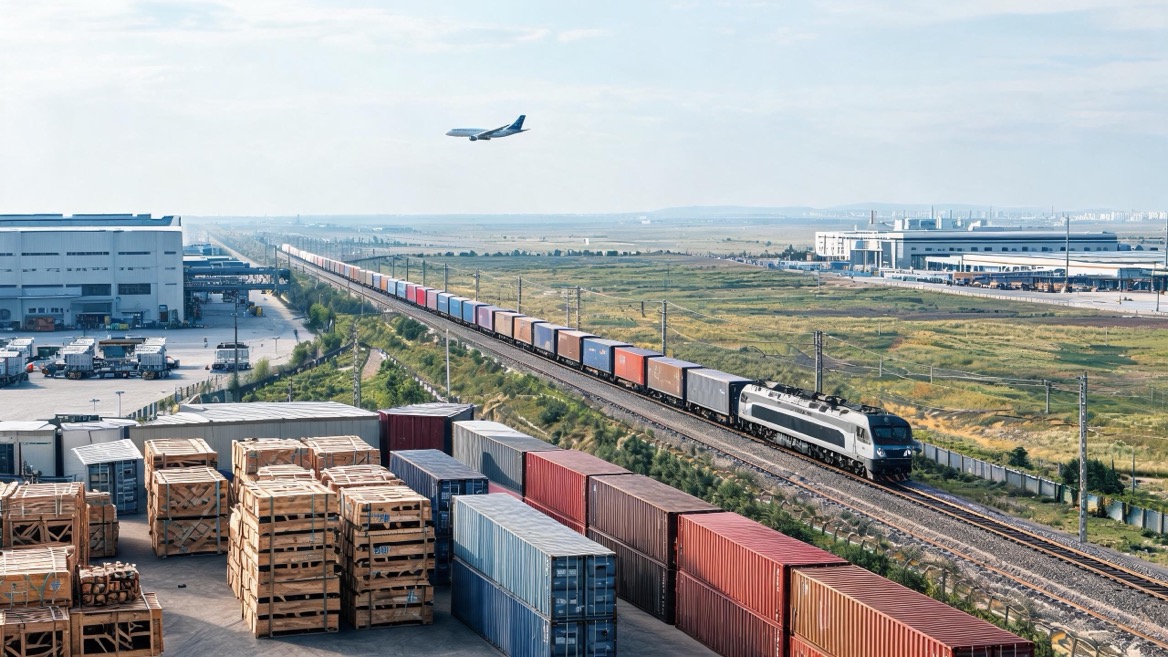
Railway freight and air freight serve very different supply-chain purposes. Air freight is designed for speed and urgency. Railway freight is designed to balance transit time, cost, capacity, and environmental impact—particularly on China-Europe trade lanes.
| Factor | Railway Freight | Air Freight |
|---|---|---|
| Typical China-Europe transit time | Usually 12–25 days, depending on route and final destination | Usually 3–7 days door to door |
| Freight cost | Medium | High to very high |
| Suitable shipment size | LCL, pallets, crates, FCL, and larger regular volumes | Small to medium urgent shipments |
| Best for | Planned replenishment, mid-value components, stable demand | Line-down prevention, prototypes, critical spare parts |
| Capacity | Higher than air for bulky cargo | Limited by aircraft space and airline capacity |
| Environmental impact | Significantly lower than air transport | Highest among major long-distance freight modes |
| Schedule flexibility | Scheduled departures; route-dependent | Frequent departures, but subject to capacity and airline handling |
| Door-to-door capability | Available with trucking at both ends | Available with pickup, airport handling, customs, and final delivery |
Air freight can move cargo from China to Europe within days. Railway freight generally requires several weeks, but it can cost substantially less than air while remaining much faster than traditional sea freight. On suitable China-Europe routes, rail is often positioned as the practical middle option between speed and cost.
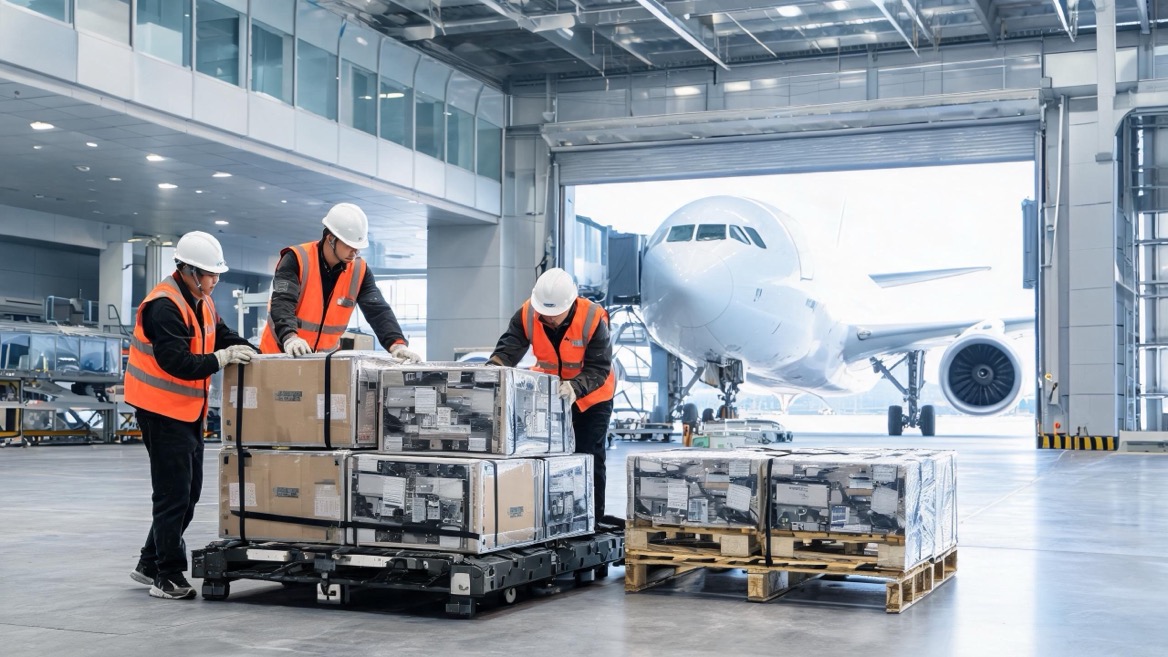
Air freight is the strongest option when the cost of a delayed component exceeds the premium paid for rapid transportation. In automotive logistics, the true cost of delay can be far greater than the freight invoice.
A delayed shipment may cause:
- Assembly-line interruption
- Missed customer delivery commitments
- Production rescheduling
- Emergency sourcing costs
- Dealer service delays
- Contractual penalties
- Reputational damage with OEMs or tier suppliers
Air freight is usually justified for high-value, low-volume, time-sensitive automotive components. Common examples include:
- Electronic control units and sensors
- Semiconductor-dependent modules
- Prototype parts for validation or testing
- Urgent replacement parts
- Precision transmission components
- Battery-management system components
- Tooling samples and pre-production parts
- Components required to avoid a line-down event
For these shipments, the key question is not, "Is air freight expensive?" The better question is: "What will the business lose if this part arrives late?"
If one urgent carton of electronic modules keeps a production line operating, air freight may be the lowest total-cost option—even when the freight rate is high.
Fastest international transit. Air freight is generally the fastest way to move automotive parts from China to overseas destinations. China-Europe door-to-door transit may take around 3–7 days under normal operating conditions.
Strong support for urgent delivery. Airlines operate frequent schedules from major Chinese gateways, including Shanghai, Shenzhen, Guangzhou, Beijing, Hong Kong, and Chengdu.
Ideal for compact, valuable cargo. High-value components with lower dimensional weight are generally more suitable for air transport than large, low-value, bulky items.
Useful for launch and recovery situations. New vehicle programs, production ramp-ups, supplier quality incidents, and demand spikes often require immediate shipment acceleration.
The primary disadvantage is cost. Airline rates are typically calculated using chargeable weight, which is based on actual weight or volumetric weight—whichever is higher. Light but oversized automotive packaging can therefore become expensive.
Air freight also has practical restrictions:
- Lithium batteries require compliant documentation, packaging, labeling, and airline acceptance.
- Dangerous goods may need specialized handling and approved packing.
- Peak-season capacity can be limited.
- Airport congestion, security checks, weather, and flight disruptions can affect actual delivery timing.
- Large automotive parts may not fit efficiently into aircraft cargo space.
For urgent shipments, proper documentation is essential. A missing invoice detail, inconsistent HS code, or incomplete battery declaration can eliminate the time advantage of air freight.
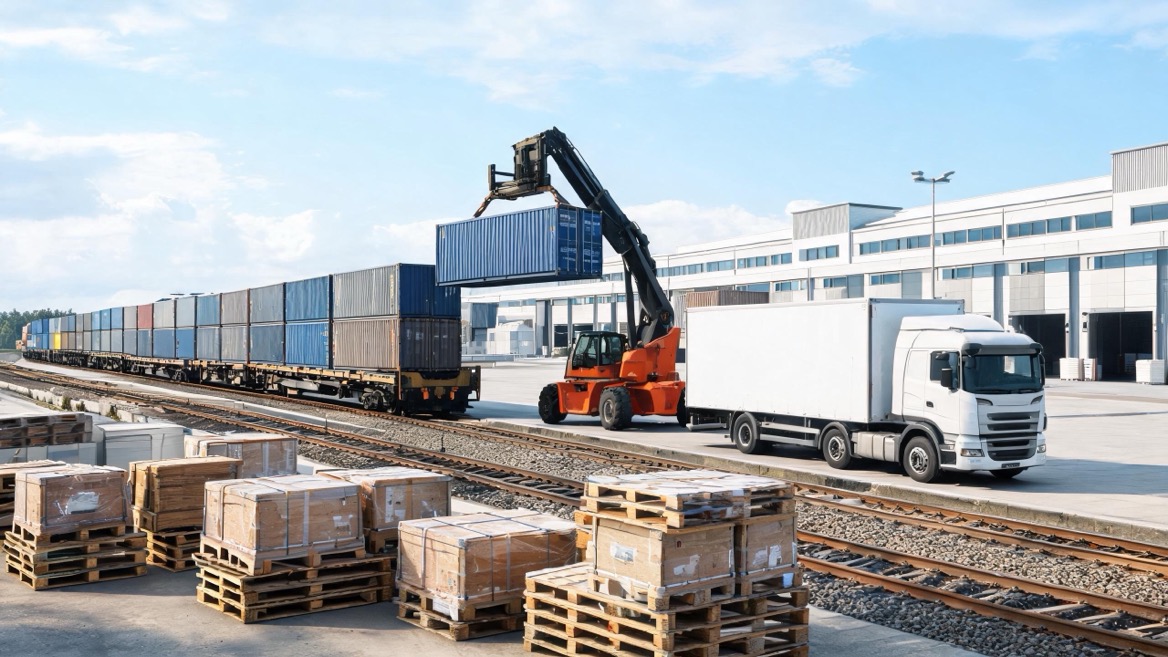
Railway freight is particularly valuable for automotive components that are important but not immediately urgent. It works well when shippers need faster delivery than sea freight but cannot justify routine air freight spending.
For China-Europe automotive supply chains, rail can support planned inventory replenishment, regular supplier shipments, and mid-value production components.
Railway freight is often a strong option for:
- Brake components and suspension parts
- Wiring harnesses
- Interior trim and automotive accessories
- Filters, bearings, fasteners, and seals
- Non-urgent electronic components
- Automotive glass and carefully packed fragile goods
- Engines, gearboxes, and mechanical assemblies
- Spare-parts inventory replenishment
- Palletized aftermarket parts
- Consolidated LCL shipments from multiple Chinese suppliers
Rail is especially useful when cargo is too heavy or too voluminous for cost-efficient air freight, but the buyer cannot wait for sea freight.
A better cost-speed balance. China-Europe rail freight is commonly faster than ocean shipping and less expensive than air freight. Actual transit time and rates vary by route, cargo type, equipment availability, border conditions, and final delivery point.
Improved inventory planning. A shipment arriving in approximately two to three weeks may allow importers to reduce safety stock compared with a sea-freight model. This can be valuable for parts with stable but forecast-driven demand.
Suitable for larger loads. Railway freight can handle pallets, wooden cases, machinery parts, and consolidated loads more efficiently than air freight.
Lower transport emissions. Rail transport has substantially lower emissions per unit moved than air cargo. The European Environment Agency identifies rail among the lowest-emission motorized transport options, while air cargo has the highest emissions by far.
LCL consolidation options. For automotive buyers sourcing from several factories in China, LCL rail consolidation can combine cargo into one export movement. This reduces supplier coordination pressure and can simplify destination customs clearance and delivery.
Rail freight is not a replacement for air freight in an emergency. It requires earlier planning, cut-off management, cargo consolidation, and route assessment.
Potential constraints include:
- Rail schedules may be less flexible than air schedules.
- Border crossings and transshipment points may create delays.
- Rail gauge changes can require operational handling in certain corridors.
- Final-mile trucking is still needed for most door-to-door deliveries.
- Route availability can change due to infrastructure, congestion, geopolitical conditions, or local regulations.
- Not every destination outside Eurasia is suitable for direct China-Europe rail service.
For North America, South America, Africa, Oceania, and many Southeast Asian destinations, air freight is usually more practical for urgent cargo, while sea freight often handles planned high-volume shipments. Railway freight is most relevant for Eurasian corridors and connected inland destinations.
A common mistake is comparing only the quotation price. Automotive logistics decisions should compare total landed supply-chain cost.
The real cost includes:
| Cost Element | Why It Matters |
|---|---|
| Freight charge | Air freight normally costs more per kilogram than rail |
| Inventory carrying cost | Longer transit can increase capital tied up in stock |
| Production disruption risk | A late critical part can create losses far above freight cost |
| Packaging cost | Air cargo may require lightweight but robust export packaging |
| Customs and compliance | Incorrect documents can create demurrage, delays, or penalties |
| Warehouse cost | Earlier arrivals may require storage; late arrivals may cause shortages |
| Final-mile delivery | Door-to-door trucking can materially affect the total quote |
| Carbon reporting | Lower-emission transport can support customer and corporate reporting requirements |
For non-urgent automotive components, consider this simplified comparison:
Total Transport Decision Cost=Freight Cost+Inventory Cost+Delay Risk Cost+Handling and Customs Cost
Air freight may have the highest direct freight cost but the lowest delay risk. Railway freight may reduce freight spending while maintaining an acceptable replenishment cycle. The preferred choice depends on which cost category matters most for the shipment.
Transit time should never mean only port-to-port, station-to-station, or airport-to-airport time. Automotive importers need to assess the full door-to-door timeline.
A typical shipment process includes:
1. Supplier cargo readiness confirmation
2. Pickup or delivery to warehouse
3. Export packing, labeling, and consolidation
4. Export customs declaration in China
5. Airline or rail terminal receiving
6. International transportation
7. Arrival handling and import customs clearance
8. Final-mile delivery to plant, warehouse, or distribution center
A shipment can move quickly internationally but still be delayed by incomplete commercial documents, incorrect product descriptions, missing origin information, or destination customs issues.
For recurring automotive shipments, do not book only after cargo is ready. Build a transport calendar with:
- Supplier production completion date
- Cargo inspection date
- Packaging deadline
- Booking cut-off
- Customs-document deadline
- Required delivery date
- Buffer days for disruption
- Alternative air-freight escalation plan
This approach is particularly effective for tier suppliers that operate fixed production schedules and need predictable inbound materials.
Packaging directly affects safety, cost, customs processing, and freight-mode selection.
For air freight, packaging should be durable but space-efficient because volumetric weight can drive pricing. For railway freight, packaging must tolerate repeated handling, longer transit, rail vibration, possible transshipment, and variable weather exposure.
- Use export-grade wooden cases for heavy precision components.
- Ensure wood packaging meets ISPM 15 requirements where applicable.
- Use anti-rust protection for metal automotive parts.
- Add moisture barriers and desiccants for long-distance transit.
- Secure cargo with internal bracing to prevent movement.
- Clearly mark gross weight, dimensions, handling symbols, and consignee details.
- Use shock indicators for sensitive electronic modules or precision equipment.
- Separate different part numbers to support customs checks and warehouse receiving.
- Confirm battery classification before booking battery-powered components.
For automotive electronics, a small packaging error can create large consequences. Poor protection may result in damage claims; inaccurate labels can delay cargo acceptance; oversize packaging can increase air-freight charges.
Customs clearance should be planned at the same time as freight booking. Automotive components can involve detailed classification requirements, country-of-origin rules, technical documentation, and product-specific import controls.
Important documents commonly include:
- Commercial invoice
- Packing list
- Bill of lading, air waybill, or rail waybill
- Export declaration documents
- HS codes
- Certificate of origin, when required
- Insurance documentation
- Battery and dangerous-goods documents, if applicable
- Product specifications or material declarations, when requested
Accurate HS classification is important because it affects duty assessment, import restrictions, and customs risk. An experienced freight forwarder should review shipment information before cargo handover rather than waiting until the shipment reaches the destination.
The strongest automotive logistics programs rarely rely on one transport mode alone. A practical model combines railway freight and air freight according to the urgency and value of each component.
A tier supplier exports three categories of parts each month:
| Shipment Type | Recommended Mode | Reason |
|---|---|---|
| Regular palletized brake parts | Railway freight | Predictable demand, moderate value, suitable volume |
| Urgent ECU replacement batch | Air freight | Prevents assembly delay and supports rapid recovery |
| Large-volume non-urgent inventory | Sea freight | Lowest cost for planned bulk replenishment |
| Mixed shipments from five suppliers | Rail LCL consolidation | Reduces coordination complexity and improves load efficiency |
This is a more resilient approach than treating every order as either "cheap freight" or "fast freight."
A well-designed model uses rail as the planned replenishment lane, sea freight for long-cycle bulk inventory, and air freight as a controlled exception for urgent production protection.
Use railway freight when your shipment is planned, moderately urgent, larger than a typical air shipment, and moving on an appropriate Eurasian route.
Use air freight when the shipment is urgently needed, compact, high value, production critical, or required for testing, repair, launch, or line-down prevention.
Before confirming a booking, ask these questions:
1. What is the latest acceptable delivery date?
2. What is the financial impact if the component arrives late?
3. Is the cargo suitable for air transport, including batteries or dangerous goods?
4. Is the shipment large enough that air freight becomes uneconomical?
5. Can rail transit meet the production schedule with a realistic buffer?
6. Are the supplier's commercial documents and HS codes ready?
7. Does the destination require special import permits or technical information?
8. Do you need LCL consolidation, warehouse services, customs support, or door-to-door delivery?
The best choice in the railway freight vs air freight decision is not always the fastest or cheapest rate. It is the option that protects your production schedule while controlling total landed cost.
GB FREIGHT AGENCY CO., LTD. can evaluate your automotive shipment from China based on cargo dimensions, weight, urgency, destination, customs requirements, and delivery deadline. We coordinate supplier pickup, export customs clearance, rail or air transport, consolidation, warehousing, and final door-to-door delivery.
Contact GB FREIGHT AGENCY CO., LTD. today for a tailored railway freight or air freight quotation for your automotive components from China.
In most cases, yes. Railway freight is generally more economical than air freight for planned China-Europe automotive shipments, especially for palletized, heavy, or medium-volume cargo. Final pricing depends on weight, dimensions, route, cargo type, season, and delivery location.
Typical rail transit can range from approximately 12 to 25 days, depending on the origin, route, border handling, destination terminal, and final-mile delivery. Door-to-door timing should include pickup, customs, terminal processing, and destination delivery.
Air freight is best for urgent, high-value, production-critical, low-volume components. It is commonly used to prevent line-down situations, deliver replacement parts, support product launches, or move prototypes and electronics quickly.
Yes. Many automotive components can move by rail, including mechanical parts, accessories, palletized spare parts, wiring harnesses, and non-urgent electronic components. Cargo suitability should be checked before booking, especially for batteries, dangerous goods, and oversized equipment.
Yes. Rail generally produces much lower freight emissions than air cargo. The European Environment Agency identifies rail as one of the lowest-emission motorized transport modes, while air freight has the highest emissions intensity among major freight options.
Yes. Door-to-door rail service can include supplier pickup in China, warehouse handling, export customs clearance, rail transportation, import customs coordination, and final truck delivery to the consignee's factory or warehouse.
Yes. LCL rail consolidation is suitable for automotive buyers sourcing smaller volumes from multiple Chinese suppliers. Consolidation can combine shipments into a coordinated rail movement, helping reduce administrative work and optimize transportation cost.
1. [European Environment Agency — Rail and waterborne: best for low-carbon motorised transport]
2. [MIT Climate Portal — Freight Transportation]
3. [Dimerco — Demand for China to Europe Rail Freight Surging]
4. [CSIS — The Rise of China-Europe Railways]
5. [European Commission — Exploring Supply Chain Transformations in the EU Automobile Industry]
6. [MOL Logistics — Rail Gauge Standardisation in Europe]
7. [Brill — Trade Facilitation Along the China-Europe Railway Corridors]


