
Views: 287 Author: GB FREIGHT Publish Time: 2026-10-03 Origin: Site


Content Menu
● What Is a Standard Container?
● What Is a Specialized Container Service?
>> Common Types of Specialized Containers
● Specialized Container Service vs Standard Container
● When a Standard Container Is the Better Choice
>> Choose a Standard Container When
>> Advantages of Standard Container Shipping
>> High-Cube Containers Can Provide Extra Space
● When Specialized Container Service Is Necessary
>> Choose Specialized Equipment When
● Open-Top Container vs Flat Rack Container
>> Open-Top Container for Tall Cargo
>> Flat Rack Container for Wide or Long Cargo
● Cost Comparison: Look Beyond the Ocean Freight Rate
>> A Better Way to Compare Shipping Costs
● Oversized Cargo Booking Checklist
>> Information Required Before Booking
● Inland Transport and Permit Planning
● Practical Recommendations for Oversized Cargo Shipping From China
>> Best Practices for Shippers
>> Can oversized cargo be shipped in a standard container?
>> What is out-of-gauge cargo?
>> Is an open-top container cheaper than a flat rack container?
>> What documents are needed for oversized cargo shipping from China?
>> How early should I book a flat rack or open-top container?
Choosing between a specialized container service and a standard container is a critical decision when shipping oversized cargo from China. The wrong choice can cause rejected bookings, loading delays, cargo damage, unexpected surcharges, port storage, and difficult final-mile delivery.
For machinery manufacturers, engineering contractors, industrial equipment exporters, and global buyers, the goal is not simply to find a container with enough space. The right solution must protect the cargo, meet carrier and terminal requirements, control the total logistics cost, and support predictable delivery.
GB FREIGHT AGENCY CO., LTD. has more than 15 years of international freight forwarding experience. We support businesses shipping from China to Europe, North America, South America, Southeast Asia, the Middle East, Africa, and Oceania. Our services cover supplier booking coordination, export customs clearance, sea freight, specialized equipment arrangements, and final delivery planning.
This guide explains the differences between a specialized container service and a standard container for oversized cargo. It also helps importers and exporters choose the right shipping method based on cargo dimensions, weight, loading requirements, cost, and destination conditions.

A standard container is the most common equipment used in international sea freight. It is designed for general cargo that can be loaded through the rear doors and remains within the container's internal dimensions and payload limit.
The most common standard container options include:
- 20ft dry container
- 40ft dry container
- 40ft high-cube container
- 20ft refrigerated container
- 40ft refrigerated container
Standard containers are widely used for cartons, pallets, wooden crates, bags, drums, furniture, consumer goods, raw materials, spare parts, and industrial products.
A standard container is usually suitable when cargo:
- Fits through the rear door opening
- Fits within the internal length, width, and height
- Remains below the equipment payload limit
- Can be secured safely inside the container
- Does not require top loading by crane
- Does not extend beyond the container frame
- Can be unloaded with normal warehouse equipment
Standard container shipping is usually simpler, more available, and more economical than specialized equipment shipping.
However, large cargo is not always oversized cargo. A machine can be heavy but still fit inside a 20ft container. Another machine can be lightweight but too tall to enter through the rear doors. Accurate cargo measurements are therefore essential before confirming a shipping method.
A specialized container service is designed for cargo that cannot be safely or efficiently transported in a conventional dry container. It combines special equipment with detailed planning, cargo securing, port handling, documentation, inland transport, and delivery coordination.
This service is commonly used for:
- Oversized machinery
- Heavy industrial equipment
- Construction equipment
- Large generators
- Transformers
- Steel structures
- Production line components
- Mining equipment
- Wind-energy equipment
- Industrial tanks
- Vehicles and boats
- Cargo requiring crane loading
- Irregularly shaped cargo
Specialized container shipping involves more than booking a different type of container. It often requires careful review of cargo dimensions, gross weight, center of gravity, lifting points, packaging design, lashing requirements, port acceptance, vessel space, trucking limitations, and delivery access.
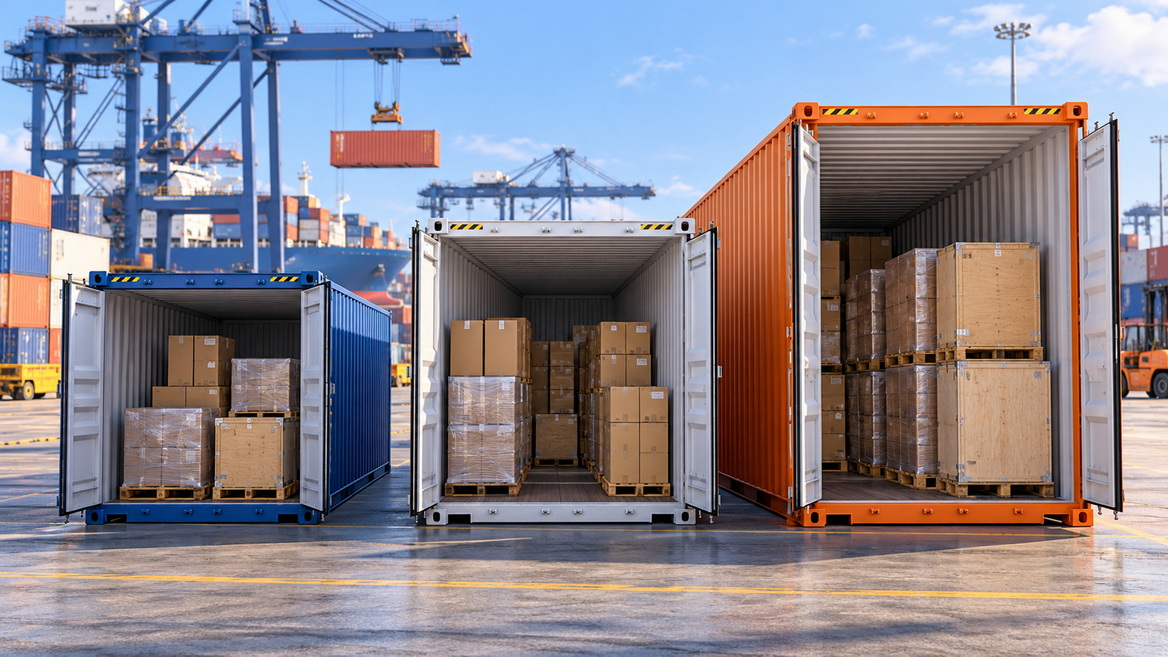
| Equipment Type | Suitable Cargo | Main Benefit | Important Consideration |
|---|---|---|---|
| Open-top container | Tall machinery, stone blocks, industrial tanks | Allows loading from above by crane | Cargo should normally remain within length and width limits |
| Flat rack container | Wide, heavy, long, or irregular machinery | Open sides and reinforced deck | Requires careful lashing and may be exposed to weather |
| Platform container | Extremely large project cargo | No side walls or end walls | Limited availability and more complex handling |
| Hard-top container | Valuable cargo requiring top loading | Strong removable roof and better cargo protection | Not suitable for major cargo overhang |
| Reefer container | Temperature-sensitive industrial products | Temperature-controlled environment | Higher cost and restricted internal dimensions |
| Breakbulk service | Cargo beyond container dimensions | Suitable for very large equipment | Requires more port handling and detailed planning |
Specialized equipment should be selected based on the full cargo profile, not only on size.
Cargo weight, shape, loading method, packaging strength, transport route, and final delivery conditions must all be evaluated before booking.
The table below compares the two options for oversized cargo shipping from China.
| Comparison Factor | Standard Container | Specialized Container Service |
|---|---|---|
| Cargo size | Suitable for cargo within internal dimensions | Suitable for over-height, over-width, over-length, and irregular cargo |
| Loading access | Mainly loaded through rear doors | Supports top loading, crane loading, side loading, or open-deck loading |
| Equipment availability | Usually widely available | May have limited availability, especially during peak shipping periods |
| Booking process | Normally straightforward | Requires dimensions, cargo photos, drawings, weight details, and approval |
| Base freight cost | Usually lower | Usually higher due to special equipment and handling needs |
| Cargo protection | Fully enclosed steel walls and roof | Protection depends on equipment type, packaging, tarpaulin, and lashing |
| Port handling | Standard terminal handling process | May require special lifting, direct delivery, or terminal approval |
| Inland trucking | Conventional container trucking | May require low-bed trailers, permits, escorts, or route surveys |
| Cargo securing | Internal blocking, bracing, and lashing | Customized lashing, dunnage, chains, straps, and engineering review |
| Best application | General cargo that fits safely inside | OOG cargo, project cargo, large machinery, and heavy equipment |
The cheapest freight quote is not always the lowest-cost shipping solution.
A standard container may have a lower sea freight rate, but it can become more expensive if the cargo must be dismantled, repacked, modified, or shipped in multiple containers. A specialized container service may have a higher initial cost but can reduce damage risk, simplify loading, and avoid expensive operational delays.
A standard container is normally the best choice when cargo fits safely and securely inside the equipment. It is especially suitable for export shipments that need predictable schedules, wide carrier availability, and lower handling complexity.
- The cargo fits through the container door.
- The cargo fits within the internal dimensions.
- The total cargo weight is below the maximum payload.
- The cargo can be safely secured with standard blocking and bracing.
- The cargo does not require crane loading from above.
- The cargo can remain stable during sea and road transport.
- The consignee can unload the cargo using standard equipment.
- The cargo does not need to extend beyond the container frame.
For example, an industrial pump may be described as oversized because it is large compared with other factory products. However, if the final wooden crate measures 4.8 meters long, 2.1 meters wide, and 2.2 meters high, it may still fit in a standard container. In this situation, using standard equipment can provide a more efficient transport solution.
- Lower equipment cost
- More frequent vessel departures
- Better protection from rain, wind, dust, and salt spray
- Simpler terminal handling
- Easier availability in major Chinese ports
- More predictable inland trucking arrangements
- Lower risk of weather exposure
- Reduced need for special permits
A 40ft high-cube container offers more internal height than a standard 40ft dry container. It can be useful for tall cargo, larger pallets, and bulky but relatively lightweight goods.
However, a high-cube container is not always the answer for oversized cargo. Cargo may still be too wide, too long, too heavy, or impossible to load through the rear doors. In these cases, an open-top or flat rack container may be more suitable.
A specialized container service becomes necessary when a standard container cannot safely accommodate the cargo. This usually happens when cargo exceeds the standard container's dimensions, requires unusual loading methods, or needs special handling throughout the transport process.
- Cargo exceeds standard container dimensions.
- Cargo cannot pass through the rear doors.
- Cargo must be loaded by crane from above.
- Cargo is too wide for internal container loading.
- Cargo is too tall for a dry or high-cube container.
- Cargo is too long for a standard container.
- Cargo has an irregular shape.
- Cargo requires reinforced flooring.
- Cargo requires a customized lashing plan.
- Cargo needs special road permits or trucking equipment.
- The destination terminal requires advance approval.
Cargo that exceeds the dimensions of a selected container is often called out-of-gauge cargo, also known as OOG cargo.
OOG cargo may extend above the container height, beyond the side walls, past the end walls, or in several directions at the same time. This cargo commonly requires a flat rack, platform container, open-top container, or breakbulk shipping method.
Accurate declarations are essential. Carriers and terminals need the final cargo dimensions, including wooden bases, wrapping, dunnage, lashing, and protective materials. If the actual cargo is larger than the declared cargo, it may be rejected at the terminal or require a revised booking.
Open-top and flat rack containers are both common solutions for oversized cargo. However, they are designed for different cargo profiles.
An open-top container has removable roof bows and a tarpaulin cover. It is useful when cargo cannot be loaded through the rear doors but can be loaded vertically by crane.
Open-top containers are often suitable for:
- Tall machinery
- Industrial tanks
- Marble and granite blocks
- Heavy equipment with lifting points
- Cargo requiring vertical loading
- Large components that fit within the length and width of the container
The cargo is loaded from above and secured inside the container. After loading, the cargo is typically protected with a tarpaulin. This can provide better side protection than a flat rack container.
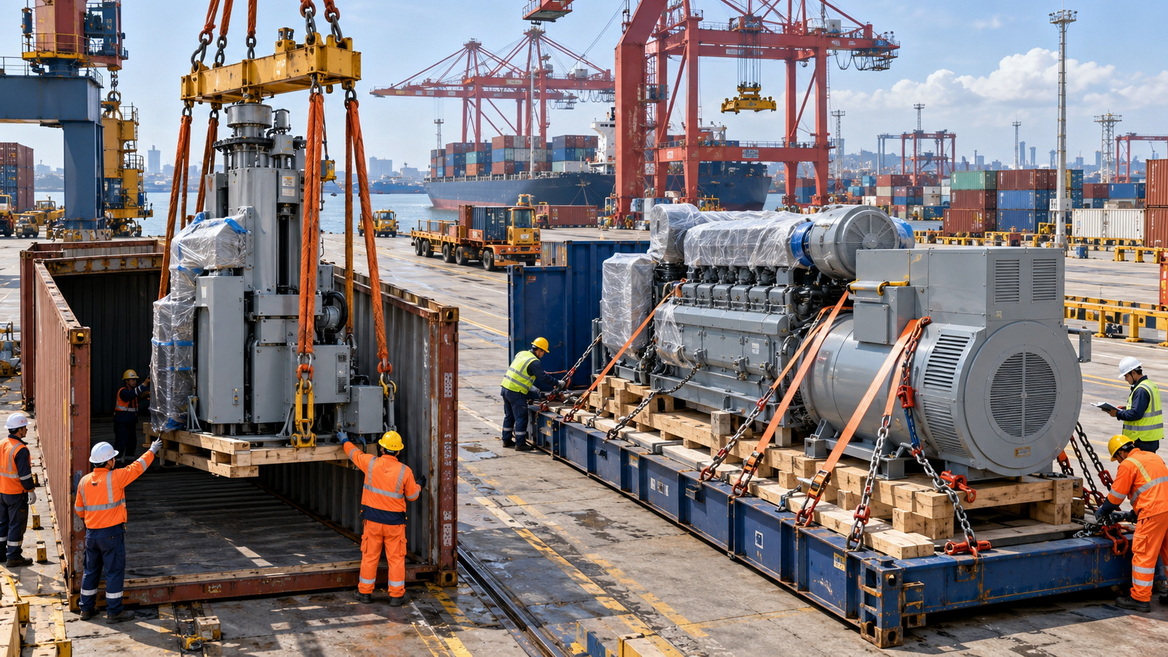
A flat rack container has a reinforced base and end walls, while the sides remain open. It is suitable for cargo that exceeds standard container width, height, or length.
Flat racks are commonly used for:
- Large generators
- Construction machinery
- Transformers
- Heavy industrial machinery
- Steel structures
- Large valves
- Boats and yachts
- Mining equipment
- Factory production equipment
- Wind-energy components
Flat rack cargo must be professionally secured. The shipment may be exposed to rain, sea spray, dust, wind, and sunlight. Strong export packing, waterproof protection, rust prevention, shrink wrapping, and lashing are essential.
Use an open-top container when cargo mainly needs top loading but remains within the equipment's length and width limits.
Use a flat rack container when cargo is over-width, over-height, over-length, unusually shaped, or too heavy for conventional loading arrangements.
Many importers compare shipping options only by ocean freight rate. This can lead to poor decisions for oversized cargo.
The real cost of specialized container shipping may include:
- Special equipment surcharge
- Out-of-gauge surcharge
- Terminal handling charges
- Crane loading charges
- Lashing and securing charges
- Export packing costs
- Dunnage and blocking materials
- Cargo survey costs
- Special inland trucking charges
- Road permits
- Escort vehicles
- Destination unloading costs
- Marine cargo insurance
- Storage and demurrage risk
A standard container may have a lower freight rate. But it may require cargo dismantling, additional wooden crates, multiple containers, extra labor, or reassembly at destination.
Use the following process before selecting equipment:
1. Calculate the total cost of shipping in a standard container.
2. Include cargo dismantling, packaging, loading labor, and reassembly costs.
3. Calculate the total cost of using an open-top, flat rack, or platform container.
4. Include lashing, crane handling, special trucking, permits, and delivery equipment.
5. Evaluate cargo risk, transit time, delivery reliability, and damage exposure.
6. Select the option with the strongest total commercial value.
For high-value machinery, a higher shipping cost may be reasonable if it prevents cargo damage, avoids production downtime, or protects a critical installation schedule.
A reliable booking decision requires complete and accurate cargo information. The more details provided before booking, the easier it is to select the right equipment and prevent delays.
1. Final cargo dimensions
- Length
- Width
- Height
- Dimensions after packing
- Dimensions after lashing and dunnage
2. Verified cargo weight
- Net weight
- Gross weight
- Weight per package
- Weight distribution
- Center of gravity
3. Cargo drawings and photographs
- Technical drawings
- Lifting-point drawings
- Front, rear, side, and top photographs
- Packaging photographs
- Crating details
4. Loading conditions
- Factory loading location
- Forklift capacity
- Crane capacity
- Lifting tools
- Loading time requirements
- Available labor
5. Destination delivery conditions
- Port of discharge
- Final delivery address
- Site access conditions
- Unloading equipment
- Road restrictions
- Delivery appointment requirements
6. Cargo protection requirements
- Wooden crating
- Vacuum packaging
- Anti-rust protection
- Waterproof wrapping
- Tarpaulin coverage
- Lashing method
- Marine cargo insurance
Final cargo dimensions must include all packaging and securing materials. This includes the wooden base, skid, steel frame, dunnage, chains, straps, protective wrapping, and any overhang created during lashing.
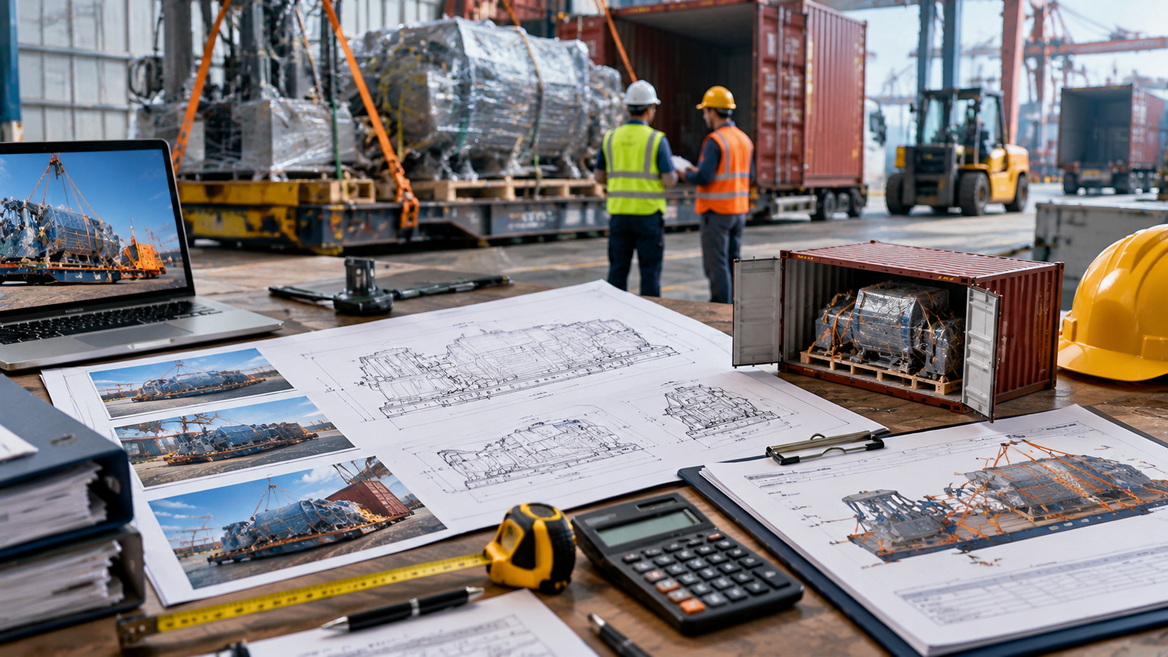
Oversized cargo logistics does not end when the vessel arrives at the destination port. Inland delivery can be the most complex stage of the shipment.
A flat rack or project cargo shipment may require:
- Low-bed trailer
- Extendable trailer
- Multi-axle trailer
- Heavy-haul truck
- Crane truck
- Route survey
- Height clearance review
- Bridge weight review
- Road permits
- Escort vehicles
- Restricted travel hours
- Delivery appointment coordination
- Site unloading equipment
In many countries, oversize and overweight road transport permits are issued by regional, state, provincial, or local authorities. Permit rules can vary significantly depending on cargo width, height, length, weight, axle configuration, travel route, and delivery time.
For this reason, the final delivery plan should be arranged before the cargo leaves the supplier's factory in China.
A shipment can arrive at destination port on schedule but still face expensive delays if permits, special trucks, cranes, delivery appointments, or unloading teams are not ready.
Successful oversized cargo shipments depend on early preparation and clear communication between the exporter, buyer, factory, freight forwarder, port, carrier, trucking company, and final delivery site.
- Measure cargo after final packing.
- Use millimeters or centimeters for detailed cargo dimensions.
- Provide cargo photos from every side.
- Confirm the gross weight before booking.
- Identify the cargo center of gravity.
- Share lifting-point information.
- Choose equipment based on actual cargo requirements.
- Confirm whether the cargo is in-gauge or out-of-gauge.
- Arrange professional lashing before cargo reaches the terminal.
- Confirm destination terminal acceptance in advance.
- Plan special trucking and road permits early.
- Protect exposed cargo against moisture and corrosion.
- Consider marine cargo insurance for high-value shipments.
- Include extra time in the shipping schedule for special equipment approval.
Container selection is not only a freight cost decision. It is also a decision about cargo safety, delivery reliability, risk management, and total commercial value.
The decision between a specialized container service and a standard container depends on more than cargo dimensions. Weight, loading method, packaging, lashing, port conditions, vessel space, trucking requirements, destination access, and total logistics cost must all be considered.
A standard container is the best option when cargo fits safely inside, can enter through the doors, and can be secured without unusual handling.
A specialized container service is the right solution when cargo is too large, too heavy, too irregular, or too complex for a conventional container.
For oversized cargo shipping from China, early planning helps reduce risk, avoid unnecessary costs, improve cargo protection, and support reliable delivery.
Share your cargo dimensions, weight, photos, loading location, destination port, and final delivery address with GB FREIGHT AGENCY CO., LTD. for a practical equipment recommendation and shipping solution tailored to your shipment.
Yes. Cargo can be shipped in a standard container if it fits within the internal dimensions, door opening, and payload limit. The cargo must also be properly secured and safe for sea and inland transport.
Out-of-gauge cargo is cargo that exceeds the available height, width, length, or other permitted dimensions of a container. It may require an open-top container, flat rack container, platform container, or breakbulk shipping service.
The answer depends on the shipping route, carrier, cargo dimensions, cargo weight, equipment availability, and handling requirements. An open-top container may be more economical if the cargo only requires top loading and fits within the container's length and width. A flat rack is often required for over-width, over-height, or over-length cargo.
Common documents include a commercial invoice, packing list, bill of lading instructions, cargo dimensions, cargo weight, technical drawings, cargo photographs, lashing plan, export customs declaration documents, and destination-specific documents where required.
For standard oversized cargo, planning should begin at least two to four weeks before the cargo-ready date. For very large machinery, project cargo, peak-season shipments, or unusual dimensions, earlier planning is recommended.
1. International Maritime Organization. [International Convention for Safe Containers (CSC)].aspx)
2. Maersk. [Out of Gauge Cargo: Special Cargo Guidance]
3. Maersk. [Shipping Special Cargo]
4. Federal Highway Administration. [State Oversize and Overweight Load Permit Contacts]
5. International Organization for Standardization. [ISO 668: Series 1 Freight Containers — Classification, Dimensions and Ratings]


