
Views: 289 Author: GB FREIGHT Publish Time: 2026-10-06 Origin: Site


Content Menu
● How to Evaluate Air Freight Forwarders
>> Transparent Selection Criteria
>> Experience Must Be Relevant
>> Certifications Require Verification
>> Technical Competence Before Price
>> 1. GB FREIGHT AGENCY CO., LTD.
>> 3. CTS International Logistics
>> 8. DSV
>> 10. Nippon Express / NX Group
>> Capacity, Minimum Charges, and Credentials
● Buyer's Guide and Risk Controls
>> Start With the Contracting Entity
>> Use a Representative Pilot Shipment
>> Compare Total Delivered Cost
>> Insider Guide: Booking Is Not Departure
>> Common Procurement Pitfalls
>> Choose a Partner You Can Measure
● FAQ
>> 1. How Can I Verify That a Forwarder's ISO Certificate Is Current?
>> 2. Does IATA Agent Status Guarantee Airline Capacity?
>> 3. Should I Accept a DDP Air Freight Quote Without a Destination Review?
>> 4. What Documents Are Needed for Lithium Battery Shipments?
>> 5. How Should I Evaluate Cargo Insurance and Claims Support?
Finding a dependable international air freight forwarder in China is not simply a matter of choosing the lowest price per kilogram. Professional buyers need a logistics partner that can coordinate suppliers, manage documentation, arrange suitable flight capacity, and resolve delivery exceptions without creating unnecessary costs.
China's manufacturing clusters provide significant sourcing advantages, but they also create coordination challenges. A purchasing program may involve several factories, different production schedules, mixed packaging standards, and multiple overseas destinations. The forwarder must connect these moving parts into a workable shipping plan.
This guide examines ten forwarding companies serving China-origin shipments. It explains their backgrounds, service focus, potential fit for different purchasing requirements, and the questions buyers should ask before establishing a long-term relationship.
China's industrial concentration helps explain why international buyers often source logistics services locally. Government reporting for 2025 shows that the nine mainland cities of the Guangdong–Hong Kong–Macao Greater Bay Area recorded foreign trade of RMB 9.15 trillion. The Yangtze River Delta accounted for 37.4% of China's total foreign trade.
These regional supply chains support practical opportunities for supplier collection, consolidation, and export coordination. However, proximity to manufacturing does not automatically make every forwarder suitable for every commodity or destination.
Market conditions also matter. IATA reported that global air cargo demand increased 3.4% in 2025, while international demand grew 4.2%. Its July 2026 analysis reported global demand growth of 3.9% year on year.
These figures provide market context. They do not guarantee available capacity, competitive pricing, or consistent transit times on a particular China-origin route.

Air freight forwarding is a service business rather than a manufacturing activity. Factory production capacity, material grades, and production MOQ therefore do not directly measure forwarding quality.
For logistics procurement, the relevant equivalents are lane-specific capacity, cargo acceptance, minimum billing, operational controls, and customized shipment management.

The companies in this guide represent a mix of China-focused coordination and international logistics networks. Their inclusion reflects publicly described services and potential relevance to China-origin purchasing programs.
No operational audit, undisclosed scoring system, or universal performance ranking is claimed.
| Evaluation area | What buyers should assess | Evidence to request |
|---|---|---|
| Legal identity | The entity accepting cargo and issuing invoices | Registration details, contract name, matching bank beneficiary |
| Flight capacity | Access to suitable departures on the required route | Carrier proposal, gateway, schedule, booking status |
| Cargo acceptance | Ability to handle the actual commodity | Written acceptance conditions and document requirements |
| Operational controls | Checks before airline handover | Warehouse procedures, inspection records, discrepancy reporting |
| Delivery reliability | Performance across the complete shipment | Comparable lane history and exception records |
| Cost transparency | Total delivered cost | Itemized origin, transport, destination, and delivery charges |
| Customization | Compatibility with purchasing requirements | Written operating procedure and escalation responsibilities |
A long company history is useful background, but buyers should prioritize experience with comparable shipments.
A forwarder familiar with general cargo may not be suitable for standalone lithium batteries, temperature-sensitive goods, oversized packages, or destinations requiring unusual import arrangements.
Ask for examples involving a similar commodity, origin region, shipment size, and destination. Where customer confidentiality prevents disclosure, request anonymized operational examples and a detailed explanation of the proposed workflow.
CE marking and RoHS compliance relate to applicable products and market requirements. They are not substitutes for checking a forwarder's logistics credentials.
Depending on the shipment, relevant evidence may include management-system certification, customs authorizations, airline agency status, and specialized cargo qualifications.
Check the exact legal entity, certificate scope, covered locations, validity, and current status. A certificate displayed by a group does not necessarily cover every branch, warehouse, or subsidiary.
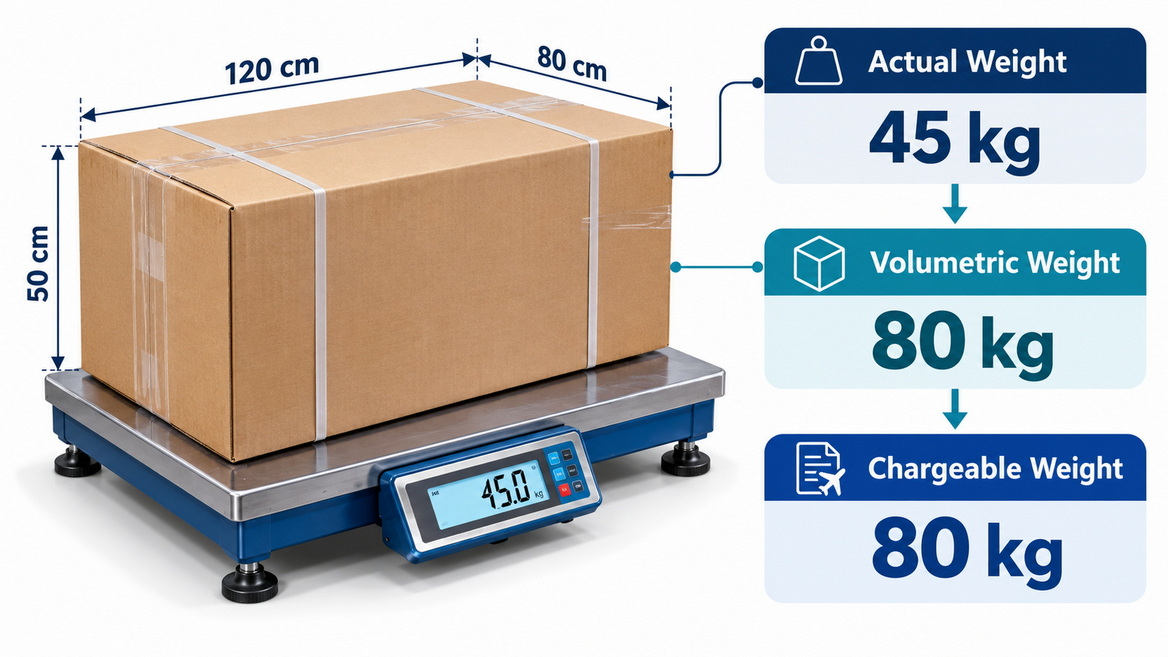
Chargeable weight is a useful starting point for evaluating a quotation.
For example, a carton measuring 120 × 80 × 50 cm has a volumetric weight of 80 kg. If its actual weight is 45 kg, the freight charge may still be calculated using 80 kg.
Confirm the applicable divisor, measurement method, rounding rules, and final packaging dimensions. These details can materially change the invoice.
Battery shipments require additional scrutiny. Buyers should provide the battery configuration, rating, model information, and applicable UN 38.3 test documentation. A generic safety data sheet does not replace a shipment-specific transport assessment.
GB FREIGHT is a Shenzhen-based freight forwarding option for buyers seeking coordinated shipping from China. Its published contact information includes a Shenzhen head office and contacts in Hong Kong and Malaysia.
Experience: The company reports 15 years of international logistics experience. Its precise legal incorporation year should be confirmed during supplier onboarding rather than inferred from that experience statement.
Service focus: Its website lists air freight, customs clearance, warehousing, door-to-door shipping, multimodal transport, and other logistics services.
Markets: Company-provided information describes shipments to Europe, North America, South America, Southeast Asia, the Middle East, Africa, and Oceania. Buyers should confirm the proposed service and destination partner for each lane.
GB FREIGHT's positioning is relevant to small and medium-sized importers looking for cost-conscious coordination, supplier communication, and flexible shipment planning.
For OEM and private-label purchasing programs, customization means supporting the movement of goods—not manufacturing them. Relevant requirements include supplier collection schedules, consolidation instructions, shipment splitting, document coordination, and final-delivery arrangements.
Its stated emphasis on flexibility and communication should be tested through a representative pilot shipment. Ask who manages the account, how exceptions are escalated, and whether the quotation identifies destination charges clearly.
Buyers should also request shipment-specific confirmation for dangerous goods, battery cargo, and delivery-duty arrangements. A published service category does not establish acceptance of every product or destination.
Founded: November 20, 2002, for Sinotrans Limited. This date refers to the listed company rather than every predecessor organization or subsidiary.
Service focus: Sinotrans provides integrated logistics services connected with China's domestic and international trade. Its portfolio includes forwarding, contract logistics, and broader supply-chain services.
Markets: Its China-linked logistics platform makes it relevant to importers sourcing from multiple Chinese regions and shipping to overseas markets.
Sinotrans is worth considering when the purchasing requirement extends beyond one airport-to-airport movement. Buyers may need supplier collections, warehousing, export coordination, and connections between different transport modes.
For OEM programs, discuss recurring shipment schedules, purchase-order coordination, and the management of suppliers with different readiness dates.
A large organization still needs clear account ownership. Confirm which branch handles collection, which team controls international transport, and who resolves destination problems.
Founded: 1984. CTS International is an established Chinese logistics company with a publicly described international forwarding business.
Service focus: Its portfolio includes international air and ocean freight, project logistics, railway transport, third-party warehousing, cross-border e-commerce logistics, aviation supplies logistics, and customs declaration services.
Markets: Its international orientation makes it a relevant candidate for China-origin purchasing programs serving overseas destinations.
CTS may suit buyers who want freight forwarding connected with warehousing or customs-related coordination.
For OEM shipments, discuss staged supplier collections, mixed documentation, purchase-order visibility, and the handling of shipment discrepancies before airport delivery.
Buyers shipping aviation supplies or other specialized goods should request a commodity-specific review. The availability of a specialized service does not establish suitability for every shipment within that category.
Founded: July 15, 1971, in Taipei. Dimerco reports entering the China market in 1991.
Service focus: Its China services include air and ocean freight, consolidation, customs brokerage, warehousing, domestic trucking, and cross-border transport.
Markets: Dimerco emphasizes China and ASEAN logistics, alongside a broader international network covering other Asian markets, North America, and Europe.
It is worth evaluating when a sourcing program spans China and Southeast Asia or requires regional consolidation.
OEM-related requirements may include combining components from several origins, coordinating release dates, and maintaining visibility across supplier handovers.
Dimerco's China materials list IATA, ISO, and AEO-related credentials. Buyers should request current certificates and confirm the contracting entity and location covered.
Founded: 1981. Formerly Kerry Logistics Network, the company changed its name to KLN Logistics Group in April 2025.
Service focus: Its air freight offering includes origin pickup, consolidation, customs clearance, delivery, and shipment tracking.
Markets: Its reported footprint includes Mainland China, Hong Kong, other Asian markets, the Americas, Europe, the Middle East, Africa, and Oceania.
KLN is relevant to buyers seeking air freight connected with distribution and destination handling.
For OEM and private-label programs, discuss supplier consolidation, release instructions, and the connection between purchasing milestones and delivery schedules.
Its air freight materials identify IATA agent status. However, agency status should not be treated as evidence of guaranteed capacity for an individual shipment.
Confirm the origin gateway, actual contracting entity, destination partner, and responsibility for delivery exceptions.
Founding reference: DHL was founded in 1969. This is a brand-history reference, not the incorporation date of every Global Forwarding entity.
Service focus: DHL Global Forwarding's China air freight offering includes standard air cargo, same-day services, and temperature-controlled options.
Markets: Its international network makes it relevant to buyers shipping from China to multiple destination regions.
DHL Global Forwarding is worth considering when procurement requires a clearly defined air freight service rather than a general promise of fast delivery.
OEM-related requirements may include supplier handovers, shipment scheduling, temperature management, and documentation coordination.
Buyers should distinguish DHL Global Forwarding freight services from DHL Express parcel services. Ask which business issues the quotation, which service product applies, and how chargeable weight and additional fees are calculated.
Founded: 1890, in Bremen, Germany.
Service focus: Kuehne+Nagel provides international transport and logistics services, including customs clearance, cargo insurance, and digital shipment management tools.
Markets: Its global network supports purchasing programs involving Chinese suppliers and multiple overseas markets.
Its China-specific digital air freight offering has included quoting, booking, tracking, payment, and invoicing functions.
Kuehne+Nagel is a candidate for buyers who want freight execution connected with structured digital visibility.
For OEM sourcing programs, discuss supplier collaboration, account reporting, shipment instructions, and purchasing-system integration where required.
Digital access does not replace operational accountability. Ask who resolves a failed pickup, a cargo discrepancy, or a missed connection when the shipment platform does not provide a clear answer.
Founded: 1976.
Service focus: DSV provides international air and sea forwarding alongside broader transport and logistics services.
Markets: Its international development covers major sourcing and destination regions, including Asia-Pacific, the Americas, Europe, and Africa.
DSV completed its acquisition of Schenker on April 30, 2025. This expanded the organization's network, but buyers should assess the actual local workflow rather than assume that corporate scale guarantees consistent execution.
For OEM programs, discuss recurring shipment planning, supplier coordination, and destination-service integration.
During 2026 onboarding, ask which operating entity manages the account, which system provides tracking, and which team handles claims. These questions are particularly important where legacy processes are being integrated.
Founded: 1979. Its company history records expansion into China in 1993.
Service focus: Expeditors offers air and ocean forwarding, vendor consolidation, customs brokerage, order management, warehousing, distribution, and customized logistics solutions.
Markets: Its regional structure supports purchasing programs involving Asian sourcing and international destinations.
Expeditors is worth evaluating when vendor coordination and customs processes are central to the shipment plan.
For OEM buyers, relevant discussions include order-level visibility, supplier consolidation, shipment data, and the relationship between procurement instructions and logistics execution.
Request a demonstration using a representative shipment. Useful visibility identifies actionable milestones, missing information, and exceptions—not simply a tracking number.
Founded: Nippon Express Co., Ltd. was established in 1937. Its history records the start of international air freight forwarding in 1957.
Service focus: The group has a long history of combining land, sea, and air transportation within international logistics.
Markets: Its documented overseas development includes the United States, Singapore, Europe, and other international locations.
NX Group merits consideration where air freight forms part of a wider multinational or intermodal purchasing program.
For OEM sourcing, discuss collection planning, shipment release controls, documentation, and the handover between international transport and final distribution.
Request current China-origin lane details and identify the destination office responsible for execution. Historical network presence does not establish a particular flight schedule or delivery commitment.
Traditional manufacturing MOQ does not directly apply to forwarding. Instead, ask about minimum charges, consolidation thresholds, cargo restrictions, and the cost efficiency of smaller shipments.
| Forwarder | Capacity and service focus | Minimum shipment consideration | Credential review |
|---|---|---|---|
| GB FREIGHT | China-origin coordination and multiple transport services | Request minimum billing and consolidation terms | Verify applicable company and service credentials |
| Sinotrans | Integrated China-linked logistics | Confirm lane-specific minimum charges | Check the contracting entity and operating branch |
| CTS International | Air freight with warehousing and related logistics | Request shipment-specific terms | Confirm current entity and site documentation |
| Dimerco | China and ASEAN forwarding and consolidation | Confirm consolidation thresholds and minimums | Verify published IATA, ISO, and AEO-related credentials |
| KLN | Pickup, consolidation, clearance, and delivery | Request route-specific terms | Verify applicable IATA and local credentials |
| DHL Global Forwarding | Defined air freight service categories | Product-specific quotation required | Confirm the selected service and operating location |
| Kuehne+Nagel | Global forwarding and digital shipment management | Request account and product terms | Check applicable entity and site certificates |
| DSV | International forwarding and integrated logistics | Confirm current account terms | Verify credentials under the actual operating entity |
| Expeditors | Forwarding, vendor consolidation, and order management | Request shipment-specific minimums | Check credentials relevant to the proposed scope |
| NX Group | International air freight and intermodal logistics | Request current lane terms | Verify China-entity and operating-site documentation |
Public network size does not reveal how much space is available for your shipment. Ask separately about carrier selection, booking arrangements, departure frequency, and contingency options.
Verify the legal entity before evaluating marketing claims.
The contract, invoice, bank beneficiary, and registration details should align. Where several entities participate, obtain a written explanation of their responsibilities.
Also identify the destination clearance and delivery parties. A familiar origin brand does not remove the need to understand the overseas handover.
A pilot should reflect the recurring purchasing program.
A small carton of uncomplicated general cargo does not demonstrate capability for later shipments involving batteries, oversized packaging, mixed suppliers, or difficult import requirements.
Follow a defined sequence:
1. Provide the commodity description, carton count, dimensions, gross weight, value, and ready date.
2. Identify batteries, liquids, magnets, temperature sensitivity, or other acceptance concerns.
3. Request an itemized quotation and proposed route.
4. Agree on collection, warehouse receipt, acceptance, departure, arrival, and delivery milestones.
5. Run a representative shipment.
6. Review timing, communication, discrepancies, and final charges before increasing volume.
A low air freight rate can become expensive when other charges are unclear.
Request separate figures for collection, origin handling, export-related services, air transport, destination handling, customs brokerage, storage, and final delivery. Clarify taxes and duties where they form part of the arrangement.
Ask which charges are fixed, estimated, conditional, or payable directly to another party.
Also establish what happens if dimensions change, a supplier misses the pickup, the airline rejects the cargo, or the consignee cannot receive delivery.
A common procurement mistake is treating a booking confirmation as proof that goods are moving.
Build separate milestones into the operating procedure:
- Space requested
- Booking confirmed
- Cargo collected
- Cargo received at origin
- Required checks completed
- Cargo accepted for transport
- Actual departure confirmed
- Destination availability confirmed
- Final delivery completed
This distinction helps prevent goods from being marked "in transit" prematurely.
Ask what evidence supports each status. A flight number and intended departure date are different from confirmation that the shipment departed.
Battery cargo deserves particular attention because documentation, classification, packaging, and carrier acceptance must all align before transport.
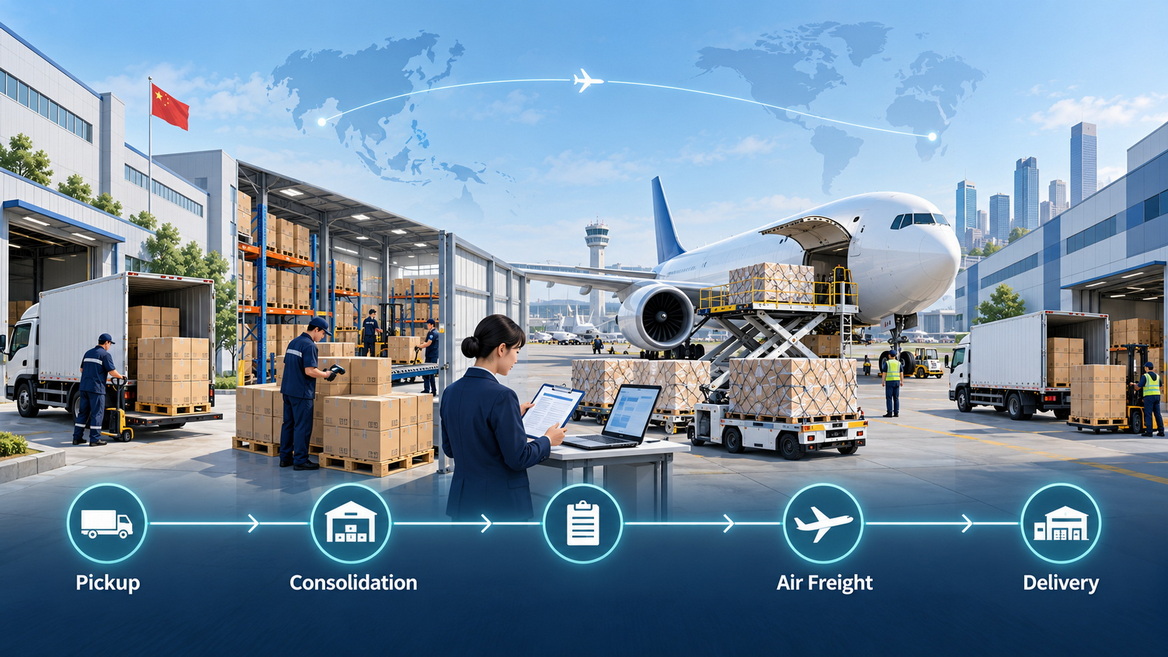
Incomplete quotes: Compare the same chargeable weight, service level, route, and destination scope.
Incorrect dimensions: Use final packed measurements, including pallets and protective packaging.
Unclear cargo descriptions: Avoid vague descriptions that hide batteries or other acceptance-sensitive features.
Overstated certifications: Check the entity, site, scope, and current certificate status.
Undefined delivery responsibilities: Identify who handles clearance, taxes, appointment booking, unloading, and delivery exceptions.
Uncontrolled supplier changes: Require approval before factories change carton sizes, shipment quantities, or battery configurations after booking.
A long-term forwarder should support measurable purchasing requirements.
Track quote response time, collection performance, documentation accuracy, milestone updates, exception resolution, invoice differences, and delivery outcomes.
Agree on definitions before using these measures. For example, "on-time delivery" should refer to an agreed delivery window rather than an undefined expectation.
The strongest choice depends on the shipment profile. Large international groups may suit buyers seeking broad network integration, while a China-based coordinator may suit importers who prioritize supplier communication and flexible shipment planning.
GB FREIGHT is a relevant option for buyers seeking China-origin coordination with a Shenzhen-based team. Its reported experience and published services provide a starting point for evaluation, while a pilot shipment can establish whether its execution matches your requirements.
To request a tailored shipping proposal, provide GB FREIGHT with supplier locations, cargo details, dimensions, weight, ready dates, destination addresses, and the required delivery scope. Ask for an itemized quotation covering the route, estimated milestones, acceptance conditions, and responsibilities before making a booking.
Check the certificate number, exact legal entity, standard, scope, covered locations, and current status.
Use the issuing certification body's verification process and an appropriate certificate-validation database. A printed expiry date alone is insufficient because a certificate may be suspended or withdrawn before that date.
If the certificate belongs to another group entity or location, request an explanation of how it applies to the service you are purchasing.
No. Agency status should not be treated as a shipment-specific capacity commitment.
Ask separately for the proposed carrier, departure schedule, booking status, cargo acceptance conditions, and alternatives if the intended service changes.
Also clarify whether the price depends on consolidation, a particular flight, or a limited booking window.
Do not approve it solely on the basis of an attractive delivered price.
Request a written explanation of the importer arrangement, customs responsibilities, taxes, product requirements, exclusions, and destination delivery scope.
Confirm who is responsible if customs requests additional information or if the goods cannot legally enter under the proposed arrangement.
Prepare the battery type, configuration, model details, relevant rating, and applicable UN 38.3 test summary.
Requirements vary depending on whether batteries are shipped alone, packed with equipment, or contained in equipment. Packaging, labels, documentation, and state-of-charge conditions may also differ.
Ask the forwarder to confirm the applicable requirements for the actual shipment date and chosen carrier. Do not assume that acceptance of a previous shipment establishes acceptance of a new configuration.
Request the proposed policy wording, insured-value basis, deductible, exclusions, geographical scope, claim deadlines, and required evidence.
Do not assume that a forwarder's contractual liability equals full cargo insurance.
Clarify who reports a loss, who gathers evidence, and who communicates with the insurer. Keep packaging records, commercial documents, photographs, and delivery exception reports where relevant.
- [GB FREIGHT — Contact Details and Published Services]
- [IATA — Full-Year 2025 Air Cargo Performance]
- [IATA — July 2026 Air Cargo Market Analysis]
- [China SCIO — 2025 Imports and Exports Briefing]
- [IATA — Battery Transport Requirements]
- [IATA — Battery Guidance Document]
- [DHL — Calculating Chargeable Weight]
- [IAF CertSearch — Certificate Validation]
- [Sinotrans — Corporate Profile]
- [CTS International — Company Overview]
- [Dimerco — China Services and Credentials]
- [KLN — Air Freight Services]
- [DHL Group — Company History]
- [DHL Global Forwarding — China Air Freight]
- [Kuehne+Nagel — Company Background]
- [Kuehne+Nagel — China Air Freight Digital Services]
- [DSV — Completion of the Schenker Acquisition]
- [Expeditors — Company History]


