
Views: 277 Author: GB FREIGHT Publish Time: 2026-10-15 Origin: Site


Content Menu
● What Does a Freight Forwarder in Canada Do?
● Top Freight Forwarders in Canada: Companies to Consider
● How to Choose the Best Freight Forwarder for China-to-Canada Shipping
>> Match Experience to Your Actual Cargo
>> Test Communication Before Booking
>> Check the Canadian Delivery Arrangement
● Sea Freight or Air Freight from China to Canada?
>> Compare LCL and FCL Using the Full Shipment
>> Use Air Freight Selectively
● How to Compare Freight Quotes Without Missing Hidden Costs
>> Request an Itemized Breakdown
>> Check the Assumptions Behind the Price
>> Understand Time-Related Charges
● Canadian Customs Preparation: What Importers Should Confirm
>> Register and Authorize Your Broker
>> Check Product Classification and Supporting Documents
>> Review China-Related Surtaxes Where Relevant
● A Practical China-to-Canada Shipping Workflow
>> Step 1: Build a Complete Shipment Brief
>> Step 2: Compare Equivalent Proposals
>> Step 3: Confirm Responsibilities in Writing
>> Step 4: Agree on Shipment Milestones
>> Step 5: Review the Completed Shipment
● Illustrative Scenario: Consolidating Orders from Several Suppliers
● How GB FREIGHT Supports Shipments from China
>> What Is the Best Freight Forwarder in Canada for Imports from China?
>> Do I Need a Canadian Forwarder and a Chinese Forwarder?
>> Is Sea Freight Always Cheaper Than Air Freight?
>> Does Door-to-Door Shipping Include Duties and Taxes?
>> Can a Customs Broker Register My Business in CARM?
Choosing among the top freight forwarders in Canada requires more than comparing company names. For businesses importing from China, the right partner must connect supplier coordination, sea freight or air freight, customs preparation, and final delivery into one clear plan.
A low freight rate offers little value if destination charges are unclear or the shipment reaches Canada before the importer is ready.
This guide explains how to compare Canadian freight forwarders, assess China-to-Canada shipping options, and prepare a shipment that supports your budget and delivery requirements.

A freight forwarder organizes cargo transportation and coordinates the parties involved. Depending on the agreed scope, services may include booking freight, arranging pickup, preparing shipping documents, coordinating customs brokerage, and organizing delivery.
Freight forwarding and customs brokerage are related but distinct functions. When comparing providers, establish which services the company performs directly and which require another party.
For China-to-Canada shipments, divide responsibilities into three stages:
- Origin: supplier communication, collection, export documentation, and departure arrangements.
- International transport: ocean or air booking, routing, and shipment updates.
- Destination: import clearance coordination, cargo release, and delivery.
Ask who owns each stage. A named contact and written handover process are more useful than a general promise of "complete logistics."
The following companies appear in Freightos' guide to Canadian freight forwarders. This is a starting shortlist, not a performance ranking. Their suitability depends on your cargo, route, required services, and local operating arrangements.
| Freight forwarder | Services highlighted in the source guide | Questions to ask |
|---|---|---|
| Kuehne+Nagel | Air, sea, road logistics, and specialized cargo services | Can the proposed team support your product requirements? |
| DHL Global Forwarding | Air and ocean freight, including specialized logistics | What origin and destination services does the quotation include? |
| CEVA Logistics | Freight, supply chain services, and complex cargo handling | Who manages delivery and customs coordination in Canada? |
| DSV | Air, ocean, ground freight, and contract logistics | Which systems and contacts will manage your shipment? |
| C.H. Robinson | International freight and North American transport services | How will international and inland transport connect? |
| eShipper | Freight, warehousing, and fulfillment services | Which freight and fulfillment charges are quoted separately? |
| Manitoulin Global Forwarding | Ocean, air, and project logistics | Can the delivery plan accommodate your final destination? |
One significant development affects comparisons: DSV completed its acquisition of Schenker on April 30, 2025. Buyers comparing legacy Schenker and DSV proposals should confirm the contracting entity, service contacts, and systems involved rather than treating them automatically as unrelated competitors.
A large international network may suit complex supply chains. A smaller provider may offer a more focused operating relationship. Neither size alone nor brand recognition proves suitability for your shipment.
Ask about shipments similar to yours, not simply how many years the company has operated.
Furniture, machinery, packaged consumer products, and batteries create different handling and documentation questions. Provide an accurate commodity description before requesting a firm quotation.
Useful questions include:
- Which product details do you need before accepting this cargo?
- Are there packaging, handling, or carrier restrictions?
- Will the goods require additional documents or approvals?
- Who checks the shipping documents before departure?
A forwarder should explain what remains unconfirmed instead of presenting every shipment as routine.
Your first quotation exchange provides an opportunity to evaluate communication.
Does the provider distinguish confirmed information from estimates? Does it identify missing cargo details? Does it explain exclusions without repeated prompting?
Request a named operating contact, an escalation contact, and an update schedule. For multi-supplier orders, also ask who will chase readiness dates and report discrepancies.
International transport is only part of the journey.
Give the forwarder your exact delivery address and explain whether the premises have a loading dock, unloading equipment, restricted receiving hours, or appointment requirements.
Ask whether the quotation ends at a port, airport, freight terminal, warehouse, or your premises. These are different service scopes.
The appropriate mode depends on shipment size, urgency, handling requirements, and the commercial consequences of delay.
| Shipping option | Consider it when | Main comparison point |
|---|---|---|
| Full container load, or FCL | You need a dedicated container or have a substantial shipment | Total container and inland transport costs |
| Less than container load, or LCL | Your cargo shares container space with other shipments | Consolidation, destination handling, and delivery charges |
| Air freight | Timing or inventory urgency outweighs a higher transport budget | Chargeable weight, routing, and airport handling |
| Split shipment | Only part of an order is urgently required | Whether reduced disruption justifies two shipping arrangements |
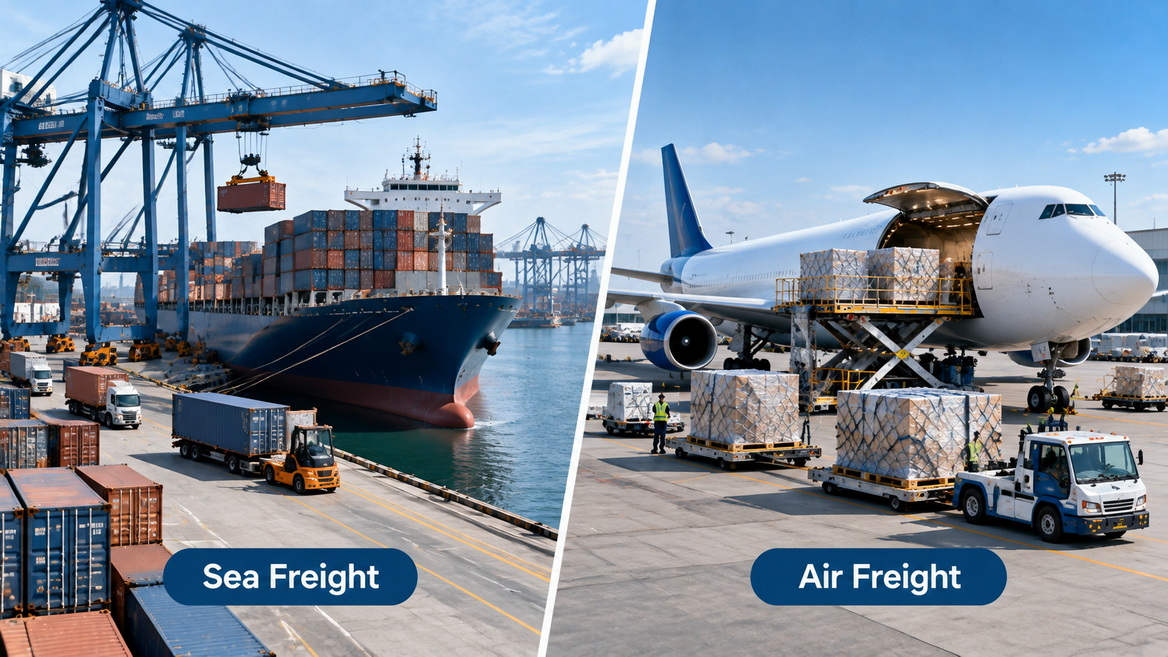
There is no universal cargo-volume threshold that makes FCL cheaper than LCL.
Ask for both options when the shipment approaches a practical decision point. Include origin handling, destination charges, inland transport, and unloading requirements.
A lower ocean freight line does not necessarily produce a lower delivered cost.
For urgent orders, identify the quantity needed immediately rather than assuming the entire purchase must travel by air.
A split shipment can be evaluated as a commercial option: an urgent portion travels by air while the balance moves by sea. Compare the additional freight expense against the disruption you are trying to avoid.
Do not accept a general transit estimate as a guaranteed delivery date. Ask which milestones the estimate includes and what could change it.
The most useful comparison is scope, not the headline rate.
Send each provider the same cargo information and require a consistent quotation format.
Ask the forwarder to identify:
1. Supplier pickup and origin handling.
2. Export declaration and documentation charges.
3. Main international freight.
4. Destination terminal or warehouse charges.
5. Customs brokerage fees.
6. Inland delivery and unloading-related services.
7. Cargo insurance, if requested.
8. Conditional charges and exclusions.
Separate duties and taxes from the forwarder's service fees. Also distinguish confirmed charges from allowances that depend on inspection, storage, or delivery conditions.

A quotation should specify cargo dimensions, weight, shipping mode, routing, validity, currency, and service endpoints.
For air freight, ask how chargeable weight is calculated. For LCL, ask which measurement basis applies and how destination handling is assessed.
Clarify what happens if the supplier changes the packaging or cargo quantity after booking.
Ask about available free time and the conditions that can trigger storage, demurrage, or detention.
Request an explanation tied to your proposed shipment. A list of fee names is less useful than understanding who must act, by when, and what happens if cargo cannot be collected promptly.
Customs readiness should be addressed before departure, not after arrival.
Canada's border agency uses the CBSA Assessment and Revenue Management system, known as CARM, to assess and collect duties and taxes on commercial imports. Businesses need a business number and an import-export program account for commercial importing.
Importers must register their own businesses in the CARM portal. A customs broker cannot complete that business registration on the importer's behalf.
Where a broker or other third party will act for you, review and complete the appropriate delegation of authority.
Before booking, confirm:
- The importer of record.
- The required business and import account details.
- The appointed customs broker.
- Whether the necessary authority has been delegated.
- How duties, taxes, and any applicable security requirements will be handled.
Avoid assuming that purchasing a door-to-door service automatically resolves these responsibilities.
Prepare a commercial invoice, packing list, and accurate product description.
Ask the broker to identify the information needed to establish tariff classification, origin, value, and any product-specific requirements.
Descriptions such as "parts" or "accessories" may leave important questions unanswered. Explain what the product is, what it does, and what it is made from.
Certain steel and aluminum goods may face additional Canadian surtaxes. Rules can depend on product classification and where the material was melted, poured, smelted, or cast.
CBSA guidance describes a 25% surtax for specified goods under the Steel Goods and Aluminum Goods Surtax Order, subject to its scope and exceptions. This is not a blanket statement that every Chinese shipment attracts that charge.
For affected products, obtain broker advice and supporting material-origin documents before approving the landed-cost budget.
A repeatable process reduces unclear handovers.
Provide supplier addresses, collection contacts, cargo descriptions, package quantities, dimensions, gross weight, readiness dates, and the delivery address.
Include the agreed trade terms and any special handling requirements.
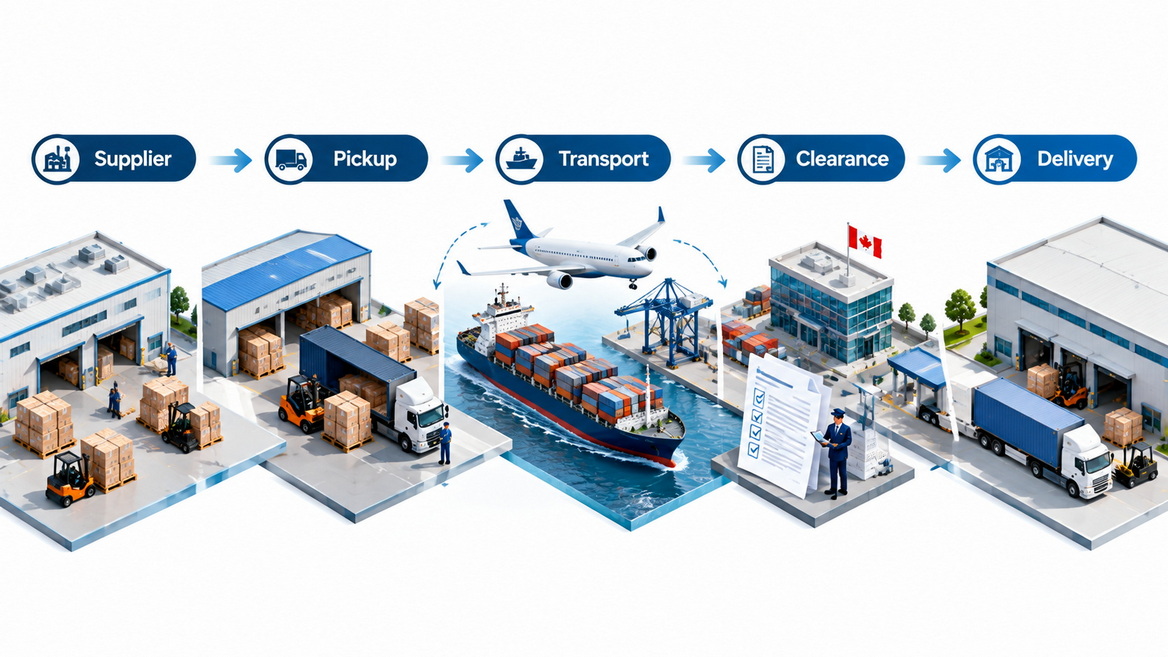
Request matching service endpoints from each forwarder.
If one proposal excludes Canadian delivery and another includes it, resolve the difference before comparing prices.
Identify who arranges pickup, checks documents, coordinates export clearance, appoints the broker, pays import charges, and receives the cargo.
Request updates for collection, departure, arrival, customs release, and delivery.
Define who reports exceptions and how quickly a response is expected.
Compare the quotation with the final invoice. Record delays, extra charges, document corrections, and communication issues.
Use those findings to improve the next booking rather than judging the provider solely on one freight rate.
Consider a hypothetical Canadian importer purchasing products from three Chinese suppliers.
One supplier finishes early, another changes carton dimensions, and the third misses the planned readiness date. Booking transport before confirming these details could create avoidable collection or storage problems.
A structured approach would be to:
- Confirm readiness with every supplier.
- Recheck package dimensions and quantities.
- Evaluate whether consolidation remains worthwhile.
- Compare waiting with shipping the ready goods separately.
- Update the quotation and documents before departure.
This is an operating example, not a GB FREIGHT customer case. Its lesson is straightforward: supplier coordination belongs inside the transport plan.
GB FREIGHT AGENCY CO., LTD. is a Chinese freight forwarding company with 15 years of international logistics experience, according to the company information provided for this article.
Its stated services cover supplier booking coordination, export customs clearance, sea freight, air freight, transportation, and final delivery arrangements.
The company serves businesses shipping from China to Europe, North America, South America, Southeast Asia, the Middle East, Africa, and Oceania.
For Canadian-bound cargo, request a proposal that clearly identifies the origin services, international routing, destination arrangements, and responsibilities requiring importer action.
The objective should be a cost-effective shipping plan matched to your shipment—not an unsupported promise of the lowest price or fastest delivery.
There is no single best provider for every importer. Compare relevant cargo experience, origin coordination, Canadian delivery arrangements, quotation transparency, and communication. Evaluate companies against the same shipment brief.
Not necessarily. One provider may coordinate the full shipment through its operating network. Confirm who handles each country's work and whether you receive one agreement or separate service arrangements.
Do not assume this for every shipment. Compare complete quotations using actual dimensions, weight, service endpoints, and urgency. Small shipments and destination charges can change the practical comparison.
Not automatically. Ask the provider to list inclusions, exclusions, importer responsibilities, and payment arrangements. The phrase "door-to-door" alone does not define customs or tax obligations.
No. CBSA states that importers must register their businesses themselves. A broker can request a business relationship so the importer can delegate authority.


