
Views: 260 Author: GB FREIGHT Publish Time: 2026-09-23 Origin: Site


Content Menu
● What Is a Warehouse Service?
● What Is Third-Party Storage?
● Warehouse Service vs Third-Party Storage: Main Differences
● Why Storage Strategy Matters in Global Distribution
● When a China Warehouse Service Is the Better Choice
>> You Buy From Multiple Suppliers
>> You Need Better Control Before Export
>> You Want Better Container Utilization
● When Third-Party Storage Is the Better Choice
>> You Are Entering an Overseas Market
>> Your Sales Volume Changes by Season
>> You Need Faster Local Delivery
● Understanding the Full Cost of Storage
● Customs Warehousing and Standard Storage Are Different
● Five Steps to Choose the Right Storage Model
>> 1. Map the Complete Cargo Route
>> 2. Separate Products by Demand Pattern
>> 3. Define Your Delivery Standard
>> 4. Review Reporting Quality
>> 5. Start With a Pilot Shipment
● A Practical Hybrid Distribution Example
● How GB FREIGHT Supports Global Distribution
● Summary
>> What is the difference between warehouse service and third-party storage?
>> Is third-party storage suitable for small importers?
>> Should I consolidate cargo from multiple Chinese suppliers?
>> Can a normal warehouse delay import duty payment?
>> How do I compare warehouse quotations?
Choosing between a warehouse service and third-party storage can shape your delivery speed, inventory cost, customer satisfaction, and ability to grow in overseas markets. For companies shipping from China to Europe, North America, South America, Southeast Asia, the Middle East, Africa, and Oceania, storage is not simply about finding space for goods. It is about building a reliable path from suppliers to final customers.
For many importers, manufacturers, wholesalers, and e-commerce sellers, the best solution is not always a single warehouse model. A China-based consolidation warehouse may improve control before export, while overseas third-party storage may shorten final delivery times. Understanding the difference helps businesses make better inventory and transport decisions.
GB FREIGHT AGENCY CO., LTD. has more than 15 years of international logistics experience. We support cargo movement from China through supplier booking coordination, warehouse receiving, cargo consolidation, export customs declaration, international freight, and final delivery. Our goal is to help customers move goods efficiently, control unnecessary logistics costs, and reduce avoidable supply-chain risks.

A warehouse service is a group of logistics activities that manage cargo before, during, or after transportation. Storage is only one part of the process. A professional warehouse can receive goods, verify carton quantities, inspect visible packaging conditions, label products, consolidate shipments, palletize cargo, and prepare goods for export or local distribution.
For businesses sourcing products from several Chinese suppliers, a warehouse service can become an important control point. Instead of allowing every supplier to ship separately, cargo can be delivered to one warehouse, checked, organized, and combined into a planned shipment.
A warehouse service may include:
- Cargo receiving from suppliers
- Quantity and carton-count checking
- Visible packaging and shipping-mark inspection
- Short-term or long-term cargo storage
- Cargo consolidation from multiple suppliers
- Palletizing, shrink wrapping, and packing reinforcement
- Product labeling and relabeling
- Sorting, kitting, and repacking
- Container loading and loading supervision
- Export preparation and document coordination
- Inventory reporting and shipment updates
- Delivery arrangement to ports, airports, warehouses, or customers
A well-managed warehouse helps businesses create a smoother connection between production and transportation. It can reduce fragmented shipments, improve loading efficiency, and make it easier to identify basic cargo issues before goods begin an international journey.
Third-party storage is an outsourced storage arrangement. Instead of operating a warehouse independently, a company uses an external logistics provider to store and manage inventory.
Third-party storage is often part of a broader distribution solution. Depending on the provider, the service may include receiving, inventory management, order picking, packing, labeling, local delivery preparation, returns handling, and reporting.
This model is particularly useful when a company wants to position goods closer to overseas customers without investing in a private warehouse, local staff, storage equipment, systems, insurance, or facility management.
For example, a company in China may send one full container of products to a warehouse in the United States, Canada, Europe, Australia, or the Middle East. Once the cargo arrives and is received into inventory, the local provider can release smaller shipments to distributors, retailers, business customers, or individual buyers.
Third-party storage can help companies enter new markets with lower operational commitment. However, service scope varies widely. Some providers only store pallets. Others manage complete fulfillment and distribution operations. Before selecting a provider, businesses should understand exactly what is included in the quotation.
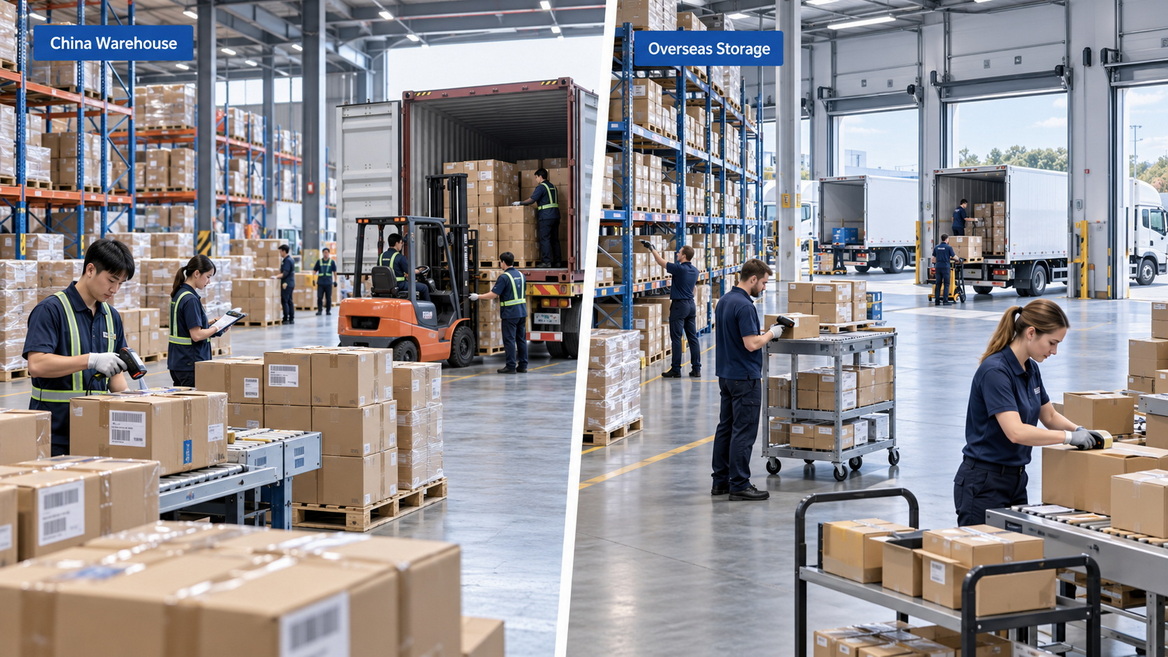
Warehouse service and third-party storage are closely related, but they are not the same.
A warehouse service describes the practical activities used to receive, store, handle, and dispatch cargo. Third-party storage describes the outsourcing model in which an external company performs those activities on behalf of the cargo owner.
| Comparison Area | Warehouse Service | Third-Party Storage |
|---|---|---|
| Main purpose | Manage cargo storage and handling at a specific supply-chain point | Outsource inventory storage and often local distribution |
| Control level | Usually higher when processes are customized for the shipper | Shared with the external logistics provider |
| Typical location | Often close to suppliers, factories, ports, or airports | Often located near overseas customers or regional markets |
| Best use | Supplier consolidation, export preparation, cargo inspection, container loading | Market entry, local inventory, order fulfillment, regional delivery |
| Cost structure | May include storage, labor, handling, loading, and special service fees | Usually charged by storage volume, receiving, handling, and outbound orders |
| Inventory flexibility | Useful for coordinating factory production schedules | Useful for adjusting capacity based on changing demand |
| Delivery impact | Improves shipping readiness and export coordination | Improves local delivery speed after international arrival |
| Technology needs | Requires clear warehouse reporting and cargo records | Requires accurate inventory and order-management integration |
The strongest strategy for many businesses is a hybrid model. Goods can be consolidated and prepared in China before export, then stored at a destination warehouse for faster local order fulfillment.
Storage decisions influence far more than monthly warehouse charges. They affect inventory availability, container utilization, freight cost, customs readiness, customer delivery times, and working-capital pressure.
A weak storage plan can create expensive problems:
- Too much inventory held in a market with slow demand
- Too little inventory available in fast-moving markets
- Separate shipments from multiple suppliers
- Low container utilization
- Repeated handling and higher transport costs
- Delayed shipment release because documents are incomplete
- Damaged goods caused by poor receiving or loading processes
- Emergency air freight used to prevent stock shortages
- Inaccurate inventory records
- Missed delivery appointments
- Customer complaints caused by delayed orders
The right storage location depends on where demand is generated, how predictable sales are, how quickly customers need delivery, and how costly it is to keep inventory in each location.
For example, a slow-moving industrial spare part may be better stored in China until an order is confirmed. A fast-selling consumer product may be better held closer to the destination market, where local delivery can be arranged more quickly.
A China warehouse service is often the most practical option when businesses need stronger control before goods leave the country.
Many buyers source products from different factories. One supplier may produce metal components, another may provide packaging, and another may manufacture finished goods.
If each supplier ships cargo independently, the buyer may face:
- Several separate bookings
- Higher handling costs
- Repeated documentation work
- Different cargo-ready dates
- Inconsistent carton labels
- Poor container utilization
- More complicated tracking
- Greater risk of delivery mismatch
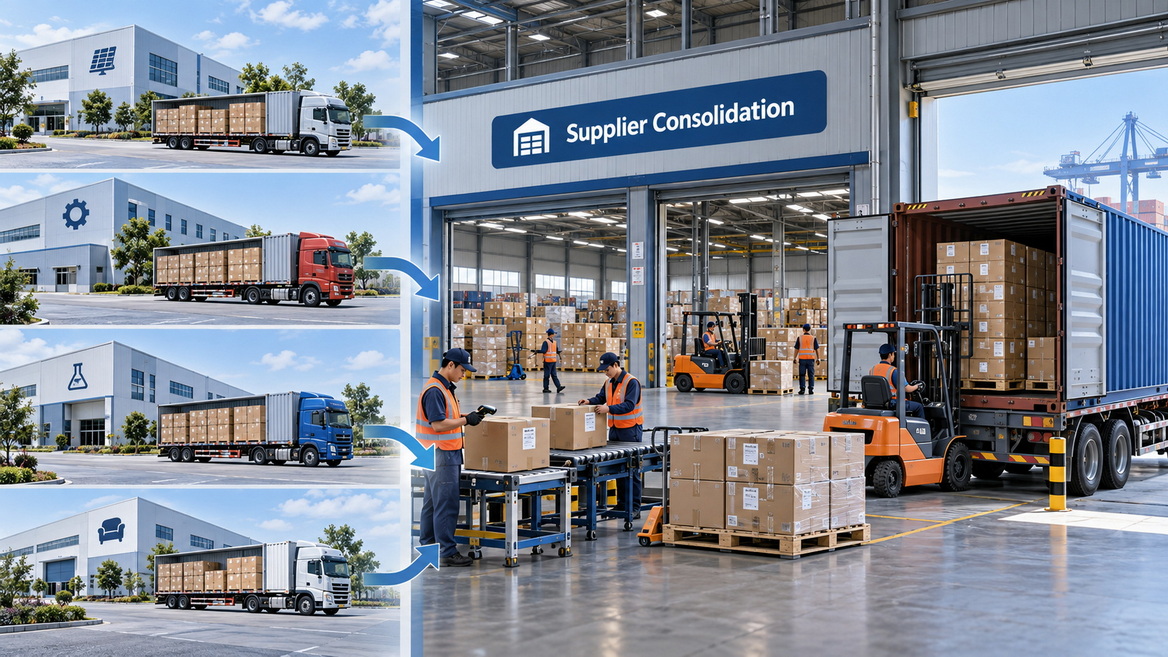
A consolidation warehouse creates one receiving point for multiple suppliers. Cargo can be stored temporarily until all items are ready. The warehouse team can then arrange loading based on the final shipment plan.
This solution is useful for:
- Importers purchasing mixed products
- Retailers sourcing multiple product categories
- Project cargo buyers
- Construction-material importers
- OEM and private-label buyers
- Wholesalers purchasing from several factories
- Businesses preparing full-container shipments
Warehouse handling can help identify obvious cargo problems before goods reach the port or airport.
Common issues include:
- Incorrect carton marks
- Missing cartons
- Damaged outer packaging
- Incorrect pallet size
- Mixed products in the wrong cartons
- Weak packing for long-distance transport
- Incorrect labels for the destination market
- Incomplete loading instructions
Basic checks at the warehouse can prevent minor issues from becoming major claims after the cargo arrives overseas.
For higher-risk products, businesses may also need independent inspection, laboratory testing, product certification, or destination-market compliance review. Warehouse checks do not replace these requirements, but they provide an important practical layer of cargo control.
Container space is valuable. Poor loading can leave unused volume, increase cargo movement during transit, and raise the transport cost per unit.
A warehouse can plan container loading based on carton dimensions, weight distribution, pallet requirements, and unloading needs. Proper loading can support safer transportation and reduce unnecessary space loss.
This is especially important for:
- High-volume consumer goods
- Furniture and home products
- Building materials
- Machinery components
- Mixed-SKU container shipments
- Fragile goods requiring careful positioning
For many importers, stronger consolidation and loading preparation can improve total logistics efficiency more than negotiating a small reduction in ocean freight rates.
Third-party storage is usually more suitable when a business wants to place inventory closer to customers and improve local distribution capability.
Setting up a private overseas warehouse can require significant investment. A business may need to manage leases, labor, insurance, warehouse equipment, local regulations, inventory software, and daily operations.
Third-party storage can reduce that commitment. It allows a business to establish local inventory without operating the facility directly.
This can be useful for companies expanding into:
- The United States
- Canada
- European Union markets
- The United Kingdom
- Australia and New Zealand
- Southeast Asian markets
- The Middle East
- Latin American markets
For businesses still testing demand, this approach can reduce the risk of committing to large fixed warehouse costs before sales become stable.
Seasonal products may require more storage before holiday sales, retail promotions, construction periods, or special events. A fixed warehouse can leave a company paying for unused space during slower months.
Third-party storage may offer more flexible capacity. The provider may charge by pallet, carton, cubic volume, bin location, or monthly transaction volume.
However, businesses should review the complete pricing structure. A low storage fee may be followed by high charges for receiving, unloading, labeling, pallet moves, order picking, packing, returns, system access, or peak-season operations.
The best quotation is not always the lowest monthly storage price. It is the one with the clearest total cost and service standard.
When goods are stored near customers, local orders can be released faster after they are received.
This can support:
- Wholesale distribution
- Retail replenishment
- Marketplace inventory replenishment
- E-commerce fulfillment
- Spare-parts delivery
- Distributor orders
- Replacement shipments
- Project delivery schedules
For products with stable demand, destination storage can shorten customer lead times and reduce the need to send individual parcels from China.
A storage decision should never be based on warehouse rent alone. The real cost includes all activities required to move goods from the supplier to the final customer.
| Cost Category | What to Review |
|---|---|
| Storage fee | Is the charge based on pallet, carton, cubic meter, bin, or square meter? |
| Receiving fee | Does it include unloading, counting, labeling, and inventory entry? |
| Handling fee | What is charged for pallet moves, sorting, repacking, and loading? |
| Outbound fee | What does the provider charge for picking, packing, and dispatching orders? |
| Transport cost | Can cargo consolidation reduce inland and international freight cost? |
| Customs support | Is customs coordination included, optional, or handled by another party? |
| Insurance | Is cargo insurance included or arranged separately? |
| Technology fee | Is inventory reporting or system access charged separately? |
| Minimum commitment | Are there monthly minimums, peak-season fees, or contract penalties? |
| Inventory risk | Who is responsible for shortages, damage, or reporting errors? |
A useful way to evaluate the decision is:
Total Distribution Cost=Storage+Handling+Transport+Customs+Inventory Carrying Cost+Risk Cost
Inventory carrying cost includes the capital tied up in stock, insurance, obsolescence, shrinkage, and the risk of holding products longer than expected.
Risk cost includes the financial effect of late delivery, damaged cargo, stock shortages, emergency freight, and lost sales opportunities.
Businesses that compare only storage rates may miss these larger costs.
Not every warehouse can hold imported goods under a customs-controlled procedure.
A standard warehouse stores goods that have already completed the required import process or are handled under normal local rules. A customs warehouse may allow eligible goods to remain under customs supervision before they are released for local sale, transferred, processed where permitted, or re-exported.
This can be valuable for businesses that want to manage duty and tax timing, hold inventory for regional distribution, or re-export products to another market.
Before using this model, confirm:
1. Whether the warehouse has the required customs authorization
2. Whether your products qualify for the intended procedure
3. Who will act as the importer of record
4. Which customs declarations are required
5. Whether duties, taxes, or guarantees apply
6. What handling activities are permitted
7. How long goods may remain in storage
8. What records must be maintained
9. How goods will be released, transferred, or re-exported
Customs rules vary by country, product category, cargo value, and trade arrangement. Businesses should confirm the requirements with the relevant customs authority, importer, broker, or qualified local advisor before shipping.
Selecting a storage solution becomes easier when the decision is based on real operating data.
Start with the physical movement of goods.
Identify:
- Supplier locations
- Production-ready dates
- Origin warehouse location
- Port or airport of departure
- Destination port or airport
- Customs clearance point
- Final warehouse location
- Final customer locations
Then ask one important question: Where does cargo wait, and why?
If goods wait because suppliers finish production at different times, China consolidation may solve the problem. If goods wait because customers need faster delivery after import, overseas storage may be the better solution.
Not every product should follow the same inventory strategy.
Classify products into:
- Fast-moving products
- Slow-moving products
- Seasonal products
- High-value products
- Fragile products
- Oversized cargo
- Spare parts
- Products with uncertain demand
Fast-moving products may justify overseas storage. Slow-moving products may be safer to keep in China until an order is confirmed.
Clarify what your customers expect.
Consider:
- Required delivery time
- Order cut-off time
- Packaging standard
- Labeling needs
- Delivery appointment requirements
- Tracking visibility
- Inventory accuracy
- Damage reporting process
- Return handling requirements
A warehouse that is cheap but cannot meet customer delivery expectations may create greater long-term cost.
Inventory reports should be clear, timely, and easy to understand.
Ask for sample reports showing:
- Goods received
- Quantity discrepancies
- Damaged cargo records
- Available stock
- Reserved stock
- Outbound orders
- Shipment status
- Aging inventory
- Storage charges
- Handling charges
Without accurate reporting, it becomes difficult to plan purchasing, manage stock levels, or make reliable customer commitments.
Before moving all inventory, begin with a limited shipment.
Choose selected products, define the required service level, and review the results after receiving and dispatching the cargo.
A pilot shipment can help you evaluate:
- Receiving accuracy
- Cargo condition reporting
- Inventory visibility
- Response time
- Handling quality
- Outbound delivery performance
- Total cost
- Communication quality
This approach gives businesses an opportunity to improve the process before larger shipments or peak-season inventory arrives.
A buyer purchases lighting products, metal brackets, electrical cables, and branded packaging from four different Chinese suppliers.
Each factory has a different production schedule. If the suppliers ship separately, the buyer may face multiple freight bookings, inconsistent cargo readiness, repeated handling, and higher transport costs.
A more coordinated plan may look like this:
1. Each supplier delivers cargo to a consolidation warehouse in China.
2. The warehouse receives the cargo and checks carton quantities and visible conditions.
3. Goods are sorted, labeled, palletized, and prepared for loading.
4. The logistics team arranges export documents and international freight.
5. The shipment moves by sea, air, rail, or multimodal transport to the destination market.
6. Cargo is received into overseas third-party storage.
7. The local warehouse releases products to distributors, retailers, project sites, or customers.
This model provides stronger control at origin and faster distribution at destination.
It can be especially effective for businesses with multiple suppliers in China and repeat customers in overseas markets.

GB FREIGHT AGENCY CO., LTD. provides international logistics solutions for businesses shipping cargo from China to worldwide destinations.
Our service support can include:
- Supplier booking and cargo collection coordination
- Warehouse receiving and temporary storage
- Cargo consolidation from multiple suppliers
- Carton, pallet, and loading preparation
- Export customs declaration coordination
- Ocean freight, air freight, rail freight, trucking, and multimodal transport
- Door-to-door logistics planning
- International shipment tracking
- Delivery coordination to overseas warehouses, distributors, or final customers
Every shipment has different requirements. A high-volume container shipment, urgent air cargo shipment, mixed supplier order, oversized project cargo movement, and local distribution plan all require different handling methods.
Our team works with customers to identify a practical route based on cargo type, volume, supplier location, destination, transit-time requirement, and budget.
Whether you need warehouse consolidation in China, international transportation, overseas storage coordination, or a combined distribution solution, GB FREIGHT can help you build a more efficient logistics process from supplier pickup to final delivery.
Share your cargo details, supplier locations, destination country, shipment volume, and expected delivery date with our team. We will help you evaluate the most suitable warehouse and transport solution for your international distribution needs.
Warehouse service and third-party storage serve different but connected purposes in global distribution.
A warehouse service is often most valuable when businesses need to receive, inspect, consolidate, prepare, and load cargo before export from China. It gives importers stronger control over supplier coordination, cargo readiness, and container utilization.
Third-party storage is often more suitable when businesses need to hold inventory closer to overseas customers. It can support faster local fulfillment, flexible capacity, market expansion, and improved delivery performance.
For many companies, the best approach is not choosing one model over the other. It is combining China warehouse consolidation with overseas third-party storage. This creates better origin control, more organized international transport, and faster destination delivery.
A well-planned storage strategy can reduce unnecessary handling, improve inventory visibility, support customer delivery expectations, and make international growth easier to manage.
Warehouse service refers to cargo receiving, storage, handling, consolidation, packing, loading, and dispatch activities. Third-party storage is an outsourcing arrangement where an external provider stores and may distribute inventory for a business.
Yes. Third-party storage can help small importers enter overseas markets without operating a private warehouse. However, businesses should carefully check minimum fees, handling charges, storage periods, and service limitations before sending inventory.
Cargo consolidation is often useful when you purchase from several suppliers. It can simplify shipment coordination, improve container utilization, reduce fragmented handling, and make it easier to inspect basic cargo conditions before export.
Usually, no. Import duty deferral generally requires a customs-authorized storage procedure. Businesses should confirm whether the warehouse has the required authorization and whether their cargo qualifies.
Compare the total cost rather than only the storage rate. Review receiving fees, unloading charges, pallet movement, labeling, repacking, picking, packing, outbound handling, system access, insurance, customs support, delivery charges, and minimum commitments.
1. World Bank. "[Logistics Performance Index]." Provides an international framework for evaluating logistics performance, supply-chain reliability, cross-border movement, and delivery efficiency.
2. World Bank. "[Connecting to Compete 2023: Trade Logistics in an Uncertain Global Economy]." Covers major logistics performance factors, including customs, infrastructure, international shipment capability, tracking, and delivery timeliness.
3. United Nations Trade and Development. "[Review of Maritime Transport 2025]." Discusses changes in maritime trade, global shipping conditions, supply-chain resilience, and the importance of adaptable logistics planning.
4. European Commission, Directorate-General for Taxation and Customs Union. "[Storage: Customs Warehousing and Free Zones]." Explains customs warehousing procedures and the storage of non-EU goods under customs supervision.
5. U.S. Customs and Border Protection. "[Bonded Warehouse Manual]." Explains the role of bonded warehouses and the handling of imported goods under U.S. customs requirements.
6. European Commission, Access2Markets. "[Customs Clearance Documents and Procedures]." Provides guidance on customs procedures, importation, storage, and related trade requirements.


