
Views: 244 Author: GB FREIGHT Publish Time: 2026-11-04 Origin: Site


Content Menu
● How Does International Shipping from China Work?
● Sea Freight vs. Air Freight from China: Which Should You Choose?
>> When Sea Freight Makes Sense
>> When Air Freight Makes Sense
● How Long Does Shipping from China Take?
● What Determines International Shipping Costs?
>> Use a Complete Shipping Cost Checklist
>> Compare Quotations on the Same Basis
● Choosing Incoterms for Shipping from China
>> FCA and FOB: Match the Rule to the Handover
>> DAP and DDP: Clarify Import Responsibility
● Documents Needed for Shipping from China
>> Check Consistency Before Departure
● A Practical Supplier Coordination Workflow
>> Step 1: Confirm What "Cargo Ready" Means
>> Step 2: Align Supplier and Forwarder Deadlines
>> Step 3: Confirm the Destination Handover
● An Illustrative Strategy: Split Urgent Stock from Routine Inventory
● Packaging, Insurance, and Exception Planning
● Shipping from China with GB FREIGHT AGENCY CO., LTD.
>> 1. Is sea freight always cheaper than air freight?
>> 2. Can I combine goods from different suppliers in China?
>> 3. What information is needed for an accurate freight quotation?
>> 4. Does door-to-door shipping include import duties?
>> 5. Should I choose FCL or LCL for a smaller shipment?
International shipping from China involves more than booking cargo space. For importers, the real challenge is coordinating suppliers, choosing between sea freight and air freight, preparing accurate documents, and controlling costs through final delivery.
At GB FREIGHT AGENCY CO., LTD., we bring 15 years of international logistics experience to these decisions. We help businesses move goods from China to Europe, North America, South America, Southeast Asia, the Middle East, Africa, and Oceania.
Our approach starts with one principle: clarity. Before cargo moves, buyers should understand the route, responsibilities, estimated schedule, and charges included in their shipping plan.
This guide explains how to build that plan and avoid preventable surprises.

A typical shipment connects several parties: your supplier, freight forwarder, carrier, customs representatives, and destination delivery provider.
The process usually includes:
1. Confirming cargo specifications and supplier readiness.
2. Selecting a shipping method and service scope.
3. Booking space and arranging collection or warehouse delivery.
4. Preparing documents and completing export customs procedures.
5. Moving cargo by sea or air.
6. Completing destination import clearance.
7. Arranging collection or final delivery.
A freight forwarder coordinates the agreed stages. However, coordination does not automatically make the forwarder the importer of record or responsible for every destination charge.
Before booking, ask who handles each stage, who pays, and which services require separate authorization.
The right shipping method depends on more than the freight price. Consider cargo size, urgency, handling requirements, and the commercial impact of late delivery.
| Decision factor | Sea freight | Air freight |
|---|---|---|
| Typical application | Larger, heavier, less urgent shipments | Urgent, lighter, or higher-value shipments |
| Pricing basis | Container rate or consolidation charging basis | Chargeable weight under the applicable tariff |
| Main trade-off | Lower transport cost may mean longer inventory lead time | Faster transport may justify a higher freight cost |
| Planning priority | Sailing availability, consolidation, port handling | Cargo acceptance, dimensions, capacity, flight routing |
| Delivery consideration | Inland transport and port release still matter | Customs and airport release still matter |
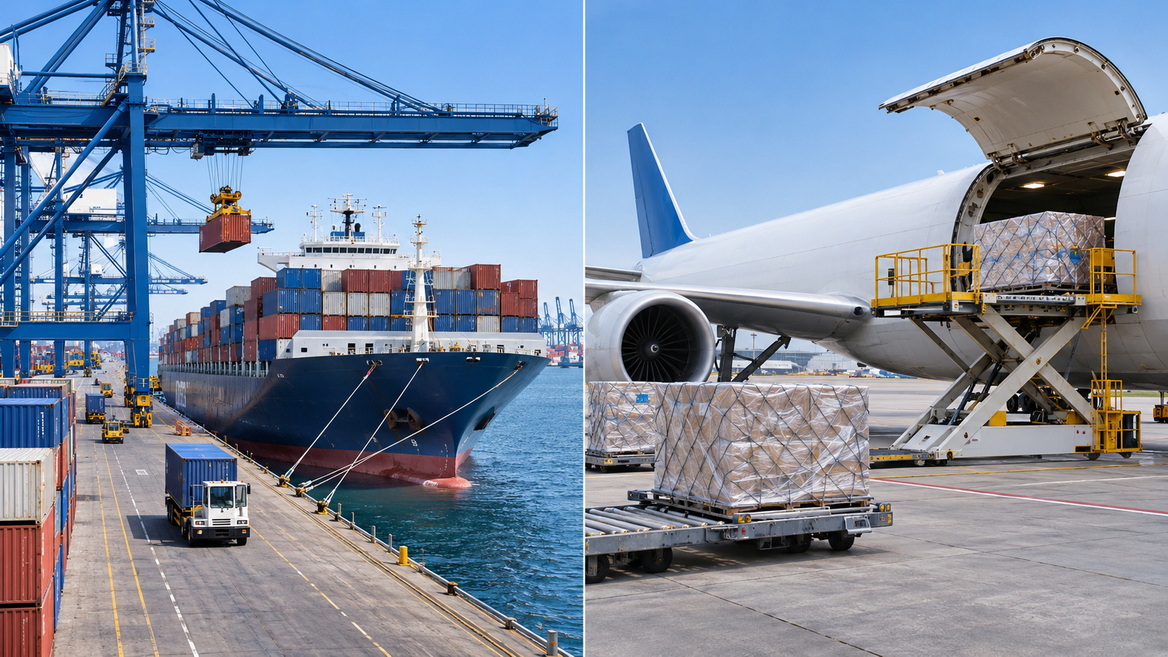
Sea freight is often suitable for furniture, machinery, building materials, and routine replenishment.
You can choose between:
- Full container load, or FCL: a container booked for your shipment.
- Less than container load, or LCL: your cargo shares container space with other shipments.
FCL does not require filling every available cubic meter. Compare the complete FCL and LCL quotations, including origin handling, destination charges, and delivery.
There is no universal shipment volume at which FCL becomes cheaper.
Air freight can help when production stops, a launch approaches, or inventory runs low.
However, lightweight cargo can still be expensive if its packaging occupies substantial space. Request the chargeable weight and calculation method, rather than comparing only per-kilogram rates.
Also check commodity acceptance before booking. Batteries, chemicals, liquids, and other restricted goods may require additional assessment, documentation, or specialized handling.
A useful transit estimate must explain where the clock starts and stops.
Port-to-port or airport-to-airport transit is not the same as door-to-door delivery. Your complete schedule may also include:
- Supplier preparation and collection.
- Warehouse receiving and consolidation.
- Export clearance and departure waiting time.
- Transshipment, where applicable.
- Import clearance and cargo release.
- Delivery appointments and inland transport.
Instead of relying on a universal number, request a route-specific estimate showing the cargo-ready date, planned departure, estimated arrival, and expected delivery window.
Ask whether the routing is direct or involves a connection. Establish a buffer based on the consequences of delay, especially for seasonal stock or production-critical components.
The headline freight rate is only one part of the budget.
For purchasing decisions, separate logistics charges from total landed cost. Landed cost also includes the goods themselves and applicable import duties and taxes.
| Cost category | What to verify |
|---|---|
| China-side services | Collection, warehouse handling, export clearance, documentation |
| Main transport | Freight rate, charging basis, applicable surcharges |
| Destination handling | Terminal or warehouse charges, cargo release, handling |
| Import procedures | Brokerage, applicable duties and taxes, required filings |
| Final delivery | Delivery address, vehicle requirements, unloading arrangements |
| Conditional charges | Inspections, storage, waiting time, container-related delay charges |
| Cargo insurance | Coverage, exclusions, deductible, insured journey |
Not every charge applies to every shipment. The objective is to distinguish included charges, excluded charges, and charges triggered by specific events.
Two quotations are not directly comparable when one ends at the destination port and another includes warehouse delivery.
Provide every forwarder with the same information:
- Pickup location and destination postal code.
- Commodity description and declared value.
- Package count, dimensions, and gross weight.
- Cargo-ready date and required delivery date.
- Agreed trade term and named location.
- Special handling or delivery requirements.
Then compare scope, routing, validity, payment terms, and exclusions—not simply the lowest total.
Incoterms define important buyer and seller responsibilities, including delivery, risk allocation, transport obligations, and customs formalities.
They do not replace a complete sales contract.
FOB applies to sea and inland waterway transport, with delivery occurring when goods are on board the vessel at the named shipment port.
For containerized goods handed to a carrier before vessel loading, FCA may better match the actual handover.
Discuss the physical delivery point with your supplier and forwarder. A familiar abbreviation is not necessarily the best fit.
Under DAP, the buyer generally handles import clearance and applicable import duties and taxes.
Under DDP, the seller assumes those import obligations.
Before accepting a DDP arrangement, verify who can legally complete the import formalities and how duties and taxes will be handled. A door-to-door service description alone does not establish these responsibilities.
Write the chosen rule, named place, and edition into the agreement—for example, "DAP [named delivery location], Incoterms 2020."
Documentation requirements depend on the product, destination, transport mode, and transaction.
Common documents include:
- Commercial invoice: transaction parties, goods description, value, and commercial details.
- Packing list: package quantities, contents, dimensions, and weights.
- Transport document: a bill of lading, sea waybill, or air waybill, as applicable.
- Certificate of origin: where required by destination rules or preferential treatment.
- Product-specific documentation: permits, test reports, declarations, or other compliance records where applicable.
The commercial invoice and packing list serve different purposes. One does not replace the other.
Review product descriptions, quantities, weights, values, consignee details, and shipping marks across documents.
Confirm tariff classification and destination requirements with the responsible customs professional. Do not assume a supplier's classification automatically resolves every importing country's requirements.
For packed ocean containers subject to the relevant rules, verified gross mass must be provided in time for vessel planning. Missing weight verification can prevent loading.
One of the most useful improvements buyers can make is establishing a shared shipment plan before production finishes.
Ask whether the goods are fully produced, inspected, packed, labeled, and available for collection.
A production completion date is not always a collection-ready date.
Request final package measurements rather than relying indefinitely on estimates.

Share booking instructions, warehouse details, document requirements, and applicable cutoffs.
For multiple suppliers, create a simple readiness tracker. A late supplier can affect the consolidated shipment, so decide beforehand whether to wait, split the cargo, or move urgent items separately.
Before departure, establish:
- Who submits import documentation.
- Who receives arrival notices.
- Who authorizes payment and cargo release.
- Whether delivery requires an appointment.
- Who provides unloading equipment.
These details turn a transport booking into a workable delivery plan.
Consider a hypothetical importer buying products from several Chinese suppliers.
Most inventory can arrive later, but a small portion is needed to prevent a stockout. Shipping everything by air may be unnecessarily expensive. Waiting for one ocean shipment may create a commercial problem.
A practical comparison would examine three options:
1. Send everything by sea.
2. Send everything by air.
3. Send the urgent portion by air and the balance by sea.
The decision should compare additional freight expense with the likely cost of unavailable inventory.
This is an illustrative planning example, not a reported GB FREIGHT customer result. Its value lies in the method: use the delivery deadline and business consequences to guide the transport choice.
Good packaging should reflect the cargo's weight, fragility, handling exposure, and transport conditions.
Check pallet stability, carton strength, moisture protection, and any destination requirements affecting packaging materials.
Photograph the goods and completed packaging before dispatch. Clear records can help establish condition if a dispute arises.
Cargo insurance should also be considered separately from carrier liability. Do not assume the carrier will reimburse the full invoice value after loss or damage.
Review the insured journey, exclusions, deductible, and claims procedure.
Finally, agree on an exception process. If cargo misses departure, customs requests information, or delivery becomes unavailable, establish who will communicate, what alternatives will be assessed, and who can approve additional costs.

GB FREIGHT AGENCY CO., LTD. provides sea freight and air freight solutions backed by 15 years of international logistics experience.
From supplier booking coordination and export customs procedures to transportation and final delivery, we help businesses plan shipments from China to markets worldwide.
The starting point is understanding your cargo and commercial priorities—not recommending the same service for every shipment.
To request a tailored quotation, send your product description, package dimensions, gross weight, supplier location, destination postal code, cargo-ready date, and required delivery date.
Also specify your agreed trade term and whether you need collection, insurance, destination clearance coordination, or final delivery. These details help us develop a clearer, more relevant shipping proposal.
No. Sea freight often suits larger shipments, but minimum charges and destination handling can affect smaller consignments. Compare complete quotations for the same delivery scope rather than freight rates alone.
Yes, supplier consolidation can be arranged where the cargo and service permit it. Confirm receiving arrangements, readiness deadlines, storage charges, document requirements, and what happens if one supplier falls behind.
Provide the commodity, package count, dimensions, gross weight, pickup location, destination, cargo-ready date, and trade term. Identify restricted goods, oversized packages, and special delivery requirements before requesting a price.
Not automatically. Door-to-door describes the transport scope, while duty and tax responsibility depends on the commercial agreement and quoted service. Request written confirmation of inclusions, exclusions, and the party responsible for import clearance.
Compare both when appropriate. Cargo volume matters, but destination charges, handling needs, departure options, and delivery arrangements also affect the result. There is no single volume threshold that works for every route.
1. [Freightos — International Freight Shipping: A Beginner's Guide to Global Logistics]
Published March 17, 2025. Original article supplied for comparative review and restructuring. Its historical rate examples and generalized transit figures have not been reused as current quotations. [freightos]
2. [International Chamber of Commerce — Incoterms® 2020]
Official overview of the rules governing buyer and seller responsibilities in international trade. Supports the discussion of delivery, costs, risks, and customs obligations. [iccwbo]
3. [International Chamber of Commerce — Incoterms® 2020 Checklist and Flowcharts]
Practical guidance on selecting trade terms, including FCA for containerized or multimodal handovers and FOB for appropriate onboard delivery arrangements. [library.iccwbo]
4. [ICC Academy — DAP & DDP Incoterms® 2020 Explained: Key Differences]
Published February 25, 2025. Explains import clearance, duty responsibilities, delivery, and unloading distinctions under DAP and DDP. [academy.iccwbo]
5. [International Trade Administration — Common Export Documents]
Explains commercial invoices, export packing lists, certificates of origin, and other commonly used trade documents. Destination-specific requirements must still be checked separately. [trade]
6. [International Trade Administration — Packing List]
Describes packing-list contents and their role in documenting package weights, measurements, and goods. [trade]
7. [International Maritime Organization — Verification of the Gross Mass of a Packed Container]
Authoritative explanation of shipper responsibilities, approved verification methods, and the verified gross mass requirement for loading packed containers subject to the rules. [imo]


