
Views: 262 Author: GB FREIGHT Publish Time: 2026-11-19 Origin: Site


Content Menu
● 1. Compare Total Landed Cost, Not Just Freight Rates
● 2. Choose the Right Freight Mode for Each Order
>> Sea Freight for Planned Replenishment
>> Air Freight for Time-Sensitive Goods
>> Railway Transportation for Suitable Routes
● 3. Compare LCL and FCL Without Assuming a Universal Break-Even Point
● 4. Reduce Air Freight Costs Through Better Packaging
>> An Illustrative Packaging Calculation
● 5. Consolidate Orders from Multiple Chinese Suppliers
● 6. Align Incoterms with the Service You Actually Need
>> Questions to Resolve Before Booking
● 7. Prevent Customs Delays Before Cargo Leaves China
● 8. Control Destination Charges and Container Free Time
● 9. Measure Savings per Sellable Unit
>> Illustrative Comparison, Not a Market Quotation
● 10. Build a Repeatable Freight Purchasing Process
● Plan Your Next Shipment with GB FREIGHT AGENCY CO., LTD.
>> What Is the Cheapest Way to Ship Commercial Goods from China?
>> Is LCL Always Cheaper Than FCL?
>> Does Door-to-Door Shipping Include Import Duties?
>> How Can I Reduce Air Freight Costs Without Delaying Everything?
>> What Information Is Needed for an Accurate Freight Quote?
To save money on freight shipping from China, look beyond the lowest freight rate. The strongest savings come from choosing the right transport mode, reducing chargeable volume, consolidating orders, and preventing avoidable destination charges.
At GB FREIGHT AGENCY CO., LTD., we approach shipping as a connected process: supplier coordination, booking, export customs clearance, international transportation, and final delivery. A cheaper booking is not necessarily a better shipment if it creates extra handling, missed delivery appointments, or expensive inventory shortages.
This guide explains how importers can reduce international shipping costs while protecting delivery reliability. It includes practical comparison tools, a packaging calculation, and a repeatable shipment-planning checklist.

A freight quotation covers a defined service scope. It does not automatically represent the full cost of receiving your goods.
Total landed cost includes the product price, transportation, insurance where purchased, applicable duties and taxes, and other charges required to bring the goods to their destination.
When comparing logistics providers, separate the product cost from shipping-related expenses and request the same scope from every bidder.
| Cost category | What to confirm |
|---|---|
| Origin services | Supplier pickup, export clearance, documentation, and terminal handling |
| International transport | Main freight, routing, and applicable surcharges |
| Destination services | Terminal or warehouse handling, customs brokerage, and delivery |
| Government charges | Duties, taxes, and applicable official fees |
| Conditional expenses | Inspections, storage, waiting time, and redelivery |
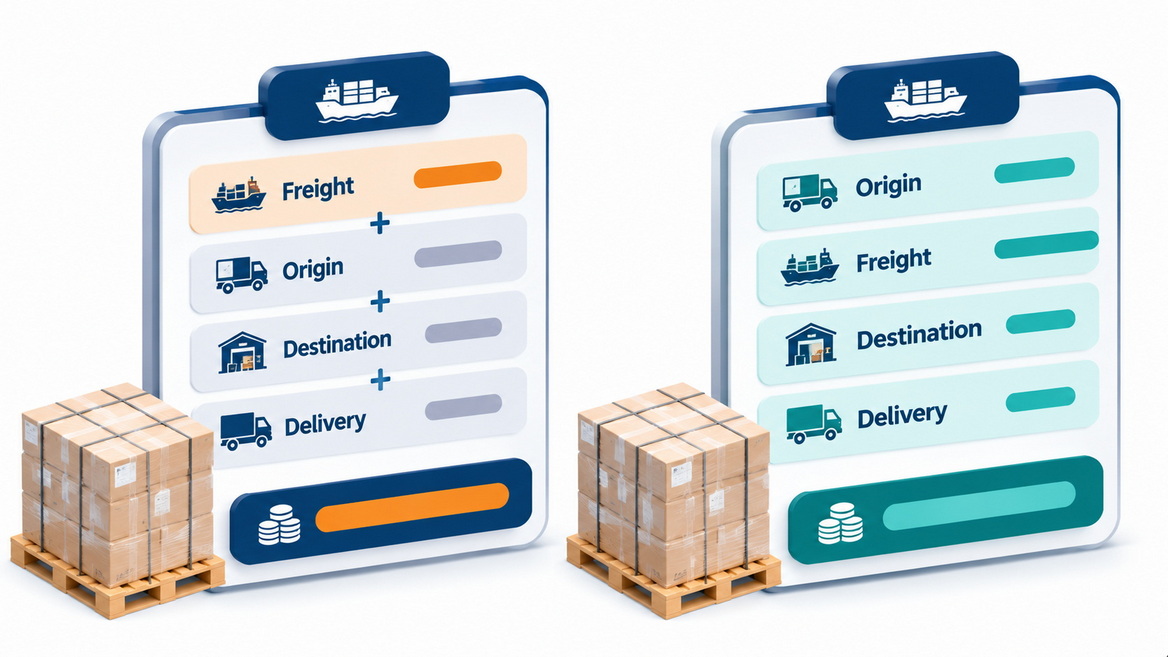
Ask which charges are fixed, estimated, excluded, or payable by the consignee.
Our recommended starting point is simple: define the complete journey before comparing prices. Otherwise, an apparently cheaper quote may merely exclude services included elsewhere.
The cheapest shipping method depends on cargo characteristics, shipment size, destination, and the commercial consequences of delay.
Sea freight is worth evaluating for nonurgent commercial orders, particularly when shipment size makes air transport expensive.
Compare full container load, or FCL, with less than container load, or LCL. Include origin and destination handling rather than comparing ocean freight alone.
Air freight can be justified when delivery speed protects production, customer commitments, or sales availability.
Instead of sending the entire order by air, consider shipping only the quantity needed to bridge an immediate shortage. Move the balance by sea when the delivery schedule allows.
Railway transportation can provide another option for eligible China–Europe shipments.
Check the complete route, border arrangements, commodity acceptance, insurance conditions, and final-mile connections. Availability and transit expectations must be confirmed for the specific service.
The useful comparison is not simply "Which mode costs less?" It is "Which combination meets the required delivery date at the lowest acceptable total cost?"
LCL lets multiple shippers share container space. FCL gives one shipper use of a container, although the container does not have to be completely full.
Neither option is automatically cheaper at a particular shipment volume.
For LCL, request the charging basis, minimum charges, consolidation fees, destination deconsolidation costs, and delivery arrangements.
For FCL, check container positioning, loading requirements, inland transport, unloading arrangements, and empty-container return obligations.
Compare both options using:
- Final packed volume and gross weight.
- Cargo dimensions and stackability.
- Complete origin and destination charges.
- Required delivery date.
- Handling and damage exposure.
- Receiving-site capabilities.
A useful decision rule is to obtain both quotations when an order becomes large enough that LCL handling charges materially affect the total.
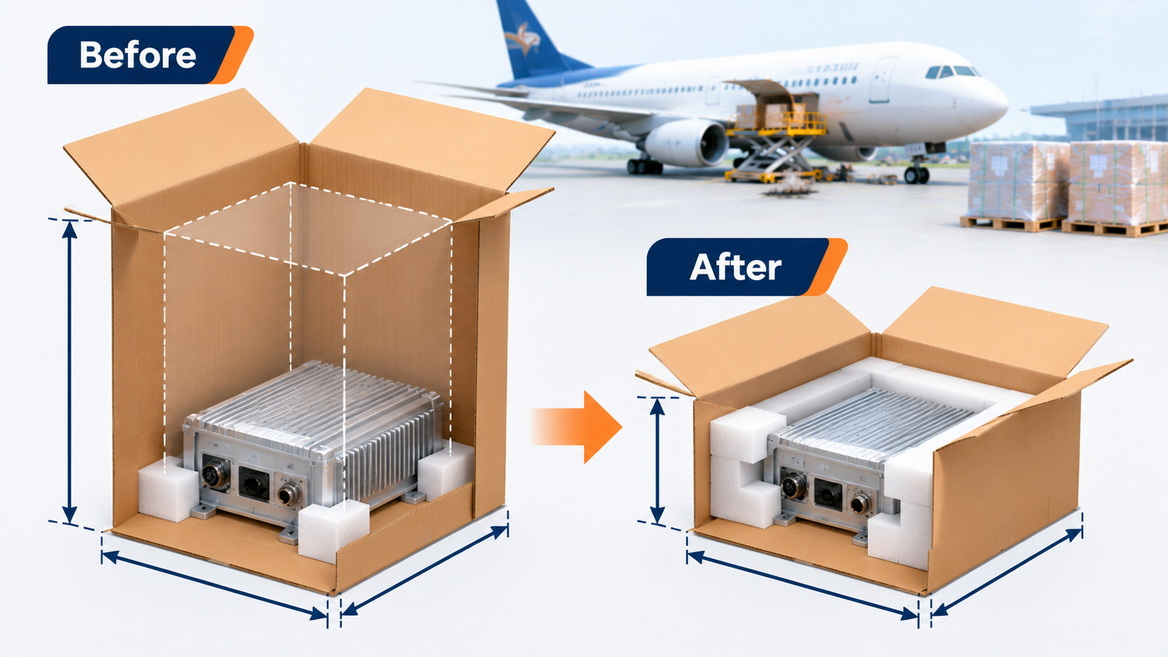
Packaging influences shipping costs because carriers consider the space cargo occupies as well as its actual weight.
For air freight, chargeable weight generally reflects the higher of actual gross weight and calculated volumetric weight, subject to the service's rating rules.
Suppose an importer ships ten cartons, each measuring 60 × 40 × 40 centimeters and weighing 10 kilograms.
Using an illustrative divisor of 6,000:
- Total actual weight: 100 kilograms.
- Total volumetric weight: 160 kilograms.
- Chargeable weight before rounding and other rules: 160 kilograms.
If suitable packaging reduces each carton to 60 × 40 × 30 centimeters, volumetric weight becomes 120 kilograms.
That reduces the calculated chargeable weight by 25%, assuming gross weight remains below 120 kilograms.
It does not guarantee a 25% invoice reduction. Minimum charges, rate breaks, surcharges, and rounding may change the result.
Confirm the applicable divisor before calculating. Some express services use 5,000 rather than 6,000. Never reduce cushioning or structural protection simply to make the carton smaller.
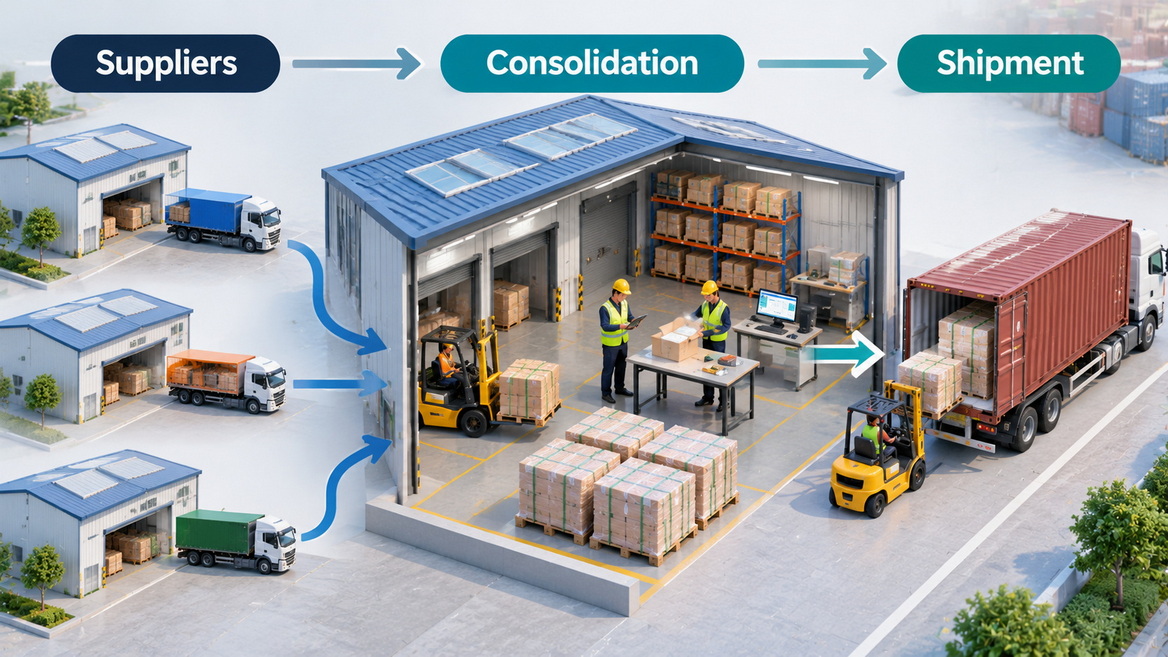
Separate supplier shipments can create repeated pickup, documentation, handling, and delivery expenses.
A consolidation warehouse allows goods from different suppliers to be received and prepared for a coordinated outbound shipment.
A practical workflow is:
1. Collect confirmed production-completion dates.
2. Agree on a common warehouse receiving window.
3. Obtain carton dimensions and packing lists in advance.
4. Check received quantities and packaging condition.
5. Arrange repacking or palletization where appropriate.
6. Book the consolidated shipment against a realistic cutoff.
However, consolidation is not free savings.
Compare avoided shipment charges against warehouse handling, storage, additional inland transport, and the cost of waiting for late suppliers.
For urgent products, a split shipment may be more economical than holding every order until the final supplier is ready.
Incoterms allocate important responsibilities, costs, and risks between buyers and sellers. They do not replace a detailed freight quotation or determine every contractual issue.
For shipments from China, clarify where the supplier's responsibility ends and where the buyer's arrangements begin.
- Who arranges supplier pickup?
- Who handles export customs formalities?
- Who contracts international transportation?
- Who pays destination handling charges?
- Who handles import clearance and pays duties and taxes?
- At what point does transport risk transfer?
Use the named place together with the agreed Incoterms version.
Also distinguish commercial delivery terms from a forwarder's service description. "Door-to-door" does not automatically mean that import duties, taxes, inspections, or every destination surcharge are included.
Where DDP is proposed, verify that the seller and its service partners can legally and operationally fulfill the required import obligations.
Documentation problems can erase savings achieved through rate negotiation.
Before departure, have the supplier, importer, forwarder, and customs broker check that shipment information is consistent.
Review:
- Commercial invoice and packing list.
- Clear product descriptions and intended use.
- Quantities, values, currency, and transaction details.
- Gross weight, net weight, and package count.
- Proposed tariff classification.
- Country-of-origin information.
- Product-specific permits or compliance documents, where required.
Do not accept undervaluation or misleading descriptions as a cost-saving strategy.
Ask the destination broker to confirm classification and import requirements before booking, especially for unfamiliar products.
The goal is not to promise inspection-free clearance. It is to identify preventable discrepancies while corrections remain easier and less disruptive.
Shipping savings can disappear after arrival if cargo is not ready for collection or the receiving warehouse cannot accept delivery.
Container-related demurrage and detention concern terminal space or equipment use beyond applicable allowances. Terminology, charging structures, and free-time arrangements vary by contract and location.
Before an FCL shipment arrives, confirm:
- Cargo availability and release requirements.
- Applicable free-time allowances.
- Whether calendar days or working days apply.
- Customs clearance status.
- Trucking and warehouse appointments.
- Unloading arrangements.
- Empty-container return location and deadline.
For LCL shipments, ask separately about destination warehouse availability, collection deadlines, and storage charges.
Assign responsibility for monitoring each milestone. A written handover between the forwarder, broker, trucker, and receiving warehouse is more useful than assuming someone else is tracking the deadline.
Freight cost per shipment can be misleading when order quantities change.
A more useful internal measure is logistics cost per sellable unit, calculated consistently across comparable shipments.
| Shipping-related expense | Option A | Option B |
|---|---|---|
| Origin services | $350 | $400 |
| Main freight | $900 | $1,050 |
| Destination handling | $650 | $350 |
| Final delivery | $300 | $300 |
| Total | $2,200 | $2,100 |
Option B has higher main freight but a lower combined shipping cost.
For 1,000 sellable units, the illustrated difference is $0.10 per unit.
These figures are hypothetical and exclude product costs, duties, taxes, insurance, and conditional expenses.
For a fuller business comparison, evaluate inventory holding costs, damage, and stockout exposure separately. This prevents a small transport saving from masking a larger commercial loss.
One-off negotiation can help, but consistent shipment information makes comparisons more meaningful.
Use the same request-for-quotation template for each provider. Ask for routing, estimated milestones, quote validity, service inclusions, exclusions, and chargeable-weight assumptions.
After delivery, compare the final invoice with the accepted quotation.
Track:
- Shipping cost per sellable unit.
- Quoted versus invoiced charges.
- Booking-to-delivery time.
- Preventable storage or waiting charges.
- Damage and shortage incidents.
- Supplier readiness against the agreed schedule.
Review the reasons behind unexpected costs rather than treating every increase as a rate problem.
A packaging change, clearer purchase-order instruction, or earlier receiving appointment may produce a more repeatable improvement than negotiating a slightly lower base rate.
GB FREIGHT AGENCY CO., LTD. is a China-based freight forwarding company with 15 years of international logistics experience.
We provide sea freight, air freight, railway transportation, customs clearance, warehousing, LCL consolidation, and door-to-door delivery services for businesses shipping from China.
Our service coverage includes Europe, North America, South America, Southeast Asia, the Middle East, Africa, and Oceania.
Send us your supplier locations, cargo description, carton dimensions, gross weight, delivery address, agreed trade terms, and required arrival date. Request a shipment-specific comparison showing the proposed route, included services, estimated charges, and exclusions.
The objective is straightforward: a cost-effective transport plan that fits your cargo and delivery requirements, rather than a low headline price with an unclear final bill.
There is no universally cheapest method. Compare sea freight, air freight, and suitable rail options against shipment size, urgency, destination charges, and inventory needs. For planned, larger orders, start by comparing complete LCL and FCL quotations.
No. LCL can suit smaller shipments, but handling and destination charges affect the result. Request both options when shipment volume increases. There is no universal cubic-meter threshold that applies across all routes and cargo types.
Not automatically. Door-to-door describes transport coverage, while the quotation and agreed commercial terms determine included charges. Confirm customs brokerage, duties, taxes, inspections, unloading, and exceptional delivery costs in writing.
Improve packaging efficiency, verify chargeable weight, and separate genuinely urgent inventory from replenishment stock. Where practical, send a smaller emergency quantity by air and ship the balance using a lower-cost service.
Provide pickup and delivery locations, product details, package count, final dimensions, gross weight, cargo readiness, required arrival date, and trade terms. Disclose batteries, liquids, dangerous goods, oversized pieces, and special handling requirements.
Note: The prices mentioned above are for reference only. We update our rates on a weekly basis; please contact us to confirm the current costs before arranging any shipments.
1. Freightos — "How to Save Money on Freight Shipping as a Small Business," published June 26, 2024. The supplied starting article introduces quotation comparison, negotiation, and technology-assisted cost control. Its full text was not retrievable during research, so no claim is made that every section was audited. [freightos]
2. International Trade Administration — "Determine Total Export Price." Supports the explanation of landed cost, including product value, freight, insurance, tariffs, taxes, and other fees, and the need to treat estimates as estimates. [trade]
3. International Trade Administration — "Know Your Incoterms." Supports the discussion of buyer and seller responsibilities, allocation of costs and risks, named delivery locations, and transport-mode distinctions. [trade]
4. DHL Global Forwarding — "Calculating Chargeable Weight by Air, Ocean, Road and Rail." Supports the actual-versus-volumetric-weight comparison and the illustrative air freight divisor of 6,000. [dhl]
5. DHL Express — "What Is Volumetric Weight and How Is It Calculated?" Supports the distinction between service-specific divisors and DHL Express's typical divisor of 5,000. [dhl]
6. International Trade Administration — "Shipping Options." Supports the discussion of freight forwarders' roles in quotations, bookings, packing advice, documentation, and coordination with customs brokers. [trade]
7. Cornell Legal Information Institute — Regulatory definition of demurrage or detention under 46 CFR § 541.3. Supports the explanation of charges related to marine terminal space and shipping-container use. [law.cornell]


