
Views: 238 Author: GB FREIGHT Publish Time: 2026-11-20 Origin: Site


Content Menu
● Why Source DDP Shipping and Customs Clearance Services in China?
● What Does Delivered Duty Paid Actually Include?
● Selection Criteria: How These Providers Were Evaluated
>> Editorial and Verification Disclosure
● Comparison Table: Capacity, Minimum Shipment, and Certification Checks
● The Top 10 Providers to Consider
>> 1. GB FREIGHT AGENCY CO., LTD.
>> 2. DHL
>> 4. DSV
>> 8. Sinotrans
>> 9. KLN Logistics Group, Formerly Kerry Logistics
● Buyer's Guide: How to Verify a DDP Partner
>> 1. Verify the Entities Before Comparing Prices
>> 2. Match Product Details to Customs Data
>> 3. Test the Service With Representative Cargo
>> 4. Compare the Same Cost Scope
● An Overlooked Pitfall: The Importer Name Can Matter More Than the Freight Rate
● Conclusion: Select the Operating Structure, Not Just the Quotation
● FAQ
>> 1. How can I check whether a forwarder's certification is current?
>> 2. Can a Chinese seller use DDP without establishing a local company?
>> 3. Does DDP protect the buyer from incorrect customs declarations?
>> 4. How should a buyer assess a quote that is much cheaper than competing DDP offers?
>> 5. Can one shipment combine products from several OEM suppliers?
Choosing a Delivered Duty Paid partner in China requires more than comparing freight rates. A low quotation has limited value if the shipment arrives with unclear importer arrangements, missing customs records, unexpected tax charges, or delivery restrictions.
For procurement managers, the stronger choice is a logistics provider that can connect supplier coordination, export documentation, international transportation, destination customs clearance, and final delivery through one accountable operating process.
This guide compares ten providers worth considering for China-origin shipments, from a Shenzhen-based forwarder serving growing businesses to multinational logistics groups supporting complex supply chains. It evaluates their suitability rather than presenting an independently audited ranking.
An important distinction comes first: these companies provide logistics services, not manufacturing. Their equivalent of production capacity is available transport space and operational resources; their equivalent of quality control is documentation accuracy, customs compliance, shipment visibility, and exception management.

China's export scale supports a substantial ecosystem of freight forwarders, customs specialists, consolidation facilities, and international carriers. According to figures released by the General Administration of Customs and reported by China's State Council, Chinese exports reached RMB 26.99 trillion in 2025, increasing 6.1% year over year. Total merchandise trade reached RMB 45.47 trillion. These figures describe national merchandise trade, not the size of the DDP services market.
The broader forwarding market also remains substantial. Transport Intelligence's *Global Freight Forwarding 2026* report valued the global market at €208.1 billion in 2025, with 4.4% growth in real terms. That is a global forwarding estimate, not a China-only or DDP-only figure.
For an overseas buyer, the practical opportunity is to coordinate export logistics close to the suppliers while retaining clear responsibility at destination. However, a China office alone does not establish that a forwarder can legally organize duty-paid delivery in every country.
The destination customs structure matters just as much as the origin network.
Under DDP, the seller arranges transportation, handles export and import customs formalities, and bears the applicable duties and taxes required under the rule. Delivery occurs at the agreed destination with the goods ready for unloading from the arriving vehicle. The buyer normally handles unloading.
A properly defined sales term should therefore identify the destination precisely:
> DDP, buyer's receiving warehouse at the agreed full address, Incoterms® 2020.
"DDP Europe" or "DDP warehouse delivery" leaves too much room for disagreement.
There is another essential distinction: DDP is a rule governing the seller–buyer relationship. A forwarder's service agreement must separately explain how it will perform the transportation, customs, tax-payment, and delivery tasks needed to support that agreement.
Selecting a shipper-paid duties option does not, by itself, resolve importer eligibility or every obligation in the underlying sale. ICC guidance specifically warns that foreign sellers can face legal difficulties completing import clearance in some destinations.
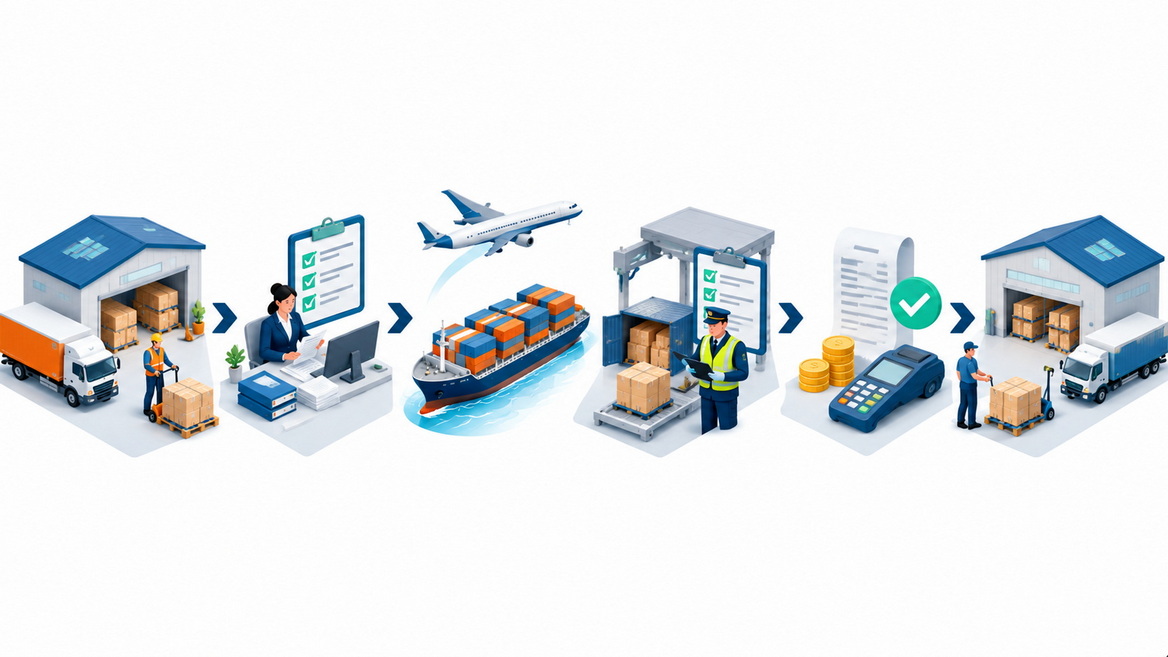
This shortlist uses publicly available company information, official customs guidance, and the operating requirements of China-origin international shipments. It does not claim that the companies underwent site audits, shipment testing, or a competitive tender.
The selection framework prioritizes six areas:
| Evaluation area | What a procurement manager should verify |
|---|---|
| Customs competence | Classification review, valuation controls, destination broker arrangements, and access to clearance records |
| Importer structure | Identification of the lawful importer and the party authorizing customs representation |
| Transport capability | Relevant air, ocean, road, rail, or multimodal services and confirmed space for the actual shipment |
| Cost transparency | Written treatment of duties, taxes, examinations, storage, delivery appointments, and surcharges |
| Operational control | Booking procedures, milestone reporting, escalation ownership, and claims handling |
| Customization | Supplier consolidation, purchase-order coordination, and agreed handling requirements for OEM/ODM goods |
For logistics providers, research and development should mean demonstrable investment in operating systems, integrations, routing tools, or service-process improvement—not an unsupported claim about product engineering.
Certification also requires careful interpretation. A corporate quality certificate does not automatically cover every branch, subcontractor, warehouse, or destination customs activity.
GB FREIGHT AGENCY CO., LTD. appears first because this guide is prepared for the company. Its stated 15 years of experience and target markets come from company-provided information. Its published contact page confirms its listed offices and advertised service categories, but does not independently establish its incorporation year, lane-specific DDP arrangements, certifications, or comparative pricing.
The other entries are comparison candidates, not endorsements of every service on every trade lane. Obtain written confirmation of destination coverage, commodity acceptance, importer arrangements, and charges before booking.
Manufacturing MOQ does not directly apply to freight forwarding. Instead, buyers should compare minimum billable weight or volume, minimum handling charges, and account requirements.
Likewise, network size is not guaranteed shipment capacity. The table describes service scope rather than inventing weekly space allocations or throughput figures.
| Provider | Capacity or service-scope indicator | MOQ / minimum-shipment position | Certification and authorization checks |
|---|---|---|---|
| GB FREIGHT | Advertises sea, air, rail, customs clearance, and door-to-door services | Not published on reviewed contact page; request lane-specific minimums | Request relevant entity registrations, broker arrangements, and any claimed certificates |
| DHL | Express network plus separately contracted freight-forwarding services | Service and account dependent; freight and express minimums differ | Verify the contracting division, commodity acceptance, and destination clearance process |
| Kuehne+Nagel | Global multimodal forwarding and customs services | Obtain shipment-specific minimum billing | Verify the relevant branch and any claimed certification scope |
| DSV | Air, sea, road, and contract-logistics network, including acquired Schenker operations | Quote and service dependent | Verify the current contracting entity and destination broker |
| Expeditors | Air and ocean forwarding, consolidation, customs, and distribution | Quote dependent | Check local brokerage authority and account-specific procedures |
| CEVA Logistics | Freight management, contract logistics, customs, and fiscal-representation services | Service and contract dependent | Confirm which local entity supplies each regulated service |
| Nippon Express | Multimodal transport, warehousing, and customs clearance | Quote dependent | Check branch-level permissions and commodity-specific handling |
| Sinotrans | China-centered integrated logistics platform | Lane and shipment dependent | Verify the entity responsible for export and destination coordination |
| KLN, formerly Kerry Logistics | Integrated logistics and international forwarding, with an Asia-centered network | Service dependent | Verify the current entity name and local operating permissions |
| Mainfreight | Air and ocean forwarding linked with transport, warehousing, and customs services | Quote dependent | Confirm the relevant branch and destination customs arrangements |
Service-scope information is drawn from the companies' published materials. No universal MOQ, current capacity guarantee, or company-wide certificate status is asserted here.

GB FREIGHT is a China-based forwarder whose published contact page lists a Shenzhen head office and associated offices in Hong Kong and Malaysia. Its advertised services include sea freight, air freight, railway transportation, customs clearance, and door-to-door delivery.
- Establishment: Exact incorporation year not verified in the reviewed source; the company reports 15 years of international logistics experience.
- Stated target markets: Europe, North America, South America, Southeast Asia, the Middle East, Africa, and Oceania.
- Procurement fit: Small and midsized businesses seeking coordinated supplier bookings and a tailored shipment plan.
Its proposed positioning is a cost-conscious alternative for buyers who need flexible coordination rather than a standardized enterprise contract. That positioning should be tested through comparable quotations and a pilot shipment, not assumed to prove lower prices or faster communication.
For OEM/ODM supply chains, buyers can request a customized operating procedure covering supplier collection, purchase-order references, document consistency, consolidation, and final delivery. Confirm any additional services—such as relabeling, repacking, or inspection coordination—in writing.
The reviewed page does not substantiate proprietary technology development or an internal research program. Buyers needing system integration should request a live demonstration and defined deliverables.
DHL was founded in 1969. Buyers should distinguish DHL Express from DHL Global Forwarding because the shipment models, contracts, and billing structures differ. DHL's published materials describe customs services and options allowing the shipper or a third party to pay destination duties and taxes.
- Markets: International express and freight lanes, subject to service availability.
- Core strength: A useful comparison candidate when speed, standardized procedures, and established shipment workflows matter.
- OEM/ODM logistics fit: Samples, urgent components, and replenishment shipments, with larger freight handled through the appropriate division.
Ask specifically about duty-payment fees, non-routine clearance, storage, and commodity restrictions. A duty-paid billing option should not be mistaken for a universal importer-of-record service.
Founded in 1890, Kuehne+Nagel offers multimodal transport and customs services. Its published network information describes operations across close to 100 countries.
- Markets: Global trade lanes, subject to local service confirmation.
- Core strength: Broad forwarding and customs capabilities for businesses coordinating multiple sourcing locations.
- OEM/ODM logistics fit: Consolidated export programs and recurring international supply chains.
It is a relevant tender candidate when buyers want to combine transportation and customs management across several markets. Ask for a lane-specific implementation plan rather than relying on group-level network figures.
The key diligence question is whether its proposed local importer, broker, tax-payment, and delivery structure matches your commercial DDP commitment.
DSV was founded in 1976 and completed its acquisition of Schenker on April 30, 2025. For a current shortlist, the two should not be treated as unrelated competitors. Their combined service scope includes air freight, sea freight, road transport, and contract logistics.
- Markets: International multimodal trade lanes.
- Core strength: A broad transport and logistics portfolio.
- OEM/ODM logistics fit: Recurring production shipments requiring coordination across transport modes or regions.
For procurement teams, integration creates a specific question: which entity, account team, system, and operating procedure will manage the shipment?
Request written confirmation of the destination customs partner, escalation contacts, and continuity arrangements if the account is transitioning between legacy systems.
Established in 1979, Expeditors provides air and ocean forwarding, vendor consolidation, customs brokerage, order management, warehousing, and distribution. Its company history records expansion into mainland China in 1993.
- Markets: International supply chains, including China-origin exports.
- Core strength: Combining forwarding with customs and compliance services.
- OEM/ODM logistics fit: Multi-vendor shipments and purchase-order-driven export programs.
Its 2025 annual report describes customs work including document screening for value, origin, classification, and special trade programs. These are useful capabilities to examine when the product range includes varied materials or complex tariff classifications.
Request a clear division between origin documentation review, destination entry preparation, and the importer's approval responsibilities.
CEVA's current combined business dates to 2007, following the combination of TNT Logistics and Eagle Global Logistics, although its predecessor businesses have earlier origins. It became a wholly owned CMA CGM subsidiary in 2019.
- Markets: Global freight-management and contract-logistics networks.
- Core strength: Linking transportation with warehousing and broader supply-chain operations.
- OEM/ODM logistics fit: Export programs requiring coordinated inventory handling and distribution.
CEVA publishes customs and fiscal-representation service categories. Nevertheless, availability and legal scope must be confirmed for the particular country and contracting entity.
Buyers should separate warehouse handling, customs representation, tax representation, and importer responsibility in the proposal.
Nippon Express Co., Ltd. was established on October 1, 1937. Its official company profile lists air, sea, rail, truck transport, warehousing, information services, and customs clearance among its activities.
- Markets: Japan-linked and broader international supply chains, with documented operations in China.
- Core strength: Multimodal logistics supported by a long-established operating network.
- OEM/ODM logistics fit: Manufacturing programs requiring coordination between production, transport, and destination handling.
It is worth evaluating where a buyer needs more than a simple freight booking. Request evidence that the proposed local team understands the cargo's dimensions, handling limits, documentation requirements, and receiving schedule.
Do not treat the group's history as a substitute for a destination-specific DDP operating plan.
Sinotrans Limited was incorporated on November 20, 2002. China Merchants Group describes it as an integrated logistics platform.
- Markets: Primarily China-centered logistics with international freight connections.
- Core strength: A substantial origin-side platform for coordinating exports.
- OEM/ODM logistics fit: China sourcing programs where domestic collection and export execution are important.
For a DDP tender, buyers should examine the destination side separately. Strong export coordination does not automatically demonstrate suitable importer arrangements in the receiving country.
Ask who controls destination clearance, who pays government charges, and which entity supplies the final delivery service.
KLN, formerly Kerry Logistics, traces its operating origins to a Hong Kong warehouse opened in 1981. Its business developed into integrated logistics, international forwarding, and customized supply-chain services. The group adopted the KLN name in 2025.
- Markets: Greater China, ASEAN, and broader international connections.
- Core strength: An Asia-centered integrated-logistics network.
- OEM/ODM logistics fit: Regional sourcing and distribution programs involving multiple suppliers or markets.
Check the current legal name on quotations, contracts, invoices, and bank details. For cross-border programs, also establish which parts of the route use group operations and which rely on partners.
Mainfreight was founded in 1978. Its published reports describe international air and sea freight, customs services, warehousing, and operations connecting China with other regions.
- Markets: Asia, Oceania, Europe, and the Americas.
- Core strength: Connecting international freight with downstream transport and warehousing.
- OEM/ODM logistics fit: Businesses that need manufacturing exports delivered into a broader distribution network.
It is a useful comparison candidate when inland delivery is commercially important. Ask for the complete destination charge schedule and confirm receiving appointments, unloading arrangements, storage exposure, and any subcontracted delivery stages.
Obtain the forwarder's registered name, registration details, contracting address, and bank beneficiary.
Then identify:
- The exporter.
- The lawful importer.
- The destination customs broker.
- The duty and tax payer.
- The final delivery operator.
These roles are not interchangeable. U.S. Customs and Border Protection states that using a broker does not remove the importer's ultimate responsibility for compliance.
A useful product file should describe function, composition, model, origin, quantity, and transaction value.
Avoid vague descriptions such as "accessories," "parts," or "samples" without further explanation. The classification and duty assessment depend on the actual merchandise, not merely the commercial nickname used by the supplier. DHL's customs guidance also highlights possible excise and anti-dumping duties beyond ordinary tariff charges.
For OEM/ODM goods, require alignment between the approved product specification, invoice, packing list, and classification review.
Product conformity and logistics competence are separate checks. A forwarder's management-system certificate is not evidence that the shipped product satisfies destination product rules.
A pilot shipment should resemble the planned commercial program.
Use a normal product mix, realistic invoice values, ordinary packaging, and the intended delivery address. A single lightweight sample does not adequately test a later multi-supplier ocean consolidation.
Measure:
- Pickup and booking accuracy.
- Document correction cycles.
- Time between arrival and customs release.
- Delivery performance.
- Final invoiced cost against the quotation.
- Completeness of the clearance records.
Set acceptance thresholds before the pilot begins.
Require every bidder to address the same charge categories:
| Cost category | Required clarification |
|---|---|
| Origin handling | Pickup, consolidation, export declaration, and documentation |
| Main transport | Mode, routing, chargeable weight or volume, and validity |
| Import clearance | Entry preparation, brokerage, permits, and special procedures |
| Government charges | Duties, taxes, and applicable additional assessments |
| Exceptions | Examination, storage, demurrage, detention, and re-delivery |
| Final delivery | Appointment, remote-area charges, vehicle requirements, and unloading |
| Risk protection | Cargo insurance quotation and applicable exclusions |
DDP does not itself require either party to buy cargo insurance. Because the seller carries risk to the agreed delivery point, insurance should be evaluated separately rather than assumed to be included.

An operational detail deserves particular attention: do not let a shipment's importer identity remain an undisclosed implementation detail.
A quotation may say "tax included," yet fail to explain whose registration is used, who authorized the broker, or who receives the customs records. That creates a serious information gap.
For U.S. shipments, CBP guidance states that brokers must execute a power of attorney directly with their client before conducting customs business in that client's name. It also places reasonable-care obligations on the importer of record for entry, classification, and valuation.
Before cargo leaves China, request a written import-structure statement covering:
1. The importer's legal identity and eligibility.
2. The broker's identity and authorization.
3. The classification and valuation approval process.
4. The duty-payment arrangement.
5. The records supplied after release.
6. Responsibility for corrections and later customs inquiries.
This is not an argument against consolidation or partner networks. It is an argument against unexplained customs arrangements.
A delivery receipt proves that cargo arrived. It does not, by itself, establish that the declaration was accurate or that the buyer received the records needed for later review. CBP's guidance treats entry data, compliance, and recordkeeping as substantive obligations.
The right DDP partner is the provider whose origin coordination, destination customs arrangements, charge structure, and delivery process fit your particular shipment.
Large logistics groups offer broad service portfolios. A specialized forwarder may offer a more tailored coordination model. Neither approach removes the need to verify the importer, define the cost scope, and test execution.
For businesses evaluating China-origin shipping, GB FREIGHT AGENCY CO., LTD. can be included in the quotation process for its advertised sea, air, railway, customs-clearance, and door-to-door services. Submit the product description, supplier locations, shipment dimensions, cargo value, destination address, and required delivery date, then request written confirmation of the proposed duty-paid operating structure.
Request the certificate number, named legal entity, covered locations, service scope, issuer, and validity dates. Seek confirmation directly from the issuing body rather than relying only on a website logo or scanned certificate.
Check regulated permissions separately. A quality-management certificate does not replace customs-broker authorization, and a broker's authority is jurisdiction-specific. CBP, for example, describes U.S. customs brokers as licensed parties conducting customs business on behalf of importers.
Possibly, but the answer depends on destination law and the proposed import structure.
ICC guidance warns that foreign sellers may have difficulty carrying out import formalities. If the seller cannot legally perform those obligations, DAP may be more suitable. Obtain destination-specific advice before promising DDP in the sales contract.
No. DDP allocates obligations between seller and buyer; it does not override customs law.
If your company is the declared importer, evaluate its statutory responsibilities independently of the seller's promise to pay charges. CBP expressly states that the importer remains ultimately responsible for ensuring compliance even when using a broker.
Request a reconciliation of the assumed classification, customs value, origin, government charges, transport basis, and exclusions.
A price difference may reflect a legitimate routing or service difference. It may also reflect an incomplete scope. Ask whether additional duties, examinations, storage, and non-routine clearance are included or charged separately; official carrier guidance identifies these as distinct potential costs.
Yes—vendor consolidation is an established forwarding service—but consolidation should not erase the shipment's underlying product information. Expeditors, for example, explicitly lists vendor consolidation alongside forwarding and customs services.
Before booking, agree how the forwarder will preserve supplier, product, value, quantity, and classification data and how discrepancies will be corrected. Combining cartons does not justify replacing detailed merchandise records with a vague declaration.
Note: The prices mentioned above are for reference only. We update our rates on a weekly basis; please contact us to confirm the current costs before arranging any shipments.
The following materials support the market figures, delivery-rule explanations, company histories, and customs guidance used above:
1. GB FREIGHT AGENCY CO., LTD., "Contact Us"—published service categories and office details. [gb-freight]
2. State Council of the People's Republic of China, "China's Foreign Trade Hits New High, Up 3.8 pct in 2025," January 14, 2026—officially reported customs trade figures. [english.www.gov]
3. ICC Academy, "DAP & DDP Incoterms® 2020 Explained: Key Differences," February 25, 2025—delivery, unloading, and import-clearance obligations. [academy.iccwbo]
4. Transport Intelligence, *Global Freight Forwarding 2026*—2025 market value and real-growth estimate. [ti-insight]
5. DHL, customs-clearance guidance and service-rate documentation—duty payment, additional charges, and billing options. [dhl]
6. DSV, "DSV Completes Acquisition of Schenker," April 30, 2025. [dsv]
7. Expeditors, "Our History" and 2025 Annual Report—establishment, China expansion, consolidation, and customs services. [expeditors]
8. CEVA Logistics, company history and establishment disclosures. [cevalogistics]
9. Nippon Express, official company profile—October 1, 1937 establishment and business activities. [nipponexpress]
10. China Merchants Group, logistics-business overview—Sinotrans Limited incorporation date. [cmhk]
11. Hong Kong Management Association, Kerry Logistics company profile—operating origins and service development. [www2.hkma.org]
12. Mainfreight, published annual reports—founding history and service scope. [mainfreight]
13. U.S. Customs and Border Protection, customs-broker guidance and importer-responsibility information. [help.cbp]


