
Views: 245 Author: GB FREIGHT Publish Time: 2026-11-17 Origin: Site


Content Menu
● Air Freight vs Rail Freight for Lithium Batteries: Quick Comparison
● Classify the Battery Before Comparing Transport Modes
>> Identify the Correct UN Number
>> Check Energy Ratings and Test Documentation
● Air Freight for Lithium Battery Shipments
>> When Air Freight Makes Commercial Sense
>> Understand Cargo-Aircraft Restrictions
>> Account for the 2026 State-of-Charge Requirements
● Rail Freight for Lithium Battery Shipments
>> Why Acceptance Requires Extra Scrutiny
>> What China's Battery Rail Trials Actually Demonstrate
● Compare Delivery Time from Cargo Readiness to Final Receipt
● Compare Total Cost, Not Just Freight Rates
>> What Changes the Air Freight Bill?
>> What Changes the Rail Freight Bill?
>> Use a Break-Even Calculation
● Safety, Packaging, and Shipment Condition
>> Build Protection Around the Actual Product
>> Separate Damaged, Recalled, and Prototype Batteries
● A Practical Booking Workflow for China Exporters
● Which Shipping Strategy Should You Choose?
>> Request a Shipment-Specific Assessment
>> Can lithium batteries be shipped internationally by air?
>> Is rail freight always cheaper than air freight for lithium batteries?
>> Can standalone lithium-ion batteries travel on passenger aircraft?
>> Does every lithium battery need a UN 38.3 test summary?
>> Does RID compliance guarantee China–Europe rail acceptance?
Choosing air freight vs rail freight for lithium battery shipments starts with one question: can the exact battery product legally and operationally travel on the proposed route? Speed and price matter only after acceptance is confirmed.
Air freight usually suits urgent, smaller shipments and destinations beyond connected rail networks. Rail freight can suit planned, heavier consignments on approved Eurasian corridors. Neither option provides automatic acceptance for every battery type.
At GB FREIGHT AGENCY CO., LTD., our approach draws on 15 years of international logistics experience: check the product, validate the route, and compare complete delivery costs—not headline rates.
This guide focuses on commercial shipments from China, particularly rechargeable lithium-ion batteries. Lithium-metal batteries, battery-powered vehicles, prototypes, and damaged batteries require separate assessment.

| Decision factor | Air freight | Rail freight |
|---|---|---|
| Best commercial fit | Urgent replenishment, smaller orders, critical components | Planned replenishment and heavier consignments |
| Geographic reach | Broad international airport connectivity | Limited to connected, accepting corridors |
| Delivery speed | Generally faster after dangerous-goods acceptance | Longer line-haul and border-processing exposure |
| Cost structure | Chargeable weight, handling, and dangerous-goods charges | Consolidation or container charges, terminals, and inland transport |
| Battery restrictions | Detailed packing instructions and airline variations | Rules and acceptance must be checked across every railway and border |
| Main planning risk | Rejection, limited eligible aircraft, missed uplift | Unavailable battery services, border delays, missed departures |
| Purchasing priority | Confirm acceptance before paying for speed | Confirm the complete corridor before calculating savings |
The practical distinction is simple: air prioritizes speed and reach; rail prioritizes consolidation economics where an approved service exists.
"Lithium battery" is not a complete shipping description. Chemistry, configuration, energy rating, condition, and packaging determine the applicable requirements.
Common classifications include:
- UN 3480: lithium-ion batteries shipped by themselves.
- UN 3481: lithium-ion batteries packed with equipment or contained in equipment.
- UN 3090: lithium-metal batteries shipped by themselves.
- UN 3091: lithium-metal batteries packed with equipment or contained in equipment.
"Packed with equipment" and "contained in equipment" are different configurations. A battery placed beside a device is not treated identically to one installed inside it.
These entries also do not cover every battery-powered product. Vehicles and certain energy-storage installations may require different classifications.
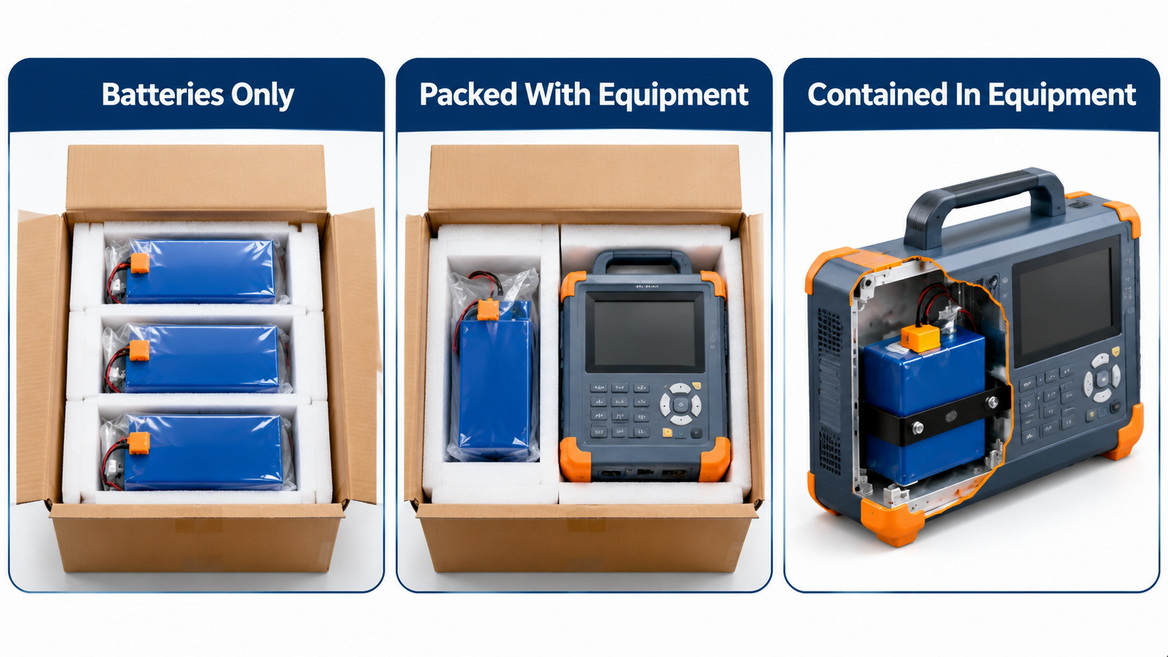
For lithium-ion products, obtain the watt-hour rating, cell or battery model, quantity, and configuration. Confirm that the design meets applicable UN 38.3 testing requirements and that the corresponding test summary is available.
A safety data sheet can assist the review, but it does not replace the test summary, correct classification, or carrier approval.
Never describe batteries as ordinary accessories to obtain a cheaper booking. Misdeclaration can create serious safety, legal, and delivery consequences.
Air freight is worth evaluating when a delay would cost more than the transport premium.
Typical situations include:
- Replacement batteries needed to prevent production downtime.
- Small replenishment orders before a product launch.
- Urgent components for warranty or maintenance commitments.
- Shipments to destinations without a practical international rail connection.
However, "urgent" does not mean immediately bookable. Document checks, suitable packaging, acceptance inspections, and eligible capacity all affect departure.
We recommend comparing the earliest acceptable flight—not simply the shortest published flight time.
Standalone lithium-ion batteries under UN 3480 and standalone lithium-metal batteries under UN 3090 are forbidden as cargo on passenger aircraft.
This limits routing options and can affect capacity, frequency, and cost.
Batteries shipped with equipment may follow different provisions, but acceptance still depends on the applicable packing instruction, quantity limits, packaging, and airline variations.
An airline's ability to carry ordinary electronics does not prove that it accepts your particular battery shipment.
Standalone lithium-ion batteries generally must be offered for air transport at no more than 30% state of charge, unless the relevant approval provisions apply.
From January 1, 2026, reduced-charge requirements also apply to lithium-ion batteries packed with equipment under Packing Instruction 966:
- Section I requires a state of charge not exceeding 30%, unless the specified approvals apply.
- Section II applies that limit to cells and batteries exceeding 2.7 Wh; higher-charge shipments require the applicable Section I approval route.
For batteries contained in equipment under Packing Instruction 967, the cited guidance recommends reduced charge rather than imposing the same general mandatory limit.
Do not apply one charge rule indiscriminately across all battery configurations.
Rail freight is most relevant when the origin and destination connect through a commercially available corridor that accepts the exact battery classification.
For suitable China–Europe or other connected Eurasian movements, rail can support planned replenishment and heavier shipments that do not justify airfreight premiums.
It is not a direct substitute for intercontinental air freight to North America, South America, Africa, or Oceania. A rail leg may form part of a multimodal route, but that changes both the service and its compliance requirements.
International dangerous-goods rules do not guarantee that every railway operator or terminal accepts lithium batteries.
RID governs international dangerous-goods carriage by rail within its applicable framework. A shipment originating in China may also encounter other national requirements, operating arrangements, and transit conditions.
Obtain written confirmation covering:
1. The exact UN number and shipping configuration.
2. The originating station and destination terminal.
3. Every transit country and participating operator.
4. Packaging, quantity, and container conditions.
5. Any road or sea connections.
A general-cargo rail quotation is not evidence of battery acceptance.
China launched large-scale trial rail movements of traction lithium batteries in November 2024, with departures from Chongqing, Guiyang, and Yibin.
This development demonstrates progress in battery rail logistics. It does not establish unrestricted availability for every battery product or international corridor.
From a procurement perspective, the lesson is important: distinguish an industry milestone from a currently bookable service.
Ask the forwarder to verify today's specific acceptance conditions before positioning rail as your default battery-shipping method.
Published flight times and station-to-station schedules measure different portions of a journey. Comparing them directly can produce a misleading result.
For both modes, request a timeline covering:
- Supplier collection and document preparation.
- Packaging corrections and acceptance inspection.
- Export customs clearance.
- Waiting time before departure.
- Main transport and transfers.
- Import clearance and final delivery.
Air generally has the faster main transport leg. Rail adds a longer overland journey and potentially several border interfaces.
Nevertheless, a rejected air shipment can miss its intended deadline, while an already approved rail shipment may depart predictably.
For lithium batteries, avoid treating generic transit-time ranges as commitments. Ask for route-specific estimates, booking cutoffs, and the consequences of missing a departure.
The useful performance measure is door-to-door delivery against your required arrival date.
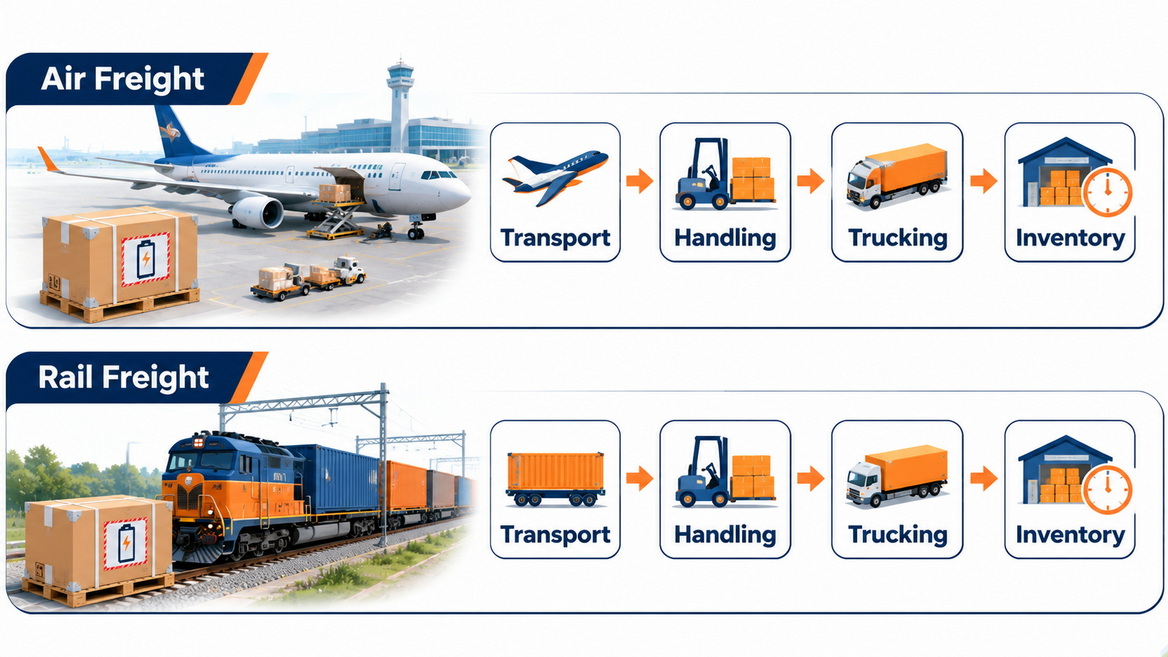
Airfreight pricing commonly considers chargeable weight: actual gross weight or volumetric weight, according to the applicable rating method.
Additional costs may include:
- Dangerous-goods acceptance and handling.
- Compliant packaging or repacking.
- Origin collection and terminal charges.
- Export documentation.
- Destination handling and delivery.
Packaging improvements can affect both compliance and chargeable dimensions. Request a quotation based on the final packed shipment.
Rail quotations may depend on consolidation arrangements, container utilization, terminals, and inland distances.
Check for:
- Minimum shipment charges.
- Dangerous-goods or special-service charges.
- Container loading and securing.
- Origin and destination trucking.
- Border or terminal handling.
- Storage following document or clearance delays.
A cheaper main-carriage rate can lose its advantage when the factory or consignee sits far from the relevant terminal.
Consider this hypothetical example—not a market quotation:
| Cost element | Air | Approved rail service |
|---|---|---|
| Comparable quoted transport package | $8,000 | $4,500 |
| Additional inventory and delay exposure | $500 | $1,800 |
| Combined planning cost | $8,500 | $6,300 |
Rail saves $2,200 under these assumptions. If the longer delivery creates more than $2,200 in additional lost margin or disruption, air becomes commercially preferable.
The decision depends on the value of time, not freight cost alone.
Lithium batteries can experience thermal runaway: a self-heating failure that may release heat, fire, and gases.
Neither transport mode removes that underlying hazard. Shorter transit does not eliminate battery risk, and ground transport does not justify weaker preparation.
The applicable packing instruction determines the specific requirements. Preparation should address:
- Short-circuit prevention.
- Protection against movement and crushing.
- Accidental activation of equipment.
- Required marks and hazard labels.
- Package strength and permitted quantities.
UN-specification packaging is required in some circumstances, but not universally. Ask for the applicable packing instruction rather than a generic "battery carton."
Do not include swollen, leaking, overheating, damaged, or recalled batteries in a routine booking.
Batteries with safety defects capable of dangerous reactions are prohibited from air transport. Rail carriage, where permitted, can require specialized packaging and additional conditions.
Prototypes and low-production-run batteries may also require special provisions. They should not be assumed to follow ordinary commercial-battery procedures.

We recommend completing the following sequence before collecting competing quotations.
1. Identify the product. Provide chemistry, model, configuration, watt-hour rating, and condition.
2. Assemble evidence. Supply the relevant test summary, supporting specifications, and any requested safety information.
3. Confirm the packed shipment. Include carton dimensions, gross weight, battery quantities, and packaging photographs.
4. Request route acceptance. Ask for written confirmation against the exact product and proposed corridor.
5. Compare equivalent scope. Align pickup, handling, clearance responsibilities, and final delivery.
6. Confirm destination readiness. Check importer information, broker arrangements, and applicable product-market requirements.
7. Release cargo after approval. Complete corrections before collection rather than at the departure terminal.
Transport compliance and permission to sell or import a product are separate issues. A freight booking does not establish that the product meets destination-market requirements.
Choose air freight when the shipment qualifies for carriage, the destination needs air connectivity, and the commercial value of speed exceeds the premium.
Consider rail when the complete corridor accepts the batteries, volumes justify the handling structure, and inventory planning can absorb the longer journey.
For some businesses, splitting an order is more effective: move the urgent quantity by air and replenish the balance through an approved rail service. Both consignments still require independent compliance checks.
GB FREIGHT AGENCY CO., LTD. coordinates supplier bookings, export customs clearance, transportation, and final delivery from China.
Send us your battery specifications, shipping configuration, available test documentation, packed dimensions, origin, destination, and required arrival date.
We will assess available air and rail options, identify acceptance constraints, and prepare a scope-matched quotation. Battery acceptance remains subject to the relevant carrier, route, and regulatory review.
Yes, many can, provided they meet the applicable classification, testing, packaging, documentation, and acceptance requirements. Some configurations require cargo aircraft, while damaged or defective batteries can face prohibitions.
No. Rail may offer lower transport costs for suitable consignments, but minimum charges, inland trucking, special handling, and inventory costs can change the result. First confirm that an accepting service exists.
No. UN 3480 lithium-ion batteries shipped by themselves are forbidden as cargo on passenger aircraft. Applicable cargo-aircraft requirements and operator acceptance still need verification.
For ordinary commercial shipments, manufacturers and subsequent distributors must make the applicable test summary available, subject to regulatory provisions. Prototypes and certain special shipments require separate assessment.
No. RID compliance does not replace Chinese requirements, transit-country conditions, terminal policies, or operator acceptance. The entire route must be checked.
Note: The prices mentioned above are for reference only. We update our rates on a weekly basis; please contact us to confirm the current costs before arranging any shipments.
- [IATA — Battery Guidance Document]. Detailed guidance supporting UN classifications, testing, passenger-aircraft prohibitions, and the distinction between 2026 charge requirements for batteries packed with versus contained in equipment. [iata]
- [IATA — Batteries]. Official resources covering battery transport, configuration-dependent requirements, and packaging guidance. [iata]
- [IATA — Dangerous Goods Regulations]. Regulatory reference for classification, marking, packing, labeling, and documentation of air shipments. [iata]
- [OTIF — Dangerous Goods–RID]. Official explanation of RID's international scope and access to the applicable regulatory editions. [otif]
- [OTIF — Bulletin of International Carriage by Rail, Issue 4/2022]. Discussion of lithium-battery test-summary availability and specialized packaging provisions. [otif]
- [China Daily — China Sets Off First Train Shipment of Lithium-Ion Batteries, November 19, 2024]. Reporting on CATL's domestic trial rail movements; not evidence of universal international acceptance. [chinadaily.com]
- [China Economic Net — China Railway Launches Rail Transport Trial for Lithium Batteries, November 20, 2024]. Reporting on the initial large-scale trials from Chongqing, Guiyang, and Yibin. [ccedn.com]


