
Views: 263 Author: GB FREIGHT Publish Time: 2026-11-07 Origin: Site


Content Menu
● Air Freight vs Ocean Shipping for Pharmaceutical Products: Quick Comparison
● Start With the Pharmaceutical Product, Not the Freight Rate
>> Confirm the Approved Temperature and Stability Requirements
>> Separate Product Requirements From Packaging Capabilities
● When Air Freight Is Better for Pharmaceutical Products
>> Urgent Deliveries and Limited Shelf Life
>> Temperature-Controlled Air Freight Still Requires Careful Handling
● When Ocean Shipping Is Better for Pharmaceutical Products
>> Planned, Higher-Volume Replenishment
>> Reefer Transport Requires More Than a Temperature Setting
● Pharmaceutical Shipping Costs: Compare the Complete Journey
>> Why the Cheapest Freight Quote May Not Be the Lowest-Cost Option
>> Use a Risk-Adjusted Cost Model
● A Three-Gate Framework for Choosing Air or Ocean Freight
>> Gate 1: Can the Transport Plan Protect the Product?
>> Gate 2: Can the Complete Journey Meet the Deadline?
>> Gate 3: Which Acceptable Option Offers Better Commercial Value?
● Illustrative Scenario: Routine Replenishment With an Urgent Shortfall
● How to Prepare Pharmaceutical Shipments From China
>> 1. Build a Product-Specific Shipping Brief
>> 2. Confirm Export and Import Readiness
>> 3. Approve the Route and Handling Responsibilities
>> 4. Confirm Packaging and Monitoring
>> 5. Define the Excursion Response
>> 6. Review Performance After Delivery
● Plan Your Pharmaceutical Shipment With GB Freight
>> Is Air Freight Always Safer for Pharmaceuticals?
>> Can Pharmaceutical Products Travel by Ocean Freight?
>> Do All Medicines Require Refrigerated Shipping?
>> What Is the Main Cold Chain Risk During Transport?
>> Should Every Pharmaceutical Shipment Use Temperature Loggers?
Choosing between air freight vs ocean shipping for pharmaceutical products is a decision about product integrity, delivery deadlines, and total logistics cost—not simply speed versus price. Air freight generally suits urgent, high-value, or short-shelf-life shipments. Ocean shipping can suit planned, higher-volume movements when product stability and a qualified transport system support the longer journey.
At GB FREIGHT AGENCY CO., LTD., our 15 years of international logistics experience shape a practical starting point: define the cargo's requirements before comparing transport options. For pharmaceutical shipments from China, the manufacturer's approved conditions and the receiving market's requirements must guide the decision.
The central question is suitability: which transport plan can protect the medicine throughout its journey while meeting the buyer's commercial needs?

| Decision factor | Air freight | Ocean shipping |
|---|---|---|
| Delivery priority | Urgent replenishment and time-critical shipments | Planned replenishment with longer lead times |
| Shipment profile | Smaller, high-value, time-sensitive consignments | Larger, predictable shipment volumes |
| Transportation cost | Usually higher; packaging can increase chargeable weight | Often lower for substantial volumes, but reefer and port costs matter |
| Temperature protection | Qualified passive packaging or active containers, supported by suitable handling | Qualified reefer transport with appropriate terminal and inland arrangements |
| Main vulnerabilities | Airport exposure, missed connections, handling delays | Extended transit, power interruptions, port delays |
| Inventory implications | Supports faster replenishment | Requires earlier ordering and more inventory planning |
| Best decision basis | Urgency, stability, route capability, and packaging duration | Stability, volume, infrastructure, and delivery flexibility |
Neither mode automatically guarantees pharmaceutical quality. A suitable transport system must include collection, storage, handling, customs clearance, and final delivery—not just the flight or voyage.
Pharmaceutical cold chain shipping is not a single temperature service.
Some products require refrigerated conditions, such as 2°C–8°C. Others may require controlled room temperature, such as 15°C–25°C, or frozen conditions. These examples are not interchangeable specifications. The manufacturer's approved requirements must determine the transport arrangement.
Before requesting quotations, confirm:
- Required transport temperature and any humidity restrictions.
- Sensitivity to freezing, heat, light, or physical shock.
- Available stability and excursion data.
- Remaining shelf life and destination acceptance requirements.
- Packaging configuration and monitoring requirements.
"Ambient" should never be interpreted as permission to expose cargo to uncontrolled conditions.
A medicine's required temperature range and its packaging's qualified protection period answer different questions.
The product specification defines acceptable conditions. Packaging qualification demonstrates how a particular configuration performs under defined test conditions.
A passive shipper qualified for a particular duration does not provide unlimited protection during customs delays. Likewise, a refrigerated container's setpoint alone does not demonstrate that every product location remained within specification.
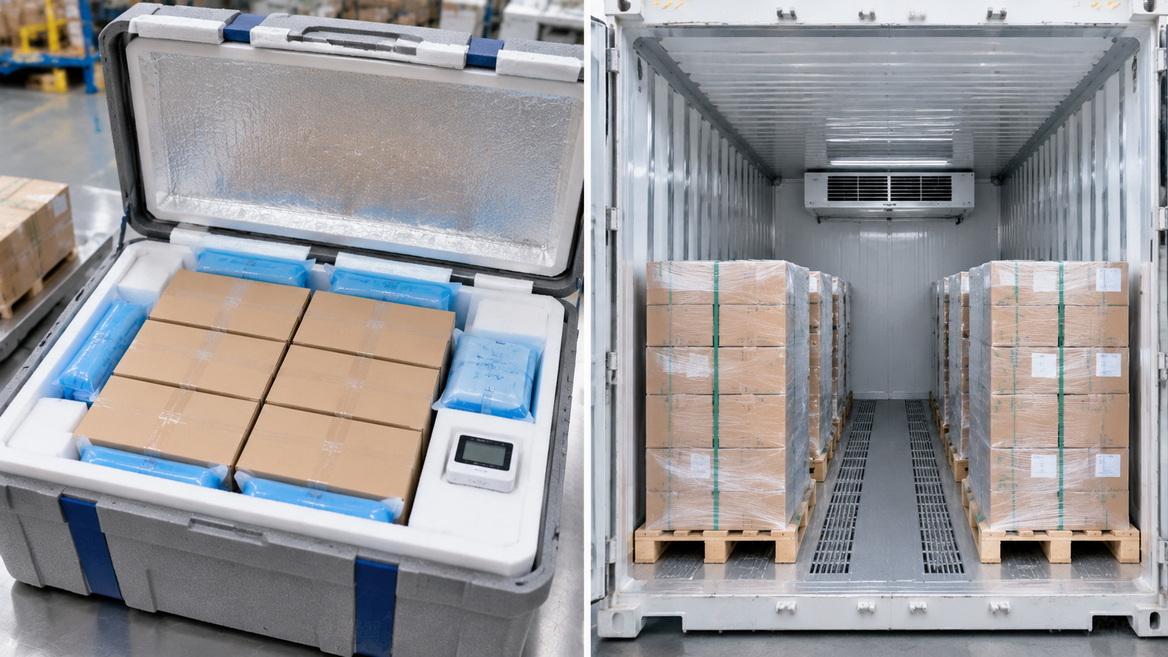
Air freight for pharmaceutical products is often appropriate when a buyer needs emergency replenishment, a clinical shipment has a fixed delivery window, or limited remaining shelf life makes a longer journey impractical.
Its main advantage is reduced transportation time. However, procurement teams should compare door-to-door schedules rather than flight duration.
The complete timeline includes:
1. Collection and delivery to the departure facility.
2. Cargo acceptance and export clearance.
3. Flight departure and any connections.
4. Import clearance and destination handling.
5. Delivery to the approved receiving location.
A short flight does not eliminate delays before departure or after arrival.
Aircraft cargo holds should not be treated as pharmaceutical refrigerators.
Protection depends on the booked service, packaging system, ground facilities, handling procedures, and agreed responsibilities. Airport transfers and loading operations can expose shipments to conditions different from those inside controlled storage.
Questions worth asking include:
- Is the proposed itinerary direct or connecting?
- What temperature-controlled storage is available at each airport?
- How will exposure during loading and unloading be minimized?
- Who manages batteries, charging, or coolant replenishment where applicable?
- What happens after a missed departure?
IATA CEIV Pharma certification can support supplier evaluation. However, buyers should verify the specific certified organization, facility, and service scope rather than assuming that certification covers every party on a route.
Ocean shipping for pharmaceuticals can be commercially attractive when demand is predictable, shipments are substantial, and approved product conditions can be maintained throughout the longer journey.
Potential applications include scheduled movements of finished medicines or pharmaceutical materials, subject to product-specific assessment. Product category alone does not establish suitability.
The strongest candidates have:
- Adequate remaining shelf life.
- A realistic delivery window.
- A qualified temperature-management arrangement.
- Suitable origin and destination infrastructure.
- An approved response plan for delays.
Sea freight savings become less meaningful when a shipment arrives too late for distribution or leaves insufficient usable shelf life.
A refrigerated container is one component of a pharmaceutical transport system—not the entire system.
The plan should address equipment inspection, loading conditions, airflow, monitoring, electrical supply, terminal handling, and inland movements.
Before approval, establish:
- How equipment condition and operating readiness will be checked.
- Whether the product and loading environment meet the approved procedure.
- How the loading pattern will preserve required airflow.
- Who maintains power during each transfer.
- How alarms and temperature records will be reviewed.
- Where cargo can be protected if transport is interrupted.
Do not assume a reefer will rapidly correct improperly conditioned cargo. Loading conditions and equipment capabilities must match the qualified procedure.
A meaningful air freight vs sea freight cost comparison should use equivalent service boundaries.
Include:
| Cost category | Items to evaluate |
|---|---|
| Transport | Main carriage, collection, destination delivery |
| Temperature protection | Packaging, active-container rental, reefer services |
| Handling | Controlled storage, specialist transfers, monitoring |
| Border processes | Brokerage, inspections, permits where applicable |
| Inventory | Additional stock held during longer replenishment cycles |
| Disruption | Delay charges, investigations, replacement movements |
| Quality review | Data retrieval, excursion assessment, disposition |
Air freight quotations should explain chargeable weight, including packaging dimensions. Ocean quotations should identify reefer-related charges and potential terminal, detention, or demurrage exposure.
Avoid generic claims that one mode is always a fixed percentage cheaper. Shipment size, route, season, equipment availability, and handling requirements change the result.
A practical comparison is:
Total decision cost = transport and handling + temperature protection + inventory carrying cost + estimated disruption exposure.
This is a planning framework, not a regulatory formula. Estimated disruption costs should use the company's own evidence where available—not invented industry averages.
For valuable or supply-critical medicines, preventing one avoidable delivery failure may matter more than securing the lowest transport rate.
First, assess whether the proposed route, packaging, equipment, and handling arrangements can maintain approved conditions.
If not, reject or redesign the option before discussing price.
Calculate backwards from the required delivery date.
Include customs preparation, cargo cutoffs, receiving hours, and realistic disruption allowances. For passive packaging, compare the complete planned duration and contingency allowance against qualified performance.
Only compare costs after both product protection and delivery requirements are satisfied.
This sequence prevents a common procurement mistake: selecting an inexpensive service first and trying to add pharmaceutical controls afterward.

Consider a distributor importing a stable, approved pharmaceutical product from China for scheduled replenishment. Most inventory is not urgently needed, but an unexpected demand increase creates a short-term shortage.
Two approaches deserve evaluation:
- Move the complete order by air to prioritize availability.
- Send an urgent portion by air and the remaining quantity by ocean.
The second approach may balance availability and freight expenditure, but only if both transport systems are independently suitable.
The shipper must confirm batch traceability, packaging configurations, receiving capacity, customs documentation, and shelf-life requirements for each movement.
This is an illustrative planning scenario, not a reported GB Freight customer case. It demonstrates why a split-mode strategy can be more useful than treating air and ocean as mutually exclusive choices.

Provide the cargo description, quantity, dimensions, weight, declared value, temperature requirements, delivery deadline, and destination.
Include relevant safety information. Medicines are not automatically dangerous goods, but refrigerants, biological materials, or particular formulations may trigger additional requirements.
Check product classification, exporter and importer responsibilities, required authorizations, and destination documentation with the appropriate parties.
An invoice and packing list may not be sufficient. Requirements differ by product and market, so pre-clearance preparation should begin before booking.
Identify every party responsible for transport, storage, monitoring, and intervention.
Document service expectations and escalation contacts. A generic instruction such as "keep refrigerated" leaves too much room for misunderstanding.
Use packaging suitable for the product and anticipated route conditions. Define logger placement, calibration status, activation, data retrieval, and acceptance procedures.
Tracking location and monitoring temperature serve different purposes. One does not replace the other.
Agree on notification, quarantine, investigation, and authorized product disposition before departure.
A temperature excursion does not automatically prove that a product is unusable. Equally, delivery without visible damage does not prove acceptability. The authorized quality function must assess the evidence against applicable stability information.
Retain shipment records and review delays, handling deviations, temperature results, and corrective actions. Use those findings to improve subsequent bookings.
GB FREIGHT AGENCY CO., LTD. provides sea freight and air freight solutions from China, coordinating supplier bookings, export customs arrangements, transportation, and final delivery.
Our international logistics experience supports shipments to Europe, North America, South America, Southeast Asia, the Middle East, Africa, and Oceania.
For pharmaceutical cargo, specialist equipment, partner capability, and product-specific arrangements must be confirmed before booking.
Send our team your origin and destination, cargo dimensions, temperature specification, required delivery date, and supporting handling instructions. Request a side-by-side air and ocean proposal with clearly stated assumptions, service inclusions, and outstanding approval requirements.
No. Shorter transit can reduce exposure time, but safety depends on packaging, handling, route suitability, and temperature control. An unsuitable air arrangement is not preferable merely because it is faster.
Yes, where approved product requirements, stability, shelf life, and a qualified transport arrangement support the journey. Suitability must be assessed for the specific shipment.
No. Requirements vary. Some need refrigeration, others controlled room temperature or frozen conditions. Follow the manufacturer's approved instructions rather than applying one temperature range to all medicines.
There is no universal single risk. Transfers between facilities and vehicles deserve particular attention because responsibility, power supply, storage conditions, and environmental exposure can change.
Monitoring requirements should reflect product specifications, applicable rules, quality agreements, and risk assessment. Define the monitoring method and review process before shipment rather than deciding at delivery.
The technical discussion draws on the following guidance. The decision framework and illustrative scenario are editorial analysis, not quoted case findings. Company background was supplied by GB FREIGHT AGENCY CO., LTD.
1. [World Health Organization — Model Guidance for the Storage and Transport of Time- and Temperature-Sensitive Pharmaceutical Products, TRS 961, Annex 9]. Guidance on product-specific transport conditions, shipping systems, service agreements, and distribution controls. [who]
2. [World Health Organization — Temperature-Controlled Transport Operations by Road and by Air, Technical Supplement 12]. Operational guidance covering risk assessment, packaging, handovers, airport handling, and monitoring. [cdn.who]
3. [World Health Organization — Good Distribution Practices for Pharmaceutical Products, TRS 957, Annex 5]. Guidance on transport selection, environmental controls, records, and distribution responsibilities. [who]
4. [International Air Transport Association — Healthcare Cargo Handling & Transport]. Overview of pharmaceutical air cargo standards, temperature-sensitive labels, and acceptance checks. [iata]
5. [International Air Transport Association — CEIV Pharma]. Certification scope covering quality systems, personnel, equipment, suppliers, routes, and operations. [iata]
6. [International Air Transport Association — Temperature Control Regulations]. Framework for temperature-sensitive air cargo responsibilities, packaging, documentation, and handling. [iata]


