
Views: 271 Author: GB FREIGHT Publish Time: 2026-11-02 Origin: Site


Content Menu
● Air Freight vs Sea Freight for Medical Equipment: Quick Comparison
● Air Freight for Medical Equipment: When Speed Justifies the Premium
>> Urgent Replacement Parts and Time-Critical Deliveries
>> Compact, High-Value Medical Devices
>> Limitations That Can Change the Decision
● Sea Freight for Medical Equipment: When Scale Matters
>> Bulky Equipment and Planned Replenishment
>> FCL vs LCL for Medical Equipment Shipping
● Shipping Costs: Compare Total Delivered Cost
>> Why Freight Rates Alone Can Mislead
>> Illustrative Air Freight Chargeable Weight
>> A Practical Break-Even Test
● Packaging and Cargo Protection: Match the Device, Not Just the Mode
>> Shock, Vibration, and Mechanical Protection
>> Moisture and Condensation in Ocean Shipping
>> Temperature-Sensitive Equipment and Sterile Packaging
● Customs and Compliance: Faster Transport Cannot Fix Missing Documents
>> Importing Medical Equipment into the United States
>> Importing Medical Devices into the European Union
>> Build a Shipment-Specific Document Pack
● Lithium Batteries: Check Acceptance Before Booking Air Freight
● Three Practical Ways to Improve the Shipping Decision
>> 1. Plan Backward from Installation Readiness
>> 2. Use a Split Shipment When Only Part Is Urgent
>> 3. Score Risk Before Comparing Rates
● Arrange Medical Equipment Shipping from China with GB FREIGHT
>> Is Air Freight Safer Than Sea Freight for Medical Equipment?
>> How Long Does Medical Equipment Shipping from China Take?
>> Can Battery-Powered Medical Equipment Travel by Air?
>> Does Medical Equipment Always Require Refrigerated Shipping?
>> Is LCL Shipping Suitable for Fragile Medical Devices?
Choosing air freight vs sea freight for medical equipment is not simply a question of speed versus price. The right decision depends on the device's sensitivity, shipment size, regulatory readiness, and the financial consequences of late delivery. A replacement component needed to restore hospital capacity deserves a different shipping strategy from a scheduled order of examination beds.
At GB FREIGHT AGENCY CO., LTD., our approach starts with one question: when must the equipment be available for use—not merely arrive at the destination port?
Drawing on 15 years of international logistics experience, we help businesses coordinate shipments from China through supplier booking, export customs clearance, transportation, and final delivery. This guide explains how to compare both modes without overlooking the costs and risks that matter most.
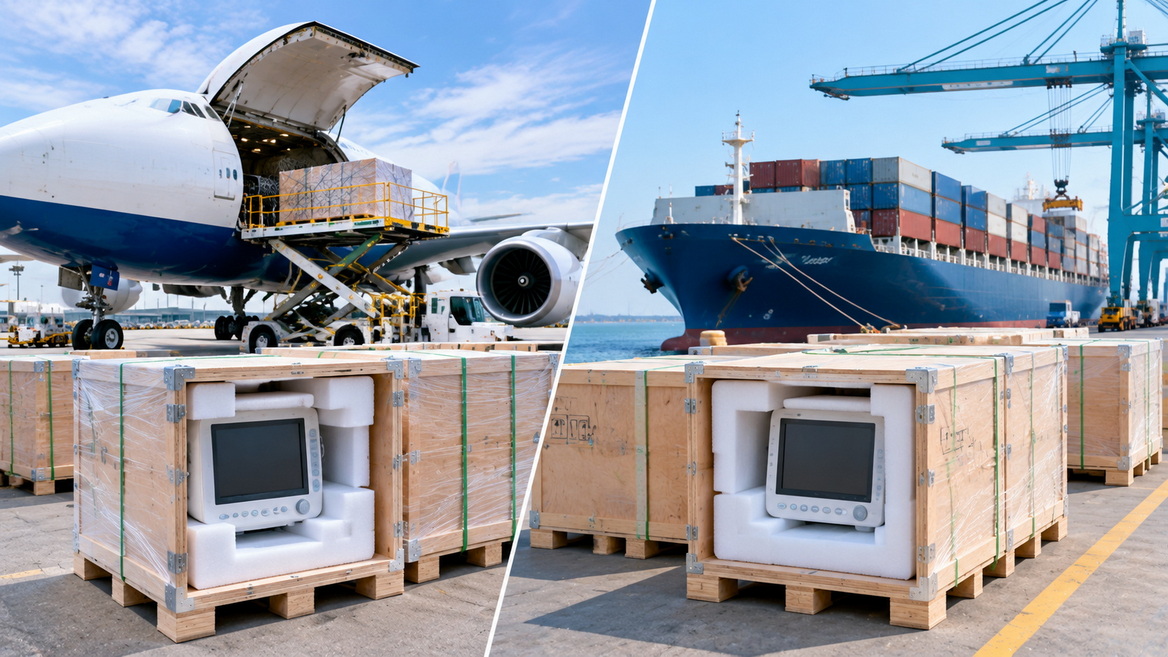
Air freight generally suits urgent, compact, high-value equipment. Sea freight is usually more economical for bulky shipments with flexible delivery schedules. However, neither mode automatically guarantees product protection or regulatory compliance.
| Decision factor | Air freight | Sea freight |
|---|---|---|
| Best application | Urgent devices, replacement parts, smaller consignments | Planned replenishment, bulky equipment, larger orders |
| Transport speed | Generally measured in days | Generally measured in weeks |
| Freight charging basis | Higher of actual or volumetric weight | Container rate or LCL volume/weight basis |
| Size limitations | Aircraft doors, loading positions, carrier acceptance | Container dimensions, payload, lifting requirements |
| Main planning concerns | Capacity, battery restrictions, airport handling | Moisture, securing, consolidation, port delays |
| Temperature protection | Requires a specified handling solution | Requires a specified handling solution |
| Customs requirements | Destination device requirements still apply | Destination device requirements still apply |
These are directional comparisons, not guaranteed transit times. Request a shipment-specific, door-to-door schedule before committing to a delivery date.
Air freight becomes attractive when waiting creates a larger cost than the transport premium.
Examples include a replacement control board for diagnostic equipment, a compact device needed for a scheduled installation, or an urgent replenishment order.
Our planning principle is to compare the additional freight cost with the operational consequences of waiting. Equipment value alone is not enough: an inexpensive component can still be critical to an expensive machine.
Smaller instruments and electronic devices can be practical air cargo candidates. However, protective crates may increase chargeable weight substantially.
Airlines and forwarders generally compare gross weight with volumetric weight and charge on the higher figure. Always obtain quotations using final packed dimensions rather than product dimensions.
Before selecting air freight, check:
- Whether the packed crate fits the proposed aircraft.
- Whether the equipment contains batteries or other dangerous goods.
- Whether the carrier accepts the commodity and configuration.
- Whether airport handling and final delivery meet the manufacturer's requirements.
A faster flight does not remove the need for suitable packaging or compliant documentation.
Sea freight is often the practical choice for hospital beds, examination tables, equipment cabinets, and other large shipments that do not face immediate installation deadlines.
Its advantage is strongest when businesses can plan production, shipment, and destination inventory together. A low ocean rate is less useful if the buyer later needs emergency air shipments to cover shortages.
Full-container load, or FCL, provides exclusive use of a container. Less-than-container load, or LCL, combines cargo from multiple shippers.
LCL can suit smaller orders, but consolidation and deconsolidation introduce additional handling stages. FCL can reduce those stages, although it does not eliminate loading, trucking, inspection, or handling risks.
For fragile equipment, compare the complete handling plan—not just the price per cubic meter. Also check destination charges, storage allowances, and delivery arrangements before booking.
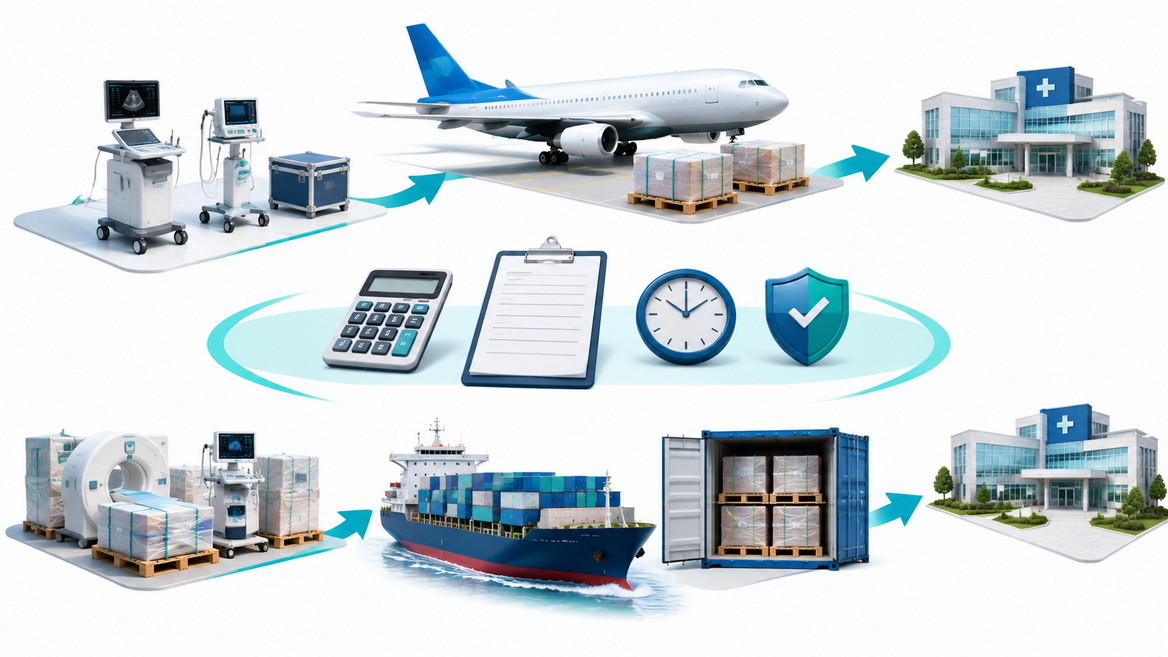
A useful comparison includes:
1. Supplier pickup and origin handling.
2. Export clearance and documentation.
3. Main air or ocean transport.
4. Destination handling and customs brokerage.
5. Duties and taxes, where applicable.
6. Final delivery, insurance, and specialist unloading.
Request equivalent service scopes. An airport-to-airport quotation should not be compared directly with a door-to-door ocean quotation.
Check the agreed Incoterm and named place, too. They help establish which party arranges particular transport stages and bears associated costs and risks.
Consider a crate measuring 120 × 100 × 100 cm with a gross weight of 150 kg.
The shipment would be rated at 200 kg rather than 150 kg under that quotation basis. Confirm the divisor, rounding rules, and minimum charges with the provider.
Suppose air freight costs $4,000 more but makes equipment available 20 days earlier. The premium equals $200 per day saved.
These are hypothetical figures, not market rates. They provide a decision framework: compare that daily premium with credible downtime costs, delayed revenue, or inventory requirements.
Use total delivered cost as the decision anchor, while treating patient-care consequences as more than a simple financial calculation.
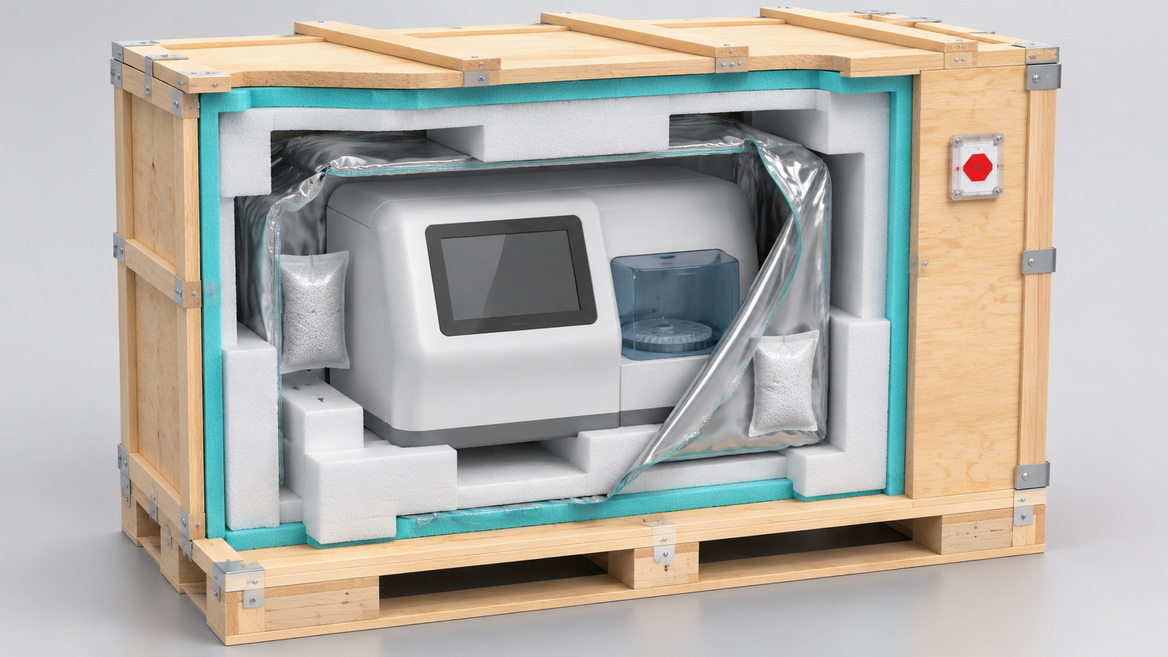
Air and sea shipments both involve road transport, loading, and unloading. Neither should be treated as damage-proof.
Ask the manufacturer to define acceptable orientation, lifting points, stacking limits, and transport conditions. Packaging should immobilize sensitive components and protect exposed surfaces.
Shock or tilt indicators may help flag handling events, but they do not replace protective engineering or establish that a device remains functional.
Closed containers can develop condensation as temperature and humidity conditions change. Cargo, timber, and packaging materials can contribute moisture inside the container.
Depending on the manufacturer's requirements, a protection plan may include:
- Suitable moisture-barrier packaging.
- Appropriately selected desiccants.
- Dry packing materials and dunnage.
- Corrosion protection compatible with the equipment.
- Secure blocking and bracing.
Desiccants alone are not a complete moisture-control strategy.
Not every medical device requires refrigerated transport. Follow the manufacturer's specified shipping limits rather than assuming all healthcare cargo needs the same temperature range.
Where controlled conditions are necessary, evaluate the whole route: supplier pickup, warehouses, terminals, main transport, customs holds, and final delivery.
Likewise, avoid opening or repacking sterile barriers without an approved procedure. Protective outer packaging and the device's sterile barrier serve different purposes.
Applicable requirements can include establishment registration, device listing, labeling, and premarket authorization, depending on the product and exemptions.
FDA and customs entry information must accurately identify the device and relevant parties. Registration alone does not establish that a product is approved or cleared.
Radiation-emitting equipment may involve additional requirements. The importer and its regulatory advisers should resolve these before dispatch.
EU importers have verification obligations concerning matters such as CE marking, required documentation, labeling, and manufacturer or authorized-representative information, as applicable.
Storage and transport conditions under the importer's responsibility must not jeopardize compliance.
Other markets have their own requirements. Do not assume that acceptance in one jurisdiction permits importation everywhere.
Depending on the equipment and destination, prepare:
- Commercial invoice and packing list.
- Accurate device descriptions and model information.
- Appropriate customs classification.
- Applicable registrations, authorizations, and conformity documents.
- Battery specifications and supporting transport information.
- Air waybill or bill of lading.
A freight forwarder coordinates transport and clearance processes; it does not replace the manufacturer's or importer's regulatory responsibilities.
Portable monitors, diagnostic instruments, and other devices may contain lithium batteries.
Air transport requirements depend on battery chemistry, rating, configuration, and applicable packing instructions. Batteries installed in equipment are not treated identically to standalone batteries.
Before requesting space, provide the forwarder with:
- Battery type and watt-hour rating or lithium content.
- Whether batteries are installed, packed with equipment, or shipped separately.
- Number of cells or batteries.
- Applicable UN 38.3 test-summary information.
- Any damaged, defective, or recalled status.
Confirm current requirements and carrier variations before shipment. Avoid applying a single state-of-charge rule to every battery-powered device.
Start with the date the equipment must be operational.
Then allow time for final delivery, unloading, inspection, installation, testing, and any required commissioning. Work backward through customs, terminal availability, transport, and supplier readiness.
This exposes a common planning mistake: treating vessel arrival or flight landing as the completion of delivery.
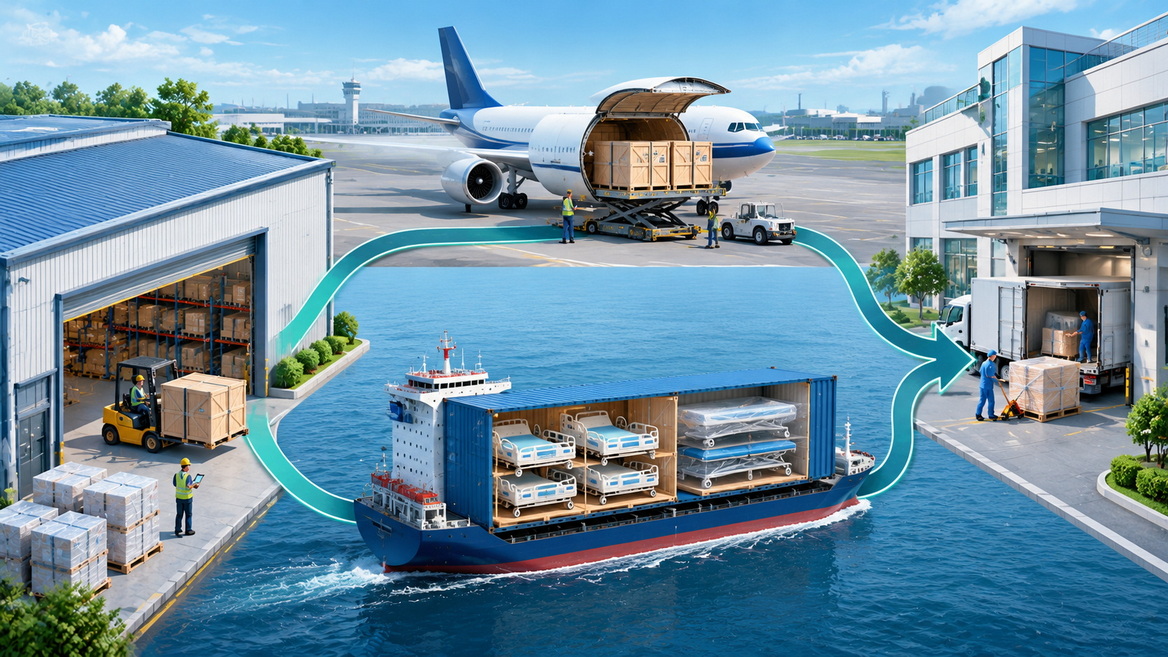
A mixed strategy may outperform an all-air or all-sea booking.
For example, a buyer could airfreight urgently needed compact devices while sending bulky furniture by sea. This is an illustrative planning scenario, not a reported customer case.
Check whether splitting creates extra documentation, receiving, or installation costs. Confirm that the urgently shipped equipment can function without components arriving later.
Use a simple assessment:
| Question | What it changes |
|---|---|
| Is the operational deadline fixed? | Determines acceptable schedule flexibility |
| Are dimensions unusually large? | May restrict aircraft or container options |
| Is moisture exposure unacceptable? | Shapes packaging and route controls |
| Are batteries included? | Triggers transport acceptance checks |
| Is import authorization unresolved? | Creates a reason to delay dispatch |
| Is specialist unloading required? | Changes final-mile planning and cost |
Use this assessment to shortlist feasible options first. Price comparison comes afterward.
GB FREIGHT AGENCY CO., LTD. brings 15 years of international logistics experience to shipments from China to Europe, North America, South America, Southeast Asia, the Middle East, Africa, and Oceania.
We coordinate supplier bookings, export customs clearance, transport, and final delivery arrangements according to the agreed shipment scope.
For an air freight versus sea freight comparison, send us your pickup location, destination, equipment description, packed dimensions, gross weight, cargo value, required delivery date, and any battery or temperature-control details.
Request a route-specific quotation showing the service scope, estimated schedule, destination charges, and handling requirements—not simply the lowest headline rate.
Not automatically. Air transport reduces time in transit, but protection also depends on packaging, handling, routing, and manufacturer-defined limits. Evaluate the complete transport chain.
Air transport generally operates on a days-based timescale, while ocean transport generally operates on a weeks-based timescale. Door-to-door delivery also includes pickup, clearance, terminal handling, and inland transport.
Often, yes, provided the configuration meets applicable requirements and the carrier accepts it. Confirm battery specifications, packing instructions, documentation, and current restrictions before booking.
No. Temperature requirements depend on the specific product and manufacturer's instructions. Equipment, reagents, and accessories in the same order may require different transport conditions.
It can be, when packaging and handling arrangements are appropriate. Compare consolidation stages and destination charges with FCL or air alternatives before deciding.
Company background, service scope, and the stated 15 years of experience were supplied by GB FREIGHT AGENCY CO., LTD. The planning scenarios and break-even example are illustrative editorial analyses, not verified customer results or live freight quotations.
1. [Maersk — Modes of Transportation in Logistics]. Supports the broad comparison of transport speed, cost, and suitable shipment profiles. [maersk]
2. [Maersk — Air Cargo Chargeable Weight Calculation Explained]. Explains actual versus volumetric weight and air cargo charging principles. [maersk]
3. [Maersk — FCL vs LCL Shipping: How to Choose the Right One]. Covers container usage, consolidation, handling, and cost differences. [maersk]
4. [FDA — Importing Medical Devices]. Details applicable device import checks and entry information. [fda]
5. [FDA — Importing Medical Devices and Radiation-Emitting Electronic Products into the U.S.]. Explains regulatory responsibilities and product-specific import requirements. [fda]
6. [European Commission — Authorised Representatives, Importers and Distributors]. Describes importer verification, traceability, and storage and transport responsibilities. [health.ec.europa]
7. [IATA — Batteries]. Provides battery transport guidance and updates on applicable requirements. [iata]
8. [UNECE — CTU Code: Mechanisms of Condensation]. Explains moisture and condensation mechanisms inside closed cargo transport units. [wiki.unece]


