
Views: 277 Author: GB FREIGHT Publish Time: 2026-10-28 Origin: Site


Content Menu
● Customs Declaration Service vs Customs Brokerage: Key Differences
● What Is a Customs Declaration Service?
>> When Declaration-Focused Support Makes Sense
>> Brokerage Does Not Mean Unlimited Coverage
● Customs Declaration, Brokerage, and Clearance Are Not Identical
● China Export Clearance vs Destination Import Brokerage
>> Destination-Side Representation
● Who Is Responsible When Something Goes Wrong?
>> United States: Importer Oversight Still Matters
>> United Kingdom: Representation Changes Liability
● Comparing Costs: Look Beyond the Filing Fee
● Expert Insight: Treat Customs Data as a Shared Workflow
>> Why Advance Security Filings Need Separate Attention
● Illustrative Case: One Shipment, Two Different Service Needs
● A Practical Checklist for Choosing a Provider
● How GB FREIGHT Coordinates Shipments from China
>> Is a customs declaration service the same as customs brokerage?
>> Do I need both services when importing from China?
>> Can a freight forwarder also be a customs broker?
>> Does hiring a broker remove my customs liability?
>> Can one provider guarantee customs release?
Choosing between a customs declaration service and customs brokerage starts with understanding what your shipment needs. A declaration service generally focuses on preparing and submitting customs information. Customs brokerage typically combines declaration filing with broader representation and compliance support, although the precise scope depends on the country and service agreement.
For businesses importing from China, the practical question is not simply which service costs less. It is which arrangement connects accurate supplier information, export procedures, destination requirements, and delivery responsibilities.
At GB FREIGHT AGENCY CO., LTD., we bring 15 years of international logistics experience to shipments from China. Our perspective is straightforward: select customs support around the shipment's risks and responsibilities—not the service label alone.

These services overlap. A customs broker may submit declarations, while a declaration provider may offer additional support. Neither label, by itself, establishes the provider's legal authority or contractual responsibilities.
| Comparison | Customs declaration service | Customs brokerage |
|---|---|---|
| Primary focus | Preparing and submitting declaration data | Representing clients and supporting customs compliance |
| Typical scope | Document checks, data entry, filing, and status updates | Filing plus classification, valuation, duty, and procedural support |
| Information supplied by customer | Usually requires shipment details and supporting documents | Also requires detailed information; may investigate inconsistencies |
| Regulatory status | Depends on the jurisdiction and activities performed | Licensing or authorization requirements vary by country |
| Best-fit situation | Straightforward shipments with verified data | Shipments requiring more extensive advice or representation |
| Pricing approach | Often priced per declaration, with extras | May combine entry fees with additional service charges |
| Main limitation | Filing alone does not resolve underlying compliance issues | Hiring a broker does not automatically remove importer responsibility |
The essential distinction is scope. Before comparing quotations, establish who will verify the information, submit the declaration, answer customs questions, and resolve discrepancies.
A customs declaration service helps convert shipment information into the format required by the relevant customs authority.
Depending on the agreement, this may include:
- Reviewing commercial invoices and packing lists.
- Entering commodity descriptions and classification codes.
- Submitting import or export declarations.
- Communicating acceptance, rejection, or release messages.
- Preparing amendments within the contracted scope.
However, "reviewing documents" can mean different things. One provider may check that mandatory fields are complete. Another may investigate whether the declared classification, value, and origin are supported.
Ask what the review actually covers.
A filing-focused service may suit a business with repeat products, established procedures, and internally verified customs data.
For example, an importer purchasing the same unregulated components from an established supplier may already have approved product descriptions and classification records. Its immediate requirement may be reliable filing rather than extensive advisory work.
This does not mean repeat shipments are automatically low risk. Product changes, new suppliers, different transaction terms, or changing requirements can make an established declaration template unsuitable.
Customs brokerage generally involves acting for a client in customs matters, within the legal framework of the destination country.
The service may include declaration preparation, classification support, valuation review, duty calculations, customs correspondence, and assistance with corrections.
The distinction matters particularly where customs business is regulated. In the United States, customs brokers are licensed to conduct customs business on behalf of others. A freight forwarding business is not automatically authorized to perform those activities merely because it arranges transportation.
Do not assume a brokerage fee includes every compliance task.
Specialist classification research, binding-ruling applications, additional government-agency requirements, inspections, and post-entry work may fall outside a standard quotation.
A useful question is: "Which decisions will you review, and which information are you accepting from us without independent verification?"
The answer reveals more than a broad promise of "complete customs clearance."
A declaration is the submission of required information. Brokerage describes professional activities performed for a client. Customs clearance is the wider process through which the relevant customs requirements are addressed.
Submitting a declaration does not guarantee immediate release.
Likewise, a freight quotation described as "customs included" may cover only a particular filing. It may exclude duties, taxes, inspections, storage, or specialist intervention.
Separate these items when comparing proposals:
1. China export declaration.
2. Destination import declaration.
3. Advance cargo security filings.
4. Duties and taxes.
5. Inspection-related services.
6. Release coordination and final delivery.
This breakdown prevents a low initial quotation from becoming an unexpectedly expensive shipment.
For shipments leaving China, export and import formalities belong to different regulatory environments.
Our role as a China-based freight forwarder is to coordinate the shipment across these stages. That coordination should not be confused with holding customs brokerage authorization in every destination.
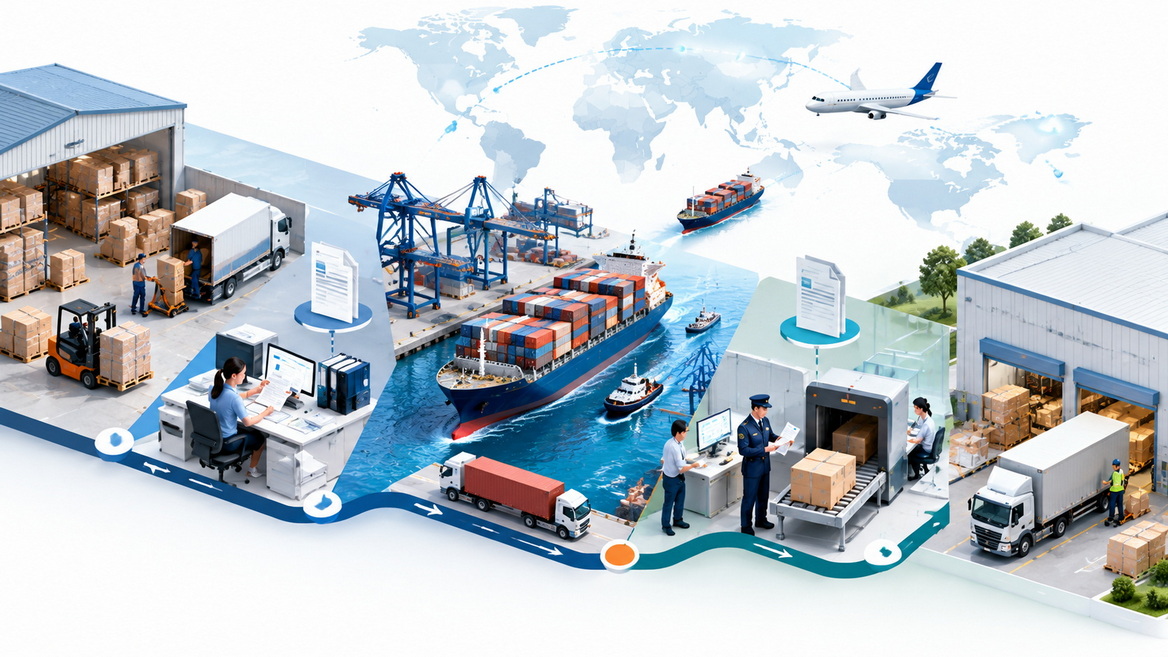
Before departure, establish who supplies and checks the export documentation.
Typical preparation includes aligning:
- Seller and buyer information.
- Commercial descriptions and quantities.
- Invoice and packing-list details.
- Shipment weights and package counts.
- Booking information and transport instructions.
Where multiple suppliers contribute to one shipment, document consistency deserves particular attention. Consolidating cargo does not automatically consolidate its commercial or regulatory responsibilities.
Before booking, confirm the importer, local representative, required authorizations, and party responsible for duties and taxes.
For U.S. customs business, the broker must obtain its customs power of attorney directly from the importer of record or drawback claimant—not through an unlicensed freight forwarder acting as an intermediary.
A coordinated transport service therefore still requires the correct legal relationship between the importer and its broker.
A dangerous assumption is that outsourcing a declaration transfers every legal obligation to the provider.
Responsibility depends on the applicable law, the representation arrangement, and the conduct of the parties.
U.S. Customs and Border Protection's reasonable-care guidance provides a framework for importers to assess their compliance practices. Using professional assistance should support that process, not replace the importer's oversight of the information supplied.
Operationally, maintain evidence for product descriptions, classification decisions, transaction values, and origin claims.
UK guidance distinguishes direct representation from indirect representation.
Under direct representation, the principal is generally solely liable for the customs debt, subject to specified exceptions. Under indirect representation, the representative and principal are jointly and severally liable, meaning customs may seek payment from either party.
Before appointing a representative, ask which arrangement applies and obtain the answer in writing.
There is no dependable worldwide price for a customs declaration service or customs brokerage. Scope, shipment complexity, destination, and additional work all affect the quotation.

Rather than asking only for the entry fee, request an itemized proposal.
| Cost category | Question to ask |
|---|---|
| Declaration or entry fee | How many commodity lines are included? |
| Additional lines | When do extra charges apply? |
| Advisory work | Is classification or valuation review included? |
| Amendments | What happens if information changes? |
| Duties and taxes | Who pays, and are advance-payment fees charged? |
| Inspections | Which coordination and handling charges are excluded? |
| Storage and delivery | What happens if release takes longer than expected? |
The lowest filing fee is not necessarily the lowest total shipment cost.
However, a higher brokerage fee does not automatically prove better service either. Compare documented responsibilities, responsiveness, and relevant shipment experience.
The handoff between supplier, forwarder, importer, and broker is often more important than the label on the quotation.
A practical approach is to create one approved shipment-data record.
It should identify the product, commercial description, composition, intended use, quantity, value, origin, and supporting documents. Record who supplied each item and who approved it.
This creates a clearer escalation path when information conflicts.

EU Import Control System 2 requirements illustrate why "the customs declaration is covered" is not a complete answer.
ICS2 requires a complete Entry Summary Declaration for goods transported to or through the EU before arrival. Air transport also involves pre-loading information requirements. Incomplete or inaccurate information can trigger rejection or requests for additional data.
The practical lesson is to identify the security-filing responsibility separately from the import declaration. Confirm the filer, information deadline, and source of shipment data.
Consider a hypothetical importer purchasing metal components from China.
The first shipment contains one established product, supported by a verified classification and consistent commercial records. Declaration-focused support may be sufficient if the provider's authority and responsibilities are appropriate.
The next shipment contains several new assemblies, mixed materials, and unfamiliar end uses. The importer also wants advice on classification and supporting documentation.
Although the transport route is unchanged, the customs support requirement has expanded.
A useful decision process is:
1. Identify what changed.
2. Determine whether existing compliance decisions remain valid.
3. Obtain specialist review where uncertainty is material.
4. Approve the data before filing.
This example is illustrative, not a reported GB FREIGHT customer case. Its purpose is to show why shipment complexity—not shipment size alone—should guide the service choice.
Before appointing a customs declaration provider or broker, obtain clear answers to these questions:
1. Who will legally submit each declaration?
2. What licensing or authorization applies?
3. Who will be the importer of record?
4. Who verifies classification, value, and origin?
5. Which documents are required before departure?
6. Who handles advance security filings?
7. What happens if customs requests more information?
8. Which charges are excluded?
9. Who handles corrections after release?
10. How will shipment records be shared?
Also request an escalation contact. A service agreement becomes much more useful when it explains who responds to an urgent customs query and how information reaches that person.
GB FREIGHT AGENCY CO., LTD. provides transport solutions from China to Europe, North America, South America, Southeast Asia, the Middle East, Africa, and Oceania.
Our 15 years of international logistics experience inform a coordination-led approach: align supplier booking, export documentation, transport arrangements, destination clearance responsibilities, and final delivery.
The objective is not to add unnecessary services. It is to identify the support each shipment needs before cargo moves.
For a tailored shipment assessment, send GB FREIGHT your cargo description, origin city, destination, shipment dimensions, weight, and delivery requirements. Ask for a quotation that separately identifies export declaration support, destination brokerage arrangements, duties and taxes, and delivery exclusions.
Not necessarily. Declaration services usually emphasize filing, while brokerage can include broader representation and compliance support. Actual responsibilities depend on local law and the service agreement.
You may need declaration filing as part of a brokerage arrangement rather than two separate purchases. China export procedures and destination import procedures should still be identified separately.
Yes, where the business has the required authorization. However, forwarding and brokerage are distinct activities; confirm the legal entity performing regulated customs work.
No universal rule provides that protection. Liability depends on the jurisdiction and representation arrangement. UK direct and indirect representation, for example, carry different customs-debt consequences.
Treat unconditional guarantees cautiously. A provider can prepare information and manage the process, but filing does not eliminate customs review or requests for further information.
- U.S. Customs and Border Protection. "Customs Brokers." Official overview of licensing and the authority to conduct customs business for others. [cbp]
- U.S. Customs and Border Protection. "Customs Broker Modernization Regulations, 19 CFR 111." Guidance covering broker-client relationships, powers of attorney, and corrective-action communications. [cbp]
- U.S. Customs and Border Protection. "Reasonable Care." Informed Compliance Publication addressing importer compliance considerations. [cbp]
- HM Revenue & Customs. "Customs Debt Liability." Guidance explaining direct and indirect representation and related liability. [gov]
- European Commission, Directorate-General for Taxation and Customs Union. "Import Control System 2 (ICS2)." Official explanation of advance security information and Entry Summary Declaration requirements. [taxation-customs.ec.europa]


