
Views: 284 Author: GB FREIGHT Publish Time: 2026-11-03 Origin: Site


Content Menu
● What Are Logistics Data Platforms for Freight Analytics and Reporting?
● Why Freight Analytics Matters for Shipments from China
● How Logistics Data Becomes a Reliable Freight Report
>> Connect Shipment Records Across the Entire Journey
>> Separate Planned, Estimated, and Actual Events
>> Show Data Freshness and Ownership
● Freight Reporting KPIs That Support Better Decisions
● Freight Cost Analytics: Look Beyond the Lowest Rate
>> Distinguish Freight Charges from Landed Cost
>> Clarify Incoterms and Service Boundaries
● Mode-Specific Reporting for Sea, Air, Rail, and LCL Freight
>> Sea Freight and LCL Shipping
>> Air Freight
>> Warehousing and Door-to-Door Delivery
● An Illustrative Case: Why the Cheaper Quotation May Cost More
● A Five-Step Plan for Practical Freight Reporting
>> 1. Define the Business Question
>> 2. Standardize Essential Fields
>> 3. Pilot One Representative Shipping Lane
>> 4. Create Actionable Exception Rules
>> 5. Review Results and Adjust
● How to Evaluate a Logistics Data Platform
● Plan Your Next Shipment from China with GB FREIGHT
>> What is the difference between shipment tracking and freight analytics?
>> Can a logistics data platform guarantee on-time delivery?
>> Is freight analytics useful for smaller importers?
>> Which reports are most useful for LCL shipments?
>> Does door-to-door shipping include import duties and taxes?
Logistics data platforms for freight analytics and reporting help businesses connect shipment updates, transportation costs, customs milestones, and delivery results. For companies importing from China, their practical value is straightforward: understanding where cargo is, what the shipment will actually cost, and which problems need attention before they affect delivery.
At GB FREIGHT AGENCY CO., LTD., our perspective comes from 15 years of international logistics experience. We coordinate sea freight, air freight, railway transportation, customs clearance, warehousing, LCL shipping, and door-to-door delivery services from China.
From a freight-forwarding perspective, the most useful report is not the one with the most charts. It is the one that helps a shipper make a timely, informed decision.

A logistics data platform brings information from different stages of transportation into a consistent reporting environment.
Inputs may include supplier booking details, warehouse receipts, carrier updates, customs documentation, freight quotations, invoices, and delivery confirmations.
Three related capabilities serve different purposes:
- Shipment visibility shows reported locations, milestones, and current status.
- Freight analytics examines patterns, costs, delays, and service performance.
- Freight reporting presents that information through dashboards, summaries, and exception lists.
For example, tracking may show that a container has arrived at its destination port. Analytics examines whether that route regularly experiences long release times. Reporting identifies which shipments require follow-up today.
These capabilities work together, but none automatically guarantees faster transportation or lower costs.
An international shipment involves multiple handovers: supplier, collection vehicle, warehouse, customs authority, carrier, destination agent, and final-mile provider.
Each participant may report a different reference number or milestone. Without consistent definitions, apparently clear updates can become misleading.
"Departed," for example, might mean a truck left a warehouse rather than a vessel left port.
The World Bank's 2023 logistics research reported an average of 44 days between a container entering the export port and leaving the destination port across potential trade routes. This is a historical global benchmark, not a current quotation or a forecast for any particular China-origin shipment.
Its practical lesson is that transportation performance extends beyond the main international journey.
For importers, useful analysis should connect supplier readiness, origin handling, transit, clearance, and final delivery—not simply display a vessel position.
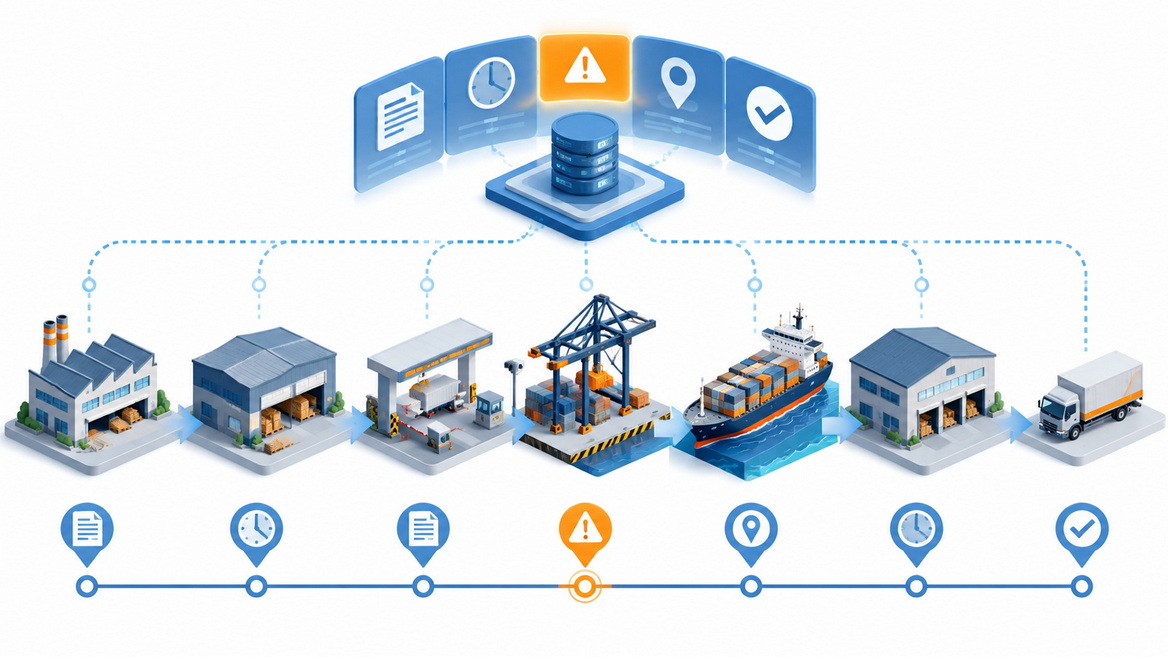
Start with a master shipment reference linked to relevant purchase orders, bookings, transport documents, containers, and invoices.
For consolidated cargo, preserve shipment-level detail beneath the shared transport reference. One container may carry multiple customers' goods, but those shipments can have different documentation requirements and delivery arrangements.
A consolidated record should make those differences visible.
A planned departure is a scheduling commitment. An estimated departure is a forecast. An actual departure records a completed event.
Combining these categories makes performance reporting unreliable.
Keep the original plan alongside revised estimates and actual results. Otherwise, repeatedly updating the expected delivery date can make a late shipment appear punctual.
DCSA's container-shipping standards provide an industry framework for consistent event exchange. However, a reporting system still depends on the completeness and timeliness of its incoming information.
Every critical milestone should include:
- Event location and time.
- Reporting source.
- Time the update was received.
- Planned, estimated, or actual status.
- Person responsible for investigating an exception.
A dashboard refreshed every minute is not necessarily receiving fresh carrier information every minute. Data freshness matters more than refresh animation.
A useful dashboard starts with a small set of clearly defined measures.
| Metric | Recommended definition | Practical purpose |
|---|---|---|
| On-time delivery rate | Deliveries completed by the agreed deadline divided by deliveries due in the period | Measures delivery reliability |
| Door-to-door lead time | Time from the agreed collection milestone to confirmed final delivery | Supports purchasing and inventory planning |
| Customs release duration | Time between defined customs submission or acceptance and release milestones | Highlights clearance bottlenecks |
| Freight cost per shipment | Included transportation and handling costs divided by shipment count | Supports comparable cost reviews |
| Exception rate | Shipments meeting defined exception criteria divided by shipments monitored | Identifies recurring operational problems |
| Invoice variance | Difference between approved quoted charges and invoiced charges | Flags items requiring explanation |
Compare similar shipments. Mixing express air cargo, LCL shipments, and full-container movements into one average can hide meaningful differences.
Also review the median and the 90th-percentile lead time. The latter helps show how long slower shipments take, rather than relying only on an average that may conceal delivery risk.
A freight quotation and a landed-cost calculation answer different questions.
A freight quotation describes specified logistics services. Landed cost considers the product's purchase price together with applicable freight, insurance, tariffs, taxes, and other relevant charges.
For China-origin shipments, review:
- Supplier collection and origin handling.
- Export documentation and customs services.
- Main transportation charges.
- Destination handling and customs services.
- Applicable duties and taxes.
- Storage, examination, or other conditional charges.
- Final delivery and accessorial services.
Avoid treating every charge as unavoidable. Some depend on the destination, shipment characteristics, contractual terms, or an actual operational event.
Record currencies and exchange-rate assumptions so comparisons remain meaningful.
Incoterms define important buyer and seller responsibilities for transportation, insurance, documentation, and customs activities.
A label such as "door-to-door" does not, by itself, establish who pays import duties and taxes or acts as importer of record.
Before approving a quotation, confirm the named locations, applicable trade term, included services, exclusions, and responsibility for additional charges.
Compare equivalent scopes, not just headline prices.
For sea freight, monitor booking confirmation, cargo cutoffs, container loading, vessel departure, transshipment, arrival, release, and delivery.
LCL—Less than Container Load—requires additional attention to consolidation and deconsolidation. Vessel arrival does not necessarily mean an individual shipment is available for collection.
Record warehouse receipt, consolidation readiness, destination unpacking, and cargo availability separately.
For air freight, distinguish booking confirmation from actual uplift.
Review cargo acceptance, departure, transfer connections, arrival, customs release, and delivery. Cost reporting should retain both actual weight and the chargeable weight used for billing.
A lower quoted rate is difficult to evaluate without understanding the weight basis and service scope.
Railway transportation reporting should identify terminals, departures, border handovers, transfers where applicable, and final delivery.
Evaluate specific corridors and service availability rather than assuming every China-to-Europe rail option follows the same route or timetable.
Warehouse reporting should cover receipt, quantity discrepancies, storage duration, release instructions, and collection.
For final delivery, record appointment requirements, attempted delivery, access restrictions, and proof of delivery. These details help distinguish international transit delays from local delivery problems.
Consider a hypothetical importer comparing two LCL quotations for the same shipment.
| Comparison item | Option A | Option B |
|---|---|---|
| Origin and main freight charges | $1,050 | $1,280 |
| Destination handling | $420 | $250 |
| Final delivery | $280 | $220 |
| Total listed logistics charges | $1,750 | $1,750 |
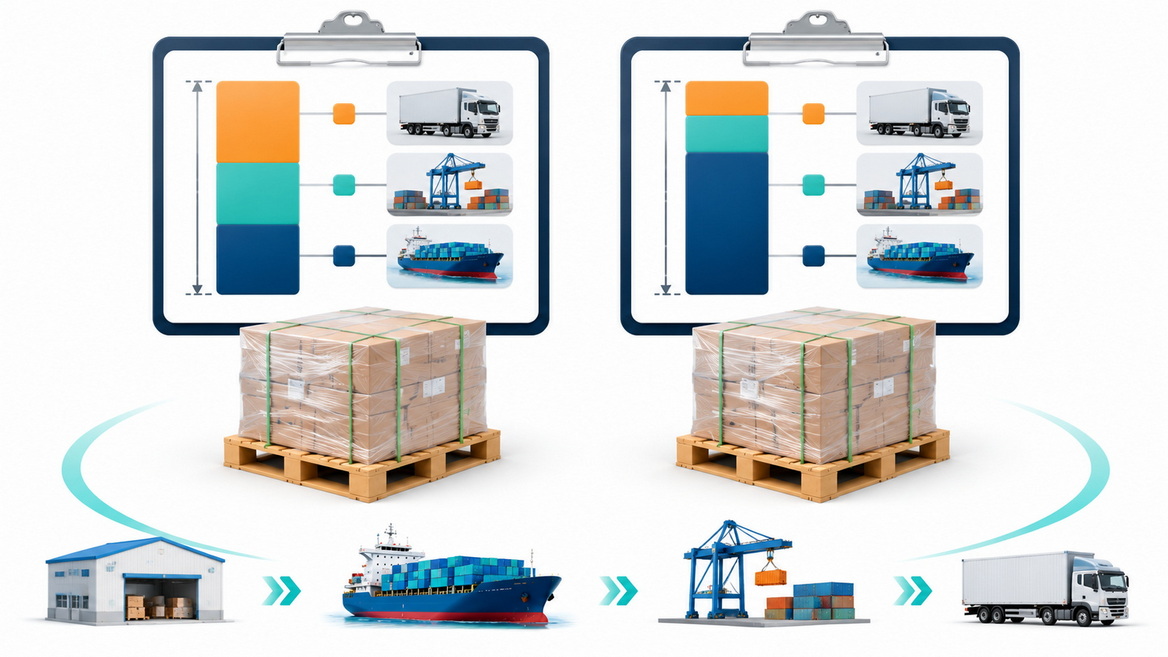
These figures are illustrative, not GB customer results or market rates. They exclude product value, duties, taxes, insurance, and unlisted conditional charges.
Option A initially appears $230 cheaper. Once the listed destination services are included, both options total the same amount.
The next questions concern reliability, exclusions, cargo availability, and delivery arrangements—not the initial rate alone.
A useful freight report preserves quotation details and compares approved scope with actual invoicing. Otherwise, a spreadsheet may reward a low opening price while overlooking costs recorded later.
Choose a specific objective: reducing unexplained invoice differences, improving delivery predictability, or identifying clearance delays.
"More visibility" is too broad unless it connects to a decision.
Agree on shipment references, cargo descriptions, locations, units, currencies, milestone definitions, and time zones.
Assign responsibility for correcting missing or inconsistent records.

Begin with a manageable China-origin lane and one service type.
Check whether the report matches operational reality before extending it across regions and transport modes.
Examples include missing export documents before a cutoff, a departure estimate moving beyond an agreed threshold, or an invoice charge exceeding the approved amount.
Each alert should identify the shipment, issue, owner, and required response.
Hold a regular review covering recurring delays, unresolved charges, data gaps, and corrective actions.
Expand only after the pilot produces dependable information. Automation should follow a workable process, not disguise an inconsistent one.
Ask providers to demonstrate your actual workflow rather than a generic dashboard.
Useful questions include:
- Can records connect purchase orders, shipments, containers, and invoices?
- Can users distinguish missing data from confirmed non-occurrence?
- Are original delivery commitments retained?
- Can LCL shipments remain individually identifiable?
- Can reports separate quoted, accrued, and invoiced costs?
- Can access be restricted by customer or team?
- Can your business export its records in a usable format?
Request a demonstration using representative, appropriately protected shipment data.
Treat predicted arrival times as estimates. Ask how uncertainty, missing inputs, and forecast changes are communicated.
GB FREIGHT AGENCY CO., LTD. supports businesses shipping from China to Europe, North America, South America, Southeast Asia, the Middle East, Africa, and Oceania.
Our services cover supplier booking coordination, sea freight, air freight, railway transportation, export customs clearance, warehousing, LCL consolidation, and door-to-door delivery.
To request a shipment assessment, provide:
1. Collection location and destination address.
2. Cargo description, packaging, dimensions, and weight.
3. Cargo-ready date and required delivery window.
4. Applicable trade term and customs responsibilities.
5. Any special handling or delivery requirements.
Contact GB FREIGHT for a clearly scoped shipping proposal that explains the proposed route, service inclusions, estimated timing, and information still required.
Tracking reports shipment events and status. Freight analytics evaluates those records alongside costs and commitments to identify patterns, compare performance, and support decisions.
No. Reporting can help identify exceptions and coordinate responses, but it cannot eliminate inspections, capacity shortages, weather disruption, or other external constraints.
Yes, provided the reporting matches their needs. A consistent shipment register and regular cost review may be a more practical starting point than a complex platform.
Prioritize consolidation readiness, actual departure, destination deconsolidation, cargo availability, clearance, destination charges, and final delivery. Container-level tracking alone does not describe every individual shipment's progress.
Not automatically. Confirm the contractual scope, applicable trade term, importer-of-record arrangements, and responsibility for taxes before booking.
- Original article and editorial starting point: WallTech/eTower, ["Logistics Data Platforms for Freight Analytics and Reporting"]. Used for the general platform-function framework; the practical workflows and illustrative comparison above are newly developed editorial material. [etowertech]
- Historical logistics benchmark: World Bank, ["World Bank Releases Logistics Performance Index 2023," April 21, 2023]. Source for the historical 44-day global container-port-to-port processing-and-transit benchmark; not a lane-specific transit estimate. [worldbank]
- Shipment-event interoperability: Digital Container Shipping Association, ["Track & Trace Standard"]. Supports the discussion of standardized container-journey information exchange. [dcsa]
- Planned, estimated, and actual event terminology: Digital Container Shipping Association, ["Shipping Glossary"]. Supports the distinction between event-time categories. [dcsa]
- Trade responsibilities: U.S. International Trade Administration, ["Know Your Incoterms"]. Supports the discussion of buyer and seller responsibilities for transport, insurance, documentation, and customs formalities. [trade]
- Landed-cost components: U.S. International Trade Administration, ["Determine Total Export Price"]. Supports the distinction between transportation charges and landed cost, including product price, insurance, freight, tariffs, taxes, and other fees. [trade]
- Company information: GB FREIGHT AGENCY CO., LTD., company description supplied for this article. Source for the stated 15 years of experience, service portfolio, and geographic coverage. No independently verified customer reviews or proprietary performance data were supplied.


