
Views: 275 Author: GB FREIGHT Publish Time: 2026-11-05 Origin: Site


Content Menu
● Introduction: Choosing a Warehouse Partner, Not Just Storage Space
● How We Selected These Warehouse Services Providers
>> 1. Operational Control and Accountability
>> 2. Capacity That Matches Your Workload
>> 3. Inventory and Quality-Control Processes
>> 4. Customization and Technical Capability
● China's Logistics Advantages for International Buyers
● Comparison Table: Ten Warehouse Services Providers in China
● The Top 10 Warehouse Services Providers in China
>> 1. GB FREIGHT AGENCY CO., LTD.
>> 3. Cainiao
>> 4. SF Holding and Its Logistics Network
>> 5. Sinotrans
>> 6. KLN Logistics Group, Formerly Kerry Logistics Network
>> 7. DSV
>> 10. DHL Supply Chain / SF Supply Chain in China
● Buyer's Guide: How to Verify a Warehouse Before Signing
>> Verify the Operator, Not Just the Sales Office
>> Replace Product Samples with an Operational Pilot
>> Specify Technical Requirements Precisely
>> Compare Total Operating Cost
● Common Procurement Pitfalls—and How to Avoid Them
>> Network Capacity Presented as Account Capacity
>> Customization Without an Approved Master
>> A Low Storage Rate with Expensive Inventory Exit
>> Insider Pitfall: Inventory "Received" Does Not Always Mean Available to Ship
● Conclusion: Select the Operating Model Before Negotiating the Rate
● FAQ
>> 1. How can I verify whether a warehouse's ISO certificate is expired or irrelevant?
>> 2. Can a warehouse support OEM/ODM products without becoming responsible for manufacturing quality?
>> 3. How should we measure inventory accuracy for mixed-SKU, multi-supplier stock?
>> 4. What should we do if the sales company uses a subcontracted warehouse?
>> 5. What evidence should we request for temperature-sensitive or regulated cargo?
The right warehouse services provider in China should protect more than your inventory. It should connect supplier deliveries, stock visibility, export preparation, and international transportation without creating unnecessary handovers.
For procurement managers, the strongest selection method starts with operational evidence: the identity of the warehouse operator, documented receiving procedures, inventory controls, site-level compliance, dispatch reliability, and the ability to investigate discrepancies.
China's logistics scale makes this evaluation particularly important. According to 2025 data from the China Federation of Logistics & Purchasing, published by China's Ministry of Commerce, the country's total social logistics value reached RMB 368.2 trillion, increasing 5.1% at comparable prices. This measures the value of goods moving through logistics activities—not warehouse industry revenue or available storage capacity.
More recent figures show continued activity: total social logistics value reached RMB 280.0 trillion in the first three quarters of 2026, up 4.9% year over year. These figures support China's importance as a sourcing and distribution base, but they do not establish the quality of any individual warehouse.
This guide presents ten providers worth evaluating for different operating models, from flexible export consolidation to large-scale contract logistics.
Editorial disclosure: This is a commercially oriented shortlist prepared for GB FREIGHT AGENCY CO., LTD., which appears first as requested. It is not an independently audited ranking. Publicly documented capabilities are distinguished from recommended procurement checks, and unavailable capacity, pricing, or certification details are not estimated.
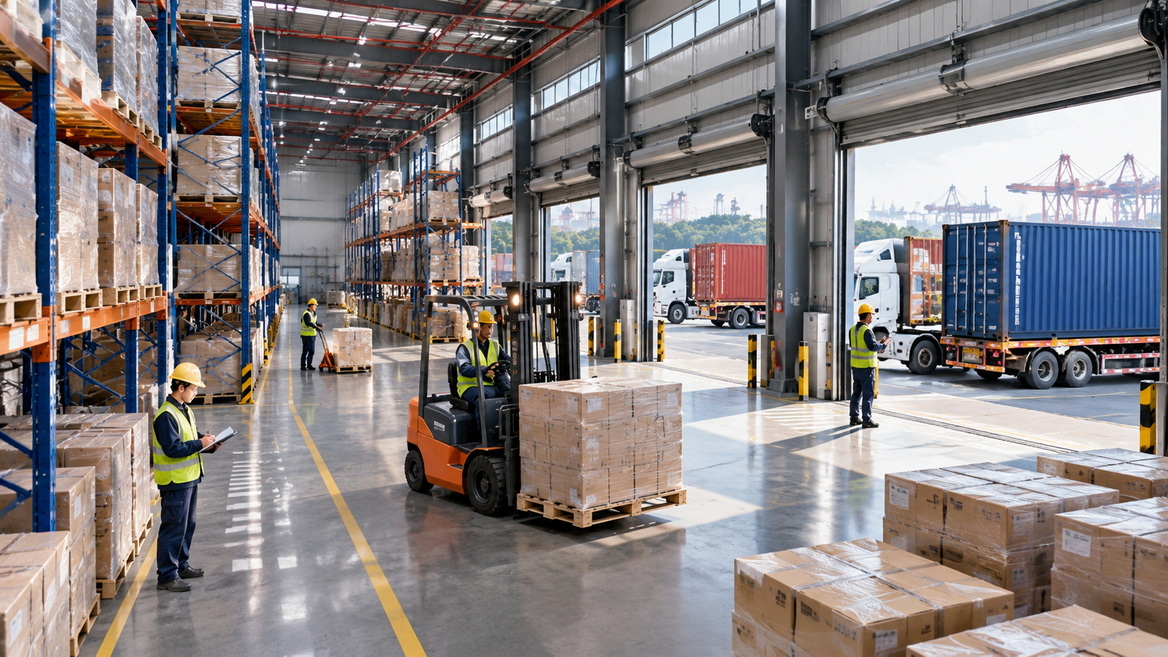
Warehouse providers are service businesses, not manufacturers. Factory production capacity, product-development laboratories, and manufacturing minimum order quantities do not translate directly into warehouse performance.
For this comparison, the relevant equivalents are traceability, available operating capacity, process engineering, inventory accuracy, and contractual accountability.
Before evaluating equipment or rates, establish:
- Which legal entity signs the contract.
- Which entity operates the warehouse.
- Whether the facility is owned, leased, or subcontracted.
- Who accepts liability for inventory loss and handling damage.
- Whether additional subcontractors require your approval.
A warehouse's floor area does not reveal its actual capacity for your account. Ask separately about:
- Available pallet positions or cubic-meter allocation.
- Daily receiving and dispatch limits.
- Peak-day order-line processing capacity.
- Dock availability and appointment rules.
- Labor committed to labeling, inspection, or kitting.
The assessment should cover receiving counts, barcode identification, exception photographs, quarantine locations, cycle counting, and release authorization.
For customized products, the warehouse must also preserve the relationship between supplier, purchase order, production batch, carton, and outbound shipment.
OEM and ODM production remains the manufacturer's responsibility. A warehouse supports these supply chains through agreed activities such as brand-specific labeling, carton segregation, accessory kitting, packaging preparation, and shipment documentation.
Assess process development and system integration rather than treating warehouse customization as product manufacturing.
Compare complete operating costs, not storage rates alone. Require visibility into receiving, handling, labeling, minimum monthly billing, overtime, inventory adjustments, and final stock withdrawal.
The provider profiles below combine documented service scope with buyer-side recommendations. Recommended applications are evaluation starting points, not guarantees that every location offers the same services.
China's advantage extends beyond inexpensive storage. Buyers can coordinate supplier collections, warehousing, customs preparation, and international transportation within established logistics networks.
GB Freight's published warehouse service coverage identifies Shanghai, Shenzhen, Guangzhou, Beijing, and Tianjin as relevant locations. Its descriptions emphasize connections with shipping, aviation, rail, and cross-border transportation.
For procurement teams, the practical implication is straightforward: choose the warehouse around supplier geography and shipment requirements.
A Shenzhen-area operation may simplify coordination for a South China supplier base. A Shanghai-area facility may better suit suppliers concentrated around the Yangtze River Delta. However, the lowest local trucking cost does not automatically produce the lowest total delivered cost.
Ask shortlisted providers to model the complete route:
Supplier collection → receiving → storage → export preparation → origin terminal → international transport → destination delivery.
Public network figures are not directly comparable. Some include partner-operated warehouses, while others describe only particular business units. No provider's network size should be interpreted as capacity reserved for a new customer.
"Quote-specific" means this guide has not verified a universal published minimum. Buyers should request minimum monthly charges, storage commitments, and handling volumes directly.
| Provider | Principal evaluation focus | Capacity evidence or limitation | MOQ / minimum commitment | Certification and compliance position |
|---|---|---|---|---|
| GB FREIGHT AGENCY CO., LTD. | Supplier consolidation and coordinated international shipping | Warehouse services published; site area and available throughput not verified | Quote-specific | Obtain certificates and permits for the actual operating site |
| JD Logistics | Integrated inventory management and fulfillment | Extensive fulfillment infrastructure documented; obtain current site allocation | Quote-specific | Verify contracted entity, site, and certificate scope |
| Cainiao | Cross-border fulfillment and multi-market inventory flows | July 2025 announcement reported 40+ overseas warehouses; not China-site capacity | Quote-specific | Confirm origin and destination operating requirements separately |
| SF Holding / SF logistics network | Warehousing connected with distribution and transport | Group reporting includes multiple operating models; site allocation requires confirmation | Quote-specific | Match approvals to the relevant SF business unit and facility |
| Sinotrans | Contract logistics and industrial supply chains | Contract logistics subsidiary reported 4+ million m² at year-end 2022; historical figure | Quote-specific | Verify current site approvals and applicable service scope |
| KLN Logistics Group, formerly Kerry Logistics Network | Asia-focused integrated logistics | Storage and value-added services documented; current site availability requires quotation | Quote-specific | Check current legal name and contracting subsidiary |
| DSV | Warehousing integrated with international transport | Contract logistics documented; China-specific capacity requires a proposal | Quote-specific | Request certificates for the proposed facility |
| Kuehne+Nagel | Industry-oriented global supply chain coordination | Global logistics network documented; local capacity must be confirmed | Quote-specific | Verify site-specific scope rather than relying on group credentials |
| CEVA Logistics | Engineered contract logistics and freight management | Contract logistics capabilities documented; available China-site capacity not verified | Quote-specific | Match local operating controls to the cargo category |
| DHL Supply Chain / SF Supply Chain in China | Structured contract logistics programs | China service route identifies SF Supply Chain as strategic partner | Quote-specific | Confirm contracting entity, operating site, and applicable certifications |
Sources for provider capabilities and the stated capacity limitations appear in the profiles below. No unverified certification is presented as an awarded credential.
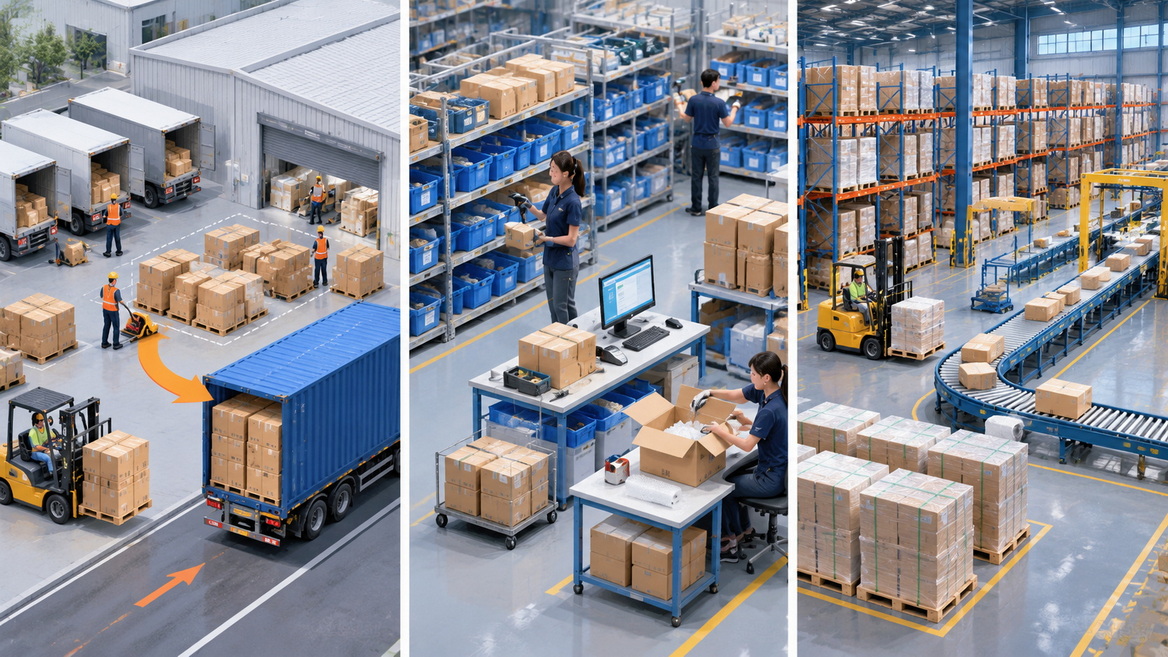
Established: Exact incorporation year not verified in the reviewed material. The company information supplied for this article states 15 years of international logistics experience.
Primary markets: Europe, North America, South America, Southeast Asia, the Middle East, Africa, and Oceania, according to the company brief.
GB Freight is a relevant first candidate for buyers seeking warehouse services alongside international freight coordination rather than a separate storage-only arrangement. Its published services include cargo storage, inventory management, loading and unloading, sorting, packing, distribution, and value-added activities such as labeling and reorganization. Its website also describes warehouse management system support for inventory updates.
The company's contact page identifies a Shenzhen head office and branch contacts in Hong Kong and Malaysia. It also lists ocean, air, rail, customs clearance, and door-to-door transportation services.
For smaller brands, the potential advantage is a coordinated discussion covering supplier deliveries, consolidation, export preparation, and onward freight. That model is worth evaluating where procurement teams want fewer communication handovers.
OEM/ODM supply-chain support to request: Brand-specific carton labels, supplier-level segregation, customized packing instructions, and consolidation against purchase orders. These should be documented in an approved work instruction rather than assumed from a general service description.
Buyer checkpoint: Test flexibility and communication efficiency with a small shipment. Ask for a named coordinator, response-time commitment, discrepancy photographs, and an itemized cost comparison. Public information does not establish a price advantage, proprietary research capability, warehouse area, or guaranteed inventory accuracy.

Established: JD began building its own fulfillment infrastructure in 2007; JD Logistics was established as a business group serving external customers in April 2017. These are different milestones.
Primary market focus: China-centered integrated supply chains, with wider services subject to the proposed network.
JD Logistics deserves consideration when warehousing is part of a broader inventory and fulfillment operation. JD's regulatory disclosure describes services spanning warehousing, transportation, delivery, customer services, after-sales support, and logistics technology.
Its appeal lies in connecting stock management with downstream execution. Buyers should nevertheless distinguish a large national network from the particular warehouse, account team, and processing capacity offered to them.
OEM/ODM supply-chain support to evaluate: SKU configuration, customized packaging workflows, lot identification, and fulfillment rules for differentiated products.
Buyer checkpoint: Request a demonstration using your actual SKU structure. Confirm whether the proposed warehouse is directly operated or provided through another operating arrangement, and obtain current capacity figures rather than relying on older network totals.
Established: 2013.
Primary markets: China-linked cross-border commerce, with documented fulfillment expansion across Asia-Pacific, Europe, and North America.
Cainiao is relevant to merchants connecting China-origin inventory with overseas fulfillment. A July 2025 company announcement reported more than 40 overseas warehouses across 18 countries and regions, together with services integrating domestic consolidation, international shipping, customs clearance, and multi-country fulfillment. These were company-reported network figures, not independently verified performance results.
Its service model is particularly relevant when the procurement question extends beyond "Where should we store goods in China?" to "How should we position inventory across several markets?"
OEM/ODM supply-chain support to evaluate: Channel-specific stock identification, relabeling instructions, brand packaging rules, and separate B2B replenishment and consumer-order workflows.
Buyer checkpoint: Map responsibilities at every cross-border handover. Obtain written confirmation of which entity controls inventory, investigates discrepancies, and manages returns in each market.
Established: 1993.
Primary markets: China, supported by international express, freight forwarding, and supply-chain services.
SF offers a broad logistics network that includes supply chain, freight, cold chain, pharmaceutical logistics, and international solutions. Its published materials describe integrated support across procurement, production, distribution, sales, and after-sales activities.
For buyers, the attraction is the possibility of connecting warehousing with domestic distribution and transport services. However, SF's breadth also makes it important to identify the exact business unit supplying the warehouse solution.
OEM/ODM supply-chain support to evaluate: Supplier replenishment procedures, packaging instructions, distribution labeling, and customized inventory-release rules.
Buyer checkpoint: Separate the warehouse agreement from express or freight terms where necessary. Confirm whether inventory claims, transport claims, and service credits follow the same contract.
Established: Sinotrans Limited was incorporated on November 20, 2002. The contract logistics subsidiary and wider group history should not be treated as the same legal-entity timeline.
Primary markets: China-centered contract logistics and international supply chains.
Sinotrans Logistics identifies itself as the flagship contract logistics segment of Sinotrans Limited. Its published profile reported more than four million square meters of warehouse area at the end of 2022, covering much of mainland China, Hong Kong, and Macao. That is historical scale evidence, not a statement of current availability.
Sinotrans is a candidate for buyers evaluating structured contract logistics rather than occasional storage. Procurement teams with industrial inventories should focus on how the proposed operation handles supplier coordination, stock controls, and outbound scheduling.
OEM/ODM supply-chain support to evaluate: Component segregation, purchase-order consolidation, packaging work instructions, and traceability between incoming batches and outgoing shipments.
Buyer checkpoint: Require a current facility list and identify which sites can handle your dimensions, weight, handling equipment requirements, and seasonal peaks.
Established: The listed holding company was incorporated in 1991. Its English name changed from Kerry Logistics Network Limited to KLN Logistics Group Limited on March 28, 2025.
Primary markets: Asia, with international forwarding connections within Asia and between Asia, Europe, and the Americas.
KLN's annual reporting describes integrated logistics services including storage, inventory management, value-added services, trucking, distribution, and returns management. This makes it relevant to procurement teams coordinating China with regional Asian distribution.
Its scope supports evaluation where warehouse performance depends on regional transport coordination rather than storage alone.
OEM/ODM supply-chain support to evaluate: Branded handling procedures, inventory segregation, retail preparation, and approved returns inspection.
Buyer checkpoint: Use the current legal name in due diligence and confirm the local subsidiary issuing the quotation. Do not assume historical group relationships or branding identify the party legally responsible for your stock.
Established: 1976 in Denmark.
Primary markets: International transport and logistics, including connections between Asia-Pacific, Europe, and the Americas.
DSV is relevant when the buyer wants warehousing considered alongside international transport. Its documented service development includes dedicated contract logistics activities, while current service descriptions connect production, warehousing, distribution, and value-added services.
The main procurement opportunity is coordinated planning: storage decisions can be evaluated against shipment frequency, transport options, and destination replenishment needs.
OEM/ODM supply-chain support to evaluate: Repacking, labeling, product-set preparation, supplier-specific stock controls, and transport-ready packaging.
Buyer checkpoint: Request a China-specific solution rather than relying on global service descriptions. Confirm which system, facility, and operating team will support the account, together with any transition arrangements affecting onboarding.
Established: 1890 in Bremen, Germany.
Primary markets: Global freight forwarding and supply chain management.
Kuehne+Nagel has developed from a freight forwarding company into a global logistics provider with specialized industry solutions. Its published corporate material identifies sea, air, road, and contract logistics as core activities.
It is a candidate for buyers who want warehouse operations considered within a wider international supply chain rather than purchased independently.
OEM/ODM supply-chain support to evaluate: Product identification, controlled packaging instructions, supplier consolidation, and shipment documentation aligned with the buyer's specifications.
Buyer checkpoint: Ask the proposed China team to demonstrate the precise warehouse workflow. Global scale does not establish local expertise in your product category, available space, or suitability for a smaller account.
Established: The CEVA name dates to 2006, when TNT Logistics was sold and renamed; the subsequent EGL combination formed another important development milestone. Its operational roots extend further back.
Primary markets: Global contract logistics and freight management.
CEVA's history and service materials position it around contract logistics and freight management, making it relevant to buyers considering a more engineered warehouse operation. Its systems portfolio describes configurable contract logistics tools, managed transportation, and integrated logistics information.
OEM/ODM supply-chain support to evaluate: Approved assembly-adjacent tasks such as kitting, repacking, labeling, and quality checkpoints—without confusing these services with manufacturing authorization.
Buyer checkpoint: Establish a responsibility matrix before implementation. Identify who approves packaging changes, handles rejected stock, authorizes rework, and pays for errors caused by incorrect work instructions.
Established: DHL was founded in 1969. That group history is not the founding date of every local supply-chain operating entity.
Primary markets: Global contract logistics, with a distinct service arrangement in mainland China, Hong Kong, and Macao.
DHL's China supply-chain page identifies SF Supply Chain as its exclusive strategic partner for supply-chain business in mainland China, Hong Kong, and Macao. Buyers should therefore avoid treating the DHL brand, the local operator, and the contracting company as interchangeable.
This option is relevant when evaluating structured, customized contract logistics. DHL describes its supply-chain business around tailored logistics services designed to reduce operational complexity.
OEM/ODM supply-chain support to evaluate: Customer-specific operating procedures, packaging controls, inventory-release rules, and systems interfaces.
Buyer checkpoint: Confirm the exact service route and contracting entity. This listing and SF's broader network are related commercial options, not necessarily independent alternatives for every requirement.
Ask for the business license of the contracting company and the identity of the warehouse operator.
Then request a live site walkthrough showing:
- The external address and receiving entrance.
- Storage zones and product segregation.
- Damaged-goods and quarantine locations.
- Packing stations and loading areas.
- Inventory identification in use.
Where commercially justified, commission an independent site inspection. An attractive office address does not establish control over a warehouse.
A service pilot should test ordinary work and exceptions.
Send a small shipment containing several SKUs and deliberately include a clearly documented discrepancy, such as one carton with a different quantity from the advance notice.
Evaluate whether the provider:
1. Detects the difference.
2. Records evidence.
3. Quarantines affected stock.
4. Requests release instructions.
5. Updates the inventory record correctly.
6. Applies the agreed charges.
Do not create unsafe or misleading customs documentation for a test.
A useful warehouse specification should define:
| Requirement | What to specify |
|---|---|
| Inventory identity | SKU, purchase order, supplier, batch, serial number where applicable |
| Receiving | Count method, inspection depth, reporting deadline |
| Storage | Temperature, humidity, stacking, segregation, security |
| Packaging | Carton dimensions, protection method, pallet configuration |
| Dispatch | Release authority, cut-off times, document checks |
| Exceptions | Quarantine, investigation ownership, escalation timing |
| Data | Required fields, update frequency, export format, access controls |
For raw-wood pallets, crates, and dunnage used in international trade, check applicable ISPM 15 requirements. The standard addresses phytosanitary risks from raw-wood packaging; processed materials such as plywood fall outside its scope as described by the IPPC.
Do not accept a general statement that "export packaging is compliant." Request evidence relevant to the actual packaging and destination.
Use one shipment profile when requesting quotations from all candidates.
Include:
- Monthly average and peak inventory.
- Inbound cartons or pallets.
- Number of SKUs and order lines.
- Inspection and labeling requirements.
- Expected storage duration.
- Consolidation frequency.
- Destination countries and delivery terms.
Then compare storage, receiving, handling, packaging materials, administration, overtime, and final withdrawal costs separately.
A provider may publish a large warehouse network while offering limited space at the location you need.
Avoid this by obtaining a written allocation, peak-volume assumptions, and an overflow plan.
Labeling errors become difficult to resolve when instructions exist only in email conversations.
Approve one master label, one packaging specification, and one version-controlled work instruction. Require change authorization before execution.
Cheap storage can be offset by withdrawal, recounting, pallet rebuilding, or transfer charges.
Request an exit-cost schedule before stock arrives, including data export and collection arrangements.
A particularly useful contract check is the gap between physical arrival and inventory availability.
A truck may have unloaded while the goods still await counting, inspection, system entry, or discrepancy resolution. If the contract measures receiving performance only by unloading time, the warehouse can meet that measure while your shipment misses its dispatch window.
Define separate milestones:
- Arrival at the gate.
- Unloading completed.
- Quantity verification completed.
- Exceptions reported.
- Inventory made available for allocation.
Use the final applicable milestone when assessing whether stock is ready for shipment. Ask each provider to demonstrate these statuses during the pilot rather than assuming its system distinguishes them.
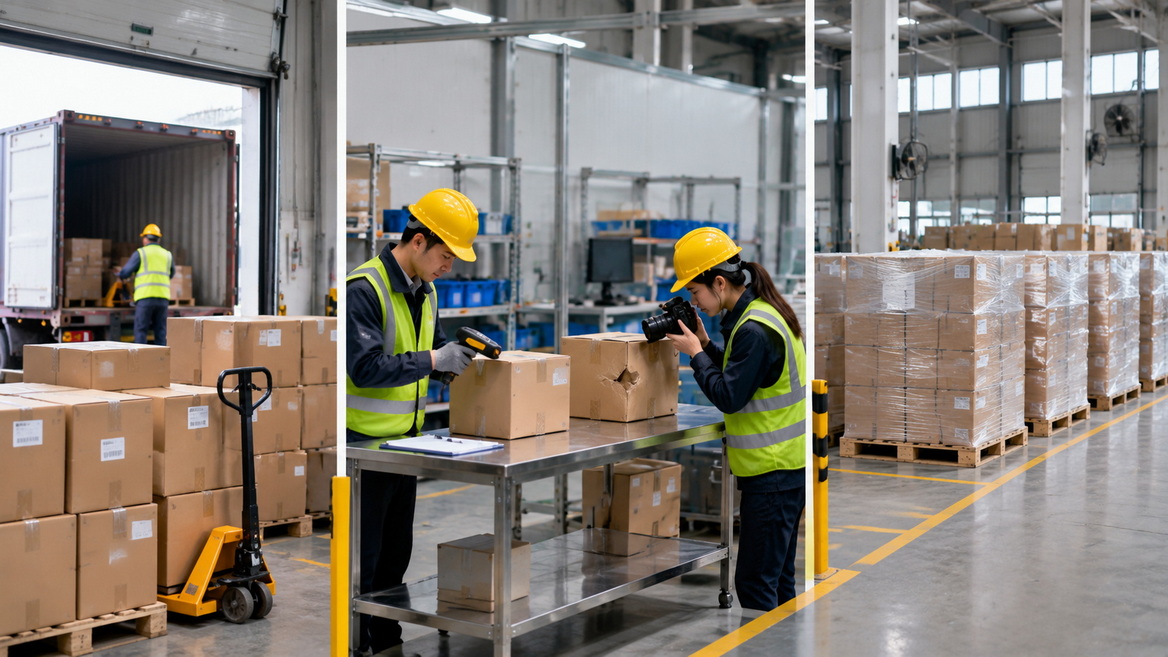
The most suitable warehouse partner is the one whose operating model fits your suppliers, inventory, shipment frequency, and destination requirements.
Large contract logistics providers warrant consideration for complex, integrated programs. Buyers consolidating purchases from several Chinese suppliers should also evaluate a freight-forwarding-led arrangement that connects storage with export coordination.
For GB FREIGHT AGENCY CO., LTD., the practical next step is a shipment-specific proposal. Send your supplier locations, cargo dimensions, SKU count, monthly volumes, storage expectations, and destination requirements to service@gb-freight.com. Ask for an itemized warehouse-and-freight quotation, the proposed operating location, and a documented pilot workflow before committing inventory. The contact address is published on the company's contact page.
Request the complete certificate, including its certificate number, legal entity, site address, standard, scope, issue date, and expiry date.
Verify it through the issuing certification body's official verification channel. Check the current status, not just the printed expiry date, and confirm that the scope includes the activities being offered.
A certificate for a parent company, sales office, or different facility should not be treated as evidence covering your warehouse. Ask the provider to explain any mismatch before signing.
Yes, but the boundaries must be contractual.
Define which tasks the warehouse performs—such as counting, labeling, kitting, or packaging—and which remain with the manufacturer. A warehouse receiving count does not establish that products meet design, material, electrical, or performance requirements.
If inspection is required, specify the inspection method, acceptance criteria, sample size, reporting format, and authorization for rejected goods.
Avoid accepting an undefined percentage.
Agree whether accuracy is measured by units, cartons, locations, SKU lines, batches, or inventory value. Then specify how quarantined stock, pending receipts, damaged inventory, and adjustments are treated.
For customized goods, include batch or serial-level accuracy where required. Matching total unit quantities is insufficient if the warehouse releases the wrong production batch.
Subcontracting is not automatically disqualifying, but it changes the questions you must ask.
Identify the operator and site, establish who controls stock records, and require clear responsibility for loss, damage, and unauthorized handling. The contract should address further subcontracting, audits, claims, stock release, and transfer if the relationship ends.
Do not rely on a verbal assurance that the sales company will "coordinate everything."
Start with the exact product category and handling conditions.
Request evidence addressing the proposed facility, including storage limits, monitoring records, alarm escalation, equipment calibration, excursion management, and any cargo-specific authorizations that apply.
A general warehouse service description does not prove suitability for pharmaceuticals, food, batteries, chemicals, or other restricted goods. Obtain written acceptance of the specific cargo and confirm transport requirements separately.
- China's Ministry of Commerce: 2025 national logistics figures based on China Federation of Logistics & Purchasing reporting. [data.mofcom.gov]
- Chinese government: logistics performance for the first three quarters of 2026. [gov]
- International Plant Protection Convention: ISPM 15 scope and implementation guidance for wood packaging used in international trade. [ippc]
- Provider information: GB Freight's warehouse and contact pages; JD's regulatory disclosure; Cainiao's company announcement; and the corporate materials cited in each provider profile. These establish published service descriptions, not independent verification of individual facilities. [gb-freight]


